
Rhetorical move structures in methods sections of Q1 Scopus-indexed applied linguistics research articles
Article Sidebar
Main Article Content
Abstract
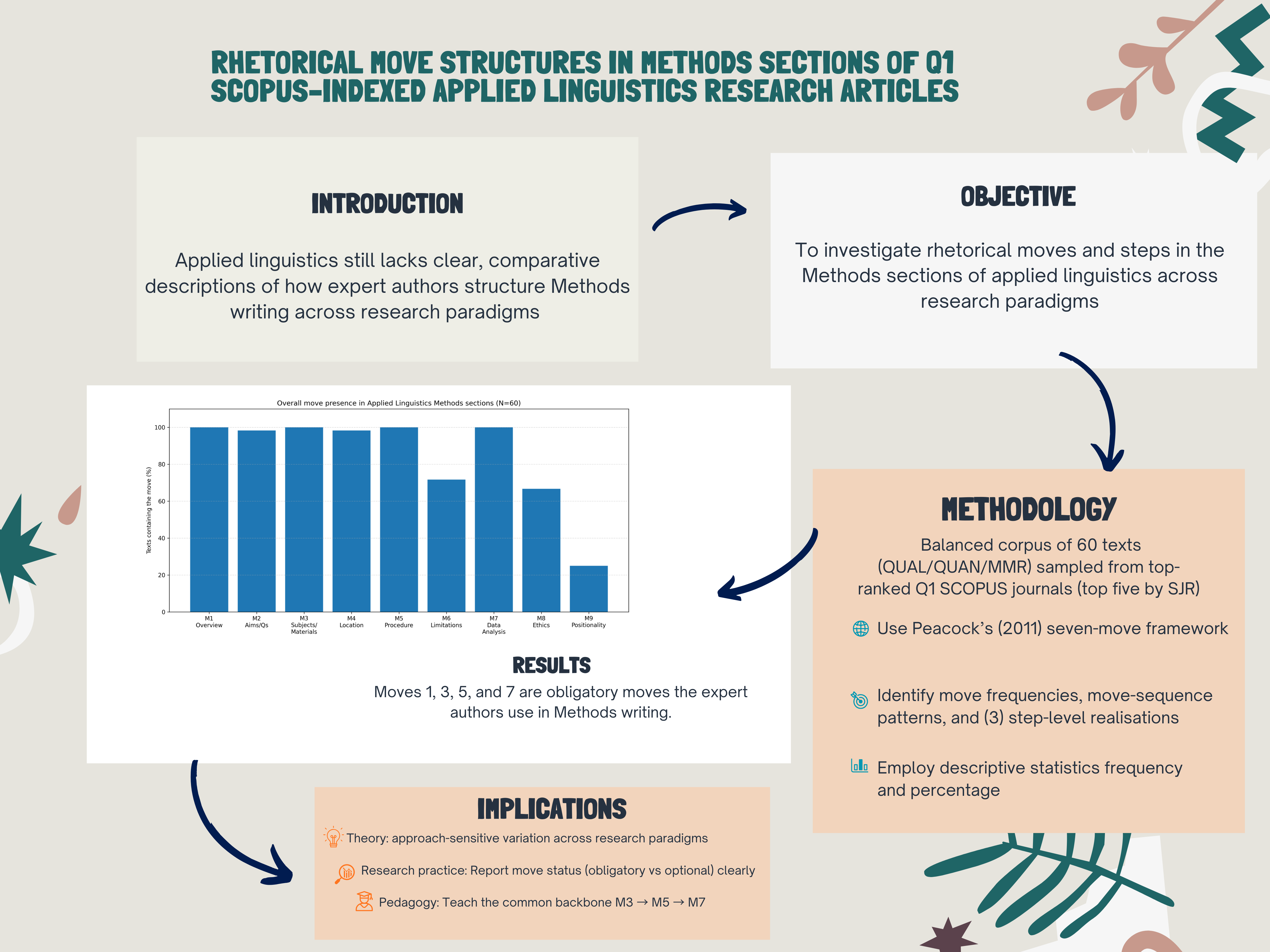
This study investigates the rhetorical move structures in the Methods sections of applied linguistics research articles (ALRAMs) published in Q1 SCOPUS-indexed journals. Drawing on Peacock’s (2011) move analysis framework—supplemented with two emergent moves—60 articles were systemically coded across qualitative, quantitative, and mixed-methods paradigms from five top-ranked journals. The study examines move frequencies, linear sequences, and step-level realizations to identify both shared conventions and paradigm-specific patterns in methodological reporting. The findings reveal four obligatory moves—Overview, Subjects/Materials, Procedure, and Data Analysis—present in all texts (100%), while Research Aims/Questions and Location appear in nearly all (98.3%). Limitation and Ethical Considerations are conventional, (71.7% and 66.7%) and Researcher Positionality emerges as optional (25%). The most frequent sequence, M3→M5→M7 (Subjects/Materials → Procedure → Data Analysis), underscores a consistent methodological backbone across paradigms. However, rhetorical step realizations vary: qualitative articles emphasize context and reflexivity, quantitative ones highlight statistical procedures, and mixed-methods texts integrate both. These insights contribute to genre analysis by offering cross-paradigmatic evidence of how Methods sections are structured in applied linguistics. Pedagogically, the study supports academic writing instruction by guiding novice researchers to align with disciplinary norms and enhance methodological clarity and credibility. The findings also suggest directions for future research across sections, disciplines, and publication contexts.
Downloads
Article Details

This work is licensed under a Creative Commons Attribution-NonCommercial-NoDerivatives 4.0 International License.
All rights reserved. Apart from citations for the purposes of research, private study, or criticism and review,no part of this publication may be reproduced, stored or transmitted in any other form without prior written permission by the publisher.
References
Alsharif, M. (2022). Rhetorical move structure in business management research article introductions. Journal of Language and Linguistic Studies, 18(4), 1268–1283.
Andersen, J., Bazerman, C., & Schneider, J. W. (2014). Beyond single genres: Pattern mapping in global communication. In E.-M. Jakobs & D. Perrin (Eds.), Handbook of writing and text production (pp. 305–322). Mouton de Gruyter. https://doi.org/10.1515/9783110220674.305
Anthony, L. (1999). Writing research article introductions in software engineering: How accurate is a standard model? IEEE Transactions on Professional Communication, 42(1), 38–46. https://doi.org/10.1109/47.749366
Basturkmen, H. (2012). A genre-based investigation of discussion sections of research articles in dentistry and disciplinary variation. Journal of English for Academic Purposes, 11(2), 134–144. https://doi.org/10.1016/j.jeap.2011.10.004
Bazerman, C. (1988). Shaping written knowledge: The genre and activity of the experimental article in science. University of Wisconsin Press.
Berkenkotter, C., & Huckin, T. N. (1995). Genre knowledge in disciplinary communication: Cognition/culture/power. Lawrence Erlbaum.
Bhatia, V. K. (1993). Analysing genre: Language use in professional settings. Longman.
Bhatia, V. K. (2004). Worlds of written discourse: A genre-based view. Continuum.
Bhatia, V. K. (2010). Interdiscursivity in professional communication. Discourse and Communication, 4(1), 32–50. https://doi.org/10.1177/1750481309351208
Biber, D., & Gray, B. (2016). Grammatical complexity in academic English: Linguistic change in writing. Cambridge University Press. https://doi.org/10.1017/CBO9780511920776
Bullock, O., Shulman, H., & Huskey, R. (2021). Narratives are persuasive because they are easier to understand: Examining processing fluency as a mechanism of narrative persuasion. Frontiers in Communication, 6, Article 719615. https://doi.org/10.3389/fcomm.2021.719615
Butler, M., & Spoelstra, P. (2023). Peer‐reviewer responses to methodological reporting in applied linguistics articles. Journal of Applied Linguistics, 12(1), 45–68.
Cheng, A. (2019). Examining the “applied aspirations” in the ESP genre analysis of published research articles. Journal of English for Academic Purposes, 38, 36–47. https://doi.org/10.1016/j.jeap.2018.12.005
Cortazzi, M., & Jin, L. (1996). Cultures of learning: Language classrooms in China. In H. Coleman (Ed.), Society and the language classroom (pp. 169–206). Cambridge University Press.
Cotos, E., Huffman, S., & Link, S. (2017). A move/step model for methods sections: Demonstrating rigour and credibility. English for Specific Purposes, 46, 90–106. https://doi.org/10.1016/j.esp.2017.01.001
Creswell, J. W., & Plano Clark, V. L. (2011). Designing and conducting mixed methods research (2nd ed.). Sage.
Cross, C., & Oppenheim, C. (2006). A genre analysis of scientific abstracts. Journal of Documentation, 62(4), 428–446. https://doi.org/10.1108/00220410610700953
Curry, M. J., & Lillis, T. (2019). Unpacking the lore on multilingual scholars publishing in English: A discussion paper. Publications, 7(2), 1–14.
Del Saz-Rubio, M. M. (2019). A contrastive genre-based approach to the rhetorical structure and use of interactional metadiscourse in the results and discussion section of Food Science & Technology Papers. Miscelánea: A Journal of English and American Studies, 59, 13–45.
Denzin, N. K., & Lincoln, Y. S. (Eds.). (2011). The SAGE handbook of qualitative research (4th ed.). Sage.
Doering, J. D., & Cooper, T. (2022). Qualitative research: Understanding the meaning of social phenomena. Sage.
Doró, K. (2013). The rhetoric structure of research article abstracts in English Studies Journals. Prague Journal of English Studies, 2(1), 119–139. https://doi.org/10.2478/pjes-2014-0013
Elsevier. (2023, March). Scopus content coverage guide. https://assets.ctfassets.net/o78em1y1w4i4/EX1iy8VxBeQKf8aN2XzOp/c36f79db25484cb38a5972ad9a5472ec/Scopus_ContentCoverage_Guide_WEB.pdf
Farhang-Ju, M., Zarei, G. R., & Zarei, H. (2024). Specificity and generality of lexical bundles in the rhetorical moves of Applied Linguistics research article introductions. Journal of English for Academic Purposes, 48, Article 100856. https://doi.org/10.1016/j.jeap.2024.101387
Finlay, L. (2002). Negotiating the swamp: The opportunity and challenge of reflexivity in qualitative research. Qualitative Research, 2(2), 209–230.
Flowerdew, J. (2012). Discourse in English language education. Routledge. https://doi.org/10.4324/9780203080870
Froehlich, D. E., Rehm, M., & Rienties, B. (2019). Mixed methods research for improved scientific study. Springer.
Geng, H., Lee, G. I., Jalaluddin, I., & Tan, H. (2023). Rhetorical moves of introduction sections in English linguistics research articles from two non-Scopus and two Scopus journals. Theory and Practice in Language Studies, 13(8), 2087–2096. https://doi.org/10.17507/tpls.1308.25
Gries, S. T. (2022). Toward more careful corpus statistics: Uncertainty estimates for frequencies, dispersions, association measures, and more. Research Methods in Applied Linguistics, 1(1), Article 100002. https://doi.org/10.1016/j.rmal.2021.100002
Hilpert, M., & Gries, S. T. (2009). Assessing frequency changes in multistage diachronic corpora: Applications for historical corpus linguistics and the study of language acquisition. Literary and Linguistic Computing, 24(4), 385–401. https://doi.org/10.1093/llc/fqn012
Hyland, K. (2002). Activity and evaluation: Reporting practices in academic writing. In J. Flowerdew (Ed.), Academic discourse (pp. 115–130). Longman.
Hyland, K. (2003). Second Language Writing. Cambridge University Press.
Hyland, K. (2004). Disciplinary discourses: Social interactions in academic writing. University of Michigan Press.
Hyland, K. (2005). Stance and engagement: A model of interaction in academic discourse. Discourse Studies, 7(2), 173–192. http://dx.doi.org/10.1177/1461445605050365
Hyland, K. (2009). Academic discourse: English in a global context. Continuum.
Hyland, K. (2015). Teaching and researching writing. Routledge.
Hyland, K., & Tse, P. (2004). Metadiscourse in academic writing: A reappraisal. Applied Linguistics, 25(2), 156–177. http://dx.doi.org/10.1093/applin/25.2.156
Ivankova, N. V., Creswell, J. W., & Stick, S. L. (2006). Using mixed-methods sequential explanatory design: From theory to practice. Field Methods, 18(1), 3–20.
Kanoksilapatham, B. (2005). Rhetorical structure of biochemistry research articles. English for Specific Purposes, 24(3), 269–292. https://doi.org/10.1016/j.esp.2004.08.003
Kanoksilapatham, B. (2015). Distinguishing textual features characterizing structural variation in research articles across three engineering sub-discipline corpora. English for Specific Purposes, 37, 74–86. https://doi.org/10.1016/j.esp.2014.06.008
Kasper, G., & Wagner, J. (2014). Conversation analysis in applied linguistics. Annual Review of Applied Linguistics, 34, 171–212. https://doi.org/10.1017/S0267190514000014
Li, Z., & Prior, M. (2022). Linking research questions to methodological choices in applied linguistics. Language Teaching Research, 26(4), 512–530.
Lim, J. M. H. (2006). Method sections of management research articles: A pedagogically motivated qualitative study. English for Specific Purposes, 25(3), 282–309. https://doi.org/10.1016/j.esp.2005.07.001
Lim, J. M. H. (2010). Commenting on research results in applied linguistics and education: A comparative genre-based investigation. Journal of English for Academic Purposes, 9(4), 280–294. https://doi.org/10.1016/j.jeap.2010.10.001
Liu, C., & Pan, F. (2024). Connecting lexical bundles and moves in medical research articles’ Methods section. Southern African Linguistics and Applied Language Studies, 42(1), 111–127. https://doi.org/10.2989/16073614.2023.2226171
Loi, C. K., & Lim, J. M. H. (2019). Hedging in the discussion sections of English and Malay educational research articles. GEMA Online Journal of Language Studies, 19(1), 36–61. https://doi.org/10.17576/gema-2019-1901-03
Lombard, M., Snyder-Duch, J., & Bracken, C. C. (2002). Content analysis in mass communication: Assessment and reporting of intercoder reliability. Human Communication Research, 28(4), 587–604. https://doi.org/10.1111/j.1468-2958.2002.tb00826.x
Lorés, R. (2004). On RA abstracts: From rhetorical structure to thematic organisation. English for Specific Purposes, 23(3), 280–302. https://doi.org/10.1016/j.esp.2003.06.001
Miles, M. B., Huberman, A. M., & Saldaña, J. (2014). Qualitative data analysis: A methods sourcebook (3rd ed.). Sage.
Montgomery, D. P. (2023). “This study is not without its limitations”: Acknowledging limitations and recommending future research in applied linguistics research articles. Journal of English for Academic Purposes, 65, Article 101291. https://doi.org/10.1016/j.jeap.2023.101291
Moreno, A. I., & Swales, J. M. (2018). Strengthening move analysis methodology towards bridging the function-form gap. English for Specific Purposes, 50, 40–63. https://doi.org/10.1016/j.esp.2017.11.006
Paltridge, B., & Starfield, S. (2013). The handbook of English for specific purposes. John Wiley & Sons.
Peacock, M. (2011). The structure of the Methods section in research articles across eight disciplines. Asian ESP Journal, 7(2), 97–124.
Pho, P. D. (2008). Research article abstracts in applied linguistics and educational technology: A study of linguistic realizations of rhetorical structure and authorial stance. Discourse Studies, 10(2), 231–250. https://doi.org/10.1177/1461445607087010
Pranckutė, R. (2021). Web of Science (WoS) and Scopus: The titans of bibliographic information in today’s academic world. Publications, 9(1), Article 12. https://doi.org/10.3390/publications9010012
Rochma, A. F. (2025). Rhetorical analysis in scholarly texts: Insights into introduction and literature review patterns. Journal on English as a Foreign Language, 15(1), 317–341. https://doi.org/10.23971/jefl.v15i1.9095
Samraj, B. (2002). Introductions in research articles: Variations across disciplines. English for Specific Purposes, 21(1), 1–17. https://doi.org/10.1016/S0889-4906(00)00023-5
Sari, N. P., Azwandi, & Arsyad, S. (2022). Rhetorical moves in introduction sections of applied linguistic research articles of different SINTA’s ranking. Journal of English Education and Linguistics, 6(1), 64–74.
Sheldon, E. (2011). Rhetorical differences in RA introductions written by English L1 and L2 and Castilian Spanish L1 writers. Journal of English for Academic Purposes, 10(4), 238–251. https://doi.org/10.1016/j.jeap.2011.08.004
Sithlaothavorn, J., & Trakulkasemsuk, W. (2016). A move analysis of research discussion section in English articles published in Thai and international journals. rEFLections, 21, 24–46.
Smagorinsky, P. (2008). The method section as conceptual epicenter in constructing social science research reports. Written Communication, 25(3), 389–411. https://doi.org/10.1177/0741088308317815
Sollaci, L. B., & Pereira, M. G. (2004). The introduction, methods, results, and discussion (IMRAD) structure: A fifty-year survey. Journal of the Medical Library Association: JMLA, 92(3), 364–367.
Sovann, L., Safnil, S., & Syafryadin, S. (2022). Rhetorical structure of method section: A comparative study on research articles written by Cambodian authors published in national and international journals. English Education: Jurnal Tadris Bahasa Inggris, 15, 168–192. https://doi.org/10.24042/ee-jtbi.v15i1.12072
Stemler, S. E. (2004). A comparison of consensus, consistency, and measurement approaches to estimating interrater reliability. Practical Assessment, Research & Evaluation, 9(1), Article 4. https://doi.org/10.7275/96jp-xz07
Suherdi, D., Kurniawan, E., & Lubis, A. (2020). A genre analysis of research article ‘Findings and Discussion’ sections written by Indonesian undergraduate EFL students. Indonesian Journal of Applied Linguistics, 10(1), 59–72. https://doi.org/10.17509/ijal.v10i1.24989
Suryawinata, V. Z., Kurniawan, E., & Lubis, A. H. (2023). A genre analysis of science and technology Scopus-indexed journal articles: Does impact factor project different rhetorical moves? Journal of Linguistics, Literature and Language Teaching, 9(1), 9–33. https://doi.org/10.32505/jl3t.v9i1.5563
Swales, J. M. (1981). Aspects of article introductions. The University of Michigan Press.
Swales, J. M. (1990). Genre analysis: English in academic and research settings. Cambridge University Press.
Swales, J. M. (2004). Research genres: Explorations and applications. Cambridge University Press.
Swales, J. M., & Feak, C. B. (2004). Academic writing for graduate students: Essential tasks and skills (2nd ed.). University of Michigan Press.
Swales, J. M., & Feak, C. B. (2012). Academic writing for graduate students: Essential tasks and skills (3rd ed.). University of Michigan Press.
Tardy, C. M. (2009). Building genre knowledge. Parlor Press.
Tardy, C. M. (2011). Genre Analysis. In K. Hyland & B. Paltridge (Eds.), The continuum companion to discourse analysis (pp. 54–68). Continuum.
Thompson, S. K. (2012). Sampling (3rd ed.). John Wiley & Sons.
Tulud, D. M. (2017). Probes on the rhetorical moves of research methods in research articles. Asian EFL Journal, 98, 16–26.
Tulud, D., & Mosquera, H. J. (2021). Methodology section of graduate school thesis manuscripts: A genre analysis probe of rhetorical structure. Journal of English Language Teaching and Applied Linguistics, 3, 36–52. https://doi.org/10.32996/jeltal.2021.3.9.4
Ulya, S. (2022). Rhetorical moves variations of research article discussion section published in reputable journals. Premise: Journal of English Education and Applied Linguistics, 11(3), 632–645. https://doi.org/10.24127/pj.v11i3.5615
Yang, R., & Allison, D. (2003). Research articles in applied linguistics: Moving from results to conclusions. English for Specific Purposes, 22(4), 365–385. https://doi.org/10.1016/S0889-4906(02)00026-1
Yaw, K., Plonsky, L., Larsson, T., Sterling, S., & Kytö, M. (2023). Research ethics in applied linguistics. Language Teaching, 56(4), 478–494. https://doi.org/10.1017/S0261444823000010
Yuvayapan, F., & Yakut, I. (2022). Functions of meta-discursive nouns: A corpus-based comparison of post-graduate genres in L1 and L2 English. Cognitive Studies | Études cognitives, 22, Article 2827. https://doi.org/10.11649/cs.2827
Zhang, Y., & Wannaruk, A. (2016). Rhetorical move structures in education research articles: A genre analysis approach. Journal of Language Studies, 15(2), 233–245.
