
Storytelling of Thai herbal plants: An exploration of biophilic design principles in art and design
Article Sidebar
Main Article Content
Abstract
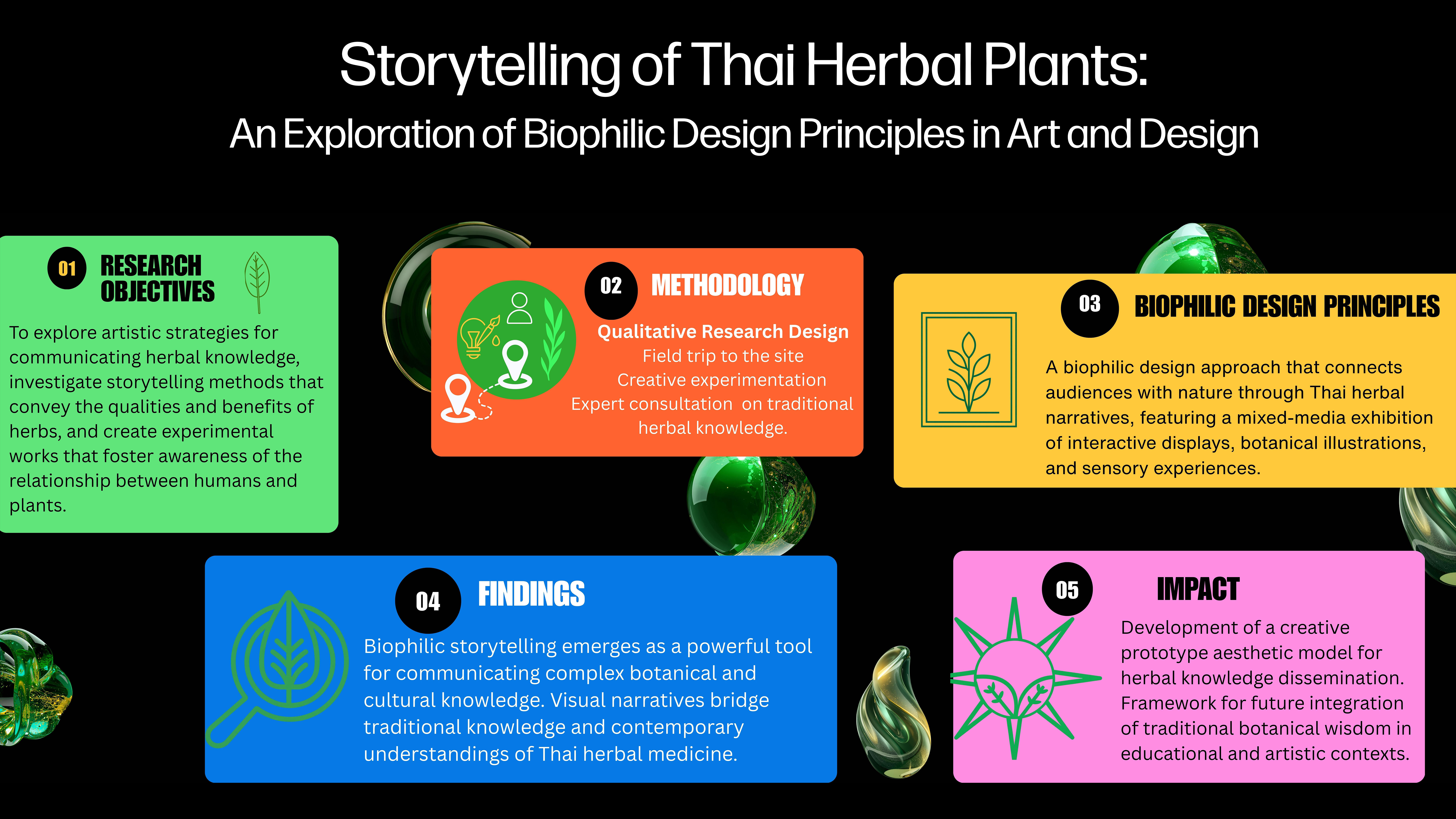
Understanding the full benefits of plants throughout their life cycles requires strategies beyond simply explaining their medicinal uses. Herbs play a vital role in human existence, significantly impacting both physical health and psychological well-being. This article, derived from the creative research project ‘Storytelling of Herbs (and Us)’, aims to achieve three primary objectives: 1) to explore strategies for conveying herbal knowledge through art and design; 2) to investigate storytelling methods that communicate the unique characteristics and benefits of herbs; and 3) to experiment with creative works that foster awareness of the reciprocal relationship between humans and plants. This study employs a qualitative research design, with data collected through expert consultation and creative experimentation. The process focuses on applying biophilic design principles to the storytelling of Thai herbal plants, specifically the Pat Hin species from Chaiyaphum Province, with the outcomes presented in a mixed-media exhibition. The findings indicate that conveying narratives about Thai herbal plants through art and design, integrated with biophilic storytelling, offers a powerful tool for communicating human-plant interdependence. Furthermore, this study offers a creative prototype and an aesthetic model as a framework for scholars and practitioners in art, design, and botanical communication.
Downloads
Article Details

This work is licensed under a Creative Commons Attribution-NonCommercial-NoDerivatives 4.0 International License.
All rights reserved. Apart from citations for the purposes of research, private study, or criticism and review,no part of this publication may be reproduced, stored or transmitted in any other form without prior written permission by the publisher.
References
Asojo, A., & Hazazi, F. (2025). Biophilic design strategies and indoor environmental quality: A case study. Sustainability, 17(5), Article 1816. https://doi.org/10.3390/su17051816
Brady, E. (2007). Aesthetic regard for nature in environmental and land art. Ethics, Place & Environment, 10(3), 287–300. https://doi.org/10.1080/13668790701578538
Deesawadi, N. (2024). The storytelling of herbs (and us) [Research report]. Silpakorn University.
Frawley, D. (2000). Ayurvedic healing: A comprehensive guide. Lotus Press.
Fromm, E. (1973). The anatomy of human destructiveness. Holt, Rinehart and Winston.
Kellert, S. R., & Calabrese, E. F. (2015). The practice of biophilic design. https://www.biophilic-design.com
Kellert, S. R., Heerwagen, J. H., & Mador, M. L. (2008). Biophilic design: The theory, science, and practice of bringing buildings to life. John Wiley & Sons.
Nartkosar, S., Suwannatat, P., & Disatapundhu, S. (2023). Conceptual framework for environmental graphic design in co-working space using the biophilia concept for Generation Y. Journal of Fine and Applied Arts Chulalongkorn University, 10(2), 13–32. https://so02.tci-thaijo.org/index.php/faa/article/view/258537 [in Thai]
North, M. (2015, September 29). A German botanical renaissance. Circulating Now; National Library of Medicine. https://circulatingnow.nlm.nih.gov/2015/09/29/a-german-botanical-renaissance/
Plant Genetic Conservation Project under the Royal Initiative of Her Royal Highness Princess Maha Chakri Sirindhorn. (n.d.). Gardenia saxatilis Geddes. Bureau of the Royal Household. http://www.rspg.or.th/plants_data/herbs/herbs_20_5.htm [in Thai]
Reisman, F. (2021). Graham Wallas: A giant standing on giants. In F. Reisman (Ed.), Celebrating giants and trailblazers: A-Z of who’s who in creativity research and related fields (pp. 794–803). KIE Conference Publications. https://kiecon.org/wp-content/uploads/2022/02/GRAHAM-WALLAS.pdf
Roös, P., Downton, P., Jones, D., & Zeunert, J. (2016, November 7–9). Biophilic inspired railway stations: The new frontier for future cities [Paper presentation]. 9th International Urban Design Conference. Canberra, Australia. https://www.academia.edu/29655528/Biophilic_Inspired_Railway_Stations_The_New_Frontier_for_Future_Cities
Schnaubelt, K. (2011). The healing intelligence of essential oils: The science of advanced aromatherapy. Healing Arts Press.
Staff Writer. (2017, October 2). Airs, waters, and places: A climate change series. Harvard T.H. Chan School of Public Health. https://hsph.harvard.edu/news/airs-waters-and-places-a-climate-change-series/
Thailand Art & Design Exhibition. (2023). The 4th Plus Thailand Art & Design Exhibition 2023 (TADE) [Exhibition]. Bangkok Art and Culture Centre (BACC), Bangkok, Thailand. https://www.harc.asia/TADE/#tade4
Thanos, C. A. (1994). Aristotle and Theophrastus on plant-animal interactions. In M. Arianoutsou & R. H. Groves (Eds.), Plant-animal interactions in Mediterranean-type ecosystems (pp. 3–11). Springer. https://doi.org/10.1007/978-94-011-0908-6_1
Ulrich, R. S. (1984). View through a window may influence recovery from surgery. Science, 224(4647), 420–421. https://doi.org/10.1126/science.6143402
Wallas, G. (1926). The art of thought. Jonathan Cape.
Wilson, E. O. (1984). Biophilia. Harvard University Press.
World Health Organization. (2023, November 2). Climate change and non-communicable diseases: connections. https://www.who.int/news/item/02-11-2023-climate-change-and-noncommunicable-diseases-connections
