
The collection of identity patterns and the development of the pottery pattern stamping rollers of Ban Na Wat Lai Community in Sukhothai Province, Thailand
Article Sidebar
Main Article Content
Abstract
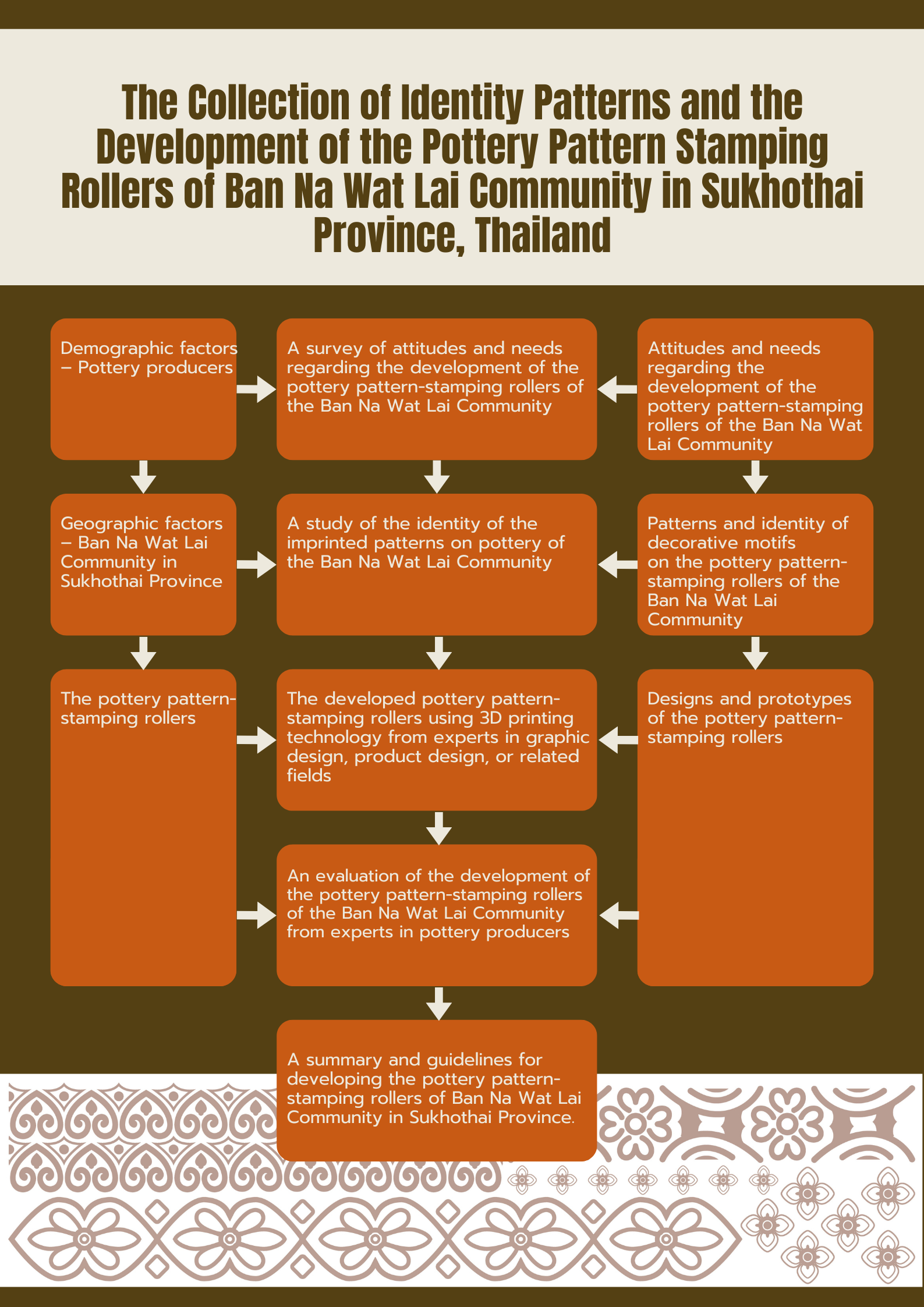
This research aimed to 1) study the identity of the imprinted patterns on pottery of the Ban Na Wat Lai Community, Thung Luang Sub-district, Khiri Mat District, Sukhothai Province, 2) design the pottery pattern stamping rollers, and 3) propose guidelines for developing the pottery pattern stamping rollers of Ban Na Wat Lai Community, Thailand. The researchers studied documents and research related to the collection of pattern identities and the development of the pottery pattern stamping rollers in the Ban Na Wat Lai Community, surveyed data on attitudes and needs regarding the development of the pottery pattern stamping rollers, designed the pottery pattern stamping rollers using 3D models, produced a prototype of the pottery pattern stamping rollers using 3D printing technology, and evaluated the pottery pattern stamping rollers’ development using a questionnaire on opinions toward the development of the pottery pattern stamping rollers of the Ban Na Wat Lai Community. The data were then analyzed by calculating the mean and standard deviation of the questionnaire. The sample group was 30 pottery producers in the Ban Na Wat Lai Community. The data analyzed revealed that Model 3 of the pottery pattern stamping rollers achieved the highest ranking. This is because, at the selection stage, it has beautiful patterns; during application, it creates sharp patterns on pottery; and throughout use, it offers a comfortable handle. The study’s findings and suggestions for further research are also discussed.
Downloads
Article Details

This work is licensed under a Creative Commons Attribution-NonCommercial-NoDerivatives 4.0 International License.
All rights reserved. Apart from citations for the purposes of research, private study, or criticism and review,no part of this publication may be reproduced, stored or transmitted in any other form without prior written permission by the publisher.
References
Angeli, E. (2024). Conceptual meanings in middle neolithic red-painted pottery from Central Greece: A case study. Journal of Archaeological Science: Reports, 59, Article 104769. https://doi.org/10.1016/j.jasrep.2024.104769
Bai, Y., Harun, Z., & Tengku Intan Suzila, T. S. (2025). Application of traditional painted decoration and modern technology in ceramic art design. Journal of Information Systems Engineering and Management, 10(5s), 731–742. https://doi.org/10.52783/jisem.v10i5s.764
Chumket, C. (2017). The development of products from local wisdom to increase the efficiency of sustainable community management of the Thai Muslim community, Cha-am district, Phetchaburi province (Research report). Faculty of Management Science, Silpakorn University.
Department of Health Service Support. (2025). Village information report of Thung Luang subdistrict, Khiri Mat district, Sukhothai province: Community health database system (3 Doctors). Ministry of Public Health. https://3doctor.hss.moph.go.th [in Thai]
Fuller, G. W. (1994). New food product development: From concept to marketplace. CRC Press.
Inthawong, T. (2020). The study and development of identity of the Ban Maying pottery occupation group to promote community tourism [Master’s thesis, Silpakorn University]. DSpace at Silpakorn University. http://ithesis-ir.su.ac.th/dspace/handle/123456789/2985 [in Thai]
Inthip, S. (2012). The development of pottery handicrafts in the identity of the Mon Pakkret community for being a contemporary product. Wittayasara: Integration Apply Engineering and Industrial Technology, 5(2), 92–101. https://li01.tci-thaijo.org/index.php/Itech/article/view/29496 [in Thai]
Ministry of Higher Education, Science, Research and Innovation. (2022). Policy and strategy framework for higher education, science, research and innovation 2023–2027. Ministry of Higher Education, Science, Research and Innovation. https://www.mhesi.go.th/index.php/all-media/book-ministry/8310-2022-12-13-06-27-40.html [in Thai]
Phruksawan, N., & Suwanpratest, O. (2015). The value and significance of pottery in Thai society: A case study of pottery in Mueang Phitsanulok district. Mekong-Salween Civilization Studies Journal, 6(2), 161–170. https://so04.tci-thaijo.org/index.php/jnuks/article/view/53090 [in Thai]
Ramadan, M. (2024, February 21). Pottery trimming & carving tools: A comparative analysis – Which one to buy? Meesh Pottery. https://www.meeshpottery.com/blog/pottery-loop-tools-comparison
Sarawasi, P. (2013). The role of local museums in preserving intangible cultural heritage. Princess Maha Chakri Sirindhorn Anthropology Centre (Public Organization). https://db.sac.or.th/museum/article/45 [in Thai]
Shott, M. J. (2018). Pottery ethnoarchaeology in the Michoacán Sierra. University of Utah Press.
Theptrakarnporn, S. (1999). Work-related postural dystonia. Health and Environment, 4(3), 1–10. https://he01.tci-thaijo.org/index.php/bamrasjournal/article/view/215114 [in Thai]
Thongjaem, W., Nuantung, P., Chotiwan, P., Sophaksrikun, R., & Nokhong, S. (2018). Wisdom dynamics in pottery production: A case study of Ban Thung Luang pottery, Thung Luang sub-district, Khiri Mat District, Sukhothai province. In the 5th National Academic Conference (pp. 1160–1167). Kamphaeng Phet Rajabhat University. [in Thai]
Turner, R. C., & Carlson, L. (2003). Indexes of item-objective congruence for multidimensional items. International Journal of Testing, 3(2), 163–171. https://doi.org/10.1207/S15327574IJT0302_5
Wongnet, S. (2013). The development of pattern stamping tools on pottery art (Research report). Rajamangala University of Technology Rattanakosin.
Zhigang, G., & Hu, J. (2023). Research on the function of digital technology in modern ceramic art creation. In R. Appleby, M. Imparato, Y. Feng, & A. H. Wheeb (Eds.), Proceedings of the 2nd International Conference on Intelligent Design and Innovative Technology (ICIDIT 2023) (pp. 567–575). Atlantis Press. https://doi.org/10.2991/978-94-6463-266-8_61
