
The development of professional learning community training with dialogue to enhance Project-Based Learning management: A case study of teachers from the Sarasas private school network in Thailand
Article Sidebar
Main Article Content
Abstract
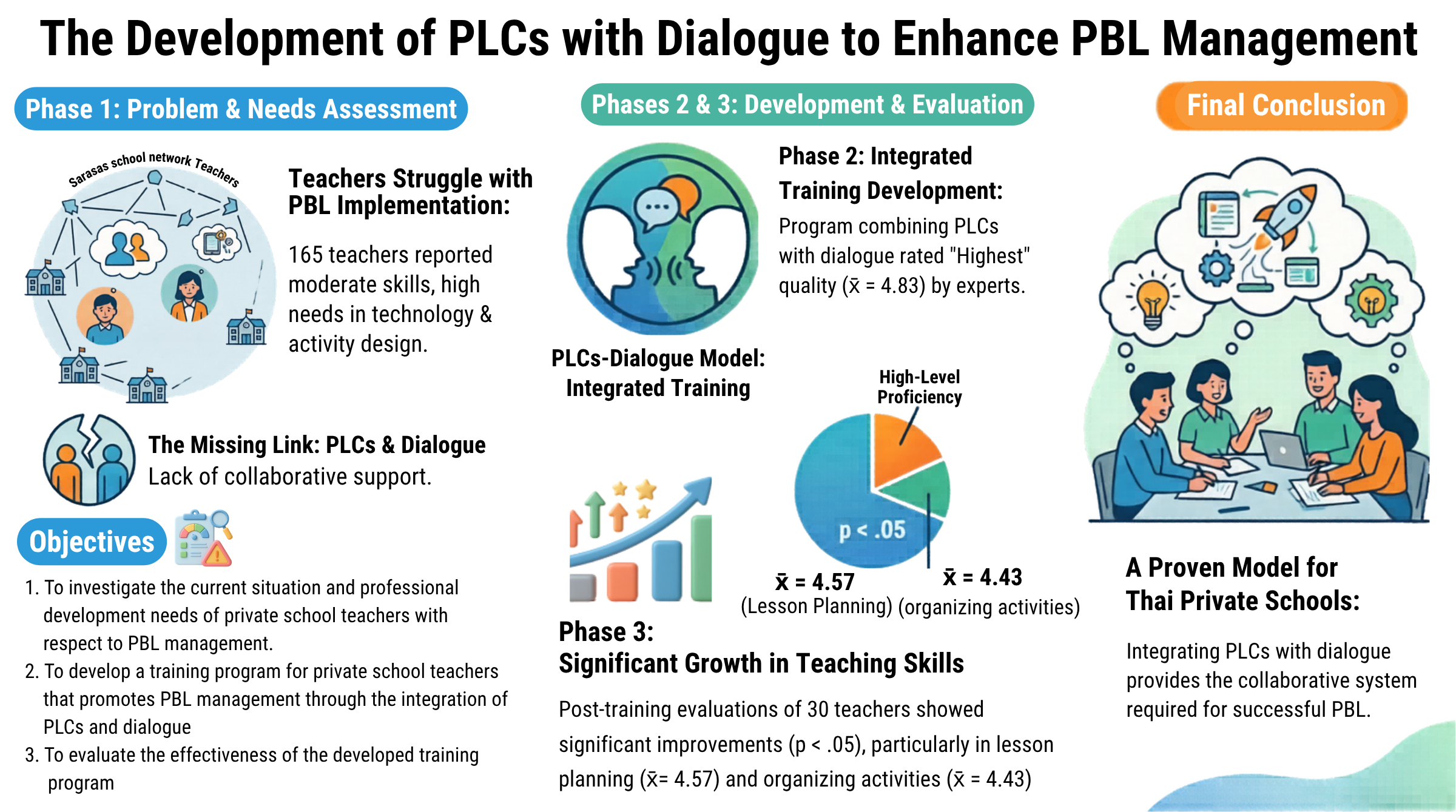
Project-Based Learning (PBL) has been widely adopted in private schools as a strategy for developing critical thinking, collaboration, and problem-solving skills, although Thai private school teachers, including those in the 42 schools of the Sarasas school network, struggle to implement it effectively. Limited access to sustained professional development and the absence of strong collaborative structures are key contributing factors. Professional Learning Communities (PLC), despite their established international track record in teacher development, remain underutilized in Thai educational settings. This study addressed these gaps by investigating the professional development needs of private school teachers in relation to Project-Based Learning, developing a training program that integrates Professional Learning Communities with dialogue, and evaluating its effectiveness. The research proceeded in 3 phases: 1. a needs assessment, 2. program development, and 3. evaluation. A sample of 165 Project-Based Learning teachers from Sarasas-affiliated elementary and secondary schools was recruited through multi-stage sampling for Phase 1; 30 of the teachers subsequently participated in the training program through a one-group pretest-posttest design. Results revealed that teachers’ Project-Based Learning knowledge, understanding, skills, and attitudes were at a moderate overall level, with high needs for skill development in technology integration, activity design, and time management. The training program’s quality and appropriateness were rated as “Highest” (x̄ = 4.83, IOC = 0.98). Post-training evaluation demonstrated significant improvements (p < .05) in teachers’ knowledge and understanding, with the highest achievement in designing lesson plans (x̄ = 4.57) and organizing activities (x̄ = 4.43). The findings demonstrated that integrating PLCs with dialogue effectively addressed the professional development needs of Thai private school teachers in Project-Based Learning, providing the collaborative support system previously lacking in Thai educational contexts.
Downloads
Article Details

This work is licensed under a Creative Commons Attribution-NonCommercial-NoDerivatives 4.0 International License.
All rights reserved. Apart from citations for the purposes of research, private study, or criticism and review,no part of this publication may be reproduced, stored or transmitted in any other form without prior written permission by the publisher.
References
Bangs, J., & Frost, D. (2012). Teacher self-efficacy, voice and leadership: Towards a policy framework for education international. University of Cambridge/Education International Research Institute. https://teachertaskforce.org/fr/node/617
Bell, S. (2010). Project-Based Learning for the 21st century: Skills for the future. The Clearing House: A Journal of Educational Strategies, Issues and Ideas, 83(2), 39–43. https://doi.org/10.1080/00098650903505415
Bohm, D. (2004). On dialogue (2nd ed.). Routledge.
Brinn, M. (2016). The conceptions of ‘dialogue’ offered by Bohm and Buber: A critical review. In D. Skidmore & K.Murakami (Eds.), Dialogic pedagogy: The importance of dialogue in teaching and learning (pp. 68–82). Multilingual Matters. https://doi.org/10.21832/9781783096220-005
Brookfield, S. D. (2017). Becoming a critically reflective teacher (2nd ed.). Jossey-Bass.
Damjanovic, V., & Blank, J. (2021). Teacher communities as a context for professional learning: A preschool case study. Professional Development in Education, 47(4), 574–585. https://doi.org/10.1080/19415257.2021.1883718
DuFour, R. (2004). What is a ‘professional learning community’? Educational Leadership, 61(8), 6–11. https://greengold.uvu.edu/edsc/3050/12R_clark/lessons/12/docs/professional_community.pdf
Hord, S. M. (1997). Professional learning communities: Communities of continuous inquiry and improvement. Southwest Educational Development Laboratory.
Isaacs, W. (1999). Dialogue and the art of thinking together: A pioneering approach to communicating in business and in life. Currency.
Khong, T. D. H., Saito, E., Hardy, I., & Gillies, R. (2023). Teacher learning through dialogue with colleagues, self, and students. Educational Research, 65(2), 170–188. https://doi.org/10.1080/00131881.2023.2192226
Krejcie, R. V., & Morgan, D. W. (1970). Determining sample size for research activities. Educational and Psychological Measurement, 30(3), 607–610. https://doi.org/10.1177/001316447003000308
Kuder, G. F., & Richardson, M. W. (1937). The theory of the estimation of test reliability. Psychometrika, 2(3), 151–160. https://doi.org/10.1007/BF02288391
Office of the Basic Education Commission. (2021). Guidelines for project-based learning in the basic education core curriculum. Ministry of Education. [in Thai]
Office of the Education Council. (2017). National education plan BE 2017–2036. Ministry of Education. https://backoffice.onec.go.th/uploaded/Outstand/2017-EdPlan60-79.pdf [in Thai]
Office of the National Economic and Social Development Council. (2022). The thirteenth national economic and social development plan (2023–2027). https://www.nesdc.go.th/wp-content/themes/plant3-child/assets/pdf/13/article_file_20230615134223.pdf
Panich, V. (2017). Learning pathways for students in the 21st century. Walailak Journal of Learning Innovations, 1(2), 3–14. https://so03.tci-thaijo.org/index.php/jliwu/article/view/95054 [in Thai]
Panin, W., & Saowsupa, S. (2021). A study of state and problems of science project instruction in secondary school in the Southern region. An Online Journal of Education, 16(2), Article OJED1602057. https://doi.org/10.14456/ojed.2021.73 [in Thai]
Putthatida, C. (2017). Effects of Project-Based Learning on science process skills and ability to complete science projects among Prathomsuksa six students. Social Sciences Research and Academic Journal, 12(35), 117–128. https://so05.tci-thaijo.org/index.php/JSSRA/article/view/72041 [in Thai]
Rinrada, K., & Chalermchai, M. (2022). The development of the ability to explore problems and project planning with Project Based Learning management through a set of Six-Hat technique questions of Mattayomsuksa 3 students, Saengthong Vittaya School, Hatyai, Songkhla. Proceedings of the Graduate School Conference, 4(1), 1215–1224. http://58.181.147.25/ojsjournal/index.php/miniconference/article/view/4129 [in Thai]
Sripairote, T., Yoelao, D., & Sombatwattana, P. (2018). Influence of Project-Based Learning coaching program on teacher competency. Veridian E-Journal, Silpakorn University (Humanities, Social Sciences and Arts), 11(2), 96–110. https://he02.tci-thaijo.org/index.php/Veridian-E-Journal/article/view/135115/101709 [in Thai]
Thomas, J. W. (2000). A review of research on project-based learning. The Autodesk Foundation.
Vangrieken, K., Meredith, C., Packer, T., & Kyndt, E. (2017). Teacher communities as a context for professional development: A systematic review. Teaching and Teacher Education, 61, 47–59. https://doi.org/10.1016/j.tate.2016.10.00
