
Bibliometric analysis of publications on professional development in the Scopus database
Article Sidebar
Main Article Content
Abstract
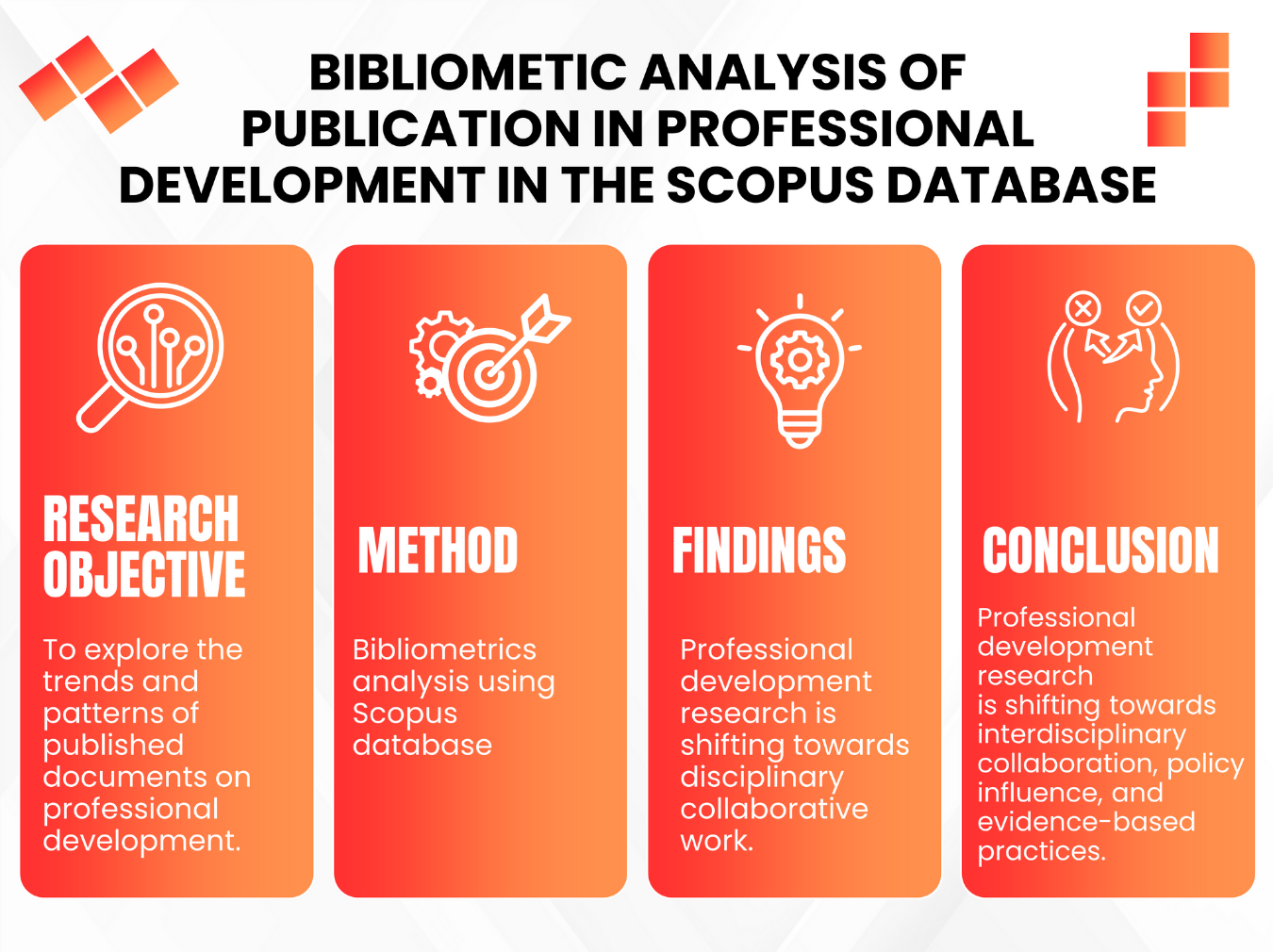
The study aimed to explore the trends and patterns of published documents online on professional development analyzed via bibliometric analysis using the Scopus database. Specifically, this study explored the documents published by year, author, affiliation, country, document type, and visualized them using VOSviewer. The methodology employed Boolean search queries to obtain peer-reviewed articles, conference proceedings, books, and peer-reviewed papers while excluding non-English and non-scholarly sources. The extraction of metadata provides information about authorship, institutional affiliation, country of origin, and document type before analyzing the publication trends alongside the co-authorship networks and citation impact using h-index calculations, most-cited papers, keyword co-occurrence, thematic mapping, and bibliographic-coupling methods. Findings revealed that the publications on professional development increased considerably between 2022 and 2023 leading Aas, M. and Valachovic, R. W. to become the most influential authors while both the University of Johannesburg and the University of Minnesota Twin Cities produced the highest number of publications. The United States possesses the most dominant position in terms of document publication while social sciences represent 50.3% of the overall contributions alongside journal articles totalling 78.4% of all documents. Publication on professional development emerges as the central theme in the field as strong co-authorship relationships connect various researchers. The study concludes that publication on professional development research shifts toward interdisciplinary collaboration, policy influence, and evidence-based practices, emphasizing inclusive academic networks and evolving priorities. It is recommended that academic leaders promote combined disciplines, broader educational alliances, digital innovation, and fair resource distribution to utilize adaptive learning for educational progress, leadership development, and employee development programs.
Downloads
Article Details

This work is licensed under a Creative Commons Attribution-NonCommercial-NoDerivatives 4.0 International License.
All rights reserved. Apart from citations for the purposes of research, private study, or criticism and review,no part of this publication may be reproduced, stored or transmitted in any other form without prior written permission by the publisher.
References
Ahmadian, I., & Ashouri, H. (2024). Designing a paradigm model for teachers’ professional development based on the foundation’s databased approach. Perspective of Human Resource Management, 1(1), 47–63.
Alsharif, A. H., Salleh, N., & Baharun, R. (2020). Research trends of neuromarketing: A bibliometric analysis. Journal of Theoretical and Applied Information Technology, 98(15), 2948–2962. https://www.jatit.org/volumes/Vol98No15/6Vol98No15.pdf
Andersen, N. (2021). Mapping the expatriate literature: A bibliometric review of the field from 1998 to 2017 and identification of current research fronts. The International Journal of Human Resource Management, 32(22), 4687–4724. https://doi.org/10.1080/09585192.2019.1661267
Asterhan, C. S., & Lefstein, A. (2024). The search for evidence-based features of effective teacher professional development: A critical analysis of the literature. Professional Development in Education, 50(1), 11–23. https://doi.org/10.1080/19415257.2023.2283437
Brooks, R. E., & Brooks, A. K. (2024). An emerging transformative learning journey to foster sustainability leadership in professional development programs. Journal of Transformative Education, 22(4), 415–432. https://doi.org/10.1177/15413446241255909
Chapman, N., Thomas, E. E., Tan, J. T., Inglis, S. C., Wu, J. H., Climie, R. E., Picone, D. S., Blekkenhorst, L. C., Wise, S. G., Colafella, K. M. M., Calkin, A. C., & Marques, F. Z. (2022). A roadmap of strategies to support cardiovascular researchers: From policy to practice. Nature Reviews Cardiology, 19(11), 765–777. https://doi.org/10.1038/s41569-022-00700-1
Chen, S., Noh, J., Jang, J., Kim, S., Gu, G. H., & Jung, Y. (2024). Reaction templates: Bridging synthesis knowledge and artificial intelligence. Accounts of Chemical Research, 57(14), 1964–1972. https://doi.org/10.1021/acs.accounts.4c00261
Deuchar, A. (2022). The problem with international students’ ‘experiences’ and the promise of their practices: Reanimating research about international students in higher education. British Educational Research Journal, 48(3), 504–518. https://doi.org/10.1002/berj.3779
Ensslin, L., Dutra, A., Ensslin, S. R., Moreno, E. A., Chaves, L. C., & Longaray, A. A. (2022). Sustainability in library management in higher education institutions: A bibliometric analysis. International Journal of Sustainability in Higher Education, 23(7), 1685–1708. https://doi.org/10.1108/ijshe-07-2021-0302
Eradze, M., De Martino, D., Tinterri, A., Albó, L., Bardone, E., Sunar, A. S., & Dipace, A. (2023). After the pandemic: Teacher professional development for the digital educational innovation. Education Sciences, 13(5), Article 432. https://doi.org/10.3390/educsci13050432
Eroglu, M., & Donmus Kaya, V. (2021). Professional development barriers of teachers: A qualitative research. International Journal of Curriculum and Instruction, 13(2), 1896–1922. https://eric.ed.gov/?id=EJ1292257
Evans, W. D., Gerard, R., Symington, L., Shaikh, H., & Agha, S. (2022). Implementation practice models for development in low- and middle-income countries: Systematic review of peer-reviewed literature. BMC Public Health, 22(1), Article 1157. https://doi.org/10.1186/s12889-022-13530-0
Fauzi, M. A. (2023). Knowledge hiding behavior in higher education institutions: A scientometric analysis and systematic literature review approach. Journal of knowledge management, 27(2), 302–327. https://doi.org/10.1108/jkm-07-2021-0527
Fu, Y. C., Marques, M., Tseng, Y. H., Powell, J. J., & Baker, D. P. (2022). An evolving international research collaboration network: Spatial and thematic developments in co-authored higher education research, 1998–2018. Scientometrics, 127(3), 1403–1429. https://doi.org/10.1007/s11192-021-04200-w
Gao, Y., Wong, S. L., Md. Khambari, M. N., & Noordin, N. (2022). A bibliometric analysis of online faculty professional development in higher education. Research and Practice in Technology Enhanced Learning, 17(1), Article 17. https://doi.org/10.1186/s41039-022-00196-w
Heng, K., Hamid, M., & Khan, A. (2020). Factors influencing academics’ research engagement and productivity: A developing countries perspective. Issues in Educational Research, 30(3), 965–987. https://search.informit.org/doi/abs/10.3316/INFORMIT.465283943914964
Hite, R. L., & Milbourne, J. D. (2022). Divining the professional development experiences of K-12 STEM master teacher leaders in the United States. Professional Development in Education, 48(3), 476–492. https://doi.org/10.1080/19415257.2021.1955733
Jin, N., Yang, N., Fawad Sharif, S. M., & Li, R. (2022). Changes in knowledge coupling and innovation performance: The moderation effect of network cohesion. Journal of Business & Industrial Marketing, 37(11), 2380–2395. https://doi.org/10.1108/jbim-05-2021-0260
Kareff, S. A., Sridhar, A., Dhawan, N., Anampa-Guzmán, A., Singhi, E. K., & Velazquez, A. I. (2023). The democratization of hematology-oncology medical education during the COVID-19 pandemic. Cancer Investigation, 41(6), 548–558. https://doi.org/10.1080/07357907.2023.2230495
Kuperman, V. Y., & Sokol, G. H. (2024). On the causes and ramifications of multi-authorship in science. Scientometrics, 129(4), 2205–2225. https://doi.org/10.1007/s11192-024-04963-y
Kurunsaari, M., Tynjälä, P., & Piirainen, A. (2022). Stories of professional development in physiotherapy education. Physiotherapy Theory and Practice, 38(11), 1742–1755. https://doi.org/10.1080/09593985.2021.1888341
Lazarenko, N., & Hapchuk, Y. (2024). E-learning and artificial intelligence as key factors in the digital transformation of higher education: Challenges, opportunities and development prospects. Pedeutology, 2(1), 7–13.
Liu, S., & Phelps, G. (2020). Does teacher learning last? Understanding how much teachers retain their knowledge after professional development. Journal of Teacher Education, 71(5), 537–550. https://doi.org/10.1177/0022487119886290
Magwenya, R. H., Ross, A. J., & Ngatiane, L. S. (2023). Continuing professional development in the last decade – a scoping review. Journal of Adult and Continuing Education, 29(2), 408–437. https://doi.org/10.1177/14779714221147297
Mao, J. J., Pillai, G. G., Andrade, C. J., Ligibel, J. A., Basu, P., Cohen, L., Khan, I. A., Mustian, K. M., Puthiyedath, R., Dhiman, K. S., Lao, L., Ghelman, R., Guido, P. C., Lopez, G., Gallego-Perez, D. F., & Salicrup, L. A. (2022). Integrative oncology: Addressing the global challenges of cancer prevention and treatment. CA: A Cancer Journal for Clinicians, 72(2), 144–164. https://doi.org/10.3322/caac.21706
Meyer, J. L., Waterman, C., Coleman, G. A., & Strambler, M. J. (2023). Whose agenda is it? Navigating the politics of setting the research agenda in education research-practice partnerships. Educational Policy, 37(1), 122–146. https://doi.org/10.1177/08959048221131567
Miller, A. M., Behan, R., Smith, I., Griffin, M., Keane, F., Langan, J., O’Rourke, C., McAleenan, N., Pandit, A., & Watson, M. (2021). A multidisciplinary approach to online support for device research translation: Regulatory change and clinical engagement. Health Policy and Technology, 10(1), 95–103. https://doi.org/10.1016/j.hlpt.2020.10.005
Molnár, T., Jenei, S., Moreno, E., Lakshmi, V. P., Malatyinszki, S., & Dávid, L. D. (2024). The role of lifelong learning in labour market competitiveness. Journal of Ecohumanism, 3(8), 7743–7761. https://doi.org/10.62754/joe.v3i8.5396
Oleksiyenko, A., Blanco, G., Hayhoe, R., Jackson, L., Lee, J., Metcalfe, A., Sivasubramaniam, M., & Zha, Q. (2021). Comparative and international higher education in a new key? Thoughts on the post-pandemic prospects of scholarship. Compare: A Journal of Comparative and International Education, 51(4), 612–628. https://doi.org/10.1080/03057925.2020.1838121
Paudel, R., & Sherm, A. (2024). Exploring the theoretical landscape: Implications of remote work on employee performance and well-being. Indonesian Journal of Applied and Industrial Sciences (ESA), 3(3), 263–278. https://doi.org/10.55927/esa.v3i3.8954
Pham, D. H. (2021). The professional development of academic staff in higher education institution. Journal of Teacher Education for Sustainability, 23(1), 115–131. https://doi.org/10.2478/jtes-2021-0009
Sahu, A., & Jena, P. (2022). Lotka’s law and author productivity pattern of research in law discipline. Collection and Curation, 41(2), 62–73. https://doi.org/10.1108/cc-04-2021-0012
Seevaratnam, V., Gannaway, D., & Lodge, J. (2023). Design thinking-learning and lifelong learning for employability in the 21st century. Journal of Teaching and Learning for Graduate Employability, 14(1), 182–201. https://doi.org/10.21153/jtlge2023vol14no1art1631
Sharma, H., Jain, V., Mogaji, E., & Babbilid, A. S. (2024). Blended learning and augmented employability: A multi-stakeholder perspective of the micro-credentialing ecosystem in higher education. International Journal of Educational Management, 38(4), 1021–1044. https://doi.org/10.1108/ijem-12-2022-0497
Sims, S., & Fletcher-Wood, H. (2021). Identifying the characteristics of effective teacher professional development: A critical review. School Effectiveness and School Improvement, 32(1), 47–63. https://doi.org/10.1080/09243453.2020.1772841
Smolinska, O., & Dzyubynska, K. (2020). Professional self-development of a teacher of a higher education institution: Interdisciplinary aspect. Journal of Vasyl Stefanyk Precarpathian National University, 7(1), 41–47. https://doi.org/10.15330/jpnu.7.1.41-47
Sydorenko, S., Kuzminska, O., Mazorchuk, M., & Barna, O. (2022). Bibliometric analysis in determining the research directions of early career researchers. Information Technologies and Learning Tools, 5(91), 113–129. https://doi.org/10.33407/itlt.v91i5.4944
Tun, S., Wellbery, C., & Teherani, A. (2020). Faculty development and partnership with students to integrate sustainable healthcare into health professions education. Medical Teacher, 42(10), 1112–1118. https://doi.org/10.1080/0142159x.2020.1796950
Ullah, A., & Ameen, K. (2021). Relating research growth, authorship patterns and publishing outlets: A bibliometric study of LIS articles produced by Pakistani authors. Scientometrics, 126(9), 8029–8047. https://doi.org/10.1007/s11192-021-04081-z
Urbano, C., & Ardanuy, J. (2020). Cross-disciplinary collaboration versus coexistence in LIS serials: Analysis of authorship affiliations in four European countries. Scientometrics, 124(1), 575–602. https://doi.org/10.1007/s11192-020-03471-z
Vasilev, I. (2024). A model of design and implementation micro-credentials in TVET: A promising and flexible pathway to employment and skill development. International Journal of Current Science Research and Review, 7(12), 8807–8819. https://doi.org/10.47191/ijcsrr/v7-i12-18
Young, G., Serbati, A., & Sim, K. N. (2024). Collaboration and co-authorship in academic development: What should we be considering? International Journal for Academic Development, 29(3), 301–307. https://doi.org/10.1080/1360144x.2024.2397418
Zhang, S., Ma, X., Xu, H., & Lu, J. (2024). The influence of mentorship in workplace on teachers’ professional development a meta-analysis based on 66 experiments. Journal of Managerial Psychology, 39(6), 815–831. https://doi.org/10.1108/jmp-11-2022-0588
