
Connecting tourism, archaeological heritage and education: A journey towards sustainability
Article Sidebar
Main Article Content
Abstract
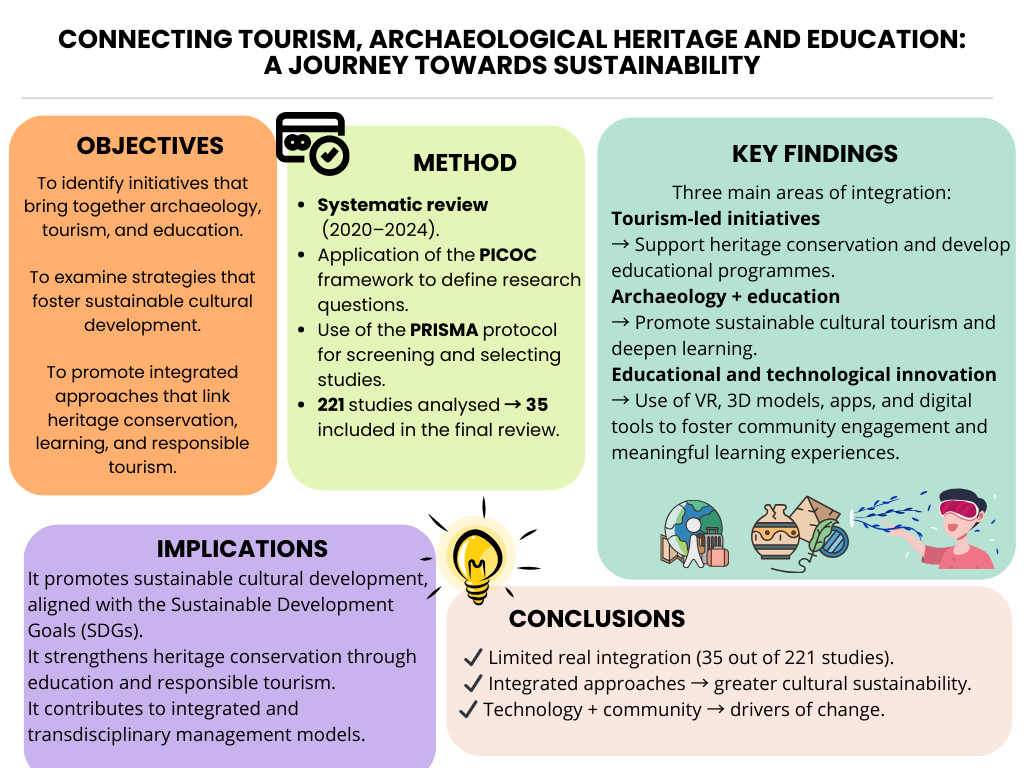
This paper examines the intersection of tourism, archaeological heritage and education within projects and research initiatives that promote sustainable management policies. Its primary aim is to identify experiences and strategies that balance heritage, tourism, and education, granting them equal relevance in objectives, outcomes, and implications. An integrative systematic review was conducted using the PICOC framework to define research questions and the PRISMA protocol to guide the meta-analysis. Data were extracted from the Web of Science database for the period 2020–2024, resulting in a final sample of 35 studies. The review reveals a strong commitment to conserving and promoting archaeological heritage through diverse actions, such as the provision of educational resources and training programmes, fostering sustainable cultural tourism, and facilitating educational tourism experiences. Most of the initiatives advocate integrated management policies that reinforce each other when combined. These findings underscore the importance of holistic approaches that align heritage conservation with educational and tourism objectives, contributing to sustainable cultural development. This study highlights the need to broaden research efforts aimed at determining an appropriate balance among the different management policies, including administrative, economic, educational, cultural and social dimensions.
Downloads
Article Details

This work is licensed under a Creative Commons Attribution-NonCommercial-NoDerivatives 4.0 International License.
All rights reserved. Apart from citations for the purposes of research, private study, or criticism and review,no part of this publication may be reproduced, stored or transmitted in any other form without prior written permission by the publisher.
References
Ababneh, A. (2021). Archaeological sites’ management, interpretation, and tourism development—A success story and future challenges: The case of Bibracte, France. Heritage, 4, 2261–2277. https://doi.org/10.3390/heritage4030128
Abahre, J. S. H. (2021). Reforming tourism and archaeology education in Palestine to meet industry expectations. Journal of Teaching in Travel & Tourism, 21(3), 248–267. https://doi.org/10.1080/15313220.2021.1898522
Altarawneh, M., & Osam, U. V. (2019). Tourism English training at the tertiary level in Jordan: Reality and expectations from a university context. Journal of Hospitality Leisure Sport & Tourism Education, 24, 155–167. https://doi.org/10.1016/j.jhlste.2019.02.005
Baer, K. J. (2024). Investigating photogrammetry as a method of developing educational materials for archaeo-tourism and public education at Xunantunich, Belize [Master’s thesis, Northern Arizona University]. https://f718f5f6-ff16-4649-955b-b63b954ed46c.filesusr.com/ugd/f1e973_14650ea5da9b411e8a2da26c203ac783.pdf
Barroso-Barcenilla, F., Alcalde-Fuentes, M. R., Audije-Gil, J., Berrocal-Casero, M., Callapez, P. M., Ozkaya de Juanas, S., Pérez-Valera, J. A., dos Santos, V. F., & Segura, M. (2022). Discovering a project for the development of geotourism in rural areas: The paleontological and archaeological interpretation centre of Tamajón (CIPAT, Guadalajara, Spain). Land, 11(3), Article 444. https://doi.org/10.3390/land11030444
Benchekroun, S. (2022). Preserving the past for an uncertain future: Low-cost, open-source methods for 3-D digital documentation in applied cultural heritage preservation (Publication No. 29993977) [Master’s thesis, San Diego State University]. ProQuest Dissertations and Theses. https://www.proquest.com/openview/5eee32285754cdd3a709b50e142823f8/1?pq-origsite=gscholar&cbl=18750&diss=y
Bristow, R. S., & Taylor, J. (2020). Recreating the Massasoit spring house with 3Dimensional modelling. Conservation and Management of Archaeological Sites, 22(3–6), 199–214. https://doi.org/10.1080/13505033.2021.1980265
Butler, R. W. (1980). The concept of a tourist area cycle of evolution: Implications for management of resources. Canadian Geographies, 24(1), 5–12. https://doi.org/10.1111/j.1541-0064.1980.tb00970.x
Campos-Quezada, A. R., & Castillo-Ortiz, I. (2024). La sostenibilidad en los estudios del turismo gastronómico: una revisión sistemática de literatura [Sustainability in food tourism studies: a systematic literature review]. PASOS Revista de Turismo y Patrimonio Cultural, 22(3), 595–614. https://doi.org/10.25145/j.pasos.2024.22.039 [in Spanish]
Casillo, M., De Santo, M., Mosca R., & Santaniello, D. (2022). An ontology-based chatbot to enhance experiential learning in a cultural heritage scenario. Frontiers in Artificial Intelligence, 5, Article 808281. https://doi.org/10.3389/frai.2022.808281
Cotes, M., Erler, D. M., Schiavetti, A., & Vieira do Nascimento, J. (2021). O legado de Niède Guidon no semiárido brasileiro: A percepção de condutores de visitantes do Parque Nacional Serra da Capivara [The legacy of Niède Guidon in the Brazilian semi-arid region: The perception of visitor guides at Serra da Capivara National Park]. Antipoda. Revista de Antropología y Arqueología, 42, 179–204. https://doi.org/10.7440/antipoda42.2021.08 [in Portuguese]
Council of the European Union. (2018). Recommendation of the Council of the European Union on key competences for lifelong learning of 22 May 2018. https://eur-lex.europa.eu/legal-content/EN/TXT/PDF/?uri=CELEX:32018H0604(01)&rid=7
Cozza, M., Isabella, S., Di Cuia, P., Cozza, A., Peluso, R., Cosentino, V., Barbieri, L., Muzzupappa, M., & Bruno F. (2021). Dive in the past: A serious game to promote the underwater cultural heritage of the Mediterranean Sea. Heritage, 4(4), 4001–4016. https://doi.org/10.3390/heritage4040220
Craft, W., Ding, L., Prasad, D., Partridge, L., & Else, D. (2017). Development of a regenerative design model for building retrofits. Procedia Engineering, 180, 658–668. https://doi.org/10.1016/j.proeng.2017.04.225
Doolen, J. (2017). Meta-analysis, systematic, and integrative reviews: An overview. Clinical Simulation in Nursing, 13(1), 28–30. https://doi.org/10.1016/j.ecns.2016.10.003
Duart-Montoliu, J. M., Roig-Vila, R., Mengual-Andrés, S., & Maseda-Durán, M. A. (2017). The pedagogical quality of MOOCs based on a systematic review of JCR and Scopus publications (2013–2015). Revista Española de Pedagogía, 75(266), 29–46. https://revistas.unir.net/index.php/rep/article/view/1410
Escribano-Muñoz, C., Gil-Fernández, R., & Calderón-Garrido, D. (2024). Confluencias entre pensamiento crítico y redes sociales en el ámbito educativo. Mapeo de experiencias y detección de desafíos a través de una revisión sistemática [Confluences between critical thinking and social media in education: Mapping experiences and identifying challenges through a systematic review]. Revista Complutense de Educación, 35(2), 363–379. https://doi.org/10.5209/rced.85615 [in Spanish]
Evci, A., & Kus Sahin, C. (2017). Bedensel Engelli Bireylerin Erişilebilir Turizmi Değerlendirmesi Üzerine Bir Araştırma [A research on assessment of accessible tourism by physically handicapped individuals]. Nevşehir Journal of Science and Technology, 6(2), 681–689. http://dx.doi.org/10.17100/nevbiltek.334625 [in Turkish]
Fancello, D., Columbu, S., Cruciani, G., Dulcetta, L., & Franceschelli, M. (2022). Geological and archaeological heritage in the Mediterranean coasts: Proposal and quantitative assessment of new geosites in SW Sardinia (Italy). Frontiers in Earth Science, 10, Article 910990. https://doi.org/10.3389/feart.2022.910990
Fileš, M., & Vukelić, D. (2021). Living history and the communication of archaeology with the public. Annales Instituti Archaeologici, 17, 247–254. https://hrcak.srce.hr/file/391488
Frisch, M. (1998). De-, Re-, and post-industrialization: Industrial heritage as contested memorial terrain. Journal of Folklore Research, 35(3), 241–249. https://www.jstor.org/stable/3814656
Gapps, S. (2009). Mobile monuments: A view of historical reenactment and authenticity from inside the costume cupboard of history. Rethinking History, 13(3), 395–409. https://doi.org/10.1080/13642520903091159
García-Peñalvo, F. J. (2022). Desarrollo de estados de la cuestión robustos: Revisiones Sistemáticas de Literatura [Developing robust state-of-the-art reviews: Systematic literature reviews]. Education in the Knowledge Society, 23, Article e28600. https://doi.org/10.14201/eks.28600 [in Spanish]
Gil-Fernández, R., Calderón-Garrido, D., & Martín-Piñol, C. (2023). Explorando el efecto de las redes sociales en Entornos Personales de Aprendizaje en el ámbito universitario: análisis de experiencias y detección de futuros desafíos [Exploring the effect of social media in Personal Learning Environments in the university settings: Analysing experiences and detecting future challenges]. Revista de Educación a Distancia, 23(71), Article 4. http://dx.doi.org/10.6018/red.526311 [in Spanish]
Gómez-Ullate García de León, M., & Vidal-Gonçalves, G. (2024). Ruralidades, património cultural, associativismo e turismo nos tempos das humanidades digitais [Ruralities, cultural heritage, associativism and tourism in the age of digital humanities]. PASOS. Revista de Turismo y Patrimonio Cultural, 22(3), 615–624. https://doi.org/10.25145/j.pasos.2024.22.040 [in Portuguese]
Harden, A., & Thomas, J. (2010). Mixed methods and systematic reviews: Examples and emerging issues. In A. Tashakkori & C. Teddlie (Eds.), Sage handbook of mixed methods in social & behavioral research (pp. 749–774). Sage.
Hartatik, H., Wahyu, W., Ruslan, M., & Putro, H. P. N. (2024). Community’s perception of buren site conservation in Upper Barito, Kalimantan, Indonesia. Journal of Cultural Heritage Management and Sustainable Development. Advance online publication. https://doi.org/10.1108/JCHMSD-05-2023-0056
Hoggarth, J. A., Awe, J. J., Ebert, C. E., Guerra, R. A., Beardall, A., Watkins, T. B., & Walden, J. P. (2020). Thirty-two years of integrating archaeology and heritage management in Belize: A brief history of the Belize Valley Archaeological Reconnaissance (BVAR) project’s engagement with the public. Heritage, 3(3), 699–732. https://doi.org/10.3390/heritage3030040
Kabassi, K., Botonis, A., & Karydis, C. (2020). Evaluating websites of specialized cultural content using fuzzy multi-criteria decision-making theories. Informatica, 44(1), 45–54. https://doi.org/10.31449/inf.v44i1.2689
Kargas, A., Loumos, G., Mamakou, I., & Varoutas, D. (2022). Digital routes in Greek history’s paths. Heritage, 5(2), 742–755. https://doi.org/10.3390/heritage5020041
Kee, K. (Ed.). (2014). Pastplay: Teaching and learning history with technology. University of Michigan Press.
Kislan, E. (2024). Living historic sites: By product of archaeological reconstruction? [Master’s thesis, The George Washington University]. https://ecommerce.saa.org/common/Uploaded%20files/saadocs/AnnualMeeting/Final%20Program/2025_saa-final-program_final.pdf
Kitchenham, B., & Charters, S. (2007). Guidelines for performing systematic literature reviews in software engineering. Keele University & Durham University. https://www.elsevier.com/__data/promis_misc/525444systematicreviewsguide.pdf
Kohn-Tavor, A. (2023). The finder, not the find: Presenting educational archaeology. Near Eastern Archaeology, 86(1), 64–73. https://doi.org/10.1086/723460
Loosley Leeming, E. (2023). Widening participation and increasing access to cultural heritage and natural science activities in Georgia [Project Reference: AH/S003541/1]. Department of Theology and Religion, University of Exeter.
Lucchi, E. (2023). Regenerative design of archaeological sites: A pedagogical approach to boost environmental sustainability and social engagement. Sustainability, 15(4), Article 3783. https://doi.org/10.3390/su15043783
Maggio, L. A., Costello, J. A., Norton, C., Driessen, E. W., & Artino, A. R. (2020). Knowledge syntheses in medical education: A bibliometric analysis. Perspectives on Medical Education, 10(2), 79–87. https://pmejournal.org/articles/10.1007/S40037-020-00626-9
Malanovicz, A. V. (2023). Itinerário para viagem de estudos: Direito Romano in loco [Itinerary for a study trip: Roman law in loco]. Rosa dos Ventos. Turismo e Hospitalidade, 15(2), 488–508. https://scispace.com/pdf/itinerario-para-viagem-de-estudos-direito-romano-in-loco-2gpudkpx.pdf [in Portuguese]
Martínez-Gil, T., Gil-Fernández, R., Calderón-Garrido, D., & Martín-Piñol, C. (2023). Virtual learning communities mediated through Instagram: Pre-teachers as creators of environments through visual narratives. International Journal of Instruction, 16(4), 827–844. https://doi.org/10.29333/iji.2023.16446a
Maté-González, M. A., Rodríguez-Hernández, J., Blázquez, C. S., Aparicio, L. J. S., López-Cuervo Medina, S., Torralba, L. T., Llauradó, P. V., Picado, J. A., González, E. G., Tejedor, T. R. H., González-Aguilera, D., Álvarez-Sanchís, J. R., & Zapatero, G. R. (2023). Vettonia project: A virtual environment for the educational dissemination of the iron age. The International Archives of Photogrammetry, Remote Sensing and Spatial Information Sciences, XLVIII-M-2-2023, 1043–1050. https://doi.org/10.5194/isprs-archives-XLVIII-M-2-2023-1043-2023
Menkshi, E., Braholli, E., Çobani, S., & Shehu, D. (2021). Assessing youth engagement in the preservation and promotion of culture heritage: A case study in Korça City, Albania. Quaestiones Geographicae, 40(1), 109–125. https://doi.org/10.2478/quageo-2021-0009
Miranda-Cruz, L., Ortega-Reyes, J., & Medellín, X. L. (2024). The importance of socio-environmental perceptions of a bat colony in the Mayan ruins of Uxmal to promote environmental awareness and sustainable tourism. El Periplo Sustentable, 46, 201–219. https://doi.org/10.36677/elperiplo.v0i46.19554
Moher, D., Liberati, A., Tetzlaff, J., & Altman, D. (2009). Preferred reporting items for systematic reviews and meta-analyses: The PRISMA statement. PLoS Medicine, 6(7), Article e1000097. https://doi.org/10.1371/journal.pmed.1000097
Page, M. J., McKenzie, J. E., Bossuyt, P. M., Boutron, I., Hoffmann, T. C., & Mulrow, C. D. (2021). The PRISMA 2020 statement: An updated guideline for reporting systematic reviews. BMJ, 372, Article n71. https://doi.org/10.1136/bmj.n71
Pallo-Hernandez, D. J., Quezada-Sarmiento, P. A., Herrera-Diaz, S., Monge-Amores, L. E., Chango-Cañaveral, P. M., & Salas-Álvarez, W. T. (2024). Archaeological tourism in Pacto-Pichincha based in a tourist educational proposal. In A. Abreu, J. V. Carvalho, P. Liberato, & H. C. Monroy (Eds.), Advances in tourism, technology and systems. ICOTTS 2023. Smart Innovation, Systems and Technologies, vol 383 (pp. 245–253). Springer. https://doi.org/10.1007/978-981-99-9765-7_22
Peraza-Guzmán, M. T., & Paredes-Guerrero, B. (2021). La gestión ciudadana en las iniciativas de regeneración del centro histórico de Mérida y su impacto turístico [Citizen management in initiatives for the regeneration of Mérida’s historic center and its tourism impact]. Península, 16(2), 167–183. https://doi.org/10.22201/cephcis.25942743e.2021.16.2.80128 [in Spanish]
Petticrew, M., & Roberts, H. (2005). Systematic reviews in the social sciences: A practical guide. Blackwell Publishing.
Re, A., Cassiodoro, G., Flores-Coni, J., Espinosa, S., Goñi, R., Solana-García, G., Molinari, R., Lange, V., Agnolin, A., Dellepiane, J., Guichón, F., Guichón-Fernández, R., Morlesin, M., Pasqualini, S., Chamorro, B., Martínez, L., & Dibernardi, M. (2024). Comunicación pública de la ciencia y arqueología del centro-oeste de la provincia de Santa Cruz [Public communication of science and archaeology in the central-western region of Santa Cruz Province]. Revista del Museo de Antropología, 17(1), 233–246. https://dx.doi.org/10.31048/1852.4826.v17.n1.43569 [in Spanish]
Richardson, W. S., Wilson, M. C., Nishikawa, J., & Hayward, R. S. (1995). The well-built clinical question: A key to evidence-based decisions. ACP J Club, 123(3), A12–A13. https://pubmed.ncbi.nlm.nih.gov/7582737/
Saini, M., & Shlonsky, A. (2012). Systematic synthesis of qualitative research. Oxford University Press.
Siri, A., Di Nuzzo, A., & Marchesini, S. (2024). Playing with the cultural pilgrimage to stimulate tourism: The xFORMAL project on cultural heritage and informal learning. Open Research Europe, 3, Article 93. https://doi.org/10.12688/openreseurope.15321.3
Sospedra-Roca, R., Hernàndez-Cardona, F. X., Boj-Cullel, I., & Íñiguez, D. (2023) Virtual approach to a battlefield: Fatarella Ridge 1938. Spanish Civil War. Cogent Arts & Humanities, 10(1), Article 2172807. https://doi.org/10.1080/23311983.2023.2172807
Spinnato, S. (2021). La storia della lavorazione dell’argilla nel bacino di Venetico - Fondachello. Un profilo del territorio tra archeologia industriale e turismo educativo [The history of clay processing in the Venetico–Fondachello basin: A territorial profile between industrial archaeology and educational tourism]. Atti della Accademia Peloritana dei Pericolanti - Classe di Scienze Fisiche, Matematiche e Naturali, 99(S1), Article A10. https://doi.org/10.1478/AAPP.99S1A10 [in Italian]
Stanga, C., Banfi, F., & Roascio, S. (2023). Enhancing building archaeology: Drawing, UAV Photogrammetry and Scan-to-BIM-to-VR Process of Ancient Roman Ruins. Drones, 7(8), Article 521. https://doi.org/10.3390/drones7080521
Stutz, L. (2008). Archaeology, identity, and the right to culture: Anthropological perspectives on repatriation. Current Swedish Archaeology, 16(1), 157–172. https://doi.org/10.37718/CSA.2008.09
Taha, H., & Van der Kooij, G. (2023). Community archaeology at Tell Balata, Palestine. In R. Bonnie, M. Lorenzon, & S. Thomas (Eds.), Living communities and their archaeologies in the middle east (pp. 121–151). Helsinki University Press. https://doi.org/10.33134/HUP-19-6
Torsi, S., Ardito, C., & Rebek, C. (2020). An interactive narrative to improve cultural heritage experience in elementary school children. Journal on Computing and Cultural Heritage, 13(3), 1–14. https://doi.org/10.1145/3382771
Trushkova, I. Y., Grachev. S. P., Flaksman, A. L., & Prigarin, A. A. (2020). CAD-technologies in archaeological reconstructions: scientific and educational experience of Vyatka State University. IOP Conference Series: Materials Science and Engineering, 971, Article 032060. https://doi.org/10.1088/1757-899X/971/3/032060
UNESCO. (2020a). What is meant by “cultural heritage”? https://www.unesco.org/en/query-list/c/421034
UNESCO. (2020b). Education for sustainable development: A roadmap. https://unesdoc.unesco.org/ark:/48223/pf0000374896
Urbańska, M., & Charzyński, P. (2021). SUITMAs as an archive of the human past: Educational implications. Journal of Soils & Sediments, 21, 1928–1937. https://doi.org/10.1007/s11368-021-02886-2
Wilson, A. (2023). Kilmallock - Derry - Bradford: Twinning North-South Irish Walled Towns and UK Cities of Culture’. UK Research and Innovation. https://gtr.ukri.org/projects?ref=AH%2FY007409%2F1
