
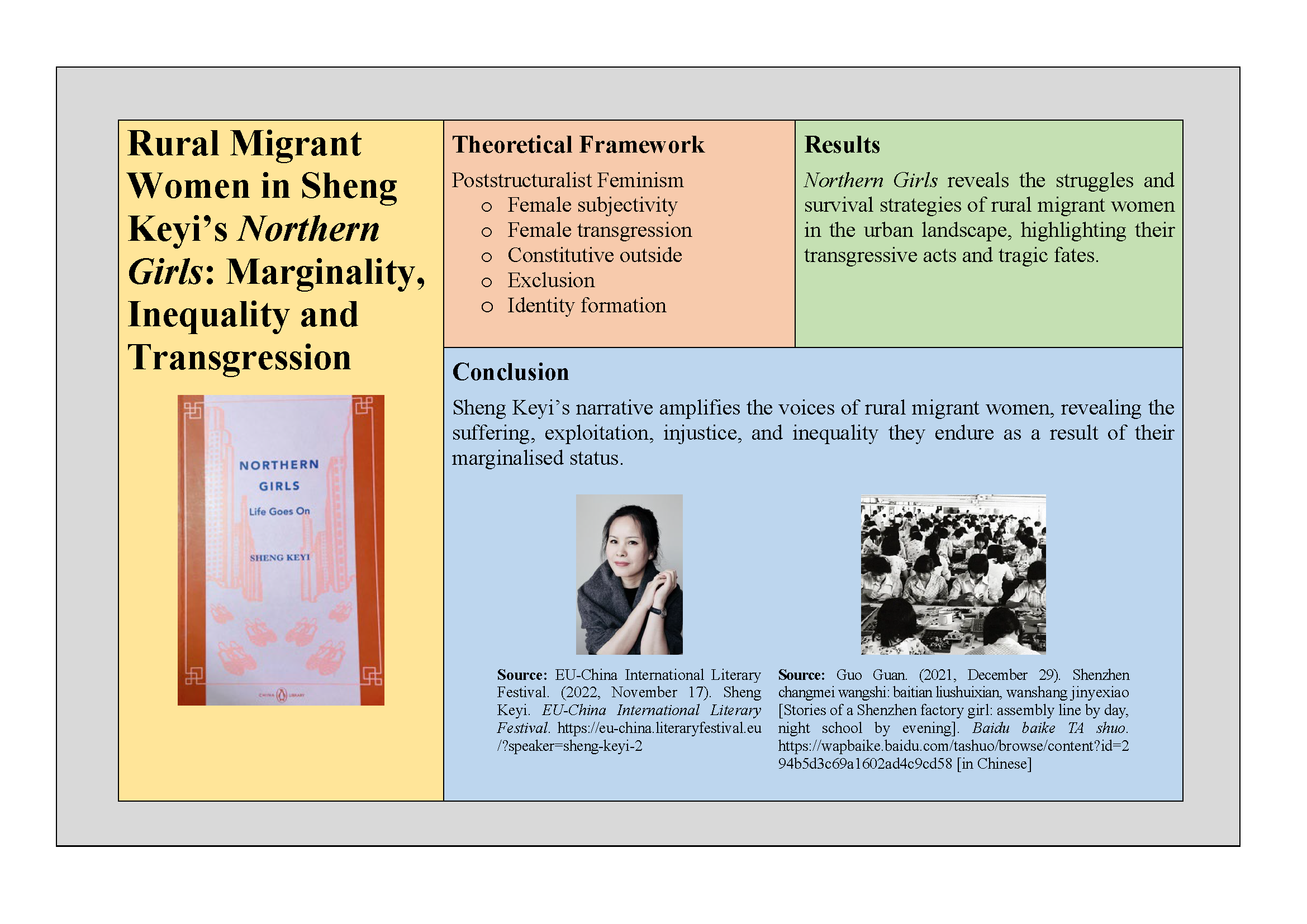
Rural migrant women in Sheng Keyi’s Northern Girls: Marginality, inequality and transgression
Article Sidebar
Main Article Content
Abstract
Sheng Keyi (b. 1973) is a prominent post-Mao woman writer of rural origin. Having migrated from a village in Hunan province, she has personally experienced rural-to-urban migration, marginalised status and inequality. Drawing on her background, she adopts an unconventional narrative style to portray rural migrant women in the city of Shenzhen—women who endure intersecting forms of oppression shaped by gender, class, and the rural–urban divide. This paper seeks to fill a research gap in studies of Chinese migrant literature by examining Sheng Keyi’s novel Northern Girls from a poststructuralist feminist perspective. It analyses the representation of rural migrant women, female subjectivity and acts of transgression in the novel. Moreover, it explores how the author articulates her own critical voice to challenge patriarchal norms, urban social hierarchies, and dominant discourses that marginalise, dismiss, and devalue rural migrant women. This paper argues that Northern Girls subverts prevailing stereotypes that reduce rural migrant women to either obedient factory workers or sex workers, instead foregrounding the complexity of female subjectivity through the protagonist’s acts of resistance. Sheng Keyi’s narrative exposes the suffering, exploitation, and injustice faced by these women. By addressing themes of subjectivity, marginality, inequality, and transgression, this paper contributes to both the feminist study of contemporary Chinese women’s writing and the broader understanding of Chinese cultural dynamics, gender relations, and the social realities of marginalised populations in post-Mao China.
Downloads
Article Details

This work is licensed under a Creative Commons Attribution-NonCommercial-NoDerivatives 4.0 International License.
All rights reserved. Apart from citations for the purposes of research, private study, or criticism and review,no part of this publication may be reproduced, stored or transmitted in any other form without prior written permission by the publisher.
References
Braidotti, R. (1994). Nomadic subjects: Embodiment and sexual difference in contemporary feminist theory. Columbia University Press.
Butler, J. (1990). Gender trouble: Feminism and the subversion of identity. Routledge.
Butler, J. (1993). Bodies that matter: On the discursive limits of “sex”. Routledge.
Colebrook, C. (2007). Feminist criticism and poststructuralism. In G. Plain & S. Sellers (Eds.), A history of feminist literary criticism (pp. 214–234). Cambridge University Press.
Dai, J. H. (2007). Shedu zhi zhou: xinshiqi Zhongguo nüxing xiezuo yu nüxing wenhua [Ferryboats: women’s writing and women’s culture in the new age of China]. Beijing daxue chubanshe. [in Chinese]
Deleuze, G., & Guattari, F. (1987). A thousand plateaus: Capitalism and schizophrenia (B. Massumi, Trans.). University of Minnesota Press.
Dong, Y. (2024). Reconstructing the gendered subaltern subject: Chinese rural migrant women in literary translation. Perspectives, 32(4), 621–635. https://doi.org/10.1080/0907676X.2022.2138471
He, J. (2021). 21 Shiji Shenzhen wenxue “nüxing huayu” de jiangou––yi Wu Jun, Sheng Keyi, Cai Dong wei li [The construction of “female discourse” in 21st-Century Shenzhen literature: A case study of Wu Jun, Sheng Keyi, and Cai Dong]. Contemporary Writers Review, 1, 22–26. https://doi.org/10.16551/j.cnki.1002-1809.2021.01.003 [in Chinese]
Jacka, T. (2006). Rural women in urban China: Gender, migration, and social change. M.E. Sharpe.
Jiang, N. (2021). Lun Sheng Keyi guanyu xiaoshuo de emoxing sikao yu shijian [On the demonic dimensions of Sheng Keyi’s literary reflections and practices]. Journal of Guiyang University (Social Sciences), 16(3), 98–102. https://doi.org/10.16856/j.cnki.52-1141/c.2021.03.018 [in Chinese]
Li, Z. (2018). Sheng wei nüren––Sheng Keyi xiaoshuo lun [Born a woman: A study of Sheng Keyi’s fiction]. Contemporary Writers Review, 5, 187–193. https://doi.org/10.16551/j.cnki.1002-1809.2018.05.023 [in Chinese]
Liu, X. (2012). The representation of rural migrant women and the discourses of modernity in contemporary China—A study of Zhang Kangkang’s novel Zhima. Frontiers of Literary Studies in China, 6(4), 511–525. https://doi.org/10.3868/s010-001-012-0029-4
Manne, K. (2017). Down girl: The logic of misogyny. Oxford University Press.
Perlez, J. (2014, October 10). Chinese writer, tackling Tiananmen, wields ‘power to offend’. The New York Times. https://www.nytimes.com/2014/10/11/world/asia/sheng-keyi-death-fugue-tiananmen-chinese-writer.html
Phillips, T. (2015, November 13). Publishers under pressure as China’s censors reach for red pen. The Guardian. https://www.theguardian.com/world/2015/nov/13/china-censorship-xi-jinping-authors-publishers
Schaffer, K., & Song, X. (2014). Women writers in postsocialist China. Routledge. https://doi.org/10.4324/9780203799222
Schaffer, K., & Song, X. (2017). Globalization, women, and poverty: A transcultural reading of Sheng Keyi’s Northern Girls. Frontiers of Literary Studies in China, 11(4), 666–687. https://doi.org/10.3868/s010-006-017-0036-0
Sheng, K. Y. (2004). Beimei [Northern Girls]. Tianjin People’s Press. [in Chinese]
Sheng, K. Y. (2011, December 2). A river’s gifts. The New York Times. https://shengkeyi.com/essays/
Sheng, K. Y. (2012a). Afterword. In K. Y. Sheng, Northern girls: Life goes on (S. Bryant, Trans.) (pp. 319–320). Penguin Books.
Sheng, K. Y. (2012b). Northern girls: Life goes on. (S. Bryant, Trans.). Penguin Books.
Sheng, K. Y. (2015, November 11). Still no dignity for Chinese women. The New York Times. https://www.almendron.com/tribuna/still-no-dignity-for-chinese-women/
Sun, W. (2014a). Subaltern China: Rural migrants, media, and cultural practices. Rowman and Littlefield.
Sun, W. (2014b). “Northern Girls”: Cultural politics of agency and south China’s migrant literature. Asian Studies Review, 38(2), 168–185. https://doi.org/10.1080/10357823.2014.901297
Swanpitak, R. (2025). Subjectivity and sexuality in contemporary Chinese feminist writing: Representations of transgressive women. Springer. https://doi.org/10.1007/978-981-97-9152-1
Xiao, H. F. (2021). “I Am Fan Yusu”: Baomu writing and grassroots feminism against the postsocialist patriarchy. In P. Zhu & H. F. Xiao (Eds.), Feminisms with Chinese Characteristics (pp. 243–270). Syracuse University Press. https://doi.org/10.2307/j.ctv1c7zg5j
Xie, Y. L. (2022). Qianxi Sheng Keyi xiaoshuo chuangzuo jiyu de chengxiang guan––yi “Bei mei”, “Yeman shengzhang”, “Shijian shaonü” wei li [A preliminary analysis of urban-rural perspectives embedded in Sheng Keyi’s fiction: A case study of Northern Girls, Wild Fruit, and The Metaphor Detox]. Culture Journal, 11, 85–88. [in Chinese]
