
Social media usage and cyberbullying: Experiences and coping strategies among secondary school students in Surat Thani, Thailand
Article Sidebar
Main Article Content
Abstract
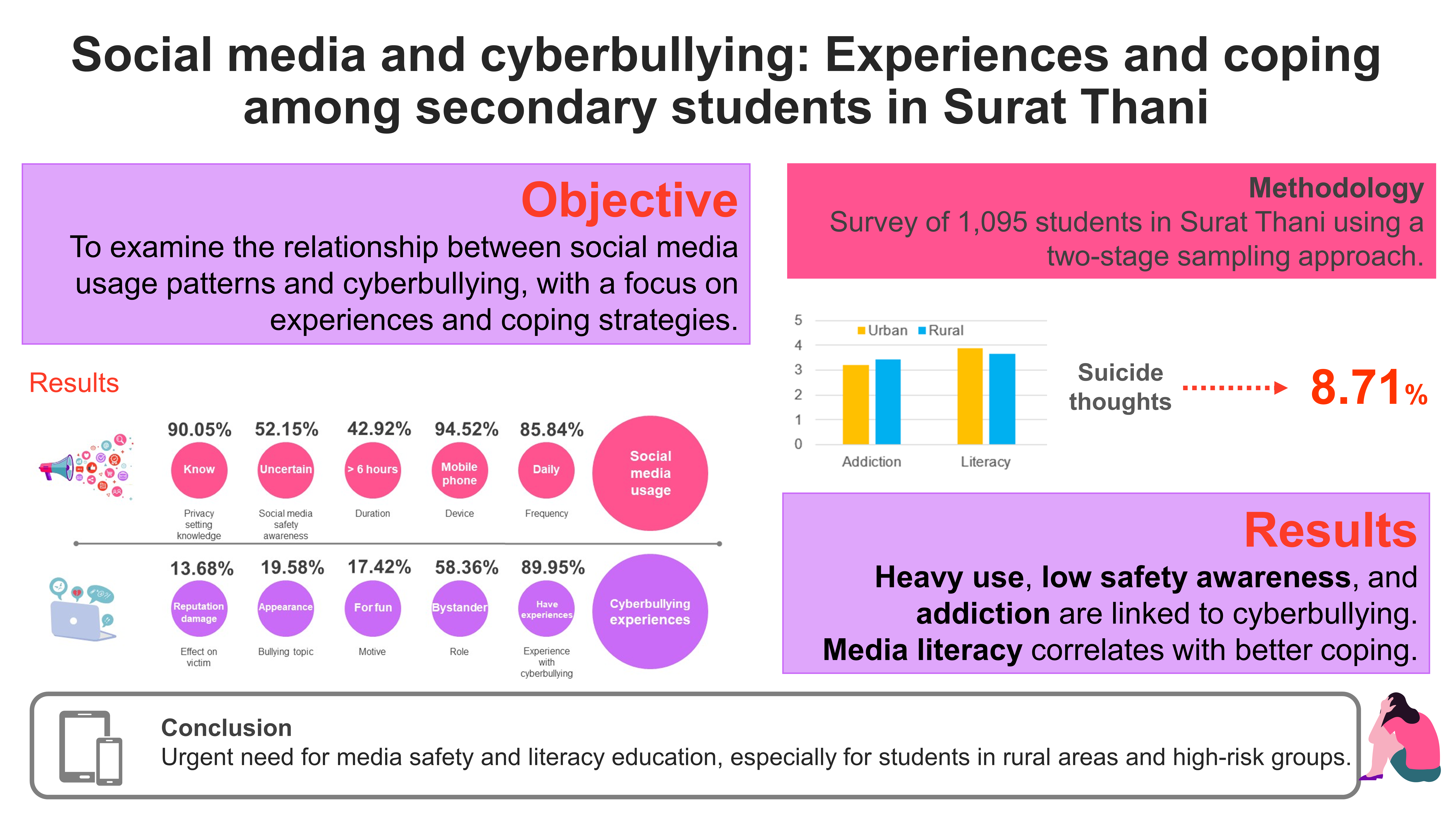
This study examines the relationship between social media usage patterns and cyberbullying, with a focus on experiences and coping strategies. A quantitative approach was employed using 1,095 anonymous questionnaires completed by secondary school students in Surat Thani, Thailand. A two-stage sampling design was used to select participants from both urban and rural areas. The results show that most participants are female, spend approximately six hours per day on Facebook, exhibit moderate social media addiction, and have high levels of social media literacy. Approximately 90% of the students reported experiencing cyberbullying, with the majority of bystanders primarily observing perpetrators targeting physical appearance and body shape. Personal factors and social media usage patterns were significantly associated with both cyberbullying experiences and coping strategies. Male students and those at higher education levels demonstrated a higher risk of engaging in cyberbullying. Urban students showed lower levels of social media addiction but higher levels of media literacy than those in rural areas. A lack of social media safety awareness was significantly correlated with all types of cyberbullying experiences. There was a positive association between perpetration behaviors and social media addiction. Students employed self-confrontation, technological coping, help-seeking, and avoidance strategies, with higher social media literacy levels linked to more effective technological coping. The findings suggest an urgent need for media safety and literacy education. Understanding cyberbullying in a regional context enhances the ability to provide effective interventions across different areas. This research contributes to the existing literature by applying Cultivation Theory in a new media context, addressing gaps in media and cyberbullying research in Thailand in particular.
Downloads
Article Details

This work is licensed under a Creative Commons Attribution-NonCommercial-NoDerivatives 4.0 International License.
All rights reserved. Apart from citations for the purposes of research, private study, or criticism and review,no part of this publication may be reproduced, stored or transmitted in any other form without prior written permission by the publisher.
References
Abaido, G. M. (2020). Cyberbullying on social media platforms among university students in the United Arab Emirates. International Journal of Adolescence and Youth, 25(1), 407–420. https://doi.org/10.1080/02673843.2019.1669059
Alipan, A., Skues, J. L., & Theiler, S. (2021). “They will find another way to hurt you”: Emerging adults’ perceptions of coping with cyberbullying. Emerging Adulthood, 9(1), 22–34. https://doi.org/10.1177/2167696818816896
Allen, S. (2019, September 20). Social media’s growing impact on our lives. American Psychological Association. https://www.apa.org/members/content/social-media-research
Andreassen, C. S., Pallesen, S., & Griffiths, M. D. (2017). The relationship between addictive use of social media, narcissism, and self-esteem: Findings from a large national survey. Addictive Behaviors, 64, 287–293. https://doi.org/10.1016/j.addbeh.2016.03.006
Ansari, J. A. N., & Khan, N. A. (2020). Exploring the role of social media in collaborative learning the new domain of learning. Smart Learning Environments, 7(1), Article 9. https://doi.org/10.1186/s40561-020-00118-7
Barlett, C. P., Kowalewski, D. A., Kramer, S. S., & Helmstetter, K. M. (2019). Testing the relationship between media violence exposure and cyberbullying perpetration. Psychology of Popular Media Culture, 8(3), 280–286. https://doi.org/10.1037/ppm0000179
Bauman, S. (2015). Types of cyberbullying. In S. Bauman (Ed.), Cyberbullying: What counselors need to know (pp. 53–58). Wiley. https://doi.org/10.1002/9781119221685.ch4
Byrne, V. L. (2021). Blocking and self-silencing: Undergraduate students’ cyberbullying victimization and coping strategies. TechTrends, 65(2), 164–173. https://doi.org/10.1007/s11528-020-00560-x
Carvalho, M., Branquinho, C., & de Matos, M. G. (2021). Cyberbullying and bullying: Impact on psychological symptoms and well-being. Child Indicators Research, 14(1), 435–452. https://doi.org/10.1007/s12187-020-09756-2
Chan, T. K. H., Cheung, C. M. K., & Wong, R. Y. M. (2019). Cyberbullying on social networking sites: The crime opportunity and affordance perspectives. Journal of Management Information Systems, 36(2), 574–609. https://doi.org/10.1080/07421222.2019.1599500
Chi, P. T. L., Lan, V. T. H., Ngan, N. H., & Linh, N. T. (2020). Online time, experience of cyberbullying, and practices to cope with it among high school students in Hanoi. Health Psychology Open, 7(1). https://doi.org/10.1177/2055102920935747
Chiang, J.-T., Chang, F.-C., & Lee, K.-W. (2021). Transitions in aggression among children: Effects of gender and exposure to online violence. Aggressive Behavior, 47(3), 310–319. https://doi.org/10.1002/ab.21944
Craig, W., Boniel-Nissim, M., King, N., Walsh, S. D., Boer, M., Donnelly, P. D., Harel-Fisch, Y., Malinowska-Cieślik, M., de Matos, M. G., Cosma, A., Van den Eijnden, R., Vieno, A., Elgar, F. J., Molcho, M., Bjereld, Y., & Pickett, W. (2020). Social media use and cyber-bullying: A cross-national analysis of young people in 42 countries. Journal of Adolescent Health, 66(6S), S100–S108. https://doi.org/10.1016/j.jadohealth.2020.03.006
Dathpong, W., & Mairieng, N. (2021). The influence social media that affects development of knowledge of high school students in Bangkok. Journal of Communication Arts Review, 25(2), 90–100. https://so06.tci-thaijo.org/index.php/jca/article/view/249066 [in Thai]
Dhond, V., Richter, S., & McKenna, B. (2019). Exploratory research to identify the characteristics of cyber victims on social media in New Zealand. In M. Themistocleous & P. Rupino da Cunha (Eds.), Information Systems—15th European, Mediterranean, and Middle Eastern Conference, EMCIS 2018, Proceedings: EMCIS 2018 (Vol. 341, pp. 193–210). Springer. https://doi.org/10.1007/978-3-030-11395-7_18
Diep, P. B., Phuong, V. M., Chinh, N. V., Diem, N. T. H., & Giang, K. B. (2021). Health science students’ use of social media for educational purposes: A sample from a Medical University in Hanoi, Vietnam. Health Services Insights, 14, 1–9. https://doi.org/10.1177/11786329211013549
Donegan, R. (2012). Bullying and cyberbullying: History, statistics, law, prevention and analysis. The Elon Journal of Undergraduate Research in Communications, 3(1), 33–42. https://www.elon.edu/u/academics/communications/journal/wp-content/uploads/sites/153/2017/06/04DoneganEJSpring12.pdf
Englander, E., Donnerstein, E., Kowalski, R., Lin, C. A., & Parti, K. (2017). Defining cyberbullying. Pediatrics, 140(Suppl. 2), S148–S151. https://doi.org/10.1542/peds.2016-1758U
Gerbner, G. (1998). Cultivation analysis: An overview. Mass Communication and Society, 1(3–4), 175–194. https://doi.org/10.1080/15205436.1998.9677855
Haand, R., & Shuwang, Z. (2020). The relationship between social media addiction and depression: A quantitative study among university students in Khost, Afghanistan. International Journal of Adolescence and Youth, 25(1), 780–786. https://doi.org/10.1080/02673843.2020.1741407
Hammad, M. A., & Alqarni, T. M. (2021). Psychosocial effects of social media on the Saudi society during the Coronavirus disease 2019 pandemic: A cross-sectional study. PLoS ONE, 16(3), Article e0248811. https://doi.org/10.1371/journal.pone.0248811
Heiman, T., Olenik-Shemesh, D., & Frank, G. (2019). Patterns of coping with cyberbullying: Emotional, behavioral, and strategic coping reactions among middle school students. Violence and Victims, 34(1), 28–45. https://doi.org/10.1891/0886-6708.VV-D-16-00141
Ho, D. Y. (1976). On the concept of face. American Journal of Sociology, 81(4), 867–884. https://doi.org/10.1086/226145
Hofstede, G. (2011). Dimensionalizing cultures: The Hofstede model in context. Online Readings in Psychology and Culture, 2(1), Article 8. https://doi.org/10.9707/2307-0919.1014
Hou, Y., Xiong, D., Jiang, T., Song, L., & Wang, Q. (2019). Social media addiction: Its impact, mediation, and intervention. Cyberpsychology: Journal of Psychosocial Research on Cyberspace, 13(1), Article 4. https://doi.org/10.5817/cp2019-1-4
Hu, Q., Bernardo, A. B. I., Lam, S. W., & Cheang, P. K. (2018). Individualism-collectivism orientations and coping styles of cyberbullying victims in Chinese culture. Current Psychology, 37(1), 65–72. https://doi.org/10.1007/s12144-016-9490-7
Kaewseenual, S., & Sittichai, R. (2021). Digital resilience of children towards cyberbullying and online hate speech: Comparative study of educational environments in Chiang Mai and Songkhla school. Journal of Information Science, 39(4), 20–45. https://doi.org/10.14456/jiskku.2021.20 [in Thai]
Kang, K. I., Kang, K., & Kim, C. (2021). Risk factors influencing cyberbullying perpetration among middle school students in Korea: Analysis using the zero-inflated negative binomial regression model. International Journal of Environmental Research and Public Health, 18(5), Article 2224. https://doi.org/10.3390/ijerph18052224
Khalid, A., Hassan, T. U., & Shabir, G. (2020). Cultivation effects of social media on cognitive, social and moral skills of adolescents in Pakistan. Journal of Business and Social Review in Emerging Economies, 6(2), 419–436. https://doi.org/10.26710/jbsee.v6i2.1146
Kim, J., Walsh, E., Pike, K., & Thompson, E. A. (2020). Cyberbullying and victimization and youth suicide risk: The buffering effects of school connectedness. The Journal of School Nursing, 36(4), 251–257. https://doi.org/10.1177/1059840518824395
Kopecký, K., & Szotkowski, R. (2017). Cyberbullying, cyber aggression and their impact on the victim—The teacher. Telematics and Informatics, 34(2), 506–517. https://doi.org/10.1016/j.tele.2016.08.014
Kumar, V. L., & Goldstein, M. A. (2020). Cyberbullying and adolescents. Current Pediatrics Reports, 8(1), 86–92. https://doi.org/10.1007/s40124-020-00217-6
Lertratthamrongkul, W. (2021). Cyberbullying among secondary school students: Prevalence, problem-solving, and risk behaviors. NEU Academic and Research Journal, 11(1), 275–289. [in Thai]
Li, T. B. Q. (2005). Cyber-harassment: A study of a new method for an old behavior. Journal of Educational Computing Research, 32(3), 265–277. https://doi.org/10.2190/8yqm-b04h-pg4d-bllh
Livingstone, S. (2004). Media literacy and the challenge of new information and communication technologies. The Communication Review, 7(1), 3–14. https://doi.org/10.1080/10714420490280152
Lizut, J. (2019). Cyberbullying victims, perpetrators, and bystanders. In G. Marzano & J. Lizut (Eds.), Cyberbullying and the critical importance of educational resources for prevention and intervention (pp. 144–172). IGI Global Scientific Publishing. https://doi.org/10.4018/978-1-5225-8076-8.ch005
Longstreet, P., & Brooks, S. (2017). Life satisfaction: A key to managing internet & social media addiction. Technology in Society, 50, 73–77. https://doi.org/10.1016/j.techsoc.2017.05.003
Machackova, H., Cerna, A., Sevcikova, A., Dedkova, L., & Daneback, K. (2013). Effectiveness of coping strategies for victims of cyberbullying. Cyberpsychology: Journal of Psychosocial Research on Cyberspace, 7(3), Article 5. https://doi.org/10.5817/CP2013-3-5
Marciano, L., Schulz, P. J., & Camerini, A.-L. (2020). Cyberbullying perpetration and victimization in youth: A meta-analysis of longitudinal studies. Journal of Computer-Mediated Communication, 25(2), 163–181. https://doi.org/10.1093/jcmc/zmz031
McLoughlin, L. T. (2021). Understanding and measuring coping with cyberbullying in adolescents: Exploratory factor analysis of the brief coping orientation to problems experienced inventory. Current Psychology, 40(9), 4300–4310. https://doi.org/10.1007/s12144-019-00378-8
Morgan, M., & Shanahan, J. (2010). The state of cultivation. Journal of Broadcasting and Electronic Media, 54(2), 337–355. https://doi.org/10.1080/08838151003735018
Navarro, R., Larrañaga, E., & Yubero, S. (2018). Differences between preadolescent victims and non-victims of cyberbullying in cyber-relationship motives and coping strategies for handling problems with peers. Current Psychology, 37(1), 116–127. https://doi.org/10.1007/s12144-016-9495-2
NeVille, C., & Sirasoonthorn, P. (2021). Social media as the learning platform of power in Thai university students. Humanities, Arts and Social Sciences Studies, 21(1), 162–170. https://so02.tci-thaijo.org/index.php/hasss/article/view/235276
Ngo, A. T., Tran, A. Q., Tran, B. X., Nguyen, L. H., Hoang, M. T., Nguyen, T. H. T., Doan, L. P., Vu, G. T., Nguyen, T. H., Do, H. T., Latkin, C. A., Ho, R. C. M., & Ho, C. S. H. (2021). Cyberbullying among school adolescents in an urban setting of a developing country: Experience, coping strategies, and mediating effects of different support on psychological well-being. Frontiers in Psychology, 12, Article 661919. https://doi.org/10.3389/fpsyg.2021.661919
Rahman, A. A. A., & Razak, F. H. A. (2019). Social media addiction towards young adults emotion. Journal of Media and Information Warfare, 12(2), 1–15. https://jmiw.uitm.edu.my/images/Journal/V122Chapter1.pdf
Sahasapath, T. (2018, October 4). Cyberbullying: Online harassment. Prachachart Business. https://www.prachachat.net/columns/news-229510 [in Thai]
Seçkin-Kapucu, M., Özcan, H., & Karakaya-Özyer, K. (2021). The relationship between middle school students’ digital literacy levels, social media usage purposes, and cyberbullying threat level. International Journal of Modern Education Studies, 5(2), 537–553.
Sestir, M. A. (2020). This is the way the world “friends”: Social network site usage and cultivation effects. The Journal of Social Media in Society, 9(1), 1–21. https://thejsms.org/index.php/JSMS/article/view/517/329
Sittichai, R., & Smith, P. (2018). Bullying and cyberbullying in Thailand: Coping strategies and relation to age, gender, religion and victim status. Journal of New Approaches in Educational Research, 7(1), 24–30. https://doi.org/10.7821/naer.2018.1.254
Smith, P. K., Mahdavi, J., Carvalho, M., Fisher, S., Russell, S., & Tippett, N. (2008). Cyberbullying: Its nature and impact in secondary school pupils. Journal of Child Psychology and Psychiatry, 49(4), 376–385. https://doi.org/10.1111/j.1469-7610.2007.01846.x
Sooksomsod, P., & Pumpruek, P. (2021). The impact of using social media to change the Thai values of teenages in Phranakhon Si Ayutthaya Province. Journal of Ayutthaya Studies, 13(1), 119–137. [in Thai]
Su, W., Han, X., Yu, H., Wu, Y., & Potenza, M. N. (2020). Do men become addicted to internet gaming and women to social media? A meta-analysis examining gender-related differences in specific internet addiction. Computers in Human Behavior, 113, Article 106480. https://doi.org/10.1016/j.chb.2020.106480
Taled, W., Karaket, A., & Soodboonma, W. (2019). Cyber bullying among nurses in Thailand. Journal of Nursing and Health Care, 37(4), 90–99. https://he01.tci-thaijo.org/index.php/jnat-ned/article/view/233662 [in Thai]
Tantathipanich, S. (Ed.). (2020). Kan samruat sathanakan dek kap phai online 2563 [Survey of Thai children and online risks 2020]. Internet Foundation for the Development of Thailand. [in Thai]
Tintori, A., Ciancimino, G., Giovanelli, G., & Cerbara, L. (2021). Bullying and cyberbullying among Italian adolescents: The influence of psychosocial factors on violent behaviours. International Journal of Environmental Research and Public Health, 18(4), Article 1558. https://doi.org/10.3390/ijerph18041558
Tsay-Vogel, M., Shanahan, J., & Signorielli, N. (2018). Social media cultivating perceptions of privacy: A 5-year analysis of privacy attitudes and self-disclosure behaviors among Facebook users. New Media and Society, 20(1), 141–161. https://doi.org/10.1177/1461444816660731
Tutgun-Ünal, A. (2020). Social media addiction of new media and journalism students. The Turkish Online Journal of Educational Technology, 19(2), 1–12. https://files.eric.ed.gov/fulltext/EJ1251117.pdf
UNICEF. (n.d.). Cyberbullying: What is it and how to stop it. https://www.unicef.org/end-violence/how-to-stop-cyberbullying
Wachs, S., Gámez-Guadix, M., Wright, M. F., Görzig, A., & Schubarth, W. (2020). How do adolescents cope with cyberhate? Psychometric properties and socio-demographic differences of a coping with cyberhate scale. Computers in Human Behavior, 104, Article 106167. https://doi.org/10.1016/j.chb.2019.106167
Wick, S. E., Nguyen, A. P., West, J. T., Nagoshi, C. T., Jordan, C., & Lehmann, P. (2020). Cyber harassment, coping, and psychological maladjustment in college students. College Student Journal, 54(1), 77–88.
Worsley, J. D., McIntyre, J. C., & Corcoran, R. (2019). Cyberbullying victimisation and mental distress: Testing the moderating role of attachment security, social support, and coping styles. Emotional and Behavioural Difficulties, 24(1), 20–35. https://doi.org/10.1080/13632752.2018.1530497
Wright, M. F., & Wachs, S. (2020). Parental support, health, and cyberbullying among adolescents with intellectual and developmental disabilities. Journal of Child and Family Studies, 29(9), 2390–2401. https://doi.org/10.1007/s10826-020-01739-9
Yoo, C. (2021). What are the characteristics of cyberbullying victims and perpetrators among South Korean students and how do their experiences change? Child Abuse and Neglect, 113, Article 104923. https://doi.org/10.1016/j.chiabu.2020.104923
Yoochareon, T. (2022). Cyber bullying in public of youth in the Bangkok area. Journal of Social Work, 30(2), 232–266. https://so04.tci-thaijo.org/index.php/swjournal/article/view/259776 [in Thai]
Yücens, B., & Üzer, A. (2018). The relationship between internet addiction, social anxiety, impulsivity, self-esteem, and depression in a sample of Turkish undergraduate medical students. Psychiatry Research, 267, 313–318. https://doi.org/10.1016/j.psychres.2018.06.033
Zhong, J., Zheng, Y., Huang, X., Mo, D., Gong, J., Li, M., & Huang, J. (2021). Study of the influencing factors of cyberbullying among Chinese college students incorporated with digital citizenship: From the perspective of individual students. Frontiers in Psychology, 12, Article 621418. https://doi.org/10.3389/fpsyg.2021.621418
Zhou, S. (2021). Status and risk factors of Chinese teenagers’ exposure to cyberbullying. SAGE Open, 11(4). https://doi.org/10.1177/21582440211056626
Zhu, C., Huang, S., Evans, R., & Zhang, W. (2021). Cyberbullying among adolescents and children: A comprehensive review of the global situation, risk factors, and preventive measures. Frontiers in Public Health, 9, Article 634909. https://doi.org/10.3389/fpubh.2021.634909
