
A comparative study of mathematics teaching anxiety among elementary schoolteachers in Indonesia and Nigeria
Article Sidebar
Main Article Content
Abstract
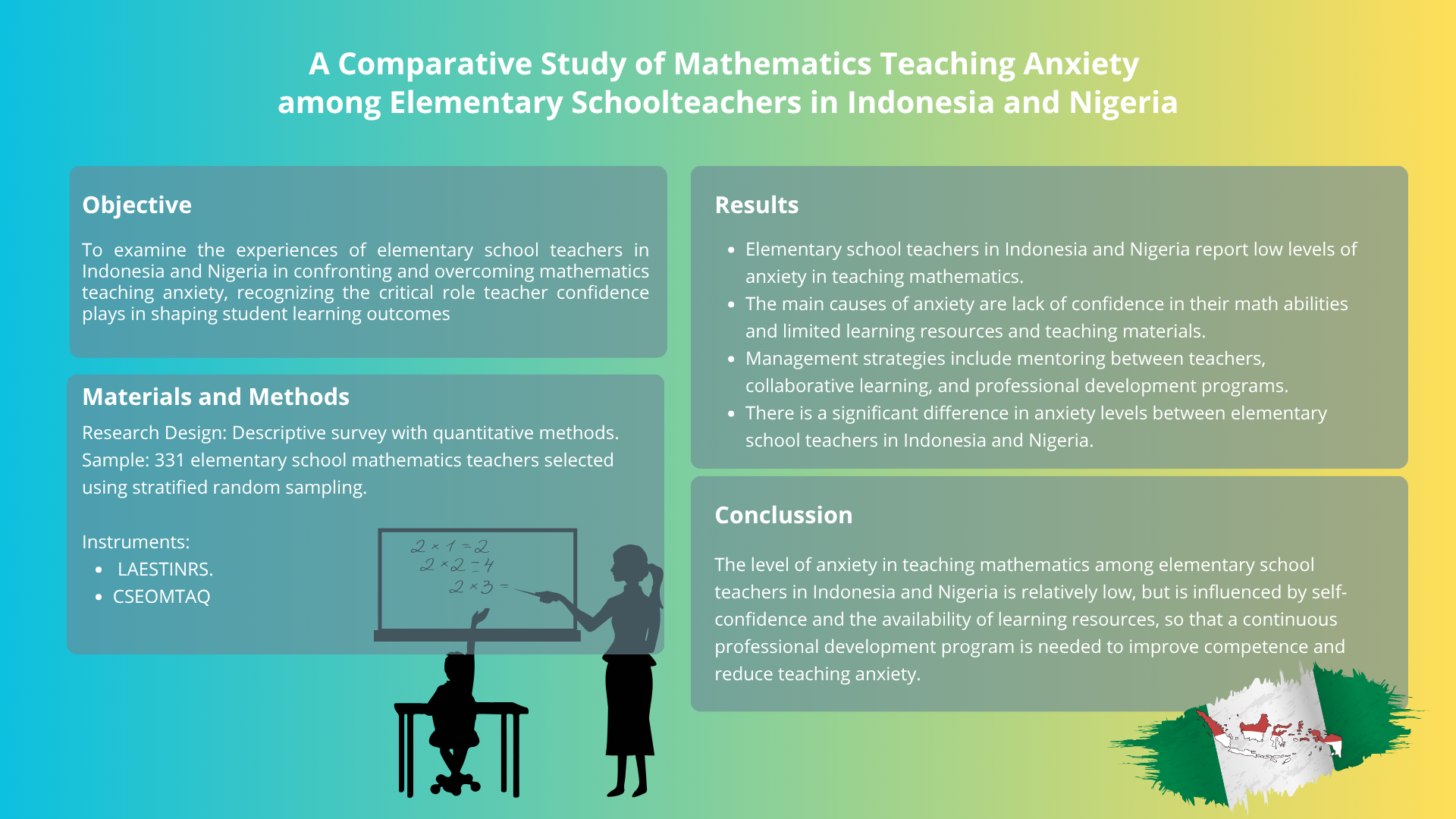
Teachers play a critical role in their efforts to provide meaningful mathematics learning to students to prevent them from experiencing learning anxiety. This study examined the experiences of elementary schoolteachers in Indonesia and Nigeria in confronting and overcoming mathematics teaching anxiety, recognizing the critical role teacher confidence plays in shaping student learning outcomes. The comparative approach of this study provided a nuanced understanding of how cultural context influences mathematics teaching anxiety and the coping strategies employed by teachers in different settings. The study utilized a descriptive survey research design, employing quantitative collection methods. This study included all elementary schoolteachers in Indonesia and Nigeria, selecting a representative sample of 331 elementary mathematics teachers using a stratified random sampling technique. Two researcher-developed instruments were used: The Level of Anxiety among Elementary School Teachers in Indonesia and Nigeria Rating Scale (LAESTINRS) and the Causes and Strategies Employed to Overcome Mathematics Teaching Anxiety Questionnaire (CSEOMTAQ). The findings revealed that the level of anxiety among elementary schoolteachers in Indonesia and Nigeria was low. Insufficient self-confidence in mathematical abilities and a lack of resources and teaching materials became the major causes of mathematics anxiety among the teachers, among others. Teacher-to-teacher mentorship and collaborative learning as well as organizing and encouraging professional development programs were the strategies used in managing mathematics teachers’ anxiety. There was a significant difference in the level of anxiety among the elementary schoolteachers in Indonesia and Nigeria. It was recommended that continuous training programs and professional development opportunities that address the root causes of mathematics teaching anxiety should be organized.
Downloads
Article Details

This work is licensed under a Creative Commons Attribution-NonCommercial-NoDerivatives 4.0 International License.
All rights reserved. Apart from citations for the purposes of research, private study, or criticism and review,no part of this publication may be reproduced, stored or transmitted in any other form without prior written permission by the publisher.
References
Adimora, D. E., Nwokenna, E. N., Omeje, J. C., & Eze, U. N. (2015). Influence of socio-economic status and classroom climate on mathematics anxiety of primary school pupils. Procedia - Social and Behavioral Sciences, 205, 693–701. https://doi.org/10.1016/j.sbspro.2015.09.109
Artemenko, C., Masson, N., Georges, C., Nuerk, H.-C., & Cipora, K. (2021). Not all elementary school teachers are scared of math. Journal of Numerical Cognition, 7(3), 275–294. https://doi.org/10.5964/jnc.6063
Aruvee, E., & Vintere, A. (2023). Overcoming mathematical anxiety to promote progress in mathematics during undergraduate engineering studies at university. In L. Malinovska & V. Osadcuks (Eds.), 22nd International Scientific Conference Engineering for Rural Development Proceedings, Volume 22 (pp. 1069–1074). Latvia University of Life Sciences and Technologies. https://doi.org/10.22616/ERDev.2023.22.TF215
Awofala, A. O. A., Akinoso, S. O., Adeniyi, C. O., Jega, S. H., Fatade, A. O., & Arigbabu, A. A. (2024). Primary teachers’ mathematics anxiety and mathematics teaching anxiety as predictors of students’ performance in mathematics. ASEAN Journal of Science and Engineering Education, 4(1), 9–24. https://doi.org/10.17509/ajsee.v3i3.51065
Bursal, M., & Paznokas, L. (2006). Mathematics anxiety and preservice elementary teachers’ confidence to teach mathematics and science. School Science and Mathematics, 106(4), 173–180. https://doi.org/10.1111/j.1949-8594.2006.tb18073.x
Çatlioğlu, H., Birgin, O., Coştu, S., & Gürbüz, R. (2009). The level of mathematics anxiety among pre-service elementary school teachers. Procedia - Social and Behavioral Sciences, 1(1), 1578–1581. https://doi.org/10.1016/j.sbspro.2009.01.277
Chiu, M.-S., & Seah, W. T. (2024). Values and valuing pedagogies in affect-focused mathematics teaching. Social Sciences & Humanities Open, 10, Article 101050. https://doi.org/10.1016/j.ssaho.2024.101050
Costado Dios, M. T., & Piñero Charlo, J. C. (2024). Mathematical anxiety among primary education degree students in the post-pandemic era: A case study. Education Sciences, 14(2), Article 171. https://doi.org/10.3390/educsci14020171
Fitriyah, A. L., Putri, A. F. S., Putra, M. I. S., Rofiki, I., & Abdullah, A. H. (2022). Pengaruh peer tutoring pada kecemasan matematika siswa sekolah menengah pertama [The effect of peer tutoring on junior high school students’ mathematics anxiety]. Jurnal Kajian Pembelajaran Matematika, 6(2), 125–134. http://dx.doi.org/10.17977/um076v6i22022p125-134 [in Indonesian]
Ganley, C. M., Schoen, R. C., LaVenia, M., & Tazaz, A. M. (2019). The construct validation of the math anxiety scale for teachers. Aera Open, 5(1), 1–16. https://doi.org/10.1177/2332858419839702
Gresham, G. (2008). Mathematics anxiety and mathematics teacher efficacy in elementary pre‐service teachers. Teaching Education, 19(3), 171–184. https://doi.org/10.1080/10476210802250133
Guzmán, B., Rodriguez, C., & Ferreira, R. A. (2023). Effect of parents’ mathematics anxiety and home numeracy activities on young children’s math performance-anxiety relationship. Contemporary Educational Psychology, 72, Article 102140. https://doi.org/10.1016/j.cedpsych.2022.102140
Haciomeroglu, G. (2013). Mathematics anxiety and mathematical beliefs: What is the relationship in elementary pre-service teachers? Issues in the Undergraduate Mathematics Preparation of School Teachers: The Journal, 5, 1–9. https://files.eric.ed.gov/fulltext/EJ1005311.pdf
Humphreys, S., Dunne, M., Durrani, N., Sankey, S., & Kaibo, J. (2020). Becoming a teacher: Experiences of female trainees in initial teacher education in Nigeria. Teaching and Teacher Education, 87, Article 102957. https://doi.org/10.1016/j.tate.2019.102957
Irfan, M. (2017). Analisis Kesalahan Siswa dalam Pemecahan Masalah Berdasarkan Kecemasan Belajar Matematika [Analysis of students’ errors in problem solving based on mathematics learning anxiety]. Kreano, Jurnal Matematika Kreatif-Inovatif, 8(2), 143–149. http://dx.doi.org/10.15294/kreano.v8i2.8779 [in Indonesian]
Irfan, M. (2018). Proses Berpikir Siswa Yang Mengalami Math-Anxiety Dalam Menyelesaikan Masalah Sistem Persamaan Linier Dua Variabel [The thinking process of students experiencing math-anxiety in solving two-variable equation system problems]. Kalamatika: Jurnal Pendidikan Matematika, 3(1), 27–38. https://doi.org/10.22236/KALAMATIKA.vol3no1.2018pp27-38 [in Indonesian]
Ismail, N., Garba, A., Osman, S., Ibrahim, N. H., & Bunyamin, M. A. H. (2022). Exploring teacher effects on intensifying and minimizing mathematics anxiety among students in Sokoto State, Nigeria. International Journal of Evaluation and Research in Education, 11(1), 161–171. http://doi.org/10.11591/ijere.v11i1.22189
Iyamuremye, E., Ndayambaje, I., & Muwonge, C. M. (2023). Relationships of mathematics achievement with self-determined motivation and mathematics anxiety among senior two students in Northern Rwanda. Heliyon, 9(4), Article e15411. https://doi.org/10.1016/j.heliyon.2023.e15411
Juhrani, J., & Faisal, R. (2017). Kecemasan Guru yang Berlatar Belakang Bukan Pendidikan Matematika dalam Mengajar Matematika [Teachers’ anxiety with non-mathematics education backgrounds in teaching mathematics]. PRISMA, Prosiding Seminar Nasional Matematika, 72–77. http://journal.unnes.ac.id/sju/prisma/article/view/21563 [in Indonesian]
Kusmaryono, I., & Ulia, N. (2020). Interaksi gaya mengajar dan konten matematika sebagai faktor penentu kecemasan matematika [The interaction of teaching style and mathematical content as a determining factor of mathematical anxiety]. Mosharafa: Jurnal Pendidikan Matematika, 9(1), 143–154. https://doi.org/10.31980/mosharafa.v9i1.599 [in Indonesian]
Mehmet, C., & Hulya, S. (2021). Factors that cause students to develop math anxiety and strategies to diminish. Cypriot Journal of Educational Sciences, 16(4), 1356–1367. https://doi.org/10.18844/cjes.v16i4.5984
Möhring, W., Moll, L., & Szubielska, M. (2024). Mathematics anxiety and math achievement in primary school children: Testing different theoretical accounts. Journal of Experimental Child Psychology, 247, Article 106038. https://doi.org/10.1016/j.jecp.2024.106038
Odebode, A. O. (2021). Comparative analysis of the impact of mathematics teaching anxiety on service and pre service teacher teaching experience. Journal of Capital Development in Behavioural Sciences, 9(1), 178–187.
Ogirima, O. A., Tolulope, J. J., & Temitope, S. J. (2021). Future teachers’ perception towards the use of YouTube for teaching-learning activities in Nigerian basic schools. Elementary School Forum (Mimbar Sekolah Dasar), 8(1), 81–95. https://doi.org/10.53400/mimbar-sd.v8i1.31378
Özlü, F. N. (2024). Examining prospective elementary and middle school mathematics teachers’ mathematics anxiety and mathematics teaching anxiety [Master’s thesis, Middle East Technical University]. OpenMETU. https://open.metu.edu.tr/handle/11511/109850
Paramitha, J., & Ajisuksmo, C. R. P. (2021). Efikasi diri matematika dan sikap terhadap matematika pada siswa sekolah menengah pertama [Mathematics self-efficacy and attitudes towards mathematics in junior high school students]. Jurnal Psikologi, 14(2), 207–216. [in Indonesian]
Park, J., Ramirez, G., & Park, D. (2024). Effect of preschool teacher’s math anxiety on teaching efficacy and classroom engagement in math. Psychology in the Schools, 61(6), 2600–2611. https://doi.org/10.1002/pits.23182
Pasaribu, T. A., & Harendita, M. E. (2018). English language anxiety of pre-service teachers: Causes and coping strategies. LLT Journal: A Journal on Language and Language Teaching, 21(2), 134–147. https://doi.org/10.24071/llt.2018.210202
Peker, M., & Ertekin, E. (2011). The relationship between mathematics teaching anxiety and mathematics anxiety. The New Educational Review, 23(1), 213–226.
Polacco, D., Zsoldos-Marchiș, I., & Dekel, R. (2023). Perspectives of teachers on the signs and causes of mathematics anxiety. Acta Didactica Napocensia, 16(2), 126–143. https://doi.org/10.24193/adn.16.2.10
Prasetyo, F., Suhendra, S., & Turmudi, T. (2023). Mathematics teachers’ anxiety in teaching and learning process: A literature review. AKSIOMA: Jurnal Program Studi Pendidikan Matematika, 12(1), 1063–1073. http://dx.doi.org/10.24127/ajpm.v12i1.6660
Rahayu, L. P., Mustadi, A., & Sarjiman, P. (2019). An investigation on pre-service elementary school teachers’ mathematics anxiety. Al-Jabar: Jurnal Pendidikan Matematika, 10(1), 111–124.
Ramirez, G., Hooper, S. Y., Kersting, N. B., Ferguson, R., & Yeager, D. (2018). Teacher math anxiety relates to adolescent students’ math achievement. AERA Open, 4(1). https://doi.org/10.1177/2332858418756052
Sa’adah, L., & Mariana, N. (2018). Studi Auto| etnografi: Kecemasan Guru Kelas Sekolah Dasar Saat Mengajarkan Matematika [Auto|ethnographic study: Elementary school teachers’ anxiety when teaching mathematics]. Jurnal Penelitian Pendidikan Guru Sekolah Dasar, 6(7), 1222–1231. https://ejournal.unesa.ac.id/index.php/jurnal-penelitian-pgsd/article/view/24022 [in Indonesian]
Schreiber, I., & Ashkenazi, H. (2024). The impact of various teaching methods on the knowledge of students of different genders: The case of mathematics word problems abstract. Heliyon, 10(16), Article e35610. https://doi.org/10.1016/j.heliyon.2024.e35610
Siedlecki, S. L. (2020). Understanding descriptive research designs and methods. Clinical Nurse Specialist, 34(1), 8–12. https://doi.org/10.1097/NUR.0000000000000493
Sopekan, O. S., & Awofala, A. O. A. (2019). Mathematics anxiety and mathematics beliefs as correlates of early childhood pre-service teachers’ numeracy skills. PedActa, 9(2), 13–24. https://doi.org/10.24193/PedActa.9.2.2
Supriadi, N., Jamaluddin, W. Z., & Suherman, S. (2024). The role of learning anxiety and mathematical reasoning as predictor of promoting learning motivation: The mediating role of mathematical problem solving. Thinking Skills and Creativity, 52, Article 101497. https://doi.org/10.1016/j.tsc.2024.101497
Swars, S. L., Daane, C. J., & Giesen, J. (2006). Mathematics anxiety and mathematics teacher efficacy: What is the relationship in elementary preservice teachers? School Science and Mathematics, 106(7), 306–315. https://doi.org/10.1111/j.1949-8594.2006.tb17921.x
Tasdemir, C. (2015). Examining occupational anxiety level of Mathematics teachers for some variables. Educational Research and Reviews, 10(12), 1578–1585. https://doi.org/10.5897/ERR2015.2325
Tasdemir, C. (2016). An examination of vocational school students’ self-efficacy beliefs in mathematics and of their achievement levels. Educational Research and Reviews, 11(8), 804–811. https://academicjournals.org/journal/ERR/article-full-text/16E201D58188
Tella, A. (2011). An assessment of mathematics teachers’ internet self-efficacy: Implications on teachers’ delivery of mathematics instruction. International Journal of Mathematical Education in Science and Technology, 42(2), 155–174. https://doi.org/10.1080/0020739X.2010.519798
Tomasetto, C., Passolunghi, M. C., De Vita, C., Guardabassi, V., & Morsanyi, K. (2025). Parental mathematics anxiety is related to children’s mathematical development in preschool and the first school years. Journal of Experimental Child Psychology, 252, Article 106185. https://doi.org/10.1016/j.jecp.2024.106185
Yanuarto, W. N., Maat, S. M., Setyanigsih, E., Isnawan, M. G., & Zakaria, M. I. (2023). The moderating model of teaching anxiety on teaching beliefs and TPACK effect to ICT literacy among pre-service mathematics teachers. Mathematics Teaching Research Journal, 15(3), 50–72.
