
Transforming performance subjectivity under generative AI: On the authenticity and simulacra of virtual performance
Article Sidebar
Main Article Content
Abstract
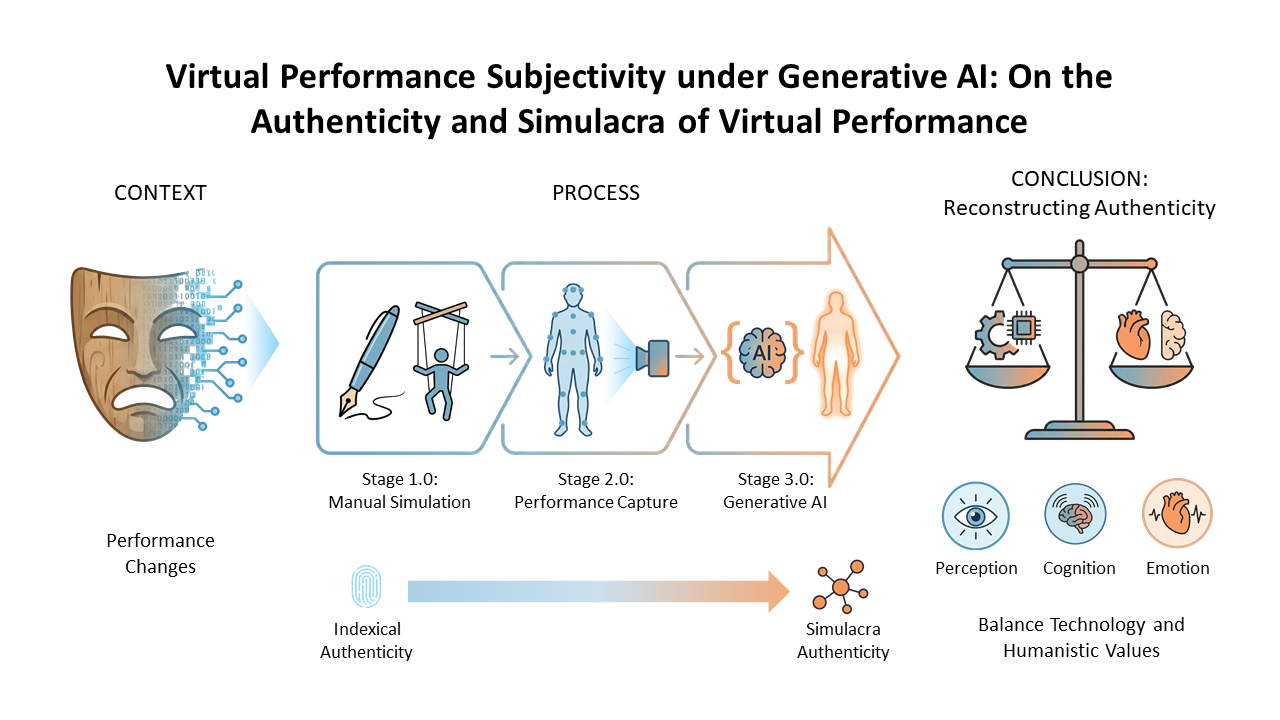
The continuous evolution of digital technology has driven a profound transformation in the performing arts. As a technology-driven artistic form, virtual performance is reshaping the logic of subjectivity and authenticity within performance practice. Drawing on Jean Baudrillard’s Simulacra theory as its analytical framework, this article examines the problem of authenticity in virtual performance and the underlying logic that sustains it. By analyzing the stage-by-stage development of virtual performance, the study explores how it becomes detached from the physical body, reconstructs human emotions and behaviours through algorithms and symbolic systems, and challenges the authenticity paradigm of traditional performance. The findings indicate that the evolution of virtual performance has progressively shifted from mimetic representation to autonomous symbolic production. Its logic of authenticity no longer depends on physical reproduction; rather, it is constituted through a dynamic “two-way mapping relationship” enabled by technological re-encoding and the self-referential operation of symbolic systems. Although virtual performance expands the boundaries of artistic expression, excessive reliance on simulacral generation may result in the erosion of experiential reality and the hollowing out of artistic authenticity. Furthermore, while generative AI endows virtual performances with the capacity for ‘self-programming’, it simultaneously intensifies the tension between technological rationality and humanistic values. Accordingly, this study advocates the development of an interdisciplinary theoretical framework, the optimization of integrative pathways between technology and the humanities, and the reconstruction of an evaluative system for audience authenticity grounded in perceptual, cognitive, and affective dimensions. It emphasizes that the sustainable reconstruction of artistic authenticity can be achieved only through a critical balance between technological innovation and humanistic reflection.
Downloads
Article Details

This work is licensed under a Creative Commons Attribution-NonCommercial-NoDerivatives 4.0 International License.
All rights reserved. Apart from citations for the purposes of research, private study, or criticism and review,no part of this publication may be reproduced, stored or transmitted in any other form without prior written permission by the publisher.
References
Baía Reis, A., & Ashmore, M. (2022). From video streaming to virtual reality worlds: An academic, reflective, and creative study on live theatre and performance in the metaverse. International Journal of Performance Arts and Digital Media, 18(1), 7–28. https://doi.org/10.1080/14794713.2021.2024398
Baudrillard, J. (1994). Simulacra and simulation (S. Faria, Trans.). University of Michigan Press. (Original work published 1981). https://eclass-b.uoa.gr/modules/document/file.php/ENL205/simulacra-and-simulation-by-jean-baudrillard.pdf
Bolter, J. D., & Grusin, R. (2000). Remediation: Understanding new media (Rev. ed.). The MIT Press.
Cambridge University Press. (n.d.). Virtual, adj. In Dictionary.cambridge.org. Retrieved March 9, 2026, from https://dictionary.cambridge.org/dictionary/english-chinese-simplified/virtual
Carlson, M. (2013). Performance: A critical introduction (2nd ed.). Routledge. https://doi.org/10.4324/9781315016153
Chalmers, D. J. (2018). The virtual and the real. Disputatio, 9(46), 309–352. https://doi.org/10.1515/disp-2017-0009
Chen, Q., Cheng, H., & Zhu, H. (2018, November 8). The world’s first “AI-synthesized news anchor” debuts at Xinhua News Agency. Xinhua News Agency. http://www.xinhuanet.com/zgjx/2018-11/08/c_137589274.htm [in Chinese]
Chen, Q. J., & Zhong, J. M. (2023). Metaphor and symbol of the simulation of existence: On the subject of digital performance. Drama (The Journal of the Central Academy of Drama), 5, 1–25. [in Chinese]
Deleuze, G. (1990). Bergsonism. The MIT Press. http://archive.org/details/Bergsonism
Dictionary.com. (n.d.). Performance. In Dictionary.com. Retrieved February 9, 2025, from https://www.dictionary.com/browse/performance
Dixon, S. (2006). A history of virtual reality in performance. International Journal of Performance Arts and Digital Media, 2(1), 23–54.
Feng, B. (2023). Aesthetic challenge and reflection of AI art in film and television works from the perspective of “face changing technology.” In Z. Hu, Z. Ye, & M. He (Eds.), Advances in artificial systems for medicine and education VI (pp. 231–242). Springer. https://doi.org/10.1007/978-3-031-24468-1_21
Guo, T. (2025). Artificial intelligence empowers innovation in mainstream media content production: A case study of CCTV.com. Television Research, 4, 11–15. [in Chinese]
Hallinan, B., & Reynolds, C. J. (2021). New media goes to the movies: Digitizing the theatrical audience. Television & New Media, 22(4), 379–399. https://doi.org/10.1177/1527476419863131
Haraway, D. (1999). The promises of monsters: A regenerative politics for inappropriate/d others. In J. Wolmark (Ed.), Cybersexualities: A reader in feminist theory, cyborgs and cyberspace (pp. 314–366). Edinburgh University Press.
Institute of Linguistics, Chinese Academy of Social Sciences (CASS). (1995). Modern Chinese dictionary. The Commercial Press.
Institute of Linguistics, Chinese Academy of Social Sciences (CASS) (Ed.). (2016). Modern Chinese dictionary (7th ed.). The Commercial Press.
Kłeczek, J. (2024). Avant-garde performing arts meet mechanical theater: A dispositive analysis. International Journal of Performance Arts and Digital Media, 20(3), 446–463. https://doi.org/10.1080/14794713.2024.2381701
Kuo, M., & Lee, P. M. (2024). Generative and adversarial: Art and the prospects of AI*. October, 189, 3–5. https://doi.org/10.1162/octo_a_00525
Kusiak, A. (2025). Generative artificial intelligence in smart manufacturing. Journal of Intelligent Manufacturing, 36(1), 1–3. https://doi.org/10.1007/s10845-024-02480-6
Lin, J. (2024). The myth of simulacra construction: The coupling of human and “non-humans” in post humanist cinema. Hubei Institute of Fine Arts Journal, 1, 117–122. [in Chinese]
Lister, M., Dovey, J., Giddings, S., Grant, I., & Kelly, K. (2008). New media: A critical introduction (2nd ed.). Routledge. https://doi.org/10.4324/9780203884829
Liu, Y., & Zhou, S. (2024, August 28). “Wukong is actually him!” – Black Myth: Wukong brings motion capture actors into the spotlight. Xinhua News Agency. http://www.news.cn/local/20240828/7429684d66bd441fb6e155019111d536/c.html [in Chinese]
Lv, Q. (2024, July 11). When AI meets the film and television industry, how was the first AI sci-fi short drama created. Yicai Global. https://www.yicai.com/news/102186747.html?utm_source=chatgpt.com [in Chinese]
Marouda, I., La Selva, A., & Maes, P.-J. (2023). From capture to texture: Affective environments for theatre training in virtual reality (VR). Theatre and Performance Design, 9(1–2), 52–73. https://doi.org/10.1080/23322551.2023.2218185
Merriam-Webster. (n.d.). Performance. In Merriam-Webster.com. Retrieved February 8, 2025, from https://www.merriam-webster.com/dictionary/performance
Oxford English Dictionary. (n.d.). Reality, n. In OED.com. Retrieved March 9, 2026, from https://www.oed.com/dictionary/reality_n
Oxford University Press (Ed.). (2005). Compact Oxford English dictionary of current English. Oxford University Press.
Page, M. J., McKenzie, J. E., Bossuyt, P. M., Boutron, I., Hoffmann, T. C., Mulrow, C. D., Shamseer, L., Tetzlaff, J. M., Akl, E. A., Brennan, S. E., Chou, R., Glanville, J., Grimshaw, J. M., Hróbjartsson, A., Lalu, M. M., Li, T., Loder, E. W., Mayo-Wilson, E., McDonald, S., . . . Moher, D. (2021). The PRISMA 2020 statement: An updated guideline for reporting systematic reviews. PLOS Medicine, 18 (3), Article e1003583. https://doi.org/10.1371/journal.pmed.1003583
Pataranutaporn, P., Mano, P., Bhongse-Tong, P., Chongchadklang, T., Archiwaranguprok, C., Hantrakul, L., Eaimsa-ard, J., Maes, P., & Klunchun, P. (2024). Human-AI Co-dancing: Evolving cultural heritage through collaborative choreography with generative virtual characters. In Proceedings of the 9th International Conference on Movement and Computing (Article 14, pp. 1–10). Association for Computing Machinery. https://doi.org/10.1145/3658852.3661317
Schechner, R. (2020). Performance studies: An introduction (4th ed.). Routledge. https://doi.org/10.4324/9781315269399
Shi, C., & Xie, Z. Z. (2024). AIGC as technical images: Generative images, seamless aesthetics, and particulate simulation. Journal of Beijing Film Academy, 11, 14–25. [in Chinese]
Shields, R. (2005). The virtual. Routledge. https://doi.org/10.4324/9780203987186
Slater, M., Howell, J., Steed, A., Pertaub, D.-P., & Garau, M. (2000). Acting in virtual reality. In Proceedings of the Third International Conference on Collaborative Virtual Environments (pp. 103–110). Association for Computing Machinery. https://doi.org/10.1145/351006.351020
Sperb, J. (2012). I’ll (always) be back: Virtual performance and post-human labor in the age of digital cinema. Culture, Theory and Critique, 53(3), 383–397. https://doi.org/10.1080/14735784.2012.720441
Sun, L. J., & Yang, L. (2023). Man-machine integration, virtual performance and technical aesthetics. Journal of Beijing Film Academy, 11, 100–105. [in Chinese]
Sun, X. (2020). The performing arts in the 21st century: Digital technology, machine, cyborg and artificial intelligence. Drama (The Journal of the Central Academy of Drama), 3, 76–84. [in Chinese]
Thomas, S. (2024). AI and actors: Ethical challenges, cultural narratives and industry pathways in synthetic media performance. Emerging Media, 2(3), 523–546. https://doi.org/10.1177/27523543241289108
Wallace, B., Nymoen, K., Torresen, J., & Martin, C. P. (2024). Breaking from realism: Exploring the potential of glitch in AI-generated dance. Digital Creativity, 35(2), 125–142. https://doi.org/10.1080/14626268.2024.2327006
Walsh, F. (2021). Grief machines: Transhumanist theatre, digital performance, pandemic time. Theatre Journal, 73(3), 256–257. https://doi.org/10.1353/tj.2021.0032
Wang, F.-Y., Miao, Q., Li, L., Ni, Q., Li, X., Li, J., Fan, L., Tian, Y., & Han, Q.-L. (2024). When does Sora show: The beginning of TAO to imaginative intelligence and scenarios engineering. IEEE/CAA Journal of Automatica Sinica, 11(4), 809–815. https://doi.org/10.1109/JAS.2024.124383
Wang, J. W. (2012). A review of the multidisciplinary accounts on the “performance” and the “performance studies.” World Ethno-National Studies, 4, 35–43. [in Chinese]
Xu, X., & Jin, X. (2024). AI video generation: Creating “new images” and transforming “human-technology relationships.” Contemporary Cinema, 8, 35–44. [in Chinese]
Yang, Y. (2024). Body, mind and self-perception: Physical expression in AI technology and film performance. Contemporary Cinema, 12, 82–90. [in Chinese]
Yu, C. (2024, December 25). The first AIGC serialized sci‑fi micro‑series Sanxingdui: Future Revelation is shortlisted at the New York International Film Festival. Shanghai Observer. https://export.shobserver.com/baijiahao/html/833752.html [in Chinese]
Yu, G. M., & Geng, X. M. (2020). Technology empowerment and deconstruction of virtual idols in the age of artificial intelligence. Journal of Shanghai Jiaotong University (Philosophy and Social Sciences), 28(1), 23–30. [in Chinese]
Zhang, C. (2020). The post corporeal condition: From “cyborg actor” to virtual idol. Film Art, 1, 94–99. [in Chinese]
Zhang, W. (2025). Symbolic intertextuality, data reconstruction, and simulacrum reproduction: Rhetorical construction and aesthetic logic of Sora’s image narrative. Social Sciences in Yunnan, 1, 162–170. [in Chinese]
Zhang, Y. (2024, August 2). AI short series “Sanxingdui: Future Revelation” released. People’s Daily Overseas Edition. https://paper.people.com.cn/rmrbhwb/html/2024-08/02/content_26072484.htm?utm_source=chatgpt.com [in Chinese]
Zhou, Q. W. (2018). On the organic nature of virtual performance. Journal of Shanghai University (Social Sciences Edition), 35(2), 45–51. [in Chinese]
Zhou, W. J. (2024). What is authenticity? -On cinema and the artificial intelligence of meaning. New Films, 4, 20–29. [in Chinese]
Zurbrugg, I. (1993). Baudrillard, modernism, and postmodernism. Economy and Society, 22(4), 482–500. https://doi.org/10.1080/03085149300000030
