
The evolution and future of wellness tourism: A two-phase review and a six-dimensional thematic framework
Article Sidebar
Main Article Content
Abstract
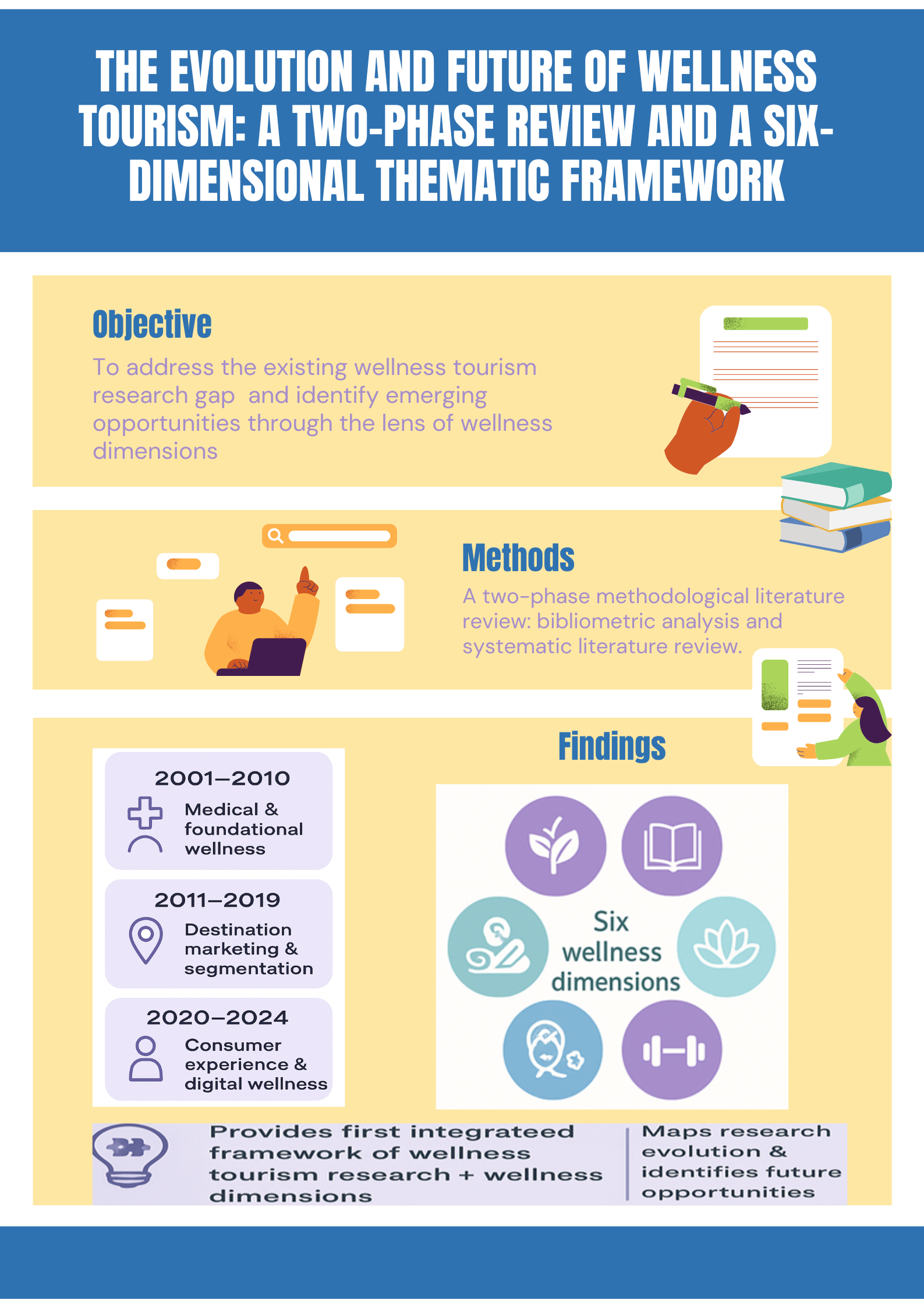
Although wellness tourism has received increasing interest from researchers and practitioners alike, the relevant research has been scattered and lacked a comprehensive understanding of its development. To fill this gap this study combines the existing research findings to track the development of wellness tourism research and explore the emerging opportunities via the perspectives of wellness dimensions. A two-phase methodological literature review combining bibliometric analysis and systematic literature review was conducted on 214 relevant Scopus-indexed articles published between 2001 and 2024. The bibliometric analysis, based on authors’ keywords, reveals three timelines in research development and evolution: an early focus on foundational and medical-based wellness concepts (2001–2010), a transition toward destination marketing and segmentation (2011–2019), and a recent emphasis on consumer experience and digital wellness (2020–2024). The systematic review identifies six wellness dimensions: nutrition and healthy eating, wellness education, mental and meditation, spa and massage, beauty and personal care, and physical fitness emerging as notably under-researched areas. This study contributes to the field by integrating wellness dimensions with wellness tourism research and offering a structured framework for future inquiry. This study focuses on wellness tourism research and its dimensions and the wellness tourism economy. Additionally, it is the only study employing a two-phase methodology focused explicitly on mapping the wellness research evolution and identifying gaps across six wellness dimensions.
Downloads
Article Details

This work is licensed under a Creative Commons Attribution-NonCommercial-NoDerivatives 4.0 International License.
All rights reserved. Apart from citations for the purposes of research, private study, or criticism and review,no part of this publication may be reproduced, stored or transmitted in any other form without prior written permission by the publisher.
References
Al-Ansi, A., Kim, S. (Sam), Xu, Y., Chen, C., Chua, B.-L., & Han, H. (2024). Wellness tourism attributes and tourist outcomes: An analysis of configurational effects. Journal of Travel Research, 64(5), 1244–1261. https://doi.org/10.1177/00472875241237262
Alemneh, A., Kebede, D. D., & Laekeslase, N. S. (2025). Exploring the dynamics of medical and wellness tourism: Services, destinations, and ethical considerations. European Journal of Tourism and Hospitality Industry Studies, 1(1), 35–46. https://oapub.org/soc/index.php/EJTHIS/article/view/1960
Ashton, A. S. (2018). Spiritual retreat tourism development in the Asia Pacific region: Investigating the impact of tourist satisfaction and intention to revisit: A Chiang Mai, Thailand case study. Asia Pacific Journal of Tourism Research, 23(11), 1098–1114. https://doi.org/10.1080/10941665.2018.1526198
Babu N, P., & Abraham, S. (2024). Exploring the conceptual structure and perspectives of religious-spiritual and wellness tourism research from the destination community: A bibliometric review. International Journal of Religious Tourism and Pilgrimage, 11(6), 142–164. https://doi.org/10.21427/bvv2-0f88
Blasche, G., deBloom, J., Chang, A., & Pichlhoefer, O. (2021). Is a meditation retreat the better vacation? Effect of retreats and vacations on fatigue, emotional well-being, and acting with awareness. PLoS ONE, 16(2), Article e0246038. https://doi.org/10.1371/journal.pone.0246038
Boonpat, O., Boonpat, S. N., Srithong, P., Chuminthachak, S., Yolthasart, S., Utchaya, N., & Saokham, M. (2023). Creating local food for health tourism by Ban Nong O community, Mae Chan district, Chiang Rai province. Kasetsart Journal of Social Sciences, 44(4), 1229–1238. https://doi.org/10.34044/j.kjss.2023.44.4.27
Campra, M., Riva, P., Oricchio, G., & Brescia, V. (2022). Bibliometrix analysis of medical tourism. Health Services Management Research, 35(3), 172–188. https://doi.org/10.1177/09514848211011738
Chang, L., Moyle, B. D., Vada, S., Filep, S., Dupre, K., & Liu, B. (2024). Re-thinking tourist wellbeing: An integrative model of affiliation with nature and social connections. International Journal of Tourism Research, 26(2), Article e2644. https://doi.org/10.1002/jtr.2644
Cohen, M. M., Elliott, F., Oates, L., Schembri, A., & Mantri, N. (2017). Do wellness tourists get well? An observational study of multiple dimensions of health and well-being after a week-long retreat. The Journal of Alternative and Complementary Medicine, 23(2), 140–148. https://doi.org/10.1089/acm.2016.0268
Dahanayake, S., Wanninayake, B., & Ranasinghe, R. (2023). Unveiling the essence: Constructs of memorable wellness tourism experiences. Tourism and Hospitality Research, 25(3), 432–446. https://doi.org/10.1177/14673584231223860
Dimitrova, B. (2025). Stress management by applying of wellness, spa and thalassotherapy - Trends in holistic well-being. HSOA Journal of Alternative, Complementary & Integrative Medicine, 11, Article 601. https://doi.org/10.24966/ACIM-7562/100601
Dini, M., & Pencarelli, T. (2022). Wellness tourism and the components of its offer system: A holistic perspective. Tourism Review, 77(2), 394–412. https://doi.org/10.1108/TR-08-2020-0373
Dunn, H. L. (1959). High-level wellness for man and society. Journal of Public Health, 49(6), 786–792. https://doi.org/10.2105/ajph.49.6.786
Farkic, J., Isailovic, G., & Taylor, S. (2021). Forest bathing as a mindful tourism practice. Annals of Tourism Research Empirical Insights, 2(2), Article 100028. https://doi.org/10.1016/j.annale.2021.100028
Field, T. (2016). Massage therapy research review. Complementary Therapies in Clinical Practice, 24, 19–31. https://doi.org/10.1016/j.ctcp.2016.04.005
Forlani, F., Dini, M., & Pencarelli, T. (2022). The importance of food and beverages in wellness experiences: A cross-continental analysis of tourists’ perceptions. British Food Journal, 124(13), 520–540. https://doi.org/10.1108/BFJ-05-2022-0430
Gawlik et al. (2024). 10 Dimensions of wellness. Northern Kentucky University. https://inside.nku.edu/studentaffairs/departments/student-wellness/dimensions.html
Giridharan, S. (2024). Residential meditation retreats: A promise of sustainable well-being? Cureus, 16(11), Article e73326. https://doi.org/10.7759/cureus.73326
Global Spa Summit. (2011). Research report: Global spa summit 2011. Wellness tourism and medical tourism: Where do spas fit? https://globalwellnessinstitute.org/wp-content/uploads/2018/06/Wellness-Tourism-and-Medical-Tourism-Report-Final.pdf
Global Wellness Institute (GWI). (2014). Global spa & wellness economy monitor. https://globalwellnessinstitute.org/wp-content/uploads/2018/06/global-spa-and-wellness-economy-monitor-2014_fix4182016.pdf
Global Wellness Institute (GWI). (2018). 2018 global wellness tourism economy. https://globalwellnessinstitute.org/industry-research/global-wellness-tourism-economy/
Global Wellness Institute (GWI). (2022). Wellness tourism. https://globalwellnessinstitute.org/what-is-wellness/what-is-wellness-tourism/
Global Wellness Institute (GWI). (2023). Global wellness economy monitor 2023. https://globalwellnessinstitute.org/wp-content/uploads/2023/11/GWI-WE-Monitor-2023_FINAL.pdf
Goyal, M., Singh, S., Sibinga, E. M. S., Gould, N. F., Rowland-Seymour, A., Sharma, R., Berger, Z., Sleicher, D., Maron, D. D., Shihab, H. M., Ranasinghe, P. D., Linn, S., Saha, S., Bass, E. B., & Haythornthwaite, J. A. (2014). Meditation programs for psychological stress and well-being: A systematic review and meta-analysis. JAMA Internal Medicine, 174(3), 357–368. http://doi.org/10.1001/jamainternmed.2013.13018
Hamułka, J., Wądołowska, L., Hoffmann, M., Kowalkowska, J., & Gutkowska, K. (2018). Effect of an education program on nutrition knowledge, attitudes toward nutrition, diet quality, lifestyle, and body composition in polish teenagers. The ABC of healthy eating project: Design, protocol, and methodology. Nutrients, 10(10), Article 1439. http://doi.org/10.3390/nu10101439
Han, H., Kiatkawsin, K., Jung, H., & Kim, W. (2017). The role of wellness spa tourism performance in building destination loyalty: The case of Thailand. Journal of Travel & Tourism Marketing, 35(5), 595–610. https://doi.org/10.1080/10548408.2017.1376031
Hattie, J. A., Myers, J. E., & Sweeney, T. J. (2004). A factor structure of wellness: Theory, assessment, analysis, and practice. Journal of Counseling & Development, 82(3), 354–364. https://doi.org/10.1002/j.1556-6678.2004.tb00321.x
Hettler, B. (1976). The six dimensions of wellness. National Wellness Center. https://cdn.ymaws.com/members.nationalwellness.org/resource/resmgr/pdfs/sixdimensionsfactsheet.pdf
Hettler, B. (1980). Wellness promotion on a university campus. Family & Community Health, 3(1), 77–95. https://doi.org/10.1097/00003727-198005000-00008
International Council on Active Aging (ICAA). (2024). Active aging and wellness. https://www.icaa.cc/activeagingandwellness/wellness.htm
Jacobs, J. (2023, February 2). 6 wellness travel trends for 2023. Pacific Prime Thailand. https://www.pacificprime.co.th/blog/6-wellness-travel-trends-for-2023/
Johnson, B., & Christensen, L. (2019). Educational research: Quantitative, qualitative, and mixed approaches. Sage.
Kaya, S. C., Sezerel, H., & Filimonau, V. (2024). How mindfulness training changes tourist experience: An exploratory study. Journal of Hospitality and Tourism Management, 59, 166–179. https://doi.org/10.1016/j.jhtm.2024.04.007
Kazakov, S., & Oyner, O. (2021). Wellness tourism: A perspective article. Tourism Review, 76(1), 58–63. https://doi.org/10.1108/TR-05-2019-0154
Lee, J., & Kim, H. (2015). Success factors of health tourism: Cases of Asian tourism cities. International Journal of Tourism Cities, 1(3), 216–233. https://doi.org/10.1108/IJTC-08-2014-0014
Liao, C., Zuo, Y., Xu, S., Law, R., & Zhang, M. (2023). Dimensions of the health benefits of wellness tourism: A review. Frontiers in Psychology, 13, Article 1071578. https://doi.org/10.3389/fpsyg.2022.1071578
Liu, L., Zhou, Y., & Sun, X. (2023). The impact of the wellness tourism experience on tourist well-being: The mediating role of tourist satisfaction. Sustainability, 15(3), Article 1872. https://doi.org/10.3390/su15031872
Liu, Y., Groot, B., de Kock, L., Abma, T., & Dedding, C. (2022). How participatory arts can contribute to Dutch older adults’ wellbeing - revisiting a taxonomy of arts interventions for people with dementia. Arts & Health, 15(2), 153–168. https://doi.org/10.1080/17533015.2022.2035417
Luo, Y., Lanlung (Luke), C., Kim, E., Tang, L. R., & Song, S. M. (2018). Towards quality of life: The effects of the wellness tourism experience. Journal of Travel & Tourism Marketing, 35(4), 410–424. https://doi.org/10.1080/10548408.2017.1358236
Majeed, S., & Gon Kim, W. (2023). Emerging trends in wellness tourism: A scoping review. Journal of Hospitality and Tourism Insights, 6(2), 853–873. https://doi.org/10.1108/JHTI-02-2022-0046
Majeed, S., Lu, C., & Javed, T. (2017). The journey from an allopathic to natural treatment approach: A scoping review of medical tourism and health systems. European Journal of Integrative Medicine, 16, 22–32. https://doi.org/10.1016/j.eujim.2017.10.001
Martins, P., de Jesus, S. N., Pocinho, M., & Pinto, P. (2025). Wellness tourism: A systematic literature review. International Journal of Spa and Wellness, 8(2), 215–245. https://doi.org/10.1080/24721735.2025.2467608
Melnyk, B. M., & Neale, S. (Eds.). (2018). 9 dimensions of wellness - Evidence-based tactics for optimizing your health and well-being. The Ohio State University. https://wellness.osu.edu/sites/default/files/documents/2021/05/9%20Dimensions%20of%20Wellness%20Digital.pdf
Minghui, R., & Guoping, L. (2014). China’s global health strategy. The Lancet, 384(9945), 719–721. https://doi.org/10.1016/S0140-6736(14)61317-9
Mohanan, M., & Shekhar, S. K. (2022). Bibliometric analysis of publications on wellness tourism. Turyzm/Tourism, 32(2), 69–86. https://doi.org/10.18778/0867-5856.32.2.04
Moriuchi, E., Agrusa, J., & Lema, J. (2024). Strategies for health and wellness tourism development: Thai massage. International Journal of Tourism Research, 26(1), Article e2622. https://doi.org/10.1002/jtr.2622
National Wellness Institute (NWI). (2020, September 24). September 2020 wellness trends. https://nwijournal.com/september-2020-wellness-trends/
Norman, A., & Pokorny, J. J. (2017). Meditation retreats: Spiritual tourism well-being interventions. Tourism Management Perspectives, 24, 201–207. https://doi.org/10.1016/j.tmp.2017.07.012
Phuthong, T., Anuntavoranich, P., Chandrachai, A., & Piromsopa, K. (2023). A framework for assessing wellness tourism destination competitiveness: A perspective from the wellness tourism clusters in Thailand. GeoJournal of Tourism and Geosites, 49(3), 973–987. https://doi.org/10.30892/gtg.49313-1097
Polat, E., & Koseoglu, M. A. (2023). Wellness tourism scholarship: A research agenda. Journal of Hospitality and Tourism Insights, 6(5), 1860–1889. https://doi.org/10.1108/JHTI-05-2022-0186
Praprom, C., & Laipaporn, J. (2023). Betong: A potential wellness tourism destination in the deep south of Thailand. GeoJournal of Tourism & Geosites, 46(1), 55–62. https://doi.org/10.30892/gtg.46106-1000
Roddick, M. L. (2016, May 27). The 8 dimensions of wellness: Where do you fit in? GoodTherapy. https://www.goodtherapy.org/blog/8-dimensions-of-wellness-where-do-you-fit-in-0527164
Sangpikul, A. (2023). Understanding a conceptual framework of spa service quality: An overview approach. Academica Turistica-Tourism and Innovation Journal, 16(3), 277–289. https://academica.turistica.si/index.php/AT-TIJ/article/view/567
Sayyad, F. Z. (2025). Examining the impact of mindful travel on stress reduction and mental well-being. In A. E. J. Ruiz, V. Rudkouskaya, Z. Landeta-Bejarano, & S. Bhartiya (Eds.), Promoting sustainability in psychosocial travel techniques (pp. 137–154). IGI Global.
Simon, R. (2013, July 10). Kathryn Stolle - The 12 dimensions of wellness. Rotary Club of Victoria-Harbourside. https://www.harboursiderotary.org/stories/kathryn-stolle-the-12-dimensions-of-wellness#:~:text=The%20continuum%20includes%3A%201)%20Self,Finding%20Meaning%3B%2012)%20Transcending
Smith, M. K. (2021). Creating wellness tourism experiences. In R. Sharpley (Ed.), Routledge handbook of the tourist experience, Chapter 26 (pp. 364–377). Routledge.
Smith, M. K., Jancsik, A., & Puczkó, L. (2020). Customer satisfaction in post-socialist Spas: A case study of Budapest, City of Spas. International Journal of Spa and Wellness, 3(2–3), 165–186. https://doi.org/10.1080/24721735.2020.1866330
Smith, M., & Puczkó, L. (2014). Health, tourism and hospitality: Spas, wellness and medical travel (2nd ed.). Routledge. https://doi.org/10.4324/9780203083772
Smith, M., & Puczkó, L. (2015). More than a special interest: Defining and determining the demand for health tourism. Tourism Recreation Research, 40(2), 205–219. https://doi.org/10.1080/02508281.2015.1045364
Sthapit, E., Ji, C., Li, M., Garrod, B., Ibrahim, B., & Björk, P. (2025). Memorable wellness tourism experiences: Antecedents that lead to enjoyable outcomes. International Journal of Spa and Wellness, 8(2), 155–181. https://doi.org/10.1080/24721735.2025.2473124
Stoewen, D. L. (2017). Dimensions of wellness: Change your habits, change your life. The Canadian Veterinary Journal, 58(8), 861–862.
United Nations World Tourism Organization (UNWTO) & European Travel Commission (ETC). (2018). Exploring health tourism. https://doi.org/10.18111/9789284420209
Wang, C., Chen, J., Wang, Y., Xu, W., Xie, M., Wu, Y., & Hu, R. (2021). Effects of family participatory dignity therapy on the psychological well-being and family function of patients with haematologic malignancies and their family caregivers: A randomised controlled trial. International Journal of Nursing Studies, 118, Article 103922. https://doi.org/10.1016/j.ijnurstu.2021.103922
Wooll, M. (2021, June 17). Understanding health and well-being & 10 ways to improve both. BetterUp. https://www.betterup.com/blog/health-and-well-being
World Health Organization (WHO). (2024). About WHO. https://www.who.int/about
Yang, Z. (2025). Linking emotions to strength: Impact of tourism emotional experience on college students’ psychological resilience. BMC Psychology, 13(1), Article 1360. https://doi.org/10.1186/s40359-025-03646-4
Yip, W., Fu, H., Chen, A. T., Zhai, T., Jian, W., Xu, R., Pan, J., Hu, M., Zhou, Z., Chen, Q., Mao, W., Sun, Q., & Chen, W. (2019). 10 years of health-care reform in China: Progress and gaps in Universal Health Coverage. The Lancet, 394(10204), 1192–1204. https://doi.org/10.1016/S0140-6736(19)32136-1
Zendell, A. (2023, August 14). The seven dimensions of wellness: Moving toward a feasible and well-rounded wellness plan. Excelsior University. https://www.excelsior.edu/article/seven-dimensions-of-wellness/
Zhang, M., Murphy, B., Cabanilla, A., & Yidi, C. (2021). Physical relaxation for occupational stress in healthcare workers: A systematic review and network meta-analysis of randomized controlled trials. Journal of Occupational Health, 63(1), Article e12243. https://doi.org/10.1002/1348-9585.12243
Zhong, L., Deng, B., Morrison, A. M., Coca-Stefaniak, J. A., & Yang, L. (2021). Medical, health and wellness tourism research—A review of the literature (1970–2020) and research agenda. International Journal of Environmental Research and Public Health, 18(20), Article 10875. https://doi.org/10.3390/ijerph182010875
