
The development of an instructional model based on research-based learning and argumentation approaches to enhance critical thinking skills for undergraduate students
Article Sidebar
Main Article Content
Abstract
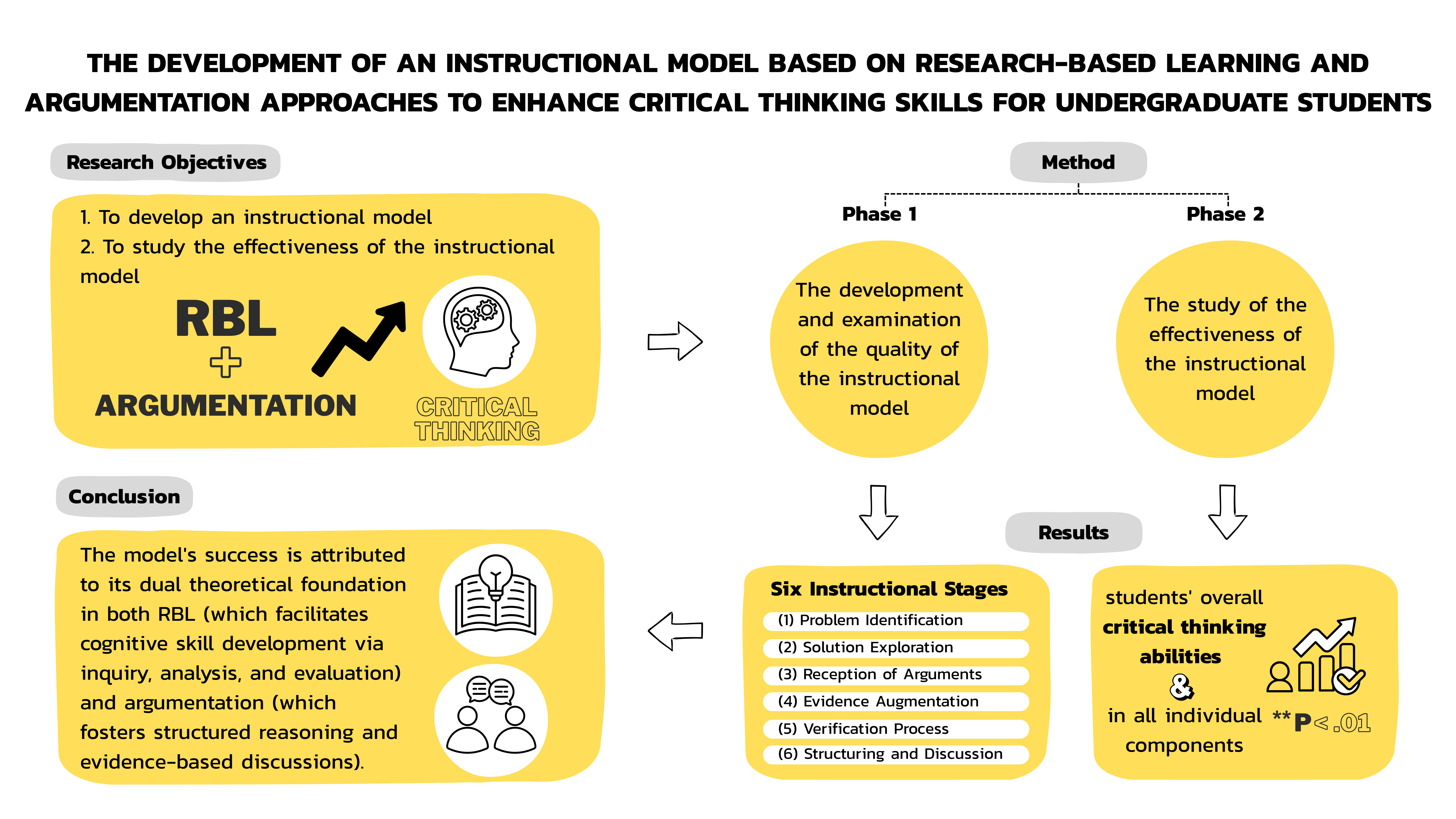
This study aimed to develop and evaluate the effectiveness of an instructional model integrating research-based learning and argumentation approaches to enhance critical thinking skills among undergraduate students. The research process consisted of two phases: (1) developing the instructional model and (2) studying its effectiveness. The target group consisted of 18 undergraduate students from a private higher education institution in Thailand, selected via purposive sampling. Data were analyzed using content and descriptive analyses. The findings indicated that the developed instructional model included four main components: (1) objectives, (2) principles, (3) instructional procedures, and (4) assessment and evaluation guidelines. The instructional procedures were organized into six stages: (1) problem identification, (2) solution exploration, (3) reception of arguments, (4) evidence augmentation, (5) verification process, and (6) structuring and discussion. The effectiveness study revealed a significant improvement in students’ critical thinking skills after participating in the instructional model, with a significance level of .01. These results underscore the potential of integrating research-based learning and argumentation approaches to enhance critical thinking among undergraduate students.
Downloads
Article Details

This work is licensed under a Creative Commons Attribution-NonCommercial-NoDerivatives 4.0 International License.
All rights reserved. Apart from citations for the purposes of research, private study, or criticism and review,no part of this publication may be reproduced, stored or transmitted in any other form without prior written permission by the publisher.
References
Andriessen, J. (2006). Arguing to learn. In K. Sawyer (Ed.), The Cambridge handbook of the learning sciences (pp. 443–460). Cambridge University Press.
Arora, V. P. S., Saxena, P., Gangwar, N., & Manna, M. S. (2017). Project based learning (PBL) and research based learning. Higher education faculty career orientation and advancement: Curriculum based on primary research, 76–91.
Baskoro, G. (2023). From VUCA to BANI: A challenge of strategic environment for higher education in Indonesia. In G. W. Bhawika, G. A. Handiwibowo, N. Nareswari, & M. F. Sugihartanto (Eds.), Advances in Economics, Business and Management Research: Proceedings of the 3rd International Conference on Business and Engineering Management (ICONBEM 2022) (pp. 229–235). Atlantis Press. https://doi.org/10.2991/978-94-6463-216-3_18
Brew, A. (2006). Research and teaching: Beyond the divide. Palgrave Macmillan.
Cropley, A. (2006). In praise of convergent thinking. Creativity Research Journal, 18(3), 391–404.
Dafik, D., Sucianto, B., Irvan, M., & Rohim, M. A. (2019). The analysis of student metacognition skill in solving rainbow connection problem under the implementation of research-based learning model. International Journal of Instruction, 12(4), 593–610. https://doi.org/10.29333/iji.2019.12438a
Dewey, J. (1910). How we think. D.C. Heath.
Dressel, P. L., & Mayhew, L. B. (1957). General education: Exploration in evaluation. American Council on Education.
Ennis, R. (1997). Incorporating critical thinking in the curriculum: An introduction to some basic issues. Inquiry: Critical Thinking Across the Disciplines, 16(3), 1–9. https://www.pdcnet.org/collection/fshow?id=inquiryct_1997_0016_0003_0001_0009&pdfname=inquiryct_1997_0016_0003_0001_0009.pdf&file_type=pdf
Facione, P. A. (1990). Critical thinking: A statement of expert consensus for purposes of educational assessment and instruction. The Delphi Report. https://philarchive.org/archive/faccta
Guilford, J. P. (1967). The nature of human intelligence. McGraw-Hill.
Halpern, D. F. (2013). Thought and knowledge: An introduction to critical thinking. Psychology Press.
Healey, M., & Jenkins, A. (2009). Developing undergraduate research and inquiry. The Higher Education Academy.
Jeeravipoolvarn, V. (2020). Argumentation and science education. Udon Thani Rajabhat University Academic Journal, 8(1), 1–25. [in Thai]
Jiménez-Aleixandre, M. P., & Erduran, S. (2007). Argumentation in science education: An overview. In S. Erduran & M. P. Jiménez-Aleixandre (Eds.), Argumentation in science education: Perspectives from classroom-based research (pp. 3–27). Springer.
Jiracheewewong, E. (2023). Tools for transforming from VUCA World to BANI World: A case of educational sector in Thailand. STOU Education Journal, 16(2), 1–12.
Johnson, D. W., & Johnson, R. T. (1989). Cooperation and competition: Theory and research. Interaction Book Company.
Kuhn, D. (1991). The skills of argument. Cambridge University Press.
Kusuma, P. G., & Sarma, K. S. R. (2023). Skill… Skill… Which skill do I acquire?---Skills requirement for the BANI environment---. Shanlax International Journal of Management, 11(2), 53–58.
Levy, P., & Petrulis, R. (2012). How do first-year university students experience inquiry and research, and what are the implications for the practice of inquiry-based learning? Studies in Higher Education, 37(1), 85–101.
Luanganggoon, N. (2012). How to link teaching and research to enhance students’ learning outcomes: Thai university experience. Procedia - Social and Behavioral Sciences, 69, 213–219. https://doi.org/10.1016/j.sbspro.2012.11.401
Menaria, N. (2024). Comparative analysis of VUCA and BANI frameworks. International Journal for Multidisciplinary Research, 6(2), Article IJFMR240215715. https://doi.org/10.36948/ijfmr.2024.v06i02.15715
Mercer, N., & Howe, C. (2012). Explaining the dialogic processes of teaching and learning: The value and potential of sociocultural theory. Learning, Culture and Social Interaction, 1(1), 12–21.
Nekamanurak, P. (1994). The development of critical thinking developing model for teachers college students [Doctoral dissertation, Chulalongkorn University]. Chula DigiVerse. https://digiverse.chula.ac.th/Info/item/dc:63441 [in Thai]
Nussbaum, E. M. (2005). The effect of goal instructions and need for cognition on interactive argumentation. Contemporary Educational Psychology, 30(3), 286–313. https://doi.org/10.1016/j.cedpsych.2004.11.002
Office of the National Education Commission. (1997). Thinking and teaching for thinking process development: Learning prototype in theoretical principles and practices. Teaching and Learning Development Project, Office of the National Education Commission. [in Thai]
Osborne, J. (2010). Arguing to learn in science: The role of collaborative, critical discourse. Science, 328(5977), 463–466.
Paul, R., & Elder, L. (1992). Critical thinking: What, why, and how. New Directions for Community Colleges, 77(2), 3–24. https://web.iitd.ac.in/~nkurur/2014-15/IIsem/cyl565/CriticalThinking.pdf
Paul, R., & Elder, L. (2014). Critical thinking: Tools for taking charge of your learning and your life (3rd ed.). Pearson Education.
Runco, M. A. (2014). Creativity: Theories and themes: Research, development, and practice. Academic Press.
Sota, C., & Peltzer, K. (2017). The effectiveness of research based learning among master degree student for health promotion and preventable disease, Faculty of Public Health, Khon Kaen University, Thailand. Procedia - Social and Behavioral Sciences, 237, 1359–1365. https://doi.org/10.1016/j.sbspro.2017.02.226
Susiani, T. S., Salimi, M., & Hidayah, R. (2018). Research based learning (RBL): How to improve critical thinking skills? SHS Web of Conferences, 42, Article 00042. https://doi.org/10.1051/shsconf/20184200042
Thampi, K. P. P. S., Ponathong, C., & Yongsorn, C. (2024). Critical thinking skills and dispositions: Perceptions of higher education students in Thailand. Journal of Education and Innovation, 26(3), 153–167.
Toulmin, S. E. (2003). The uses of argument. Cambridge University Press.
Watson, G., & Glaser, E. M. (1964). Watson-Glaser critical thinking appraisal manual. Harcourt, Brace and World.
Yaemkhayai, C. (2023). Development of instructional model based on engineering design process principles and 360-degree feedback approaches to enhance creative problem-solving abilities of pre-service teachers. URU Journal of Integrated Sciences for Development, 13(2), Article URU–J.ISD 267152. [in Thai]
