
Effectiveness of using an electronic audiobook for the pronunciation of Korean vowels, consonants, and final sounds to improve the pronunciation skills of Thai teachers
Article Sidebar
Main Article Content
Abstract
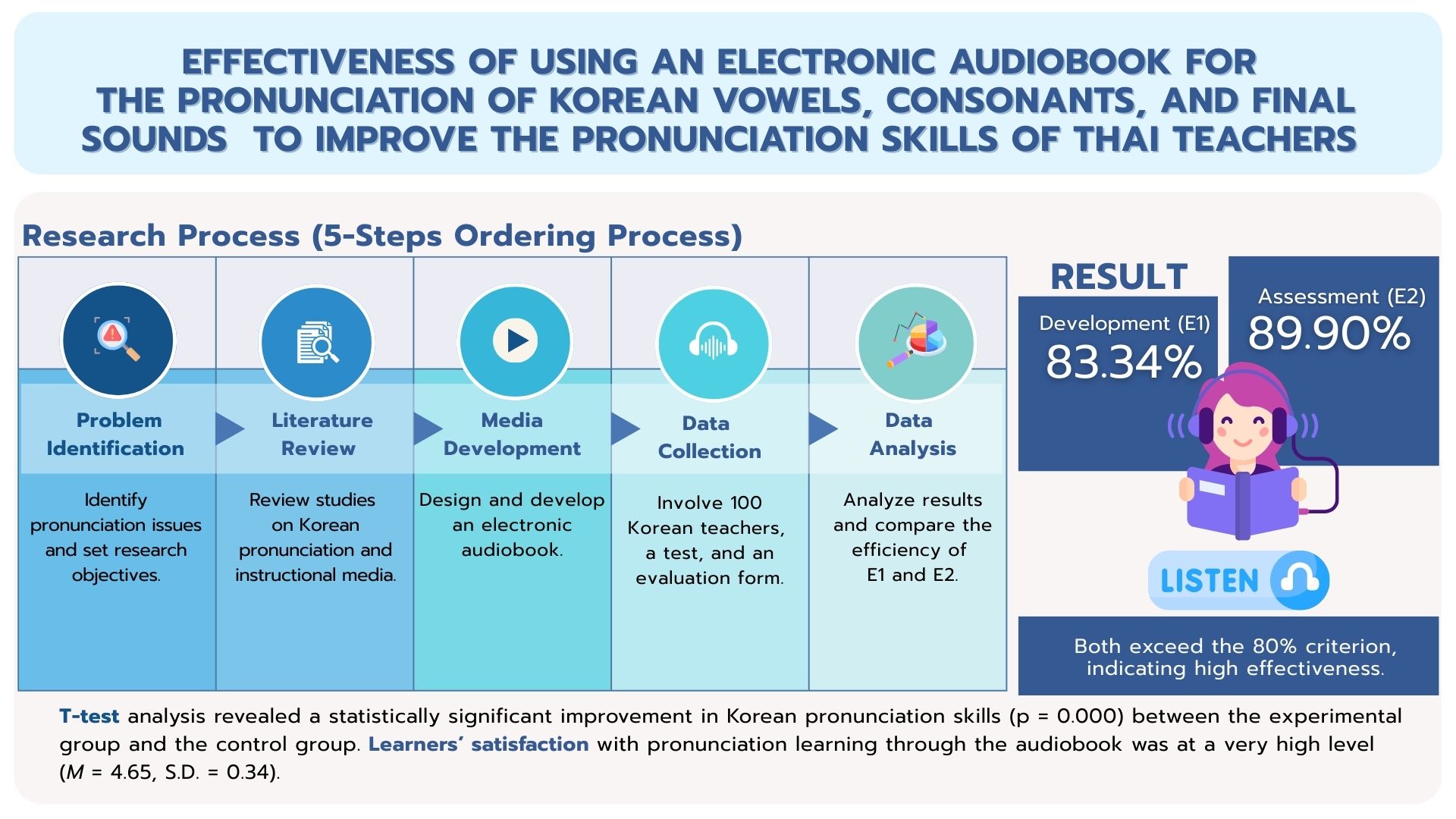
This research aims to: 1) develop an electronic audiobook on the pronunciation of Korean vowels, consonants, and final sounds; 2) compare the effectiveness of the electronic audiobook among Thai teachers; and 3) assess the Thai teachers’ satisfaction with the use of the electronic audiobook. The sample group consists of 100 teachers who teach Korean in schools under the Office of the Basic Education Commission (OBEC). The research tools used are: 1) the electronic audiobook; 2) the quality assessment form for the electronic audiobook; 3) the achievement assessment form using the electronic audiobook; and 4) the satisfaction assessment form for learning through the electronic audiobook. Data were analyzed using percentages, means, standard deviations, t-tests, and E1/E2 efficiency measures. The research results are as follows: 1) The quality of the electronic audiobooks, as evaluated by experts, is at a good level, with an average score of 4.47 and a standard deviation of 0.57. The developed electronic audiobook has an E1/E2 efficiency score that meets the criterion of an average of 80%, with scores of 83.34/89.90. 2) the results showed that using an electronic audiobook on the pronunciation of Korean vowels, consonants, and final sounds is effective in improving Korean pronunciation skills as evidenced by the highly significant difference (p = 0.000) between the scores of post-tests of the control group and experimental group using t-test. 3). The evaluation of satisfaction with learning pronunciation skills via the electronic audio-book was at the highest level, with an average score of 4.65 and a standard deviation of 0.34.
Downloads
Article Details

This work is licensed under a Creative Commons Attribution-NonCommercial-NoDerivatives 4.0 International License.
All rights reserved. Apart from citations for the purposes of research, private study, or criticism and review,no part of this publication may be reproduced, stored or transmitted in any other form without prior written permission by the publisher.
References
Almekhlafi, A. G. (2021). The effect of E-books on preservice student teachers’ achievement and perceptions in the United Arab Emirates. Education and Information Technologies, 26(1), 1001–1021. https://doi.org/10.1007/s10639-020-10298-x
Boonmalerd, K. (2013). A study on Korean pronunciation teaching for Thai learners – focused on final consonant [Master’s thesis, Keimyung University]. https://m.riss.kr/link?id=T13091165 [in Korean]
Clinton-Lisell, V., Seipel, B., Gilpin, S., & Litzinger, C. (2021). Interactive features of E-texts’ effects on learning: A systematic review and meta-analysis. Interactive Learning Environments, 31(6), 3728–3743. https://doi.org/10.1080/10494820.2021.1943453
Connor, C. M., Day, S. L., Zargar, E., Wood, T. S., Taylor, K. S., Jones, M. R., & Hwang, J. K. (2019). Building word knowledge, learning strategies, and metacognition with the Word-Knowledge e-Book. Computers & Education, 128, 284–311. https://doi.org/10.1016/j.compedu.2018.09.016
Deok Kyu, M. (2019). A study on analysis about Thai students’ mispronunciation of Korean and the method for teaching Korean pronunciation to Thai students [Master’s thesis, Inha University]. https://m.riss.kr/link?id=T15096374 [in Korean]
Hismanoglu, M. (2012). Teaching word stress to Turkish EFL (English as a foreign language) learners through internet-based video lessons. US-China Education Review, 26–40. https://files.eric.ed.gov/fulltext/ED530678.pdf
Hismanoglu, M., & Hismanoglu, S. (2011). Internet-based pronunciation teaching: An innovative route toward rehabilitating Turkish EFL articulation problems. European Journal of Educational Studies, 3(1), 23–36.
Joo, Y. J., Park, S. Y., & Shin, E. K. (2017). Students’ expectation, satisfaction, and continuance intention to use digital textbooks. Computers in Human Behavior, 69(2), 83–90. https://doi.org/10.1016/j.chb.2016.12.025
Kamonjiranuwat, C. (2014). A study of Korean diphthong pronunciation by Thai learners: Focused on the beginner learners [Master’s thesis, Hankuk University of Foreign Studies]. https://shorturl.asia/TcLIS
Koheng, B. (2015). A study of Korean pronunciation education for Thai learners – defined through obstruent perception and phoneme fluctuation [Master’s thesis, Kyung Hee University]. https://m.riss.kr/link?id=T13845782 [in Korean]
Mizher, R. A., & Alwreikat, A. A. (2023). EFL students’ use of E-books for e-learning: Applying technology acceptance model (TAM). Journal of Language Teaching and Research, 14(1), 153–162. https://doi.org/10.17507/jltr.1401.16
Mohsen, M. A., & Almudawis, S. (2021). Second language vocabulary gains from listening versus reading comprehension input: A comparative study. Journal of Psycholinguistic Research, 50(3), 543–562. https://doi.org/10.1007/s10936-020-09690-y
Mueangkaew, S., & Aphiratvoradej, K. (2018). Development of electronic book (E-book) on neighboring countries language and culture course for first year students in Bansomdejchaopraya Rajabhat University. CMU Journal of Education, 2(1), 18–32. https://so01.tci-thaijo.org/index.php/cmujedu/article/view/167043 [in Thai]
Na Sulong, W., Sukkanit, A., & Sermsuk, K. (2018). The current use, needs, and satisfaction in the use of open online learning resources for general education courses at Rajamangala University of Technology Srivijaya [Research report]. Rajamangala University of Technology Srivijaya. [in Thai]
Rizal, D., Masruroh, S., Rahman Syah, R. F., Fathina, I. F., Amrullah, M. F., & Zakariyah, S. (2022). Audiobooks as media to increase listening and speaking skills: A qualitative systematic review. ETERNAL (English, Teaching, Learning, and Research Journal), 8(1), 200–216. https://doi.org/10.24252/Eternal.V81.2022.A14
Ru, M. Y. (2011). A study of Korean vowels pronunciation errors by Thai learners – Focus on the first step learners [Master’s thesis, Kyung Hee University]. https://khu.dcollection.net/public_resource/pdf/200000062573_20251201222841.pdf [in Korean]
Supsin, S. (2012). A study on teaching method of Korean pronunciation for Thai learners [Master’s thesis, Yonsei University]. https://dcollection.yonsei.ac.kr/public_resource/pdf/000000131908_20251201224259.pdf [in Korean]
Tang, K. Y. (2021). Paradigm shifts in E-book-supported learning: Evidence from the Web of Science using a co-citation network analysis with an education focus (2010–2019). Computers & Education, 175, Article 104323. https://doi.org/10.1016/j.compedu.2021.104323
Vorobel, O. (2022). A systematic review of research on distance language teaching (2011–2020): Focus on methodology. System, 105, Article 102753. https://doi.org/10.1016/j.system.2022.102753
Woo, A. R. (2020). A study on the Korean pronunciation education method for Thai learner [Master’s thesis, Kyungpook National University]. http://www.riss.kr/link?id=T15655442&outLink=K [in Korean]
Wood, C., Fitton, L., Petscher, Y., Rodriguez, E., Sunderman, G., & Lim, T. (2018). The effect of e-book vocabulary instruction on Spanish–English speaking children. Journal of Speech, Language, and Hearing Research, 61(8), 1945–1969. https://doi.org/10.1044/2018_JSLHR-L-17-0368
Xodabande, I., & Hashemi, M. R. (2023). Learning English with electronic textbooks on mobile devices: Impacts on university students’ vocabulary development. Education and Information Technologies, 28(2), 1587–1611. https://doi.org/10.1007/s10639-022-11230-1
