
Incubating creative skills for learning the Urak Lawoi ethnic group’s music culture
Article Sidebar
Main Article Content
Abstract
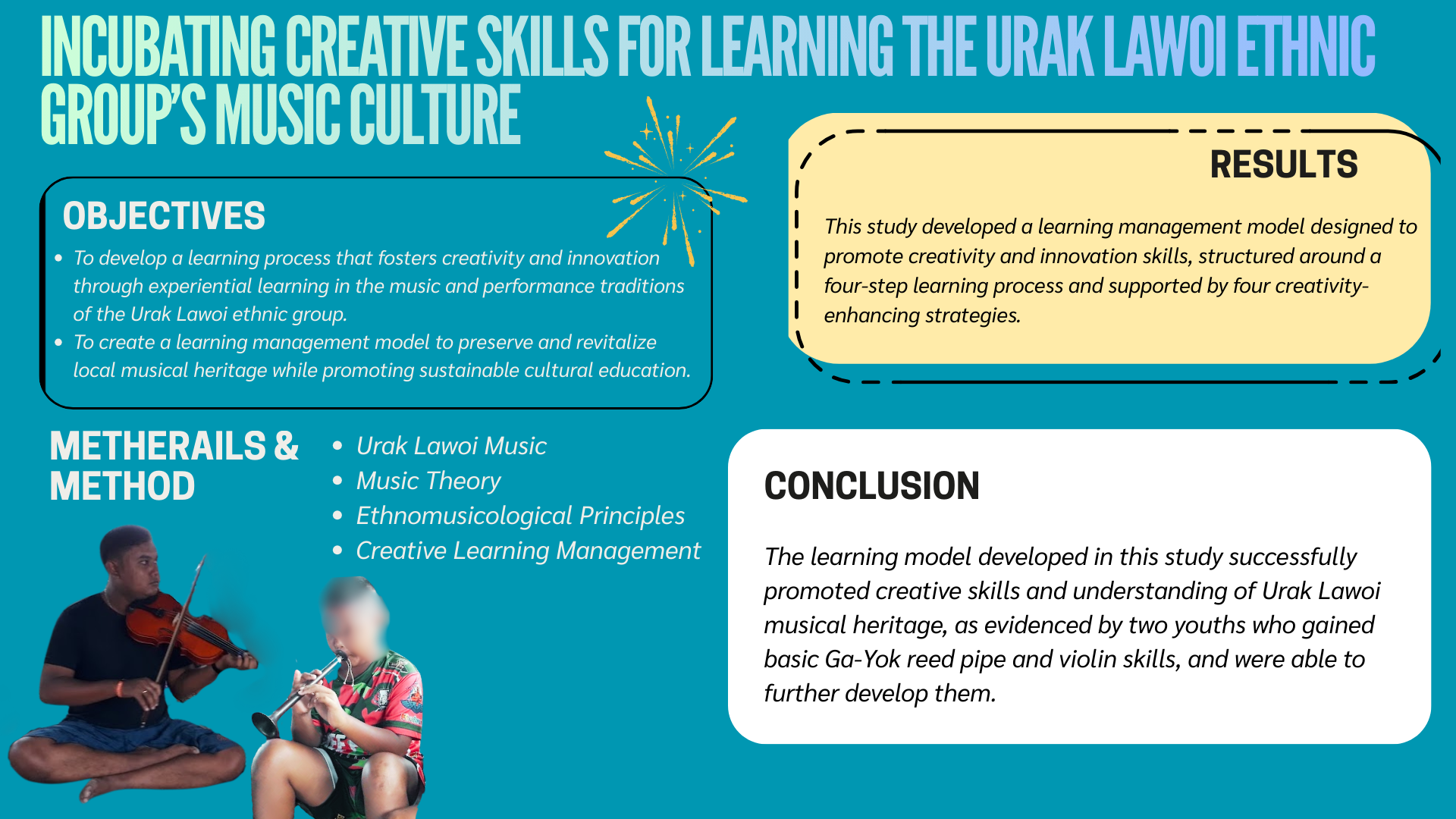
This research aimed to develop a learning process that fosters creativity and innovation through experiential learning in the music and performance traditions of the Urak Lawoi ethnic group. Adopting a qualitative approach integrated with action research, the study engaged knowledge holders and youth representatives in co-creating a learning management model centered on local music and folk performance. Participants included Urak Lawoi children and youth interested in traditional music, along with cultural practitioners. Data were collected through interviews, observations, and document analysis. The findings reveal that creative and innovative skill development can be effectively promoted through four stages of learning management: (1) identifying knowledge transmitters and youth participants, (2) preparing musical instruments, (3) creating experiential learning activities in music and performance culture, and (4) cultivating performance experience. These steps were supported by four creativity development strategies: (1) individual knowledge acquisition, (2) raising awareness of community music culture, (3) facilitating collaborative brainstorming, and (4) co-creating artistic outputs. As a result, two youth participants acquired foundational skills in playing the Ga-Yok reed pipe and violin, forming a basis for enhanced creative thinking and a deeper understanding of Urak Lawoi musical heritage. Furthermore, this learning model aligns with the United Nations’ Sustainable Development Goals (SDGs), specifically supporting Quality Education (SDG 4) and the preservation of cultural heritage within Sustainable Cities and Communities (SDG 11).
Downloads
Article Details

This work is licensed under a Creative Commons Attribution-NonCommercial-NoDerivatives 4.0 International License.
All rights reserved. Apart from citations for the purposes of research, private study, or criticism and review,no part of this publication may be reproduced, stored or transmitted in any other form without prior written permission by the publisher.
References
Andaman Pilot Project. (2008). Background information of Surin islands and Moken. http://www.andaman.cusri.chula.ac.th [in Thai]
Arunotai, N. (2003). Indigenous people and conservation parks: The Surin islands project. Social Research Institute. [in Thai]
Choeychuenjit, S. (2008). Tsunami impact: The world of Morgan, Morglan and Urak Lawoi Sea Gypsies after the Waves. Heinrich Böll Foundation.
Granbom, A. C. (2005). Urak Lawoi: A field study of an indigenous people in Thailand and their problems with rapid tourist development. Lunds University.
Hope, S. (2001). Outcasts of the islands: The sea gypsies of South East Asia. HarperCollins.
Office of the Education Council of Thailand. (2007). Learning management to promote creativity. Office of the Education Council.
Susaoraj, P. (2013). Development of thinking. 9119 Technic Printing. [in Thai]
Ungpho, R. (2013). The Pi Ga-Yhong - A musical instrument used in Urak Lawoi martial arts. In G. Jähnichen (Ed.), Studia Insrumentorum Musicae Popularis III (pp. 377–386). MV-Verlag.
Ungpho, R. (2014). Urak Lawoi sea gypsy music culture in Bulon archipelago, Satun province. Prince of Songkla University. [in Thai]
Wongbusarakam, S. (2007). The Urak Lawoi of the Adang archipelago, Thailand. Themma Group.
