
Synergizing the academic credit bank system and the Thai national digital learning massive open online course platform for lifelong learning: A data-mining approach
Article Sidebar
Main Article Content
Abstract
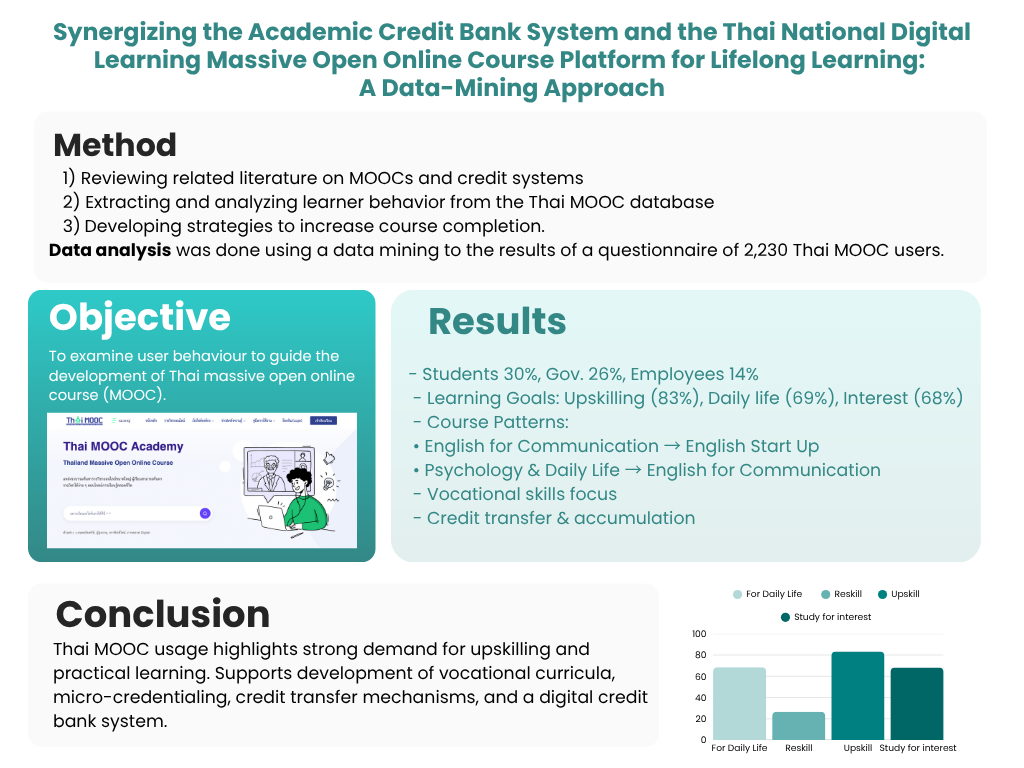
This study analyzes user behavior to support the development of Thai massive open online course (MOOC) in Thailand. Data analysis was conducted using data-mining techniques on questionnaire responses from 2,230 users. The study obtained the following results. Analysis of learners’ basic information and course trends derived from MOOC courses reveal that more than 250 students design a micro credit and alternative credit system, including a credit bank system. In terms of user interface, the results underscore the formats of contents, activities, and learning styles. Lastly, analysis of basic data on the Thai MOOC digital learning platform indicates that further development of the academic credit bank system is required. The study identified the need for a curriculum that focuses on vocational skills to develop work competencies, the accumulation and transfer of credits between universities, and recognition of previous credits and certificates to pursue a master’s degree. Thai MOOC users were mainly composed of students (30.04%), government officials (25.65%), and private employees (14.44%). In general, learners sought to upskill (83.41%), apply learning to daily life (68.57%), and conduct interest-based study (68.21%). We observed two patterns of registration in three consecutive courses, namely, (1) Personality, Psychology, and Adjustment; Startup: Pushing your Dream; and Consumer Behavior and Retailing Business in the Digital Age and (2) Startup: Pushing your Dream; Online Store Entrepreneur; and Consumer Behavior and Retail Business in the Digital Era. The top three patterns of registration in two consecutive courses included: (1) English for Communication and English Start Up, (2) English for Communication and Easy English for Everyday Life, and (3) Psychology and Daily Life and English for Communication.
Downloads
Article Details

This work is licensed under a Creative Commons Attribution-NonCommercial-NoDerivatives 4.0 International License.
All rights reserved. Apart from citations for the purposes of research, private study, or criticism and review,no part of this publication may be reproduced, stored or transmitted in any other form without prior written permission by the publisher.
References
Albelbisi, N., Yusop, F. D., & Salleh, U. K. M. (2018). Mapping the factors influencing success of massive open online courses (MOOC) in higher education. Eurasia Journal of Mathematics, Science and Technology Education, 14(7), 2995–3012. https://doi.org/10.29333/ejmste/91486
Chen, C., Sonnert, G., Sadler, P. M., Sasselov, D. D., Fredericks, C., & Malan, D. J. (2020). Going over the cliff: MOOC dropout behavior at chapter transition. Distance Education, 41(1), 6–25. https://doi.org/10.1080/01587919.2020.1724772
Choi, S.-D. (2007). Country background report OECD thematic review on recognition of non-formal and informal learning. OECD. www.oecd.org/edu/recognition
Chunwijitra, S., Khanti, P., Suntiwichaya, S., Krairaksa, K., Tummarattananont, P., Buranarach, M., & Wutiwiwatchai, C. (2020). Development of MOOC service framework for life long learning: A case study of Thai MOOC. IEICE Transactions on Information and Systems, E103.D(5), 1078–1087. https://doi.org/10.1587/transinf.2019EDP7262
Dhir, A., & Alsumait, A. (2013). Examining the educational user interface, technology and pedagogy for Arabic speaking children in Kuwait. Journal of Universal Computer Science, 19(7), 1003–1022. https://doi.org/10.3217/jucs-019-07-1003
European Commission. (2020). Cash for development? The use of microcredits and cash transfers as development tools. https://www.europarl.europa.eu/RegData/etudes/STUD/2020/653624/EXPO_STU(2020)653624_EN.pdf
Faghih, B., Azadehfar, M. R., & Katebi, S. D. (2013). User interface design for E-learning software. The International Journal of Soft Computing and Software Engineering, 3(3), 786–794. https://doi.org/10.7321/jscse.v3.n3.119
González, J. A. C., & Morales, L. D. G. (2019). Factors that adults attribute for finishing a xMOOC on energy sustainability. In M. Á. C. González & F. J. R. Sedano (Eds.), Proceedings of the Seventh International Conference on Technological Ecosystems for Enhancing Multiculturality (pp. 751–755). Association for Computing Machinery. https://doi.org/10.1145/3362789.3362889
Heppner, A., Pawar, A., Kivi, D., & Mago, V. (2019). Automating articulation: Applying natural language processing to post-secondary credit transfer. IEEE Access, 7, 48295–48306. https://doi.org/10.1109/ACCESS.2019.2910145
Horsley, T., Moreau, K., Lockyer, J., Zeiter, J., Varpio, L., & Campbell, C. (2016). More than reducing complexity: Canadian specialists’ views of the royal college’s maintenance of certification framework and program. Journal of Continuing Education in the Health Professions, 36(3), 157–163. https://doi.org/10.1097/CEH.0000000000000099
Kahan, T., Soffer, T., & Nachmias, R. (2017). Types of participant behavior in a massive open online course. The International Review of Research in Open and Distributed Learning, 18(6), 1–18. https://doi.org/10.19173/irrodl.v18i6.3087
Kao-Iean, S., & Koraneekij, P. (2020). Guidelines for developing Thailand’s massive open online course (Thai MOOC) in accordance with learners’ needs: Max-diff analysis. Thailand Cyber University.
Kim, J., Park, H., Kwon, I. T., & Yu, P. S. (2014, June 4–7). Critical review of credit bank system in South Korea: A new mediator for lifelong learning? [Paper presentation]. Adult Education Research Conference. Harrisburg, PA, United States of America. https://newprairiepress.org/aerc/2014/papers/40/
Kim, Y., & Yun, K. (2017). Persistence of college students in the South Korean academic credit bank system. New Directions for Community Colleges, 2017(177), 2 851–60. https://doi.org/10.1002/cc.20241
Kopylova, N. (2023). Technologies for higher education digitalization. In D. Bylieva & A. Nordmann (Eds.), Technologies in a multilingual environment. PCSF 2022. Lecture notes in networks and systems, vol 636 (pp. 402–412). Springer. https://doi.org/10.1007/978-3-031-26783-3_33
Korableva, O., Durand, T., Kalimullina, O., & Stepanova, I. (2019). Usability testing of MOOC: Identifying user interface problems. In J. Filipe, M. Smialek, A. Brodsky, & S. Hammoudi (Eds.), Proceedings of the 21st International Conference on Enterprise Information Systems - Volume 2: ICEIS (pp. 468–475). SciTePress. https://dx.doi.org/10.5220/0007800004680475
KoraneekiJ, P., & Kao-Iean, S. (2020). Guidelines to increase course completion rates for users in massive open online course (Thai MOOC): Data mining analysis. Thailand Cyber University.
Langseth, I., Jacobsen, D. Y., & Haugsbakken, H. (2023). The role of support units in digital transformation: How institutional entrepreneurs build capacity for online learning in higher education. Technology, Knowledge and Learning, 28(4), 1745–1782. https://doi.org/10.1007/s10758-022-09620-y
Lemay, D. J., & Doleck, T. (2020). Grade prediction of weekly assignments in MOOCS: Mining video-viewing behavior. Education and Information Technologies, 25(2), 1333–1342. https://doi.org/10.1007/s10639-019-10022-4
Lim, C. L., Nair, P. K., Keppell, M. J., Hassan, N., & Ayub, E. (2018). Developing a framework for the university-wide implementation of micro-credentials and digital badges: A case study from a Malaysian Private University. In P. Huang (Ed.), Proceedings of 2018 IEEE 4th International Conference on Computer and Communications (ICCC) (pp. 1715–1719). IEEE. https://doi.org/10.1109/CompComm.2018.8780706
Lu, M., Tamura, K., Okamoto, T., Oi, M., Shimada, A., Hatano, K., Yamada, M., & Konomi, S. (2019). Proposal and implementation of an elderly-oriented user interface for learning support systems. In Proceedings of the Sixth (2019) ACM Conference on Learning @ Scale (pp. 1–4). Association for Computing Machinery. https://doi.org/10.1145/3330430.3333650
Malaysian Qualifications Agency. (2019). Guideline on micro-credential. http://mdps.upm.edu.my/wp-content/uploads/2019/07/Guideline-on-Micro-credential-10-Mei.pdf
Murthy, S., Warriem, J. M., Sahasrabudhe, S., & Iyer, S. (2018). LCM: A model for planning, designing and conducting learner-centric MOOCs. In V. Kumar, S. Murthy, Kinshuk, & S. Iyer (Eds.), Proceedings – 2018 IEEE Ninth International Conference on Technology for Education (T4E) (pp. 73–76). IEEE. https://doi.org/10.1109/T4E.2018.00022
Nuffic. (2016). Education system South Korea. https://www.nuffic.nl/en/education-systems/south-korea
Office of the Education Council. (2020). Credit bank system and driving mechanism: Links between higher education and labor/business sector. Prikwarn Graphic. [in Thai]
Office of the Education Council. (2021). Guidelines for promoting learning linked to national digital learning platforms for Thailand. Prikwarn Graphic. https://backoffice.onec.go.th/uploads/Book/1921-file.pdf [in Thai]
Oppermann, R. (2002). User-interface design. In H. H. Adelsberger, B. Collis, & J. M. Pawlowski (Eds.), Handbook on information technologies for education and training (pp. 233–248). Springer.
Park, H., Choi, J., Kim, J., & Hwang, J. (2019). The academic credit bank system in the republic of Korea: An effective medium for lifelong learning in higher education? International Review of Education, 65(6), 975–990. https://doi.org/10.1007/s11159-019-09814-0
Park, H., & Song, H.-D. (2015). Make E-learning effortless! Impact of a redesigned user interface on usability through the application of an affordance design approach. Journal of Educational Technology & Society, 18(3), 185–196. http://www.jstor.org/stable/jeductechsoci.18.3.185
Qu, S., Li, K., Wu, B., Zhang, S., & Wang, Y. (2019). Predicting student achievement based on temporal learning behavior in MOOCs. Applied Sciences, 9(24), Article 5539. https://doi.org/10.3390/app9245539
Railean, E. A. (2016). User interface design of digital textbooks (vol. 1). Springer. https://doi.org/10.1007/978-981-10-2456-6
Rizvi, S., Rienties, B., & Rogaten, J. (2018). Temporal dynamics of MOOC learning trajectories. In Proceedings of the First International Conference on Data Science, E-learning and Information Systems (DATA '18) (Article 39, pp. 1–6). Association for Computing Machinery. https://doi.org/10.1145/3279996.3280035
Sanz-Martínez, L., Er, E., Martínez-Monés, A., Dimitriadis, Y., & Bote-Lorenzo, M. L. (2019). Creating collaborative groups in a MOOC: A homogeneous engagement grouping approach. Behaviour & Information Technology, 38(11), 1107–1121. https://doi.org/10.1080/0144929X.2019.1571109
Shanghai Open University. (2019). Shanghai academy credit transfer and accumulation bank for LIFELONG education. https://global.sou.edu.cn/academics/shanghai-academy-credit-transfer-and-accumulation-bank-for-lifelong-education/
Share. (2016). Mapping student mobility and credit transfer systems in ASEAN region student mobility and credit transfer system in ASEAN. http://www.shareasean.eu/publishedmaterials/reports/
Thai MOOC. (2021). Statistic of learners in Thai MOOC. https://thaimooc.org
Thammetar, T., Theeraroundchaisri, A., Khlaisang, J., & Duangchinda, V. (2022). Empowering lifelong learning with Thai MOOC academy: Accredited online lifelong learning at national level. 2022 Trend Report: ACU Secretariat (ASEAN Cyber University Secretariat), Higher Education and e-Learning in ASEAN, 6, 43–51. http://www.aseanoer.net/notice/doNoticeSelect.acu?noticeSeqno=50#
The National Institute for Lifelong Education. (2017). Academic credit bank system & bachelor’s degree examination for self-education system. https://www.nile.or.kr/usr/wap/detail.do?app=13309&seq=623&lang=en
Theeraroungchaisri, A., & Khlaisang, J. (2019). Thai MOOC sustainability: Alternative credentials for digital age learners. In M. Calise, C. D. Kloos, C. Mongenet, J. Reich, J. A. Ruipérez-Valiente, G. Shimshon, T. Staubitz, & M. Wirsing (Eds.), Proceedings of EMOOCs 2019: Work in Progress Papers of the Research, Experience and Business Tracks (Vol. 2356, pp. 203–209). CEUR-WS.org. https://ceur-ws.org/Vol-2356/experience_short20.pdf
Tungpantong, C. (2017). Factors affecting learning achievement on online supplement learning [Master’s thesis, Chulalongkorn University]. Chula Digital Collections. https://digital.car.chula.ac.th/chulaetd/1126/ [in Thai]
