
The transfictional and transmedial journey of Petruk: Artistic transformations from puppetry to theatre and painting in the context of two Indonesian presidencies
Article Sidebar
Main Article Content
Abstract
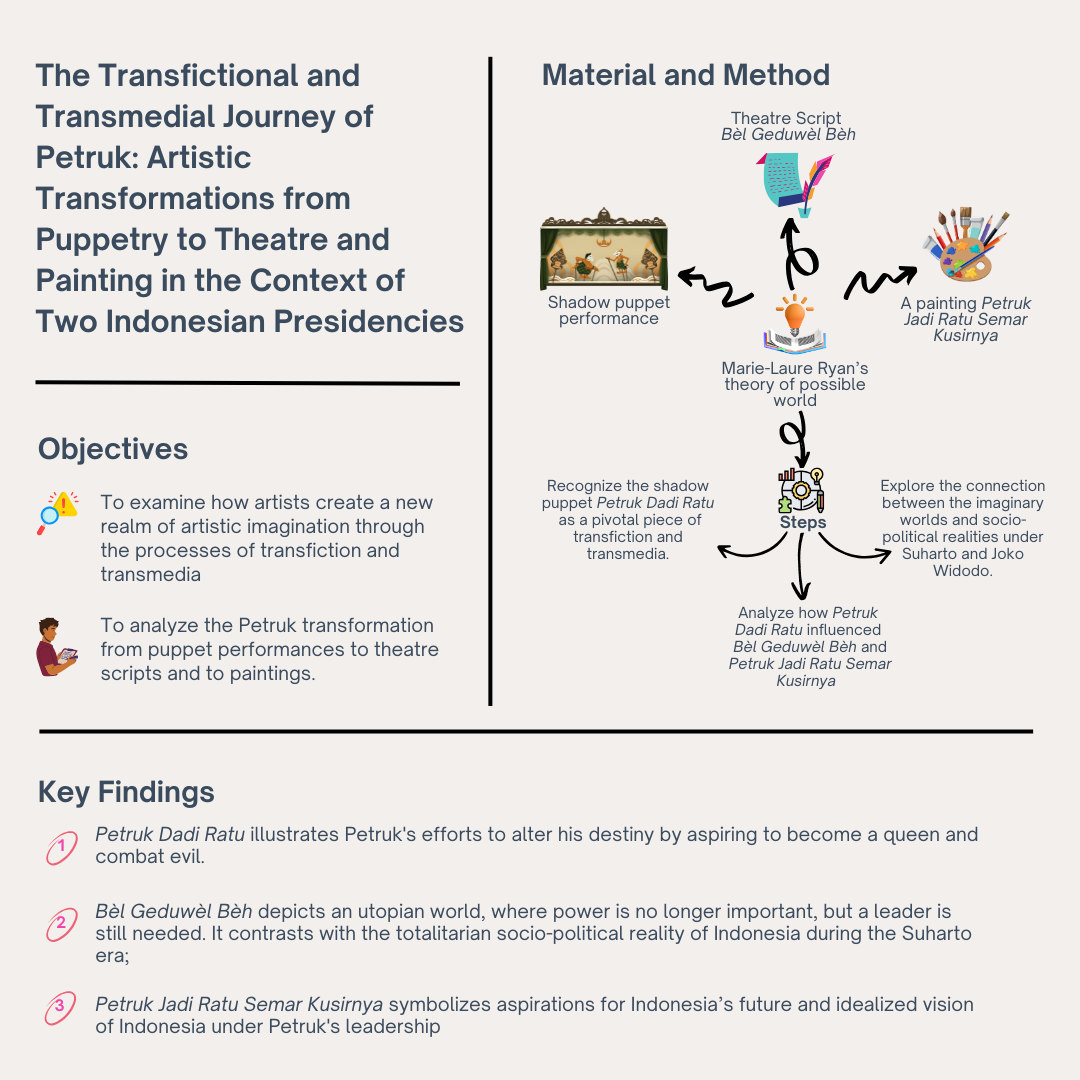
This study examines how artists create a new realm of artistic imagination through the processes of transfiction and transmedia, utilizing the works of Danarto and Djoko Pekik as case studies. Specifically, this study analyzes Danarto's theatre script Bèl Geduwèl Bèh, created during the Suharto regime, and Djoko Pekik's painting Petruk Jadi Ratu Semar Kusirnya (Petruk Becomes a King; Semar is His Coachman), inspired by the shadow puppet performance Petruk Dadi Ratu (Petruk Becomes a King). By applying the theory of possible worlds, this study reveals how these works transform the previous artistic realm, creating a new imaginary world. This study employed several steps: (1) identifies the shadow puppet Petruk Dadi Ratu as a key work of transfiction and transmedia; (2) traces its influence on Bèl Geduwèl Bèh and Petruk Jadi Ratu Semar Kusirnya; and (3) analyzes the relationship between these imaginary worlds and socio-political reality during the presidencies of Suharto and Joko Widodo. This study finds that (1) Bèl Geduwèl Bèh presents a utopian world without rulers and authorities, contrasting with the totalitarian socio-political reality of Indonesia during the Suharto era, while (2) Petruk Jadi Ratu Semar Kusirnya reflects the Joko Widodo regime's utopian vision. This study proposes a cross-media reading strategy for artistic and literary works, contributing to the humanities by exploring how the transformative power of imagination generates possible worlds that reflect Indonesia's socio-political reality.
Downloads
Article Details

This work is licensed under a Creative Commons Attribution-NonCommercial-NoDerivatives 4.0 International License.
All rights reserved. Apart from citations for the purposes of research, private study, or criticism and review,no part of this publication may be reproduced, stored or transmitted in any other form without prior written permission by the publisher.
References
Administrator. (2024). Data Pokok Kebahasaan dan Kesastraan: Hadiah Sastra Majalah Horison [Database of language and literature: Horison magazine literary award]. Badan Pengembangan dan Pembinaan Bahasa, Kementerian Pendidikan Dasar dan Menengah. https://dapobas.kemdikbud.go.id/home?show=isidata&id=1262 [in Indonesian]
Alfiyah, N. (2020, February 22). Lukisan Petruk untuk Istana Baru [Petruk Paintings for the New Palace]. Tempo. https://www.tempo.co/tokoh/jokowi-membeli-lukisan-petruk-karya-djoko-pekik-867361 [in Indonesian]
Ali Mustofa Official. (2021, August 3). Ki H Manteb Sudarsono Lakon Petruk Dadi Ratu [Ki H Manteb Sudarsono Plays Petruk Becomes Queen] [Video]. Youtube. https://www.youtube.com/watch?v=0Ya9aXKNRJM [in Indonesian]
Anderson, B. R. O. (1973). Notes on contemporary Indonesian political communication. Indonesia, 16, 38–80. https://www.jstor.org/stable/3350646
Barthes, R. (1964). Elements of semiology (A. Lavers & C. Smith, Trans.). Hill and Wang.
Capellita, M. B., & Lestari, N. S. (2019). Digital life society education from Punakawan history. Journal of Physics: Conference Series, 1339(1), Article 012086. https://doi.org/10.1088/1742-6596/1339/1/012086
Channel Budaya Nusantara. (2018, April 19). “Petruk Dadi Ratu” Dalang : Ki Seno Nugraha [“Petruk Becomes Queen” puppeteer: Ki Seno Nugraha] [Video]. YouTube. https://www.youtube.com/watch?v=dai835M-2W8 [in Javanese]
Clark, M. (2001). Shadow boxing: Indonesian writers and the Ramayana in the New Order. Indonesia, 72, 159–187. https://www.jstor.org/stable/3351485
Clark, M. (2006). Pipit Rochijat’s subversive mythologies: The Suharto era and beyond. Asian Folklore Studies, 65(1), 21–44. https://www.scopus.com/inward/record.uri?eid=2-s2.0-60950094798&partnerID=40&md5=1beb78a7c0f866910c25f31575994bde
Danarto. (2015). Bèl Geduwèl Bèh [The willful reign]. Nalar. [in Indonesian]
Dermawan T, A. (2020, June 13). “Petruk Jadi Ratu”, Istana Baru, dan Korona Itu [Petruk Becomes Queen, the New Palace, and the Corona]. Kompas.id. https://www.kompas.id/artikel/petruk-jadi-ratu-istana-baru-dan-korona-itu [in Indonesian]
Dewan Kesenian Jakarta. (2018, April 11). Berpulangnya Sastrawan Danarto [The passed away of literary figure Danarto]. Jakarta Arts Council. https://dkj.or.id/berpulangnya-sastrawan-danarto/
Doležel, L. (1998). Heterocosmica: Fiction and possible worlds. The Johns Hopkins University Press.
Downes, M. (2018). Women writing Wayang in post-reform Indonesia: A comparative study of fictional interventions in mythology and national history. In G. V. S. Chin & K. Mohd Daud (Eds.), The Southeast Asian woman writes back: Gender, identity and nation in the literatures of Brunei Darussalam, Malaysia, Singapore, Indonesia and the Philippines (pp. 107–127). Springer Nature Singapore. https://doi.org/10.1007/978-981-10-7065-5_7
Fatah, A. A. (2025). Kepemimpinan Berbasis Nilai-Nilai Lakon Petruk Dadi Ratu oleh Ki Enthus Susmono 2013–2018 [Leadership based on the values of Petruk Dari Ratu by Ki Enthus Susmono 2013–2018] [Undergraduate thesis]. Institutional Repository Universitas Islam Negeri Syarif Hidayatullah Jakarta. https://repository.uinjkt.ac.id/dspace/handle/123456789/83881 [in Indonesian]
Gheysari, M. S., & Maziar, A. (2023). Productive imagination in painting from Ricoeur’s point of view. Journal of Philosophical Investigations, 17(43), 436–451. https://doi.org/10.22034/jpiut.2022.49320.3072
Haugtvedt, E., & Palmer, B. (2024). Victorian transfictions and transmedia storytelling. Victorian Popular Fictions Journal, 6(2), 1–11. https://doi.org/10.46911/BMZC4098
Heryanto, A. (1985). Perdebatan Sastra Kontekstual [The debate on contextual literature]. CV. Rajawali. [in Indonesian]
Heryanto, A. (1988). Masihkah Politik Jadi Panglima? Politik Kesusatraan Indonesia Mutakhir [Is politics still in command? The politics of contemporary indonesian literature]. Prisma, 17(8), 3–16. https://arielheryanto.com/2016/03/04/masihkah-politik-jadi-panglima/ [in Indonesian]
Heryanto, A., & Hadiz, V. R. (2005). Post-authoritarian Indonesia: A comparative Southeast Asian perspective. Critical Asian Studies, 37(2), 251–275. https://doi.org/10.1080/14672710500106341
Hui, D. M., & Abdullah, S. (2024). A visual analysis between the sheng character of shadow puppets of the central plains of China and Sri Rama of Wayang Kulit Kelantan, Malaysia. International Society for the Study of Vernacular Settlements, 11(2), 268–289. https://doi.org/10.61275/ISVSej-2024-11-02-28
Kartika, D. S. (2017). Seni Rupa Modern [Modern of art]. Rekayasa Sains. [in Indonesian]
Lyotard, J.-F. (1984). The postmodern condition: A report on knowledge. University of Minnesota Press.
Maharani, S. (2015, October 1). Pelukis Djoko Pekik Bicara G30S 1965 dan Adu Domba Rakyat [Painter Djoko Pekik speaks about G30S 1965 and divide and conquer politics]. Tempo. https://www.tempo.co/politik/pelukis-djoko-pekik-bicara-g30s-1965-dan-adu-domba-rakyat-1417859 [in Indonesian]
Mittermayer, T., & Capanema, L. X. L. (2019). Transfictionality and transmedia storytelling: A conceptual distinction. In M. Kurosu (Ed.), Human-computer interaction. Perspectives on design (Vol. 11566, pp. 550–558). Springer. https://doi.org/10.1007/978-3-030-22646-6_41
Novák, R. (2021). Transmedia principles in impressionism spanning painting, music and literature. Neohelicon, 48(1), 299–312. https://doi.org/10.1007/s11059-020-00558-7
Nugroho, S. (2024). Transformation of Kakawin Arjunawiwāha into the scenario text of Wayang Kulit Purwa performance Lakon Harjuna Wiwaha. International Society for the Study of Vernacular Settlements, 11(4), 115–129. https://doi.org/10.61275/ISVSej-2024-11-04-06
Nuriarta, I. W., Suarka, I. N., Sari, I. A. L., & Suryadi, S. (2024). Articulation of Indonesian identity in Mahabharata epic puppet comics by Sundanese, Javanese, and Balinese comic artists. Jurnal Kajian Bali, 14(1), 19–44. https://doi.org/10.24843/JKB.2024.v14.i01.p02
Nurrochsyam, M. W., Somantri, R. A., Purwana, B. H. S., Dwinanto, A., Khair, M. L., & Wasito, W. U. (2023). Towards re-enchantment of the Wayang puppet theatre: Puppeteers as agents of morality in the contemporary Indonesian society. International Society for the Study of Vernacular Settlements, 10(11), 92–108. https://doi.org/10.61275/ISVSej-2023-10-11-18
Nusa Tivi. (2025, June 29). Ki Anom Suroto - Petruk Dadi Ratu -Bintang Tamu Kirun -Lusi Braman [Ki Anom Suroto - Petruk becomes queen with guest star Kirun - Lusi Braman] [Video]. YouTube. https://www.youtube.com/watch?v=khCYDCSItMU [in Javanese]
Pausacker, H. (2004). Presidents as Punakawan: Portrayal of national leaders as clown-servants in central Javanese Wayang. Journal of Southeast Asian Studies, 35(2), 213–233. https://doi.org/10.1017/S0022463404000128
Prasetya, H. B., Hariyanto, Pangestu, S. M., Udreka, Handayani, L. L. A., & Saka, P. A. (2024). Shortage of sculptors of shadow puppets’ facial features (Bedhahan) for Wayang performance. Humanities, Arts and Social Sciences Studies, 24(2), 467–481. https://doi.org/10.69598/hasss.24.2.267790
Rajewsky, I. O. (2005). Intermediality, intertextuality, and remediation: A literary perspective on intermediality. Intermédialités: Histoire et théorie des arts, des lettres et des techniques, 6, 43–64. https://doi.org/10.7202/1005505ar
Ratchatakorntrakoon, R. (2024). How sustainable is traditional folk rod puppetry in Thailand? Humanities, Arts and Social Sciences Studies, 24(2), 441–453. https://doi.org/10.69598/hasss.24.2.268376
Ryan, M.-L. (1991a). Possible worlds and accessibility relations: A semantic typology of fiction. Poetics Today, 12(3), 553–576. https://doi.org/10.2307/1772651
Ryan, M.-L. (1991b). Possible worlds, artificial intelligence, and narrative theory. Indiana Universtity Press.
Ryan, M.-L. (2013). Transmedial storytelling and transfictionality. Poetics Today, 34(3), 361–388. https://doi.org/10.1215/03335372-2325250
Ryan, M.-L., & Bell, A. (2019). Introduction: Possible worlds theory revisited. In A. Bell & M.-L. Ryan (Eds.), Possible worlds theory and contemporary narratology (pp. 1–43). University of Nebraska Press.
Saint-Gelais, R. (2005). Transfictionality. In D. Herman, M. Jahn, & M.-L. Ryan (Eds.), Routledge encyclopedia of narrative theory (p. 728). Routledge.
Saint-Gelais, R. (2008). Transfictionality. In D. Herman (Ed.), Routledge encyclopedia of narrative theory (pp. 612–613). Routledge.
Sanggar Cemara. (2020, October 6). Live Wayang Kulit Ki Entus Susmono. Lakon Petruk Dadi Ratu. Bt. Wiwid dkk [Live performance of Wayang Kulit by Ki Entus Susmono. the story of Petruk Becomes King. Guest stars Wiwid et al.] [Video]. YouTube. https://www.youtube.com/live/JPIUXH2NVI4 [in Javanese]
Sedana, I. N. (2019). Triadic interplay: A model of transforming literature into Wayang theatre. Southeast Asian Review of English, 56(1), 11–25. https://doi.org/10.22452/SARE.vol56no1.3
Stange, P. (1994). Silences in Solonese dance production. Southeast Asian Journal of Social Science, 22, 210–229. https://www.jstor.org/stable/24491930
Suaka, I. N., & Budiasa, I. M. (2024). Puppet show as popular culture in Bali: The revitalization of puppet performing arts through the rhetoric originality of Wayang Cenk Blonk. Jurnal Kajian Bali, 14(1), 45–69. https://doi.org/10.24843/JKB.2024.v14.i01.p03
Sunarto. (2012). Panakawan Wayang Kulit Purwa: Asal-usul dan Konsep Perwujudannya [Panakawan Wayang Kulit Purwa: Origins and conceptualization]. Panggung: Jurnal Seni Budaya, 22(3), 225–350. https://doi.org/https://doi.org/10.26742/panggung.v22i3.74 [in Indonesian]
Suwondo, T., Zamzuri, A., Wahyuni, D., Saptawuryandari, N., Satiyoko, Y. A., Sukistono, D., & Hariyanto. (2025). Exploring the potential of Wayang Beber Remeng Mangunjaya’s creative industry to develop a cultural-educational tourism village. Harmonia: Journal of Arts Research and Education, 25(1), 13–27. https://doi.org/10.15294/harmonia.v25i1.2262
Tempo. (2018, April 11). Mengenal Karya-karya Seniman Paket Lengkap, Danarto [Recognizing the works of complete package artist, Danarto]. Tempo. https://www.tempo.co/teroka/mengenal-karya-karya-seniman-paket-lengkap-danarto-943402 [in Indonesian]
Teoh, J. G. I. (2018). Shadow plays with imperial pasts: Writing Wayang in Pramoedya Ananta Toer’s the fugitive. MFS Modern Fiction Studies, 64(3), 403–430. https://doi.org/10.1353/mfs.2018.0036
The Jakarta Post. (2018, April 12). Indonesian arts and literature scene mourns passing of Danarto. The Jakarta Post. https://www.thejakartapost.com/life/2018/04/12/indonesian-arts-and-literature-scene-mourns-passing-of-danarto.html
Tia Video Pro. (2023a, March 5). Petruk Dadi Ratu Ki Dalang Wisnu Hadi Sugito Bagian 1 [Petruk Becomes King - The puppeter Wisnu Hadi Sugito, part 1] [Video]. YouTube. https://www.youtube.com/watch?v=n70X4ANgQR4 [in Javanese]
Tia Video Pro. (2023b, March 6). Petruk Dadi Ratu Dalang Ki Wisnu Hadi Sugito Bagian 2 [Petruk Becomes King - The Puppeter Wisnu Hadi Sugito, part 2] [Video]. YouTube. https://www.youtube.com/watch?v=n3x-_OJqQsA [in Javanese]
Widarmanto, T. (2020, October 5). Cerita Wayang Petruk Dadi Ratu: Kritik Sepanjang Zaman [The puppet story of Petruk Dadi Ratu: A critique across the ages]. LP Ma’arif NU Jateng. https://maarifnujateng.or.id/2020/10/cerita-wayang-petruk-dadi-ratu-kritik-sepanjang-zaman/ [in Indonesian]
Winaja, I. W. (2016). Demokrasi di Layar Wayang: Cara Baru Menstransformasi Ajaran Kepemimpinan Hindu [Democracy on the puppet screen: A new approach to transforming Hindu leadership principles]. Jurnal Kajian Bali (Journal of Bali Studies), 6(2), 33–56. https://ojs.unud.ac.id/index.php/kajianbali/article/view/24892 [in Indonesian]
Wolf, W. (2002). Intermediality revisited reflections on word and music relations in the context of a general typology of intermediality. In S. M. Losado, S. Aspdan, & W. Benhart (Eds.), Intermediality revisited: Reflections on word and music relations in the context of a general typology of intermediality (pp. 13–34). Rodopi.
Xu, T., & Shanat, M. b. H. (2024). Visual rhetoric: An alternative method of designing Luoshan shadow creative products. Humanities, Arts and Social Sciences Studies, 24(1), 145–157. https://doi.org/10.69598/hasss.24.1.263409
Yohanes, B. (2015). Teks Ludik Danarto: Saat Bahasa Menjadi Kartun Pikiran [Danarto’s Ludik text: When language becomes a cartoon of the mind]. In Danarto (Ed.), Bèl Geduwèl Bèh (pp. vii–xv). Nalar. [in Indonesian]
Yudabakti, I. M. (2016). Marginalisasi dan Revitalisasi Wayang Kulit Parwa di Kabupaten Gianyar pada Era Globalisasi [Marginalisation and revitalisation of Parwa shadow puppetry in Gianyar regency in the era of globalisation]. Jurnal Kajian Bali (Journal of Bali Studies), 6(1), 223–252. https://ojs.unud.ac.id/index.php/kajianbali/article/view/19952 [in Indonesian]
Yule, G. (2015). Kajian Bahasa [Language studies]. Pustaka Pelajar. [in Indonesian]
Yuniawan, H. B., & Marzuki, M. (2020). Nilai-Nilai Pendidikan Karakter Pada Makna Lukisan Petruk Dadi Ratu, Semare Kaling-Kalingan Mega Karya Subandi Giyanto [Character education values in the meanings of Petruk Dadi Ratu, Semare Kaling-Kalingan Megapainting by Subandi Giyanto]. Jurnal Pendidikan Karakter, 11(1), 49–68. https://doi.org/10.21831/jpk.v10i1.26189 [in Indonesian]
Zoetmulder, P. J. (1983). Kalangwan: Sastra Jawa Kuno Selayang Pandang [Kalangwan: An overview of old Javanese literature] (D. Hartoko, Trans). Djambatan. [in Indonesian]
