
LINE OA media development using game-based learning for vocational law skills
Article Sidebar
Main Article Content
Abstract
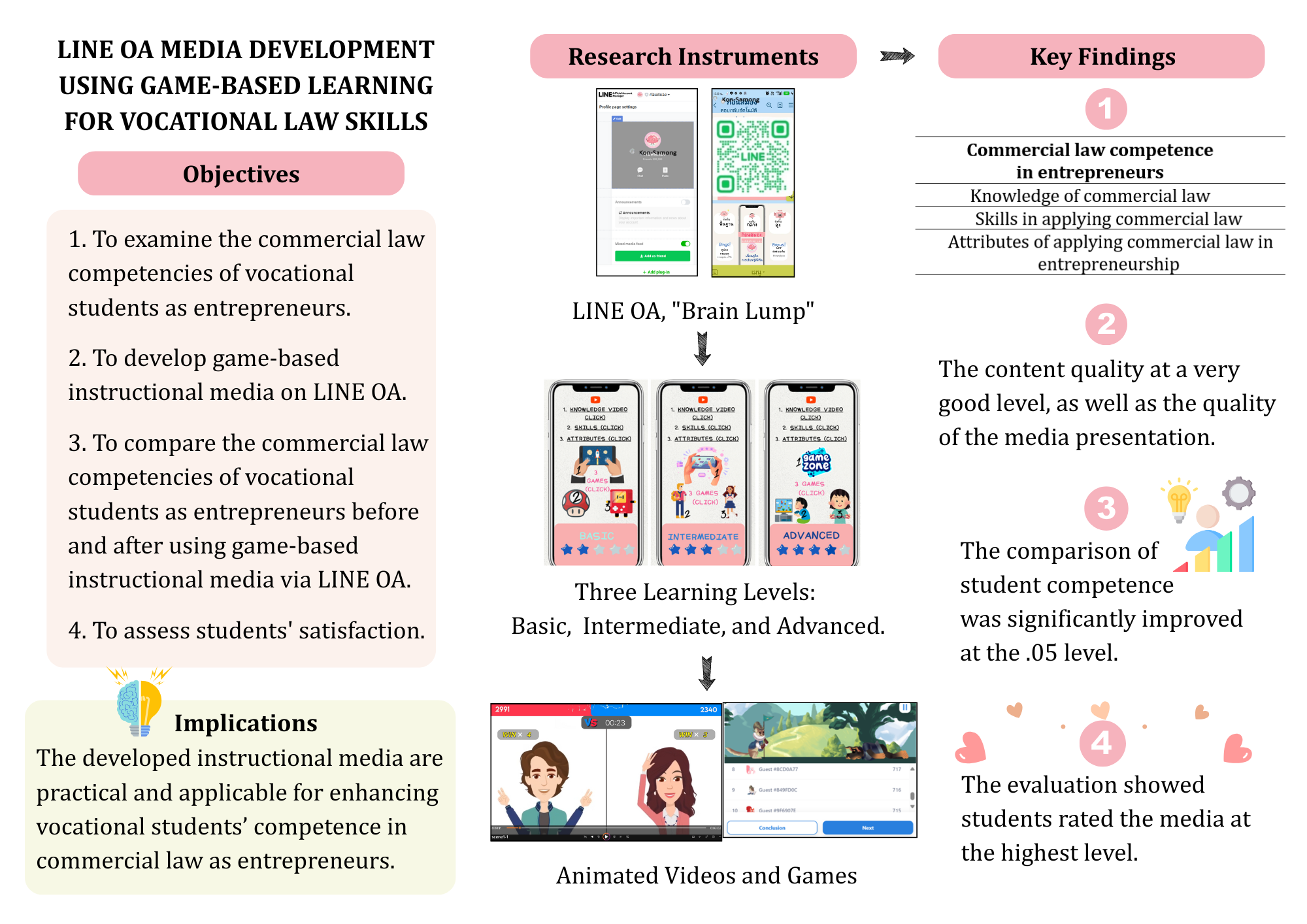
Due to the features of a LINE Official Account, which enable the gamification of learning and enhance student engagement, this research aimed to: (1) examine the commercial law competencies of vocational students as entrepreneurs, (2) develop and evaluate the quality of instructional media via LINE Official Account using game-based learning for vocational law skills as entrepreneurs, (3) compare the commercial law competence of vocational students before and after learning with the developed instructional media, and (4) assess students’ satisfaction with the developed instructional media. Data were collected from a sample of 40 vocational students majoring in Business Computing, selected through cluster random sampling during the first semester of the 2024 academic year. The research findings revealed that commercial law competence in entrepreneurship comprises: (1) knowledge of commercial law, (2) skills in applying commercial law, and (3) attributes for applying commercial law in entrepreneurial contexts. The instructional media were developed based on these findings, incorporating game- based learning via a LINE Official Account. The media included basic, intermediate, and advanced content presented as animated videos and games, accompanied by an AI assistant named "Brain Lump." Expert evaluations revealed that the content quality was rated at a very good level (x̄ = 5.00, S.D. = 0.00), and the quality of the presentation media was also rated at a very good level (x̄ = 4.94, S.D. = 0.08). A comparison of students’ competence before and after using the developed instructional media demonstrated a statistically significant improvement at the .05 level (t-test = 13.88). Furthermore, the satisfaction evaluation indicated that the students rated the instructional media at the highest level (x̄ = 4.54, S.D. = 0.53). Therefore, the developed instructional media are practical and applicable for enhancing vocational students’ competence in commercial law as entrepreneurs.
Downloads
Article Details

This work is licensed under a Creative Commons Attribution-NonCommercial-NoDerivatives 4.0 International License.
All rights reserved. Apart from citations for the purposes of research, private study, or criticism and review,no part of this publication may be reproduced, stored or transmitted in any other form without prior written permission by the publisher.
References
Boyatzis, R. E. (1982). The competent manager: A model for effective performance. John Wiley & Sons.
Dahalan, F., Alias, N., & Shaharom, M. S. N. (2024). Gamification and game based learning for vocational education and training: A systematic literature review. Education and Information Technologies, 29(2), 1279–1317. https://doi.org/10.1007/s10639-022-11548-w
Kaewsomnues, A., Jirachai, P., & Thamwipat, K. (2023). Development of an e-exhibition in conjunction with a game-based learning communication activity. Science, Engineering and Health Studies, 17, Article 23040014. https://li01.tci-thaijo.org/index.php/sehs/article/view/260236/177675
Kanjanavasee, S., Pittayanont, T., & Srisukho, D. (2016). Selection of appropriate statistics for research (7th ed.). Chulalongkorn University Press. [in Thai]
Kuratko, D. F. (2011). Entrepreneurship theory, process, and practice in the 21st century. International Journal of Entrepreneurship and Small Business, 13(1), 8–17. https://doi.org/10.1504/IJESB.2011.040412
Kurt, S. (2018). ADDIE model: Instructional design. Educational Technology.
Lackéus, M. (2015). Entrepreneurship in education. OECD Local Economic and Employment Development. https://www.oecd.org/en/publications/entrepreneurship-in-education_cccac96a-en.html
Lindner, J. (2020). Entrepreneurial learning for TVET institutions: A practical guide. United Nations Educational, Scientific and Cultural Organization. https://unesdoc.unesco.org/ark:/48223/pf0000375209
McClelland, D. C. (1973). Testing for competence rather than for "intelligence." American Psychologist, 28(1), 1–14. https://doi.org/10.1037/h0034092
Napaporn, S., Maneewan, S., Thamwipat, K., & Nittayathammakul, V. (2023). The cloud-powered hybrid learning process to enhance digital natives’ analytical reading skills. International Journal of Advanced Computer Science and Applications, 14(1), 622–627. http://doi.org/10.14569/IJACSA.2023.0140168
National Vocational Qualifications Framework B.E. 2567. (2024, February 2). Royal Thai Government Gazette. No. 141. Special section 33 D. p. 22. [in Thai]
Office of the Secretary of the National Strategy Committee. (2018). National strategy 2018–2037. Thailand. Office of the National Economic and Social Development Council. https://www.ratchakitcha.soc.go.th/DATA/PDF/2561/A/082/T_0001.PDF [in Thai]
Parry, S. B. (1996). The quest for competencies. Training; Minneapolis, 33(7), 48–54. https://www.proquest.com/docview/203398191?sourcetype=Trade%20Journals
Platts-Mills, E., & Wapples, E. (2023). Thinking like entrepreneurs: Qlegal’s experience of teaching law students to have an entrepreneurial mindset. International Journal of Clinical Legal Education, 2023(Special edition), 73–108. https://doi.org/10.19164/ijcle.2023.1317
Poonpon, K., Chansanam, W., Nilubol, K., Sameephet, B., Jannok, A., Satthamnuwong, B., Rakhshandehroo, M., & Srisawat, C. (2024). TIGA-based English learning platform for language learner competency development in a digital environment. International Journal of Learning, Teaching and Educational Research, 23(6), 73–95. https://doi.org/10.26803/ijlter.23.6.4
Preedeedilok, K. (2016). Organizational management theory. Chanakanpim. [in Thai]
Princhankol, P., & Thamwipat, K. (2018). The development of media and special events through cooperative learning to raise funds for students with financial difficulties at Faculty of Industrial Education and Technology. International Education Studies, 11(11), 88–94. https://doi.org/10.5539/ies.v11n11p88
Professional and Organizational Development Network of Thailand Higher Education. (2024). Game-based Learning. https://active-learning.thailandpod.org/learning-activities/game-based-learning [in Thai]
Rizal, R., Rusdiana, D., Setiawan, W., & Siahaan, P. (2021). Development of a problem-based learning management system-supported smartphone (PBLMS3) application using the ADDIE model to improve digital literacy. International Journal of Learning, Teaching and Educational Research, 20(11), 115–131. https://doi.org/10.26803/ijlter.20.11.7
Rovinelli, R. J., & Hambleton, R. K. (1976). On the use of content specialists in the assessment of criterion-referenced test item validity (ED121845). ERIC. https://eric.ed.gov/?id=ED121845
Salas-Rueda, R.-A., Salas-Rueda, É.-P., & Salas-Rueda, R.-D. (2020). Analysis and design of the web game on descriptive statistics through the ADDIE model, data science and machine learning. International Journal of Education in Mathematics, Science and Technology, 8(3), 245–260. https://files.eric.ed.gov/fulltext/EJ1263277.pdf
Schlimbach, R., Khosrawi-Rad, B., Lange, T. C., Strohmann, T., & Robra-Bissantz, S. (2024). Design knowledge for virtual learning companions from a value-centered perspective. Communications of the Association for Information Systems, 54, 293–330. https://doi.org/10.17705/1CAIS.05411
Seibert, J., Schmoll, I., Kay, C. W. M., & Huwer, J. (2020). Promoting education for sustainable development with an interactive digital learning companion students use to perform collaborative phosphorus recovery experiments and reporting. Journal of Chemical Education, 97(11), 3992–4000. https://doi.org/10.1021/acs.jchemed.0c00408
Southeast Asian Ministers of Education Organization (SEAMEO). (2021). SEAMEO strategic plan 2021–2030. Thailand. SEAMEO Secretariat. https://tcg.uis.unesco.org/wp-content/uploads/sites/4/2021/11/SEAMEO-Strategic-Plan-2021%E2%80%932030.pdf
Srisa-ard, B. (2011). Preliminary research (9th ed.). Suwiriyasan. https://www.car.chula.ac.th/display7.php?bib=1929148 [in Thai]
Suropan, P. (2021, March 14). Ideas for using LINE Official in an integrated way to create lessons. Inskru. https://inskru.com/idea/-MPADmSUv3rncz_8ES9f/ [in Thai]
Thamwipat, K., Princhankol, P., & Deeyen, N. (2019). The development of multimedia and activities to promote products made by State Enterprise Communities in the Bangmod Project 4.0 through community-based learning. International Education Studies, 12(4), 49–59. https://doi.org/10.5539/ies.v12n4p49
Thamwipat, K., Pongpimol, P., Supinanont, P., & Princhankol, P. (2024a). The development of digital content in the metaverse combined with participatory communication and learning with religious leader to enhance students’ perception of the community mosque. International Education Studies, 17(1), 58–68. https://doi.org/10.5539/ies.v17n1p58
Thamwipat, K., Namaso, K., & Princhankol, P. (2024b). A synthesis of research studies on public relations multimedia utilization within an educational institute during the COVID-19 pandemic: A comparative analysis of textual and data visualization approaches. Kasetsart Journal of Social Sciences, 45, 433–442. https://so04.tci-thaijo.org/index.php/kjss/article/view/272011/183403
Thamwipat, K., Princhankol, P., Maneewan, S., Pintong, M., & Eaksombun, T. (2024c). Development and assessment of review clips by disabled students for a teenage soul healing program on the TikTok platform. Studies in Media and Communication, 12(3), 168–176. https://doi.org/10.11114/smc.v12i3.6896
Tran, K. N. P., Weng, C., Tran-Nguyen, P. L., Astatke, M., & Tran, N.-P.-D. (2024). What are tutors’ perceptions of an online tutoring project—digital learning companion—during the COVID-19 pandemic? A case study in Taiwan. Universal Access in the Information Society, 23(3), 1409–1425. https://doi.org/10.1007/s10209-023-00976-1
United Nations Development Programme (UNDP) and the Citi Foundation. (2017). Youth Co: Lab. https://www.youthcolab.org/
Waiwingrob, P., Thamwipat, K., & Princhankol, P. (2023). Active learning extracurricular activities using digital content to raise awareness of Thai arts and culture among undergraduate students. Humanities, Arts and Social Sciences Studies, 23(3), 642–655. https://so02.tci-thaijo.org/index.php/hasss/article/view/260536
Yamkuan, L., & Niwattanakul, S. (2017). The using of game-based learning for promote mathematics process skills of 6th grade students. Journal of Information Science and Technology, 7(1), 33–41. https://doi.org/10.14456/jist.2017.4 [in Thai]
