
Dummy-subject man constructions in Thai: A study of forms and functions
Article Sidebar
Main Article Content
Abstract
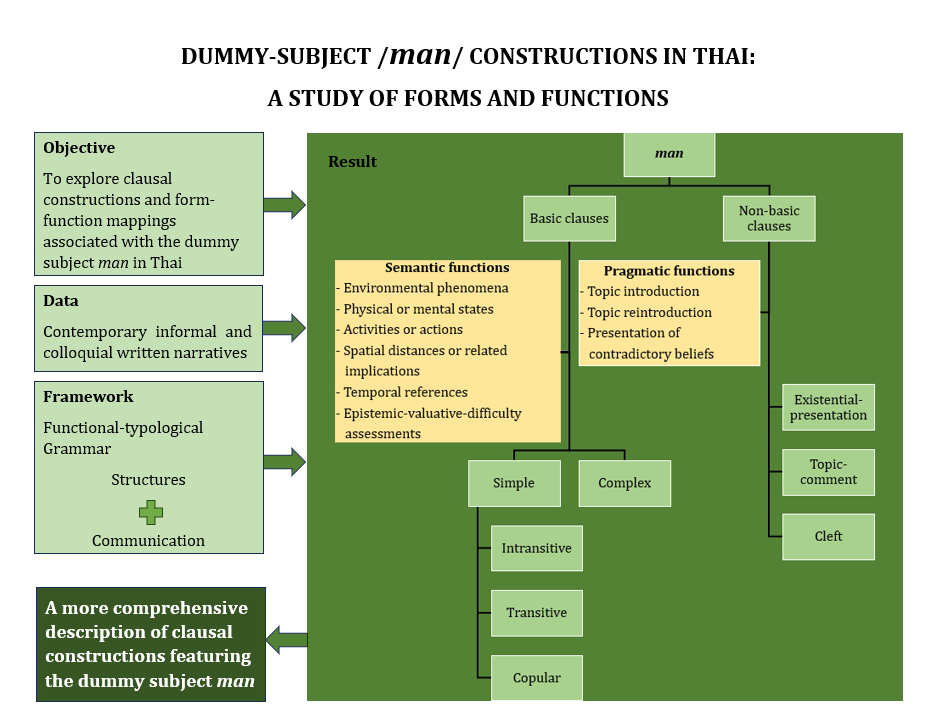
The investigation of the dummy subject man, a non-referential pronoun in Thai, has historically received limited scholarly attention, and therefore, lacks a comprehensive analysis encompassing its diverse forms, structures, functions, and their interrelation. This article aims to explore the clausal constructions and the form-function mappings associated with the dummy subject man in Thai. Employing a qualitative approach, this study analyzes a variety of data extracted from contemporary informal and colloquial written narratives. The analysis was conducted within the framework of functional-typological grammar, which elucidates the interaction between grammatical structures and communicative functions. The findings reveal that the dummy subject man occurs across a range of constructions, encompassing both basic and non-basic clause types. Basic clauses exhibit both simple and complex structural patterns. Simple clauses feature intransitive, transitive, and copular verbs. Complex basic clauses manifest as extrapositional pronoun structures. Non-basic clauses include existential-presentational, topic-comment, and cleft constructions. Functionally, basic clauses express lexical-semantic features pertaining to environmental or meteorological phenomena, physical or mental states, activities or actions, spatial distances or related implications, temporal references, and epistemic-valuative-difficulty assessments. Non-basic clauses fulfill discourse-pragmatic functions within two primary domains: information structuring and pragmatic emphasis, such as topic introduction, topic reintroduction, and the presentation of contradictory beliefs. The results of this study not only identify a broader array of structures and functions compared to previous research but also offer a more comprehensive description of clausal constructions featuring the dummy subject man, thereby contributing to a more nuanced understanding of this linguistic phenomenon.
Downloads
Article Details

This work is licensed under a Creative Commons Attribution-NonCommercial-NoDerivatives 4.0 International License.
All rights reserved. Apart from citations for the purposes of research, private study, or criticism and review,no part of this publication may be reproduced, stored or transmitted in any other form without prior written permission by the publisher.
References
Asher, N. (1993). Reference to abstract objects in discourse: A philosophical semantics for natural language metaphysics. Kluwer Academic.
Bergsma, S., Lin, D., & Goebel, R. (2008). Distributional identification of non-referential pronouns. In J. D. Moore, S. Teufel, J. Allan, & S. Furui (Eds.), Proceedings of ACL-08: HLT (pp. 10–18). Association for Computational Linguistics. https://aclanthology.org/P08-1002.pdf
Boyd, A., Gegg-Harrison, W., & Byron, D. (2005). Identifying non-referential it: A machine learning approach incorporating linguistically motivated patterns. In E. Ringger (Ed.), Proceedings of the ACL Workshop on Feature Engineering for Machine Learning in Natural Language Processing (pp. 40–47). Association for Computational Linguistics. https://aclanthology.org/W05-0406.pdf
Burusphat, S. (1989). Thai language: Topic focused language. Journal of Language and Culture, 8(1), 11–17. [in Thai]
Byron, D., & Gegg-Harrison, W. (2004). Eliminating non-referring noun phrases from coreference resolution. In A. Branco, T. McEnery, & R. Mitkov (Eds.), Proceedings of DAARC (pp. 21–26). Edições Colibri.
Chutisilp, P. (1984). A sociolinguistic study of an additional language: English in Thailand (Publication No. 8502107) [Doctoral dissertation, University of Illinois]. ProQuest Dissertations and Theses Global. https://www.proquest.com/dissertations-theses/sociolinguistic-study-additional-language-english/docview/303295591/se-2
Givón, T. (2001). Syntax: An introduction volume I. John Benjamins Publishing.
Gundel, J. K., Hedberg, N., & Zacharski, R. (2005). Pronouns without NP antecedents: How do we know when a pronoun is referential? In A. Branco, T. McEnery, & R. Mitkov (Eds.), Anaphora processing: Linguistic, cognitive and computational modelling (pp. 351–364). John Benjamins Publishing. https://www.researchgate.net/profile/NancyHedberg2/publication/289838375_Pronouns_Without_NP_Antecedents/links/585d6b7808ae329d61f692df/Pronouns-Without-NP-Antecedents.pdf
Hoonchamlong, Y. (1991). Some issues in Thai anaphora: A government and binding approach (Publication No. 9128917) [Doctoral dissertation, The University of Wisconsin-Madison]. ProQuest Dissertations and Theses Global. https://www.proquest.com/dissertations-theses/some-issues-thai-anaphora-government-binding/docview/304008264/se-2
Indrambarya, K. (2011, May 12). On the non-referential subject/man/‘it’ in Thai [Paper presentation]. The 21st Annual Conference of Southeast Asian Linguistics Society. Bangkok, Thailand.
Iwasaki, S., & Ingkaphirom, P. (2005). A reference grammar of Thai. Cambridge University Press.
Kaenmuang, J. (2022). Semantic change in referentiality of the pronoun /man1/ in Thai. Vacana Journal, 10(1), 28–52. http://rs.mfu.ac.th/ojs/index.php/vacana/article/view/327 [in Thai]
Kaenmuang, J., Piyamahapong, P., & Pittayaporn, P. (2025). Mān on the referentiality continuum in Thai. Journal of the Southeast Asian Linguistics Society, 18(1), 1–18. http://hdl.handle.net/10524/52535
Li, C. N., & Thompson, S. A. (1976). Subject and topic: A new typology of language. In C. N. Li (Ed.), Subject and Topic (pp. 457–489). Academic Press.
Ng, V. (2005). Supervised ranking for pronoun resolution: Some recent improvements. In A. Cohn (Ed.), Proceedings of AAAI-05: Twentieth National Conference on Artificial Intelligence (pp. 1081–1086). Association for the Advancement of Artificial Intelligence. https://aaai.org/papers/01081-AAAI05-171-supervised-ranking-for-pronoun-resolution-somerecent-improvements/
Ng, V., & Cardie, C. (2002). Identifying anaphoric and non-anaphoric noun phrases to improve coreference resolution. In S. Tseng (Ed.), COLING 2002: The 19th International Conference on Computational Linguistics (pp. 730–736). Association for Computational Linguistics. https://aclanthology.org/C02-1139/
Pramunwong, P. (Trans.). (2006). The year of magical thinking. Matichon. [in Thai]
Prasithrathsint, A. (1997). The emergence and development of abstract nominalization in standard Thai. In A. S. Abramson (Ed.), Southeast Asian linguistics studies in honor of Vichin Panupong (pp. 179–190). Chulalongkorn University Press.
Royal Institute. (2013). Royal institute dictionary 2011. Nanmeebooks. [in Thai]
Soon, W. M., Ng, H. T., & Lim, D. C. Y. (2001). A machine learning approach to coreference resolution of noun phrases. Computational Linguistics, 27(4), 521–544. https://aclanthology.org/J01-4004.pdf
Wongwattana, U. S. (2015a). Complexities of Thai copular constructions. Journal of Southeast Asian Linguistics Society, 8, 97–120. http://hdl.handle.net/1885/95200
Wongwattana, U. S. (2015b). Communicative functions and syntax of clause variations in Thai: A case of contrastive focus constructions. Journal of Language and Linguistics, 33(2), 70–91. [in Thai]
Wongwattana, U. S. (2017). An analysis of communicative roles and syntactic aspects of variant clauses, the case of marked-topic constructions. Journal of Humanities, Naresuan University, 14(3), 15–34. https://so03.tci-thaijo.org/index.php/jhnu/article/view/172187 [in Thai]
Wongwattana, U. S. (2022). Communicative Thai grammar: An analysis in the functional-typological approach. Naresuan University Press. [in Thai]
Yaneva, V., Ha, L. A., Evans, R., & Mitkov, R. (2018). Classifying referential and non-referential it using gaze. In E. Riloff, D. Chiang, J. Hockenmaier, & J. Tsujii (Eds.), Proceedings of the 2018 Conference on Empirical Methods in Natural Language Processing (pp. 4896–4901). Association for Computational Linguistics. https://aclanthology.org/D18-1528.pdf
