
Guanyin can understand Pali: Cross-traditional practices of Indonesian Buddhists who worship Guanyin through Pali Paritta
Article Sidebar
Main Article Content
Abstract
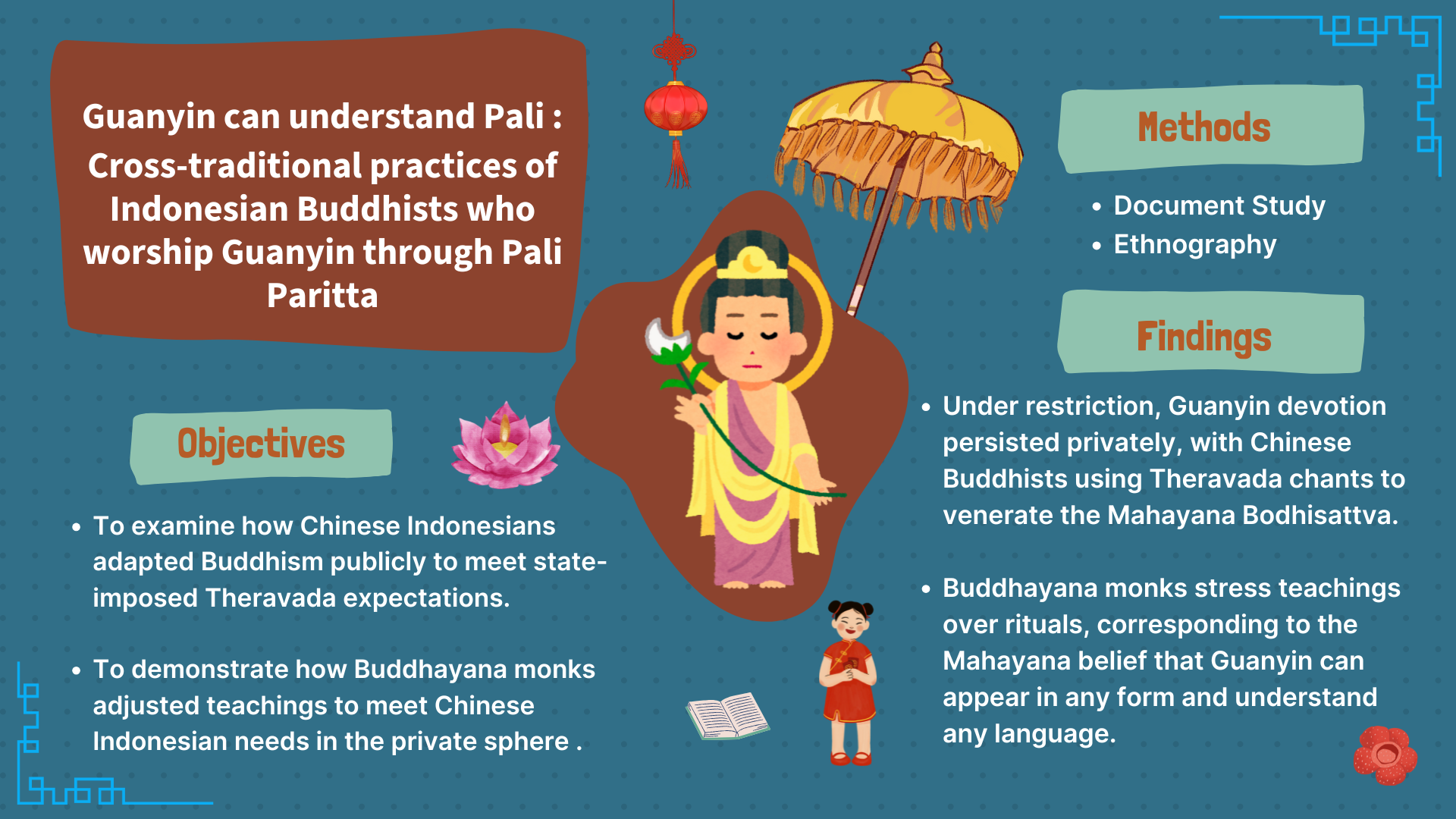
In the 1960s–1990s, Buddhism in Indonesia had to adapt significantly to state policies. Chinese cultures and Mahayana Buddhism were marginalized because they were seen as obstacles to assimilation into Indonesian identity. This resulted in significant growth of Theravada Buddhism. This article addresses two questions: (1) how did Chinese communities who were forced to adopt Theravada Buddhism maintain their beliefs in public areas? and (2) how have Buddhist monks in the Buddhayana organization, the largest and most adaptable Buddhist group in Indonesia, adjusted their teachings to serve the needs of Chinese communities? The research is based on document study of Buddhist magazines published since the 1960s and ethnographic fieldwork conducted through residence in Buddhayana temples in Java for two years (2021–2022). The figure of Guanyin, in terms of history, development, and worship in Indonesia, serves as the central theme to illustrate the adaptation of Buddhist rituals using the concepts of hybridity and interspirituality. The study has two major findings. (1) Although Chinese Buddhists chant in Pali, the veneration of Guanyin has not been abandoned. The Theravada Paritta is used as a medium to worship the Mahayana Bodhisattva. (2) While other Buddhist groups may view this practice as a form of mixed or syncretic Buddhism, Buddhayana followers interpret it as a cross-tradition practice rather than syncretism. For them, true Buddhism lies in its teachings, not in rituals, which may be contextually adaptable. The adaptive approach of Buddhayana monks aligns with the Mahayana ideal that Guanyin can manifest in any form to help sentient beings. The commitment to liberate beings from suffering should not be confined by language or culture. Ultimately, this article argues that Guanyin symbolizes not only a cross-gender and cross-national deity but also a cross-sectarian figure that enables practitioners to transcend boundaries of religious traditions.
Downloads
Article Details

This work is licensed under a Creative Commons Attribution-NonCommercial-NoDerivatives 4.0 International License.
All rights reserved. Apart from citations for the purposes of research, private study, or criticism and review,no part of this publication may be reproduced, stored or transmitted in any other form without prior written permission by the publisher.
References
Buaban, J. (2025). War of authenticity: Religious competition among Indonesian Buddhists. Asian Journal of Arts and Culture, 25(3), Article e285384. https://doi.org/10.48048/ajac.2025.285384
Buaban, J., Makin, A., & Sutrisno, E. L. (2024). Theravadization of Buddhayana under the discourse of modern Buddhism and Indonesian politics. Simulacra, 7(1), 97–111. https://doi.org/10.21107/sml.v7i1.25102
Chia, J. M.-T. (2018). Neither Mahayana nor Theravada: Ashin Jinarakkhita and the Indonesian Buddhayana movement. History of Religions, 58(1), 24–63. http://dx.doi.org/10.1086/697932
Chia, J. M.-T. (2020). Monks in motion: Buddhism and modernity across the South China Sea. Oxford University Press.
Dharmawimala, B. (2012). Buddhayana dan kontekstualisasi agama Buddha di Indonesia [Buddhayana and contextualization of Buddhism in Indonesia]. In E. Juangari & L. Suheman (Eds.), Buddhayana values (pp. 1–12). Karaniya. [in Indonesian]
Gross, R. M. (1993). Buddhism after patriarchy: A feminist history, analysis, and reconstruction of Buddhism. Suny Press.
Hedges, P. (2011). Guanyin, queer theology, and subversive religiosity: An experiment in interreligious theology. In U. Winkler, O. Leirvik, & J. Gruber (Eds.), Interreligious hermeneutics in pluralistic Europe: Between texts and people (pp. 203–229). Brill. https://doi.org/10.1163/9789401200370_013
Jackson, P. A. (2020). Beyond hybridity and syncretism: Kala-Thesa contextual sensitivity and power in Thai religious and gender cultures. Journal of Anthropology, Sirindhorn Anthropology Centre, 3(1), 1–37. https://so06.tci-thaijo.org/index.php/jasac/article/view/243148
Juangari, E. (2022). Menabur benih Dharma di Nusantara: Riwayat singkat Y.A.MNS Ashin Jinarakkhita [Sow the seed of Dharma in Nusantara: A short biography of Ven.Ashin Jinarakkhita]. Karaniya. [in Indonesian]
Keluarga Buddhayana Indonesia (KBI). (2024). Phu Men Phin (Saddharma Pundarika Sutra) [Lotus Sutra]. STIAB Smaratungga. [in Indonesian]
Kim, J.-E. (2001). White-robed Guanyin: The sinicization of Buddhism in China seen in the Chinese transformation of Avalokiteshvara in gender, iconography, and role. Athanor, 19, 17–25. https://journals.flvc.org/athanor/article/view/126459
Kimura, B. (2003). Present situation of Indonesian Buddhism: In memory of Bhikkhu Ashin Jinarakkhita Mahasthavira. Sambhasa: Nagoya Studies in Indian Culture and Buddhism, 23(1), 53–72. https://tinyurl.com/mrnm2vfu
Kumarajiva, B. (2007). The Lotus Sutra (T. Kubo & A. Yuyama, Trans.). Numata Center for Buddhist Translation and Research. (Original work published n.d.)
Lele, H. (2022). The ambiguity of the gender of Avalokiteśvara: A comparative study on the representations of Avalokiteśvara from India and China during Sui-Tang-Period. Asia Social Issues, 15(2), Article 251786. https://doi.org/10.48048/asi.2022.251786
Levering, M. (2006). Guanyin/Avalokitesvara in encounter dialogues: Creating a place for Guanyin in Chinese Chan Buddhism. Journal of Chinese Religions, 34(1), 1–28. https://doi.org/10.1179/073776906803525147
Li, Y. (2012). Embroidering Guanyin: Constructions of the divine through hair. East Asian Science, Technology, and Medicine, 36(1), 131–166. https://doi.org/10.1163/26669323-03601005
McMahan, D. L. (2008). The making of Buddhist modernism. Oxford University Press.
Meulenbeld, M. (2016). Death and demonization of a Bodhisattva: Guanyin’s reformulation within Chinese religion. Journal of the American Academy of Religion, 84(3), 690–726. https://doi.org/10.1093/jaarel/lfv104
Nadiwana, W. (Ed.). (1987). Buletin Dharma Prabha (Vol. 1, No. 1) [Dharma Prabha Bulletin]. Cetya Buddha Prabha. [in Indonesian]
Racheman, H. (2011). Buddhayana dalam Pandangan Seorang Maha Upasaka Phao Krishnaputra [Buddhayana in the perspective of Maha Upasika Phao Krishnaputra]. Lembaga Media Kominikasi & Penerbitan MBI Prasadha Jinarakkhita. [in Indonesian]
Sadono, S. (1959). Waicak: Buku Peringatan Perajaan Waicak 2503 [Waicak: Commemoration book of Vesak 1959]. (n.p.). [in Indonesian]
Setiono, G. (2008). Tionghoa dalam Pusaran Politik [Indonesian Chinese under political turmoil]. Trans-media Pustaka. [in Indonesian]
Soepangat, P. (1956). Keibuan dalam Buddha-Dharma [Motherhood in Buddhist teaching]. In Mangunkawatja (Ed.), 2500 Buddha Jayanti (pp. 155–158). PUUI. [in Indonesian]
Souza, M. (2016). Inside out: Exploring an interspiritual approach to teaching about different religions and spiritual beliefs and practices. In J. Hochheimer & J. Fernandez-Goldborough (Eds.), Spirituality: Conversations for the 21st century (pp. 357–362). Brill.
Steenbrink, K. (2013). Buddhism in Muslim Indonesia. Studia Islamika, 20(1), 1–34. https://studiaislamika.ppimcensis.or.id/index.php/studia-islamika/article/view/346
Suryadinata, L. (2014). State and ‘Chinese religions’ in Indonesia: Confucianism, Tridharma and Buddhism during the Suharto rule and after. In C. B. Tan (Ed.), After migration and religious affiliation: Religions Chinese identities and transnational networks (pp. 19–42). World Scientific.
Sutrisno, E. L. (2018). Negotiating the Confucian religion in Indonesia: Invention, resilience and revival (1900–2010) [Doctoral dissertation, University of Washington]. ResearchWorks at the University of Washington. http://hdl.handle.net/1773/42177
Wang, G. (1996). Sojourning: The Chinese experience in Southeast Asia. In A. Reid (Ed.), Sojourners and settlers: Histories of Southeast Asia and the Chinese (pp. 1–9). University of Hawai'i Press.
Xu, Y. (2023). Guanyin as mediation: A new study on women’s Buddhist devotion in late imperial China. Studies in Chinese Religions, 9(1), 99–108. https://doi.org/10.1080/23729988.2023.2210982
Yu, C. F. (2001). Kuan-yin: The Chinese transformation of Avalokitesvara. Columbia University Press.
Yu, C. F. (2020). Chinese Buddhism: A thematic history. University of Hawai'i Press.
Yulianti, Y. (2022). The birth of Buddhist organizations in modern Indonesia, 1900–1959. Religions, 13(3), Article 217. https://doi.org/10.3390/rel13030217
Yulianti, Y. (2024). The making of Buddhism in modern Indonesia: South and Southeast Asian networks and agencies, 1900–1959. Leiden University Press.
