
The development of a training curriculum to promote mathematical learning design and test construction abilities according to the PISA mathematical literacy assessment guidelines for undergraduate students majoring in mathematics
Article Sidebar
Main Article Content
Abstract
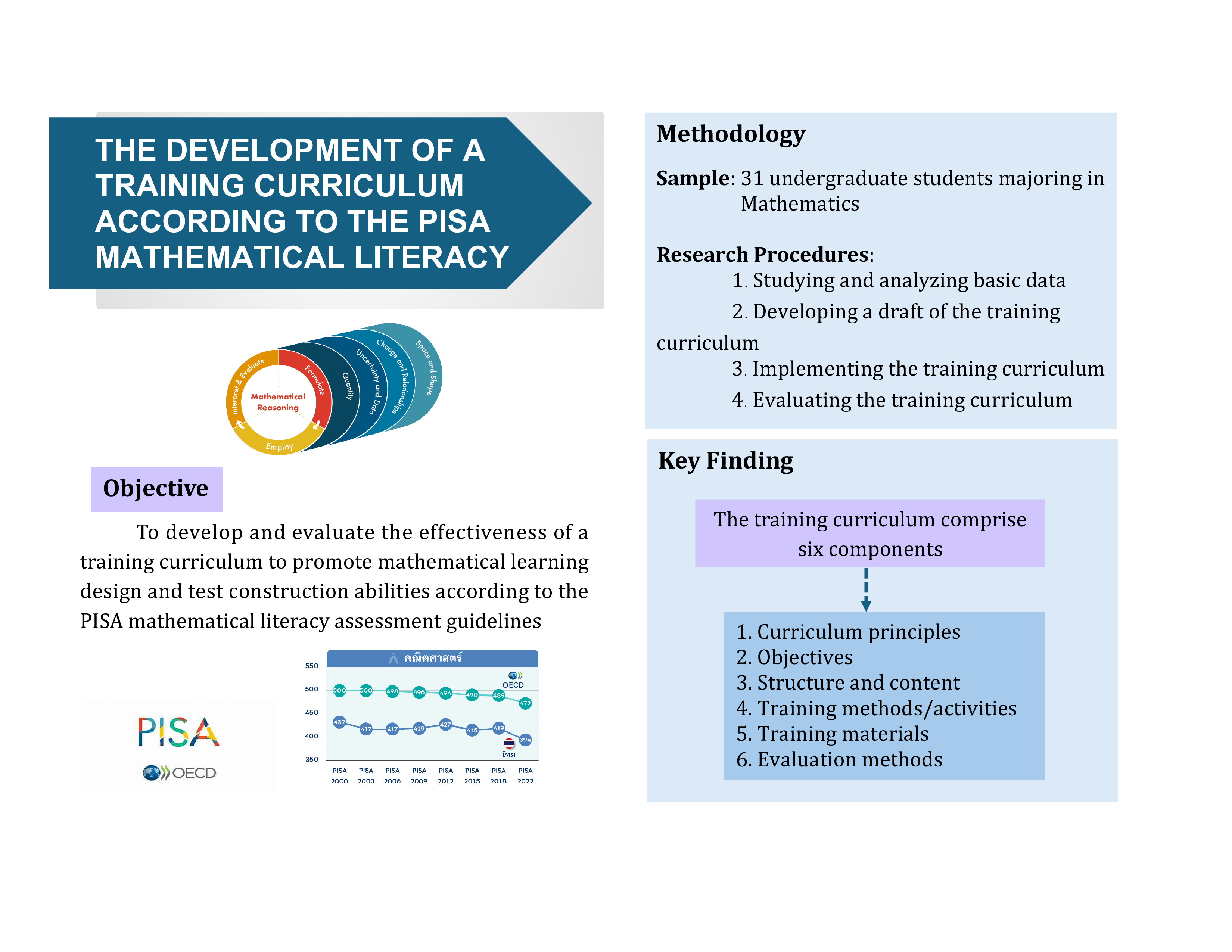
The objective of this research was to develop and evaluate the effectiveness of a training curriculum to promote mathematical learning design and test construction abilities according to the PISA mathematical literacy assessment guidelines. The sample comprised 31 undergraduate students majoring in mathematics from the Faculty of Education, Burapha University, enrolled in the first semester of the 2024 academic year, who volunteered and were interested in participating in this training curriculum. The research methodology consisted of four steps: Step 1 was conducted by studying and analyzing basic data, Step 2 was conducted by developing a draft of the training curriculum and conducting a pilot test, Step 3 was conducted by implementing the training curriculum with the sample, and Step 4 was conducted by evaluating the effectiveness and refining the training curriculum. The findings revealed that: 1) the developed training curriculum contained six components. Its structure indicated the highest level of consistency (M = 4.97, SD = 0.17) and appropriateness (M = 4.90, SD = 0.30); 2) an assessment of the curriculum’s effectiveness revealed that, at post-training, students showed a higher knowledge level regarding PISA mathematical literacy assessment compared to pre-training levels, exceeding the 70% criterion with a statistical significance level of 0.05. Moreover, students’ mathematical learning design and test construction abilities according to the PISA mathematical literacy assessment guidelines at post-training were higher than the 70% criterion, with a statistical significance level of 0.05. Overall, the students rated the training curriculum at the highest level (M = 4.52, SD = 0.58), meeting all effectiveness criteria as specified in the training curriculum guidelines.
Downloads
Article Details

This work is licensed under a Creative Commons Attribution-NonCommercial-NoDerivatives 4.0 International License.
All rights reserved. Apart from citations for the purposes of research, private study, or criticism and review,no part of this publication may be reproduced, stored or transmitted in any other form without prior written permission by the publisher.
References
Angganapattarakajorn, V. (2012). What mathematics teachers should know: Curriculum, instruction, and research. Charansanitwong Printing. [in Thai]
Boonpattanaporn, S. (2017). The results of the PISA relevant to their role in learning management. Journal of Research and Curriculum Development, 7(1), 16–29. https://ejournals.swu.ac.th/index.php/jrcd/article/view/9146 [in Thai]
Colwell, J., & Enderson, M. C. (2016). “When I hear literacy”: Using pre-service teachers' perceptions of mathematical literacy to inform program changes in teacher education. Teaching and Teacher Education, 53, 63–74. http://doi.org/10.1016/j.tate.2015.11.001
Deng, Z., & Gopinathan, S. (2016). PISA and high-performing education systems: Explaining Singapore’s education success. Comparative Education, 52(4), 449–472. https://doi.org/10.1080/03050068.2016.1219535
Dick, W., Carey, L., & Carey, J. O. (2009). The systematic design of instruction (7th ed.). Pearson.
Kaiyawan, Y. (2016). Research and training curriculum development. Chulalongkorn University Press. [in Thai]
Meepan, S. (2020). Guidelines for improving the quality of education in mathematics, science, and reading to prepare for the upgrading of PISA test results of Bangkok Metropolitan schools. Department of Education, Bangkok Metropolitan Administration. [in Thai]
National PISA Operations Center, The Institute for the Promotion of Teaching Science and Technology (IPST). (2024). PISA 2022 evaluation results: Executive summary. https://pisathailand.ipst.ac.th/pisa2022-summary-result/ [in Thai]
National PISA Operations Center, The Institute for the Promotion of Teaching Science and Technology (IPST). (2025). PISA 2022 evaluation results: Mathematics, reading, and sciences. https://drive.google.com/file/d/1FKno7edjZqU_lRRRCflLnhXS6LshdiH-/view [in Thai]
Ngamying, M. (2020). The development of mathematical literacy curriculum for primary school students [Doctoral dissertation, Srinakharinwirot University]. DSpace at Srinakharinwirot University. http://ir-ithesis.swu.ac.th/dspace/handle/123456789/1273 [in Thai]
Office of the Civil Service Commission (OCSC). (2010). Handbook for constructing test questions for personnel selection. OCSC. [in Thai]
Organisation for Economic Co-operation and Development (OECD). (2023). PISA 2022 assessment and analytical framework. PISA, OECD Publishing. https://doi.org/10.1787/dfe0bf9c-en
Ornstein, A. C., & Hunkins, F. P. (2018). Curriculum: Foundations, principles, and issues (7th ed.). Pearson.
Panich, V., Susilworn, S., & Vidyaporn, N. (2023). For teachers and students as self-developers. S. R. Printing Mass Products. [in Thai]
Patphol, M. (2011). A training curriculum development to enhance research-based instruction for teachers. Graduate School, Srinakharinwirot University. [in Thai]
Pornkul, C. (2009). Instruction design, integration, reading, analytical thinking, and writing (2nd ed.). Chulalongkorn University Press. [in Thai]
Pornkul, C. (2011). Teaching for thinking process: Theory and application. Chulalongkorn University Press. [in Thai]
Saengloetuthai, J., Thongnin, P., Booncherdchoo, N., Maneerat, C., Srisopha, Y., & Takomsane, M. (2020). Action learning. Academic Journal of Phetchaburi Rajabhat University, 10(3), 155–163. https://journal.pbru.ac.th/admin/upload/article/5729-2021-04-05.pdf [in Thai]
Stacey, K., Almuna, F., Caraballo,R. M., Chesné, J.-F., Garfunkel, S., Gooya, Z., Kaur, B., Lindenskov, L., Lupiáñez, J. L., Park, K. M., Perl, H., Rafiepour, A., Rico, L., Salles, F., & Zulkardi, Z. (2015). PISA’s influence on thought and action in mathematics education. In K. Stacey & R. Turner (Eds.), Assessing mathematical literacy (pp. 275–306). Springer. https://doi.org/10.1007/978-3-319-10121-7_15
Taba, H. (1962). Curriculum development: Theory and practice. Harcourt Brace Jovanovich.
Tanyabut, P., Kotchasit, S., & Sri-Iam, S. (2022). The training curriculum for professional teacher students to enhance competency in the creation of reading literacy assessment tools according to the PISA style. Journal of MCU Peace Studies, 10(2), 750–762. http://so03.tci-thaijo.org/index.php/journal-peace/article/view/259122/173386 [in Thai]
The Institute for the Promotion of Teaching Science and Technology (IPST). (2018, December 17). Behind the success of some countries in PISA. PISA Thailand. https://pisathailand.ipst.ac.th/issue-2018-36/ [in Thai]
The Institute for the Promotion of Teaching Science and Technology (IPST). (2024, January 3). Supporting the utilization of PISA 2022 results: Enhancing teacher competencies in instruction to develop future skills. https://www.ipst.ac.th/news/55661/20231226-pisa.html [in Thai]
Thongthew, S. (2012). ASEAN literacy curriculum. Journal of Education and Innovation, 14(3), 95–106. https://so06.tci-thaijo.org/index.php/edujournal_nu/article/view/9357 [in Thai]
Tougaw, P. W. (1994). A study of the effect of using an “open-approach” to teaching mathematics upon the mathematical problem-solving behaviors of secondary school students (Publication No. 304091165) [Doctoral dissertation, Southern Illinois University at Carbondale]. ProQuest Dissertations and Theses Global. https://www.proquest.com/dissertations-theses/study-effect-using-open-approach-teaching/docview/304091165/se-2
Tucker, K. (2014). Mathematics through play in the early years (3rd ed.). Sage Publications.
Wongyai, W., & Patphol, M. (2014). Cognitive coaching (3rd ed.). Charansanitwong Printing. [in Thai]
