
Governing shared water to achieve the SDGs: A case study of the Mekong River, Chiang Khong District, Chiang Rai Province, Thailand
Article Sidebar
Main Article Content
Abstract
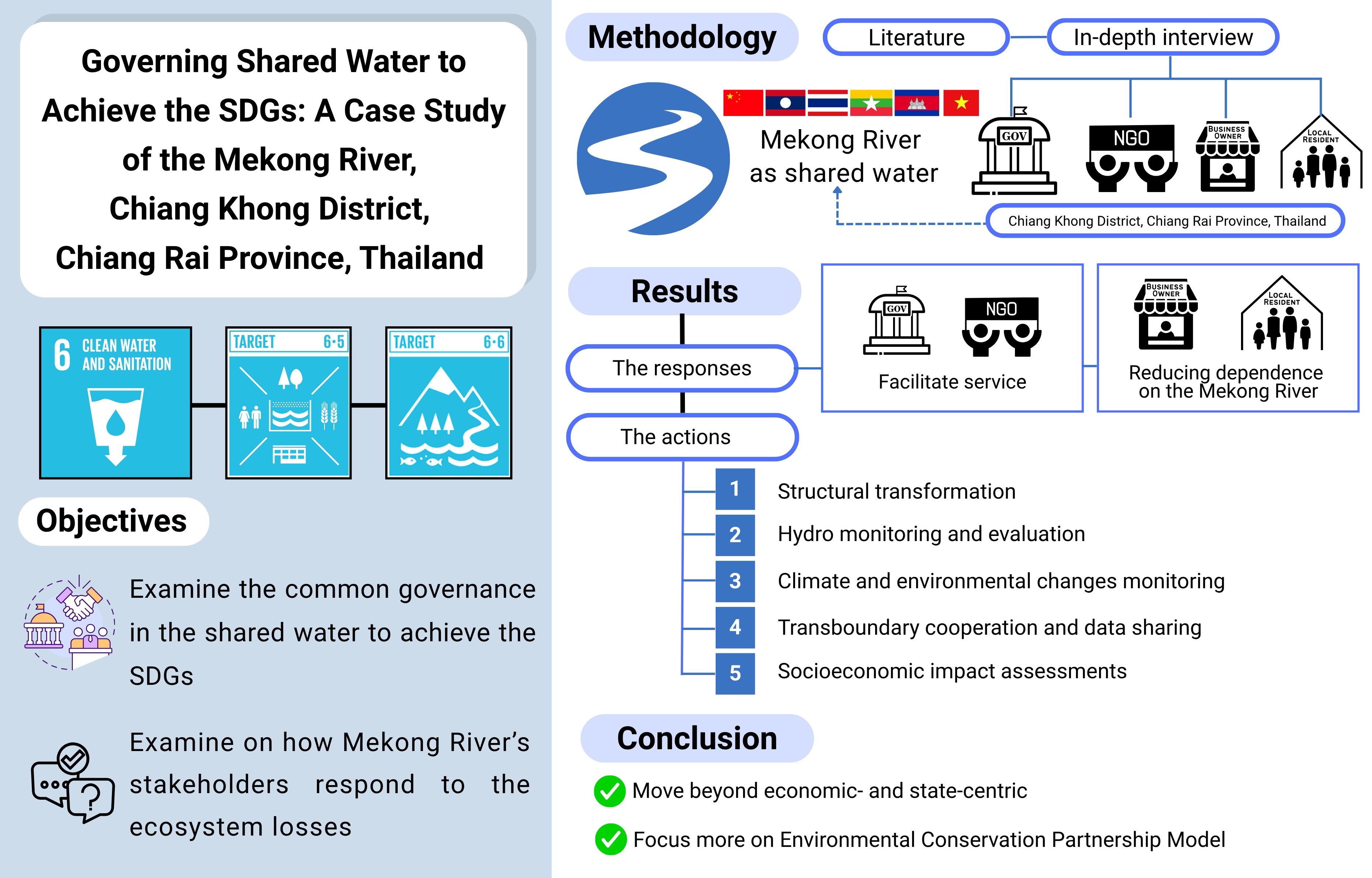
Water is crucial for life, ecosystems, and economic activities, necessitating its equitable distribution and sustainable management to achieve the United Nations’ Sustainable Development Goals (SDGs). SDG 6, “clean water and sanitation,” includes specific emphasis on integrated water resources management (IWRM) and the protection and restoration of water-related ecosystems, which are mentioned in targets 6.5 and 6.6. Implementation of IWRM frameworks involving governments, local communities, and civil society is essential for effective shared water governance. This study examines the Mekong River Basin as a shared river basin that is exacerbated by rapid economic development and hydropower projects that reduce sediment flow, disrupting ecosystems and local livelihoods. The study utilized qualitative research, in which the data were collected by in-depth interviews with a purposive sampling method based on the Chiang Khong population’s career sector and the relevant literature. It has been found that governance challenges in managing shared water resources include complex political dynamics and inadequate legal frameworks, and the absence of inclusive decision-making exacerbates tensions among riparian countries. Addressing these challenges requires a holistic approach that considers ecological, socio-economic, and political factors. Applying the concept of governing the commons to the Mekong Basin faces challenges, especially power imbalances and competing interests. However, it offers opportunities for cooperation and collective action. Stakeholders, including national governments, the private sector, NGOs, and local residents, play unique roles in promoting sustainable water management. This study advocates for a holistic approach to water governance, integrating ecological, socio-economic, and political considerations and emphasizes the roles of national governments, the private sector, NGOs, and local communities in promoting sustainable water management. Addressing the shared water issues requires multi-stakeholder collaboration to achieve the SDG targets and ensure the Mekong Basin’s long-term water resource and ecosystem sustainability.
Downloads
Article Details

This work is licensed under a Creative Commons Attribution-NonCommercial-NoDerivatives 4.0 International License.
All rights reserved. Apart from citations for the purposes of research, private study, or criticism and review,no part of this publication may be reproduced, stored or transmitted in any other form without prior written permission by the publisher.
References
Agrawal, A., & Ostrom, E. (2001). Collective action, property rights, and decentralization in resource use in India and Nepal. Politics & Society, 29(4), 485–514. https://doi.org/10.1177/003232920102900400
Ansell, C., & Gash, A. (2008). Collaborative governance in theory and practice. Journal of Public Administration Research and Theory, 18(4), 543–571.
Armitage, D., Marschke, M., & Plummer, R. (2009). Adaptive co-management and the paradox of learning. Global Environmental Change, 19(1), 14–24. https://doi.org/10.1016/j.gloenvcha.2008.11.001
Bakker, K. (2010). Privatizing water: Governance failure and the world's urban water crisis. Cornell University Press.
Berkes, F. (2009). Evolution of co-management: Role of knowledge generation, bridging organizations and social learning. Journal of Environmental Management, 90(5), 1692–1702. https://doi.org/10.1016/j.jenvman.2008.12.001
Blaikie, P. (1985). The political economy of soil erosion in developing countries. Routledge. https://doi.org/10.4324/9781315637556
Blaikie, P., & Brookfield, H. (1987). Land degradation and society. Routledge.
Bryant, L. R. (1992). Political ecology: An emerging research agenda in Third-World studies. Political Geography, 11(1). 12–36. https://doi.org/10.1016/0962-6298(92)90017-N
Chheang, V. (2010). Environmental and economic cooperation in the Mekong region. Asia Europe Journal, 8(3), 359–368.
Cinner, J. E., Daw, T., & McClanahan, T. R. (2012). Socioeconomic factors that affect artisanal fishers’ readiness to exit a declining fishery. Conservation Biology, 26(5), 1–7. https://doi.org/10.1111/j.1523-1739.2012.01924.x
Cockburn, A., & Ridgeway, J. (1979). Political ecology. Times Books.
Delli Priscoli, J. (1996). The evolution of principles and practices in international water resources management. Water International, 21(2), 96–104.
Dinar, S., Katz, D., & De Stefano, L. (2015). International water treaties: Negotiation and cooperation along transboundary rivers. Routledge.
Duc, H. A., Sabin, L. L., Cuong, L. Q., Thien, D. D., & Feeley, R. (2012). Potential collaboration with the private sector for the provision of ambulatory care in the Mekong region, Vietnam. Global Health Action, 5(10126), Article 10126. https://doi.org/10.3402/gha.v5i0.10126
Eyler, B. (2020). 2020 status of Lower Mekong Mainstream and tributary dams [Infographic]. Stimson. https://www.stimson.org/2020/2020-status-of-lower-mekong-mainstream-and-tributary-dams/
Gari, R. S., Newton, A., Icely, J. D., & Delgado-Serrano, M. M. (2022). An analysis of the global applicability of Ostrom’s design principles to diagnose the functionality of common-pool resource institutions. Sustainability, 9(7), Article 1287. https://doi.org/10.3390/su9071287
Giordano, M., Giordano, M. A., & Wolf, A. T. (2007). The geography of water conflict and cooperation: Internal pressures and international manifestations. Geographical Journal, 168(4), 293–312.
Gray, B. (1989). Collaborating: Finding common ground for multiparty problems. Jossey-Bass.
Greenberg, J. B., & Park, T. K., (1994). Political ecology. Journal of Political Ecology, 1(1), 1–12. https://doi.org/10.2458/v1i1.21154
Ha, M.-L. (2011). The role of regional institutions in sustainable development: A review of the Mekong River commission first 15 years. Consilience: The Journal of Sustainable Development, 5(1), 125–140. https://doi.org/10.7916/consilience.v0i5.4436
Haefner, A. (2023). Water governance in the Mekong region: The role and impact of civil society organizations. Water International, 49(3–4), 310–317. https://doi.org/10.1080/02508060.2024.2321777
Hardin, G. (1968). The tragedy of the commons. Science, 162(3859), 1243–1248. http://www.jstor.org/stable/1724745
Hensengerth, O. (2015). Environmental security and transboundary water politics in the Greater Mekong Subregion. Environmental Politics, 24(4), 607–626.
Hirsch, P. (2010). The changing political dynamics of dam building on the Mekong. Water Alternatives, 3(2), 312–323.
IFAD. (2021, November 11). Public-private partnerships accelerate climate change adaptation in Viet Nam. https://www.ifad.org/en/web/latest/-/ppp-viet-nam
Kallio, M., & Fallon, A. (2020, April 28). CRITICAL NATURE: Are China’s dams on the Mekong causing downstream drought? The importance of scientific debate. Resource politics, Critical Nature, Chulalongkorn University. https://www.csds-chula.org/publications/2020/4/28/critical-nature-are-chinas-dams-on-the-mekong-causing-downstream-drought-the-importance-of-scientific-debate
Kim, S.-Y., & Thuc, L. D. (2020). Sustainable location selection for investing in public–private partnership infrastructure projects: From a developing country’s perspective. Sustainability, 12(15), Article 5914. https://doi.org/10.3390/su12155914
Korwatanasakul, U., & Durongkaveroj, W. (2022). Water politics in the Greater Mekong Subregion: Implications and challenges on Thailand’s border trade and inbound labour immigration. In B. Chellaney & F. Kliem (Eds.), The displaced: disrupted trade, labour, and politics in the Mekong River Basin (pp. 256–281). The Konrad-Adenauer-Stiftung’s Regional Economic Programme Asia (SOPAS).
Kummu, M., & Sarkkula, J. (2008). Impact of the Mekong River flow alteration on the Tonle Sap flood pulse. Ambio, 37(3), 185–192.
Leach, M., Mearns, R., & Scoones, I. (1999). Environmental entitlements: Dynamics and institutions in community-based natural resource management. World Development, 27(2), 225–247. https://doi.org/10.1016/s0305-750x(98)00141-7
Magee, D., & Kelley, S. (2009). Damming the Salween River. In F. Molle, P. Sookhem, T. Foran, & M. Käkönen (Eds.), Contested waterscapes in the Mekong Region (pp. 115–140). Earthscan.
Mekong River Commission. (2004). MRC annual report 2004. https://www.mrcmekong.org/publications/mrc-annual-report-2004/
Mekong River Commission. (2018). MRC annual Mekong flood report 2015. https://www.mrcmekong.org/publications/annual-mekong-flood-report-2015/
Mirumachi, N. (2015). Transboundary water politics in the developing world. Routledge.
Mueller, S. (2009). Institutional Quality and Competitiveness in the Greater Mekong Subregion. In United Nations Economic and Social Commission for Asia and the Pacific, Studies in trade and investment 66. Impact of trade facilitation on export competitiveness: A regional perspective (pp. 89–120). United Nations Publication. https://hdl.handle.net/20.500.12870/360
Open Development Mekong. (2015, February 6). Hydropower dams. https://opendevelopmentmekong.net/topics/hydropower/#_edn3
Ostrom, E. (1990). Governing the commons: The evolution of institutions for collective action. Cambridge University Press.
Provan, K. G., & Kenis, P. (2008). Modes of network governance: Structure, management, and effectiveness. Journal of Public Administration Research and Theory, 18(2), 229–252.
Randhir, T. O. (2016). Globalization impacts on local commons: Multiscale strategies for socioeconomic and ecological resilience, International Journal of the Commons, 10(1), 387–404. https://doi.org/10.18352/ijc.517
Rasche, A., & Waddock, S. (2014). Global Sustainability governance and the UN global compact: A rejoinder to critics. Journal of Business Ethics, 122(2), 209–216.
Reed, M. S. (2008). Stakeholder participation for environmental management: A literature review. Biological Conservation, 141(10), 2417–2431.
Reed, M. S. (2009). Who's in and why? A typology of stakeholder analysis methods for natural resource management. Journal of Environmental Management, 90(5), 1933–1949.
Schlager, E., & Ostrom, E. (1992). Property-rights regimes and natural resources: A conceptual analysis. Land Economics, 68(3), 249–262. http://dx.doi.org/10.2307/3146375
Schmeier, S. (2009). Regional cooperation efforts in the Mekong River Basin: Mitigating river-related security threats and promoting regional development. ASEAS, 2(2), 28–52.
The Development Dimension. (2020). Innovation for water infrastructure development in the Mekong Region. https://www.mekonginstitute.org/uploads/tx_ffpublication/Innovation_for_water_infrastructure_in_Mekong_region_updated.pdf
The United Nations. (2015). Sustainable development goals. https://documents.un.org/doc/undoc/gen/n15/291/89/pdf/n1529189.pdf?token=As84W4JzjjvkFWglwU&fe=true
Warner, J. (2006). More sustainable participation? Multi-stakeholder platforms for integrated catchment management. International Journal of Water Resources Development, 22(1), 15–35.
Watts, M. (2000). Political ecology. In E. Sheppard & J. T. Barnes (Eds.), A companion to economic geography (pp. 257–274). Blackwell.
Wolf, A. T., Kramer, A., Carius, A., & Dabelko, G. D. (2003). Managing and transforming water conflicts. Cambridge University Press.
Wouters, E., (2012). Multistakeholder partnerships in global health: The case of HIV/AIDS. Social Science & Medicine, 74(4), 502–509.
Yun, G., Williams, S., & Wenbin, D. (2017). Water management of the Mekong River. Malaysian Journal of Sustainable Agriculture. 1(2). 15–17. https://doi.org/10.26480/mjsa.02.2017.15.17
Yusuda, Y. (2014). Formal rules, informal norms and advocacy strategies of NGOs: Lessons from the Mekong River (Research Brief Series No. 1). Centre for Water Law, Policy and Science, University of Dundee. https://doi.org/10.13140/RG.2.1.1317.5848
Zeitoun, M., & Warner, J. (2006). Hydro-hegemony – A framework for analysis of trans-boundary water conflicts. Water Policy, 8(5). 435–460. https://doi.org/10.2166/wp.2006.054
Zeitoun, M., Allan, J. A., & Alatout, S. (2016). The hydro-social contract and its discontents: A political ecology of Nile waters. Water International, 41(1), 105–120.
