
Youth acceptance and challenges in expanding shared mobility in Japan: A case study of Sapporo, Hokkaido
Article Sidebar
Main Article Content
Abstract
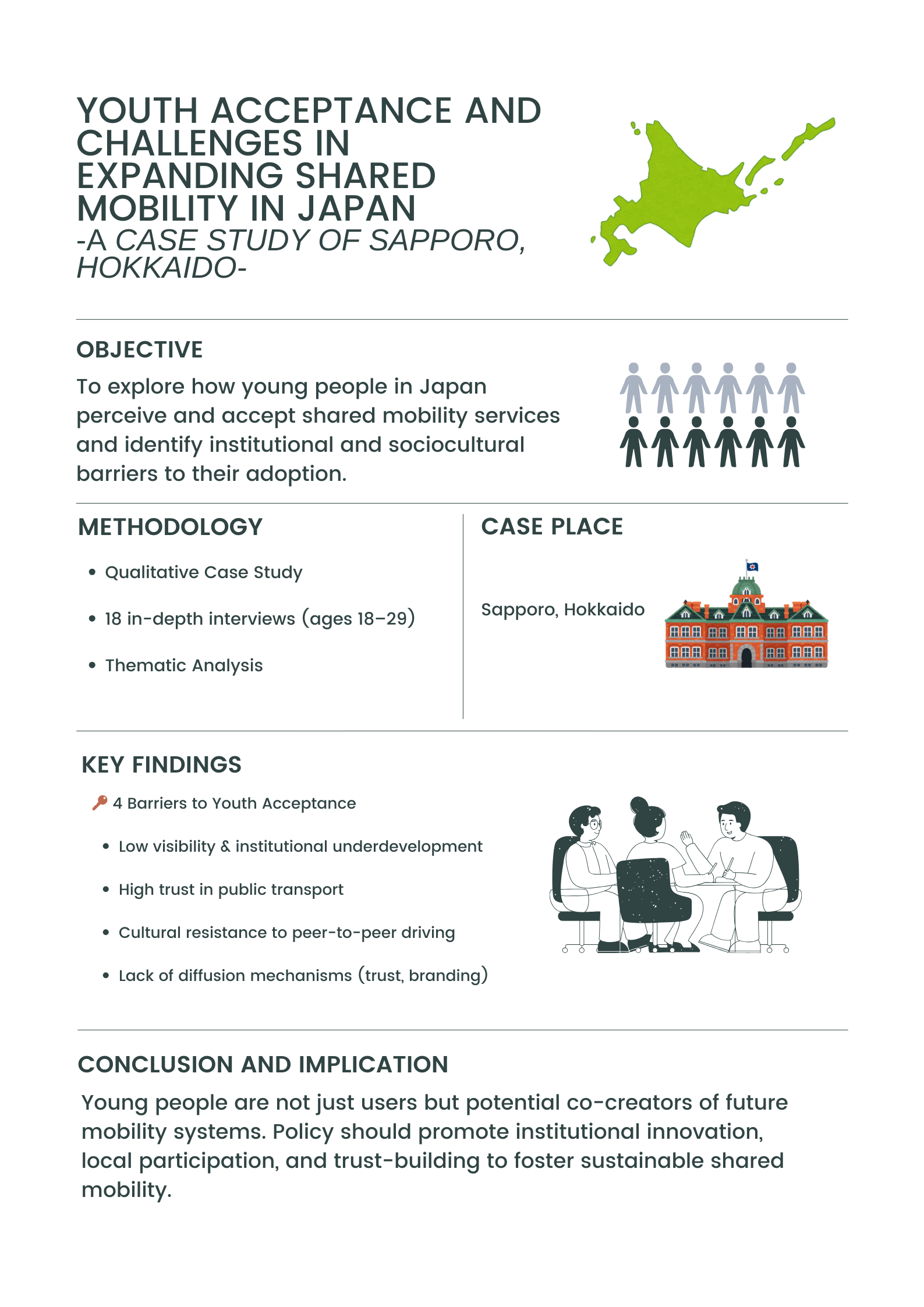
Shared mobility services, including ride-hailing and carpooling, are attracting growing attention in Japan as alternatives to challenges such as population decline, taxi driver shortages, and ageing transport infrastructure. In April 2024, the Japanese government partially relaxed regulations on paid ride services to alleviate urban taxi shortages. However, institutional rigidity, socio-cultural resistance, and a fragmented infrastructure continue to impede widespread adoption. While platform-based mobility is expanding globally, uptake in Japan remains limited due to entrenched institutional and cultural barriers. Young people are expected to play a vital role as future users and providers of shared mobility services. Yet empirical research on their perceptions and acceptance remains scarce, hindering the development of sustainable and inclusive transport policies. This study investigates how youth aged 18 to 29 in Sapporo, Hokkaido, understand and engage with shared mobility through in-depth interviews of 18 participants. Through thematic analysis, the following four factors emerged as elements influencing acceptance: (a) the underdevelopment of services in terms of institution building and visibility; (b) differentiation from well-developed existing services; (c) necessity of proper matching of shared activities and specific national characteristics; and (d) understanding the social diffusion mechanisms behind service adoption. These findings suggest that youth engagement is not merely about convenience or cost but reflects deeper institutional and sociocultural dynamics. Although digitally literate and open to new technologies, young people remain cautious due to concerns over legal ambiguity, social norms, and expectations around service quality. Drawing on insights from a non-metropolitan context, this study repositions youth as co-creators rather than passive users of mobility systems. It argues that shared mobility in Japan should be reconceptualised as part of the broader social infrastructure, requiring institutional innovation, regulatory flexibility, and participatory governance grounded in the notion of social common capital.
Downloads
Article Details

This work is licensed under a Creative Commons Attribution-NonCommercial-NoDerivatives 4.0 International License.
All rights reserved. Apart from citations for the purposes of research, private study, or criticism and review,no part of this publication may be reproduced, stored or transmitted in any other form without prior written permission by the publisher.
References
Abe, N. (2017). How can we understand the differences between France and Japan in the growth of shared mobility services?: The paradox of trust and its social construction. CEAFJP Discussion Paper Series 17-01. The Centre d'études avancées franco-japonais de Paris (CEAFJP). https://hal.science/hal-01670789
Aguiléra, A., & Pigalle, E. (2021). The future and sustainability of carpooling practices. An identification of research challenges. Sustainability, 13(21), Article 11824. https://doi.org/10.3390/su132111824
Altura, T. G., Hashimoto, Y., Jacoby, S. M., Kanai, K., & Saguchi, K. (2021). Japan meets the sharing economy: Contending frames. Social Science Japan Journal, 24(1), 137–161. https://doi.org/10.1093/ssjj/jyaa041
Boddy, C. R. (2016). Sample size for qualitative research. Qualitative Market Research: An International Journal, 19(4), 426–432. https://doi.org/10.1108/QMR-06-2016-0053
Braun, V., & Clarke, V. (2006). Using thematic analysis in psychology. Qualitative research in psychology, 3(2), 77–101. https://doi.org/10.1191/1478088706qp063oa
Butler, L., Yigitcanlar, T., & Paz, A. (2021). Barriers and risks of Mobility-as-a-Service (MaaS) adoption in cities: A systematic review of the literature. Cities, 109, Article 103036. https://doi.org/10.1016/j.cities.2020.103036
Castellanos, S., Grant-Muller, S., & Wright, K. (2021). Technology, transport, and the sharing economy: Towards a working taxonomy for shared mobility. Transport reviews, 42(3), 318–336. https://doi.org/10.1080/01441647.2021.1968976
City of Sapporo. (2024, May 15). Unten menkyo hoyu sha su [Number of driving licence holders]. https://www.city.sapporo.jp/toukei/jinko/suikei-jinko/suikei-jinko.html [in Japanese]
Davis, F. D. (1989). Perceived usefulness, perceived ease of use, and user acceptance of information technology. MIS Quarterly, 13(3), 319–340. https://doi.org/10.2307/249008
Dewan, K. K., & Ahmad, I. (2007). Carpooling: A step to reduce congestion (A case study of Delhi). Engineering Letters, 14(1), 61–66.
Farrugia, D. (2016). The mobility imperative for rural youth: The structural, symbolic and non-representational dimensions rural youth mobilities. Journal of Youth Studies, 19(6), 836–851. https://doi.org/10.1080/13676261.2015.1112886
Fors, P., Inutsuka, Y., Majima, T., & Orito, Y. (2021). Is the meaning of the “sharing economy” shared among us? Comparing the perspectives of Japanese and Swedish policymakers and politicians. The Review of Socionetwork Strategies, 15(1), 107–121. https://doi.org/10.1007/s12626-021-00070-z
Fujimoto, K. (2023, December 20). “Rideshare” 24 nen 4 gatsu ni gentei kaikin zenmen donyu ni gyokai teikou [Industry resistance to the full introduction of a limited ban on “rideshare” on April 2024]. Nihon Keizai Shimbun. https://www.nikkei.com/article/DGXZQOUA18C7U0Y3A211C2000000/ [in Japanese]
Fujisaki, K., Yasuda, T., Ishigami, T., Makimura, K., & Ishida, H. (2022). Empirical recommendations based on case studies in Japan for sustainable innovative mobility in rural areas. Asian Transport Studies, 8, Article 100079. https://doi.org/10.1016/j.eastsj.2022.100079
Furuhata, M., Dessouky, M., Ordóñez, F., Brunet, M.-E., Wang, X., & Koenig, S. (2013). Ridesharing: The state-of-the-art and future directions. Transportation Research Part B: Methodological, 57, 28–46. https://doi.org/10.1016/j.trb.2013.08.012
Google. (n.d.). [Google Maps view of Hokkaido and Sapporo City, Japan] [Map]. Retrieved September 8, 2024, from https://www.google.com/maps
Guyader, H., Friman, M., & Olsson, L. E. (2021). Shared mobility: Evolving practices for sustainability. Sustainability, 13(21), Article 12148. https://doi.org/10.3390/su132112148
Hokkaido Prefectural Police. (2023). Kourei untensha (1 tou) no koutsu jiko jittai [Actual road traffic accidents among older drivers (1st category)]. https://www.police.pref.hokkaido.lg.jp/info/koutuu/koureisha/jittai_kako5.pdf [in Japanese]
Hokkaido Prefecture. (2022a). Hokkaido Databook 2022. https://www.pref.hokkaido.lg.jp/ss/tkk/databook/ [in Japanese]
Hokkaido Prefecture. (2022b, November 11). Hokkaido no kaso taisaku [Measures to combat depopulation in Hokkaido]. https://www.pref.hokkaido.lg.jp/ss/ckk/chicho/kaso_taisaku.html [in Japanese]
Ikezoe, K., Kiriyama, E., & Fujimura, S. (2020). Car-sharing intention analysis in Japan by comparing the utility of car ownership for car-owners and non-car owners. Transport Policy, 96, 1–14. https://doi.org/10.1016/j.tranpol.2020.05.018
Japan Federation of Hire-Taxi Associations. (2022). Taxi today in Japan in 2022. http://www.taxi-japan.or.jp/pdf/Taxi_Today_2022.pdf [in Japanese]
Japan Federation of Hire-Taxi Associations. (2023). Taxi unten sha chingin roudou jikan no genkyou [Current status of taxi driver wages and working hours]. http://www.taxi-japan.or.jp/pdf/toukei_chousa/tinginR4.pdf [in Japanese]
Jido Unten Labo. (2024, August 26). Rideshare towa? (2024 nen saishin ban) nihon no kaikin jyokyo ya sannyu kigyo matome [What is rideshare? (2024 latest edition) summary of Japan’s ban on the ban and participating companies]. https://jidounten-lab.com/u_rideshare-rule-japan#33 [in Japanese]
Junior Chamber International Nagano. (2023). Kawaru chihou, kaeru Nagano. Changing provinces, changing Nagano. https://nagano-jc.or.jp/70thkouenkai/ [in Japanese]
Kawaguchi, T., Murata, H., Fukushige, S., & Kobayashi, H. (2019). Scenario analysis of car-and ride-sharing services based on life cycle simulation. Procedia CIRP, 80, 328–333. https://doi.org/10.1016/j.procir.2019.01.051
Machado, C. A. S., de Salles Hue, N. P. M., Berssaneti, F. T., & Quintanilha, J. A. (2018). An overview of shared mobility. Sustainability, 10(12), Article 4342. https://doi.org/10.3390/su10124342
Mainichi Shimbun. (2024, August 24). Nihon ban rideshare, Sapporo demo hajimatta ga... Hokkaido deno katsuyaku wa fuyu? [Japan's version of ride-sharing has started in Sapporo, but ... Is it winter in Hokkaido?]. https://mainichi.jp/articles/20240823/k00/00m/040/357000c [in Japanese]
Majima, T., Fors, P., Inutsuka, Y., & Orito, Y. (2021). Is the meaning of the “sharing economy” shared among us? Comparing the perspectives of Japanese and Swedish researchers. The Review of Socionetwork Strategies, 15(1), 87–106. https://doi.org/10.1007/s12626-021-00068-7
Malterud, K., Siersma, V. D., & Guassora, A. D. (2016). Sample size in qualitative interview studies: Guided by information power. Qualitative Health Research, 26(13), 1753–1760. https://doi.org/10.1177/1049732315617444
Marshall, B., Cardon, P., Poddar, A., & Fontenot, R. (2013). Does sample size matter in qualitative research?: A review of qualitative interviews in is research. Journal of Computer Information Systems, 54(1), 11–22. https://doi.org/10.1080/08874417.2013.11645667
Mason, M. (2010). Sample size and saturation in PhD studies using qualitative interviews. Forum Qualitative Sozialforschung / Forum: Qualitative Social Research, 11(3), Article 8. http://www.qualitative-research.net//index.php/fqs/article/view/1428/3027
Miyasaka, N., & Hihara, K. (2021). Sharing economy as a means to solve regional issues – An analysis of sharing economy in Japan based on data survey and modelling the market structures –. Proceedings of JITR Annual Conference, 36, 105–110. https://doi.org/10.18979/jitrproceedings.36.0_105
Mobility Transportation. (2019, September 25). Ride share service no nihon sannyu hukyu wo sogai shiteiru shouheki towa [What are the barriers preventing the entry and spread of ridesharing services in Japan?]. https://mobility-transformation.com/magazine/rideshare/
Morse, J. M. (1995). The significance of saturation. Qualitative Health Research, 5(2), 147–149. https://doi.org/10.1177/104973239500500201
Mulley, C., Nelson, J. D., Ho, C., & Hensher, D. A. (2023). MaaS in a regional and rural setting: Recent experience. Transport Policy, 133, 75–85. https://doi.org/https://doi.org/10.1016/j.tranpol.2023.01.014
Nakamura, A. (2022). New competition in regulated service markets after the smartphone diffusion: Regulations on ride-hailing services in Japan. In T. Jitsuzumi & H. Mitomo (Eds.), Policies and challenges of the broadband ecosystem in Japan (pp. 153–170). Springer Nature Singapore. https://doi.org/10.1007/978-981-16-8004-5_7
Neoh, J. G., Chipulu, M., & Marshall, A. (2017). What encourages people to carpool? An evaluation of factors with meta-analysis. Transportation, 44(2), 423–447. https://doi.org/10.1007/s11116-015-9661-7
Olsson, L. E., Maier, R., & Friman, M. (2019). Why do they ride with others? Meta-analysis of factors influencing travelers to carpool. Sustainability, 11(8), Article 2414. https://doi.org/10.3390/su11082414
Orita, T. (2024, September 27). Sapporo ken rideshare waku kakudai bun ni 20 sha shinsei [Sapporo area ride-sharing 20 companies applied for expansion]. Hokkaido Shimbun. https://www.hokkaido-np.co.jp/article/1068180/ [in Japanese]
Patulny, R. V., & Lind Haase Svendsen, G. (2007). Exploring the social capital grid: Bonding, bridging, qualitative, quantitative. International Journal of Sociology and Social Policy, 27(1/2), 32–51. https://doi.org/10.1108/01443330710722742
Putnam, R. D. (1994). Social capital and public affairs. Bulletin of the American Academy of Arts and Sciences, 47(8), 5–19. https://doi.org/10.2307/3824796
Rogers, E. M., Singhal, A., & Quinlan, M. M. (2019). Diffusion of innovations. In D. W. Stacks, M. B. Salwen, & K. C. Eichhorn (Eds.), An integrated approach to communication theory and research (3rd ed., pp. 432–448). Routledge. https://doi.org/10.4324/9780203710753-35
Sarfo, J. O., Debrah, T. P., Gbordzoe, N. I., Afful, W. T., & Obeng, P. (2021). Qualitative research designs, sample size and saturation: Is enough always enough? Journal of Advocacy, Research and Education, 8(3), 60–65. http://dx.doi.org/10.13187/jare.2021.3.60
Saunders, M. N. K., Lewis, P., Thornhill, A., & Bristow, A. (2019). Understanding research philosophy and approaches to theory development. In M. N. K. Saunders, P. Lewis, & A. Thornhill (Eds.), Research methods for business students (8th ed., pp. 128–171). Pearson.
Shaheen, S. (2018). Shared mobility: The potential of ridehailing and pooling. In D. Sperling (Ed.), Three revolutions: Steering automated, shared, and electric vehicles to a better future (pp. 55–76). Island Press. https://doi.org/10.5822/978-1-61091-906-7_3
Sharing Economy Association. (2022, January 18). Sharing economy kyokai “sharing economy shijyo chousa 2021” wo happyou [Sharing economy association “sharing economy market survey 2021 edition”]. https://prtimes.jp/main/html/rd/p/000000064.000022734.html [in Japanese]
Sheller, M., & Urry, J. (2006). The new mobilities paradigm. Environment and Planning A: Economy and Space, 38(2), 207–226. https://doi.org/10.1068/a37268
Sheller, M., & Urry, J. (2016). Mobilizing the new mobilities paradigm. Applied Mobilities, 1(1), 10–25. https://doi.org/10.1080/23800127.2016.1151216
Thelen, T., & Oguma, H. (2021). Local governance of public transport services: Maintaining identity and independence after the Heisei mergers. In S. Ganseforth & H. Jentzsch (Eds.), Rethinking locality in Japan (pp. 153–167). Routledge.
Uchiyama, Y. (2025a). Sustainable shared mobility as social common capital: Conceptual framework and case analysis. Mobilities, 1–21. https://doi.org/10.1080/17450101.2025.2510513
Uchiyama, Y. (2025b). Sustainable shared mobility in depopulated Japan: A case of Teshio, Hokkaido. Japan Forum, 1–23. https://doi.org/10.1080/09555803.2025.2523485
Uchiyama, Y., & Furuoka, F. (2025). Uberisation and resistance to online food delivery gig work in Asia: Lessons from Malaysia. Journal of Contemporary Asia, 1–18. https://doi.org/10.1080/00472336.2024.2449081
Uchiyama, Y., Furuoka, F., & Akhir, M. N. M. (2022). Gig workers, social protection and labour market inequality: Lessons from Malaysia. Jurnal Ekonomi Malaysia, 56(3), 165–184. http://dx.doi.org/10.17576/JEM-2022-5603-09
Uzawa, H. (2005). Economic analysis of social common capital. Cambridge University Press.
Watanabe, C., Naveed, K., Neittaanmäki, P., & Fox, B. (2017). Consolidated challenge to social demand for resilient platforms-Lessons from Uber’s global expansion. Technology in Society, 48, 33–53. https://doi.org/10.1016/j.techsoc.2016.10.006
Zhang, H., Chen, J., Li, W., Song, X., & Shibasaki, R. (2020). Mobile phone GPS data in urban ride-sharing: An assessment method for emission reduction potential. Applied Energy, 269, Article 115038. https://doi.org/10.1016/j.apenergy.2020.115038
