
Thai parental roles in English learning: From sponsors to peer learners and role models
Article Sidebar
Main Article Content
Abstract
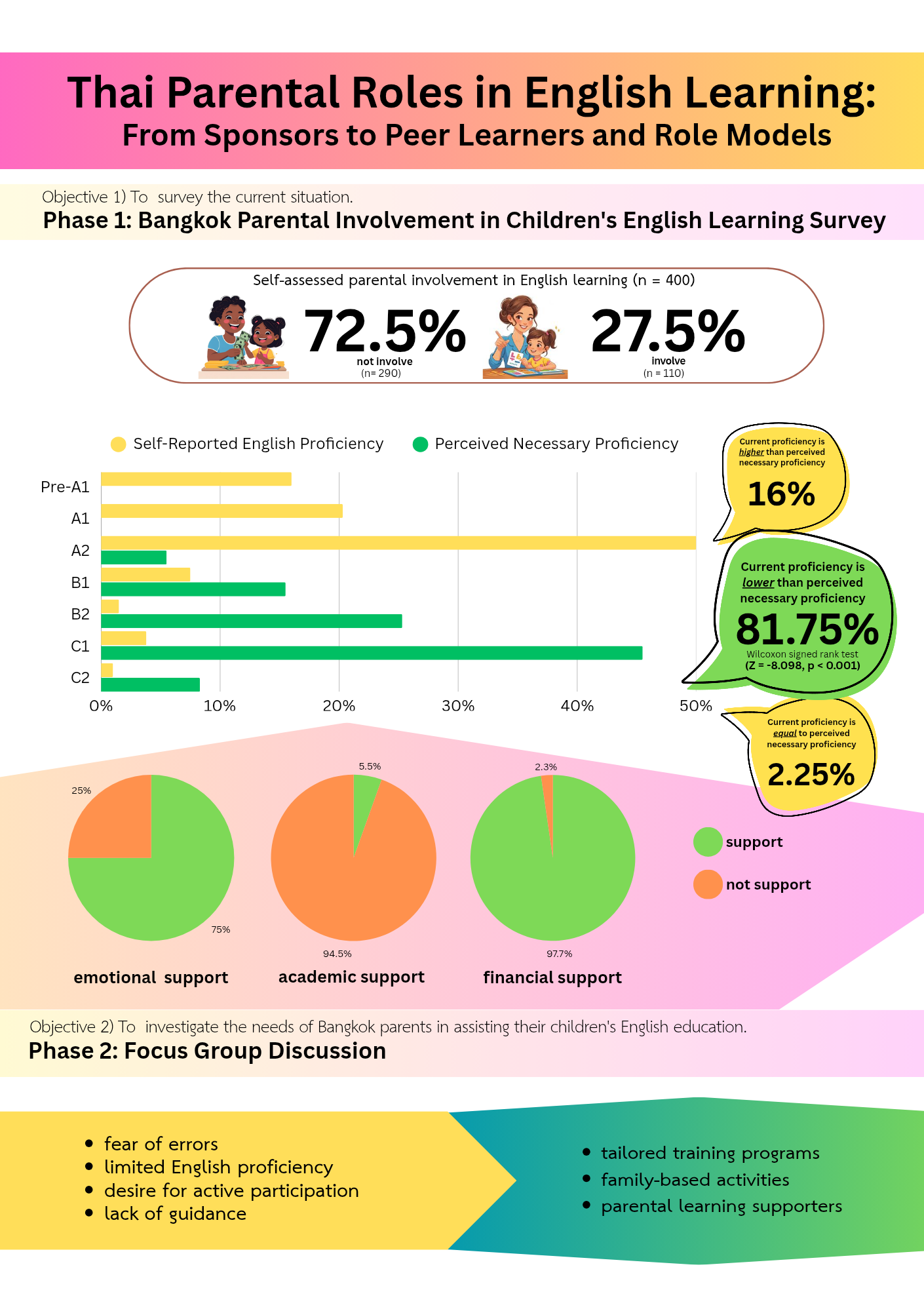
This research aimed to explore the roles of Thai parents in supporting their children’s English learning in Bangkok where English is rarely used outside the classroom. The mixed-method study sought to promote parental involvement beyond the traditional role of financial sponsor, encouraging parents to be role models, peer learners, and active participants in language development. In Phase 1, a literature review and survey of 400 parents in Bangkok were conducted to assess current levels of involvement. In Phase 2, focus group discussions with 15 parents explored their perspectives on supporting English learning, obstacles they face, and the support they need. Data were analyzed using descriptive statistics, the Wilcoxon signed-rank test, and content analysis. The results showed that while parents were willing to act as peer learners, many lacked confidence in serving as role models due to their limited English proficiency (81.75%). Most parents provided financial support (97.8%) and emotional encouragement (75%), but only a small number offered academic support (5.5%). Parents emphasized the need for specific training in phoneme perception and reading aloud, as well as opportunities for family-based English activities. They also requested training to be better peer learners, emotional supporters, and role models. Recommendations for educational policy and parent training programs were proposed to help parents engage more effectively in their children’s English education.
Downloads
Article Details

This work is licensed under a Creative Commons Attribution-NonCommercial-NoDerivatives 4.0 International License.
All rights reserved. Apart from citations for the purposes of research, private study, or criticism and review,no part of this publication may be reproduced, stored or transmitted in any other form without prior written permission by the publisher.
References
Baker, C., Clayton, S., & Bragg, E. (2021). Educating for resilience: Parent and teacher perceptions of children’s emotional needs in response to climate change. Environmental Education Research, 27(5), 687–705. https://doi.org/10.1080/13504622.2020.1828288
Bennett, K. K., Weigel, D. J., & Martin, S. S. (2002). Children’s acquisition of early literacy skills: Examining family contributions. Early Childhood Research Quarterly, 17(3), 295–317. https://doi.org/10.1016/S0885-2006(02)00166-7
Boonsuk, Y., Wasoh, F., & Ambele, E. A. (2024). Global Englishes pedagogical activities for English-as-a-foreign language settings and beyond: Understanding Thai teachers’ practices. RELC Journal, 55(2), 379–393. https://doi.org/10.1177/00336882221112193
Creswell, J. W. (2003). Research design: Qualitative, quantitative, and mixed methods approaches. Sage.
Forey, G., Besser, S., & Sampson, N. (2016). Parental involvement in foreign language learning: The case of Hong Kong. Journal of Early Childhood Literacy, 16(3), 383–413. https://doi.org/10.1177/1468798415597469
Heidlage, J. K., Cunningham, J. E., Kaiser, A. P., Trivette, C. M., Barton, E. E., Frey, J. R., & Roberts, M. Y. (2020). The effects of parent-implemented language interventions on child linguistic outcomes: A meta-analysis. Early Childhood Research Quarterly, 50(Part 1), 6–23. https://doi.org/10.1016/j.ecresq.2018.12.006
Iwaniec, J. (2020). The effects of parental education level and school location on language learning motivation. The Language Learning Journal, 48(4), 427–441. https://doi.org/10.1080/09571736.2017.1422137
Jetiyanuwat, S., Kawilapat, S., Narkpongphun, A., & Pojanapotha, P. (2024). Association between family functioning, child emotional and behavioral problems, and parental stress during the COVID-19 pandemic in Thailand. Behavioral Sciences, 14(4), Article 270. https://doi.org/10.3390/bs14040270
Jeynes, W. H. (2007). The relationship between parental involvement and urban secondary school student academic achievement: A meta-analysis. Urban Education, 42(1), 82–110. https://doi.org/10.1177/0042085906293818
Kamalanavin, V. (2015). Raising Thai-English bilingual children in a native Thai family: Worth a try or waste of time. Pasaa Paritat Journal, 30, 251–279. https://www.culi.chula.ac.th/Images/asset/pasaa_paritat_journal/file-10-104-tluzbd045818.pdf
Kanta, S., Kiddee, K., & Ratanaolarn, T. (2024). The expectations of lecturers and employers towards work-integrated learning in the fields of hospitality and tourism education. Humanities, Arts and Social Sciences Studies, 24(2), 292–302. https://doi.org/10.69598/hasss.24.2.265518
Korosidou, E., Griva, E., & Pavlenko, O. (2021). Parental involvement in a program for preschoolers learning a foreign language. International Journal of Research in Education and Science, 7(1), 112–124. https://doi.org/10.46328/ijres.1219
Naite, I. (2021). Impact of parental involvement on children’s academic performance at crescent international school, Bangkok, Thailand. IOP Conference Series: Earth and Environmental Science, 690, Article 012064. https://doi.org/10.1088/1755-1315/690/1/012064
Pechapan‐Hammond, S. (2020). English in Thailand. In K. Bolton, W. Botha, & A. Kirkpatrick (Eds.), The handbook of Asian Englishes (pp. 629–648). John Wiley & Sons.
Petchprasert, A. (2014). The influence of parents' backgrounds, beliefs about English learning, and a dialogic reading program on Thai kindergarteners' English lexical development. English Language Teaching, 7(3), 50–62. http://dx.doi.org/10.5539/elt.v7n3p50
Poonsup, U. (2024). Minimal contrast approach and English error pronunciation skills of Thai parents and guardians. Vacana, 12(1), 36–54. http://rs.mfu.ac.th/ojs/index.php/vacana/article/view/422
Pudpong, N., Julchoo, S., Sinam, P., Uansri, S., Kunpeuk, W., & Suphanchaimat, R. (2022). Family health among families with primary school children during the COVID pandemic in Thailand, 2022. International Journal of Environmental Research and Public Health, 19(22), Article 15001. https://doi.org/10.3390/ijerph192215001
Pudpong, N., Julchoo, S., Sinam, P., Uansri, S., Kunpeuk, W., & Suphanchaimat, R. (2023). Self-reported anxiety and depression among parents of primary school children during the COVID-19 pandemic in Thailand, 2022. International Journal of Environmental Research and Public Health, 20(9), Article 5622. https://doi.org/10.3390/ijerph20095622
Sara, H. (2023). Guided learning hours. Cambridge English. https://support.cambridgeenglish.org/hc/en-gb/articles/202838506-Guided-learning-hours
Seo, Y. (2025). The role of home language environment and parental efforts in children’s English development in an EFL context. Journal of Multilingual and Multicultural Development, 46(2), 273–287. https://doi.org/10.1080/01434632.2023.2177657
Tarasawa, B., & Waggoner, J. (2015). Increasing parental involvement of English language learner families: What the research says. Journal of Children and Poverty, 21(2), 129–134. https://doi.org/10.1080/10796126.2015.1058243
Vandeweyer, M., Espinoza, R., Reznikova, L., Lee, M., & Herabat, T. (2020). Thailand’s education system and skills imbalances: Assessment and policy recommendations (Working Papers No. 1641). OECD Publishing. https://doi.org/10.1787/b79addb6-en
