
Narrative strategy of myth and power in the play Dumadine Jeneng Dina Jawa
Article Sidebar
Main Article Content
Abstract
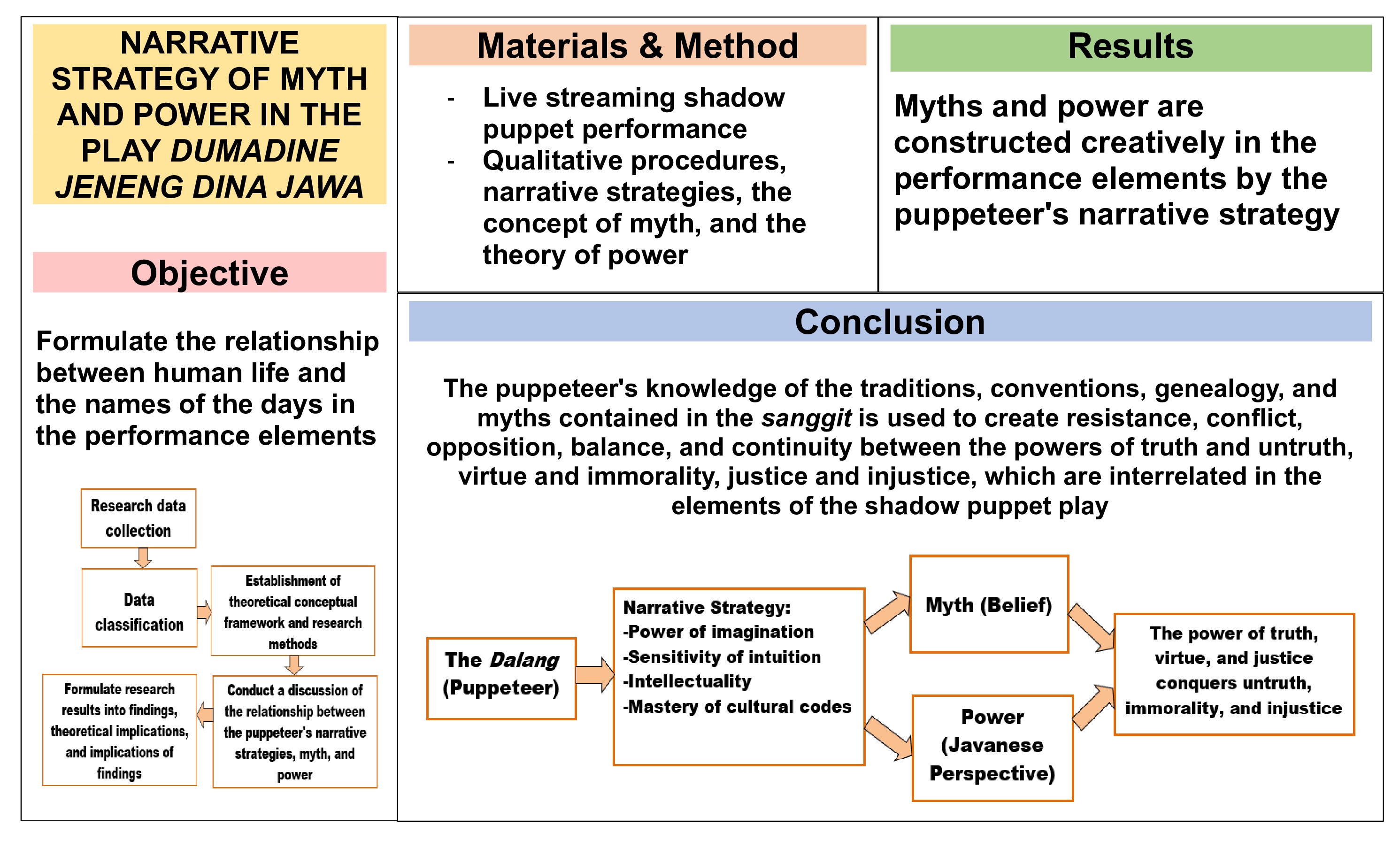
This article discusses the narrative strategy of myth and power in the play Dumadine Jeneng Dina Jawa (The Origin of Javanese Day Names), composed by Ki Purbo Asmoro. Javanese culture's time and space system is constructed in the shadow puppet play and presented in the performing arts. How the puppeteer's narrative strategy builds the concept of power, the play's structure in the performance as a text, and the time and space system as a context is a problem that needs to be solved in this article. This article aims to compile and formulate the relationship between Javanese human life and nature through the names of the days by examining the structure of the play text in the performance. The methodology for solving the problem uses Creswell’s qualitative procedures, narrative strategies developed by Darmoko, Van Peursen’s concept of myth, and Anderson’s theory of power, supported by Suseno. The results of the discussion show that (1) narrative strategies are built through the formation of supernatural characters (gods and goddesses) images, supported by instruments of time, place, and events, by arranging the names of days as a system of knowledge in the Javanese human life order. The time and space systems are visualized as living and non-living objects by placing narrative texts as dramas (conflicts) so that antagonists and protagonists emerge; (2) the concept of power is structured in the relationship between subject and object. Humans surrender to God diligently in a quiet place as a manifestation of the object. Power is manifested in the knowledge that comes from the perfection of the inner core of man.
Downloads
Article Details

This work is licensed under a Creative Commons Attribution-NonCommercial-NoDerivatives 4.0 International License.
All rights reserved. Apart from citations for the purposes of research, private study, or criticism and review,no part of this publication may be reproduced, stored or transmitted in any other form without prior written permission by the publisher.
References
Abbott, H. P. (2002). The Cambridge introduction to narrative. Cambridge University Press.
Ahmad, I. (2023). The power of storytelling: Exploring the cultural significance of narrative. Policy Research Journal, 1(1), 74–81. https://ipindexing.com/article/45094
Anderson, B. R. O. (1990). Language and power: Exploring political cultures in Indonesia. Cornell University Press.
Basuki, R. (2010). Negosiasi Identitas dan Kekuasaan dalam Wayang Kulit Jawa Timuran [Negotiation of identity and power in East Javanese shadow puppets] [Doctoral dissertation, Universitas Indonesia]. Universitas Indonesia Library UPT. https://lib.ui.ac.id/detail.jsp?id=132053&lokasi=lokal [in Indonesian]
Creswell, J. W. (2010). Research Design: Pendekatan Kualitatif, Kuantitatif, dan Mixed [Research design: Qualitative, quantitative, and mixed approaches] (A. Fawaid, Trans). Pustaka Pelajar. [in Indonesian]
Darmoko. (2014). Konsep Darma dalam Budaya Jawa: Tinjauan Pada Lakon Wahyu Pancadarma [The Concept of dharma in Javanese culture: A review of the play Wahyu Pancadarma]. Jurnal Ikadbudi : Jurnal Ilmiah Bahasa, Sastra, dan Budaya Daerah, 3(10), 55–62. https://doi.org/10.21831/ikadbudi.v3i10.12037 [in Indonesian]
Darmoko. (2017). Wayang Kulit Purwa Lakon Semar Mbabar Jatidiri: Sanggit dan Wacana Kekuasaan Soeharto [The Purwa shadow puppet Semar Mbabar Jatidiri play: Sanggit and power discourse of Soeharto]. [Doctoral dissertation, Universitas Indonesia]. Universitas Indonesia Library UPT. https://lib.ui.ac.id/detail?id=20453957&lokasi=lokal [in Indonesian]
Darmoko. (2020). Wacana Kekuasaan dalam Wayang: Pergulatan Sanggit Estetik dan Sanggit Politik dalam Wayang Kulit Purwa Lakon Semar Mbabar Jatidiri [The power discourse in Wayang: The struggle of aesthetic Sanggit and political Sanggit in the Purwa shadow puppet play Semar Mbabar Jatidiri]. Pusat Dokumentasi Seni Indonesia. [in Indonesian]
Darmoko. (2022). Durga Ruwat Sebagai Simbol Pembebasan Kejahatan dalam Kehidupan Masyarakat Jawa [Durga Ruwat as a symbol of freedom from evil in the life of Javanese society]. In S. J. Suyono, D. Butler, & I. G. A. Paramita (Eds.), Membaca Durga: Bunga Rampai Tulisan Tentang Durga, Vol. 1 (pp. 177–202). Borobudur Writers and Cultural Society (BWCF). [in Indonesian]
Fasaei, J., Balaghi Inaloo, A., & Doustparvar, M. (2023). Myth, power-oriented discourse. Literary Text Research, 27(97), 271–300. https://www.researchgate.net/publication/375075287_Myth_Power-Oriented_Discourse
Freytag, G. (1900). Technique of the drama: An exposition of dramatic composition and art (3rd ed.). Scott, Foresman and Company.
Kagaba Amina, G. (2024). The role of myth in contemporary storytelling. Eurasian Experiment Journal of Arts and Management (EEJAM), 6(2), 1–4. https://www.eejournals.org/public/uploads/1733292025_129c1ea54c1b91b44ec2.pdf
Mulder, N. (1984). Kebatinan dan Hidup Sehari-Hari Orang Jawa: Kelangsungan dan Perubahan Kulturil [Spirituality and daily life of the Javanese: Cultural continuity and change]. Gramedia Pustaka Utama. [in Indonesian]
Munandar, A. A. (2014). Mitra Satata: Kajian Asia Tenggara Kuna [Satata partners: Ancient Southeast Asian studies]. Wedatama Widya Sastra. [in Indonesian]
Poerwadarminta, W. J. S., Hardjasoedarma, C. S., & Poedjasoedira, J. CHR. (1939). Baoesasta Djawa [Javanese-Javanese Dictionary]. J.B. Wolters Uitgevers Maatschappij. [in Javanese]
Prawiroatmojo, S. (1981). Bausastra Djawa – Indonesia [Javanese-Indonesian Dictionary] (2nd ed.). Gunung Agung. [in Javanese and Indonesian]
Purbo Asmoro Official. (2020, September 18). Pergelaran Wayang Kulit Lakon DUMADINE JENENG DINA JAWA || Dalang Ki Purbo Asmoro [Shadow Puppet Performance play THE ORIGIN OF JAVANESE DAY NAMES || Puppeteer Ki Purbo Asmoro]. YouTube. https://www.youtube.com/watch?v=R5SV1UoqIS8 [in Javanese]
Soemodidjojo, R. (2008). Kitab Primbon Betaljemur Adammakna [Primbon Book Betaljemur Adammakna]. Soemodidjojo Mahadewa. [in Javanese]
Suseno, F. M. (1993). Etika Jawa: Sebuah Analisa Filsafat Tentang Kebijaksanaan Hidup Jawa [Javanese ethics: A philosophical analysis of Javanese life wisdom]. Gramedia Pustaka Utama. [in Indonesian]
Van Peursen, C. A. (1989). Strategi Kebudayaan [Cultural strategy]. Kanisius. [in Indonesian]
Waluyo, S. (2019). Kontestasi Representasi Tokoh Arya Penangsang [Contestation of Arya Penangsang's Representation] [Doctoral dissertation, Universitas Indonesia]. Universitas Indonesia Library UPT. https://lib.ui.ac.id/detail?id=20492204&lokasi=lokal. [in Indonesian]
Zubenko, Y. (2021). Narrative strategies in the text structure research history. In V. M. Shaklein (Ed.), The Russian language in modern scientific and educational environment, vol 115. European proceedings of social and behavioural sciences (pp. 325–333). European Publisher. https://doi.org/10.15405/epsbs.2021.09.36
