
The effects of a learning management model using design thinking and community-based learning to enhance local visual art design in line with the creative economy concept among high school students
Article Sidebar
Main Article Content
Abstract
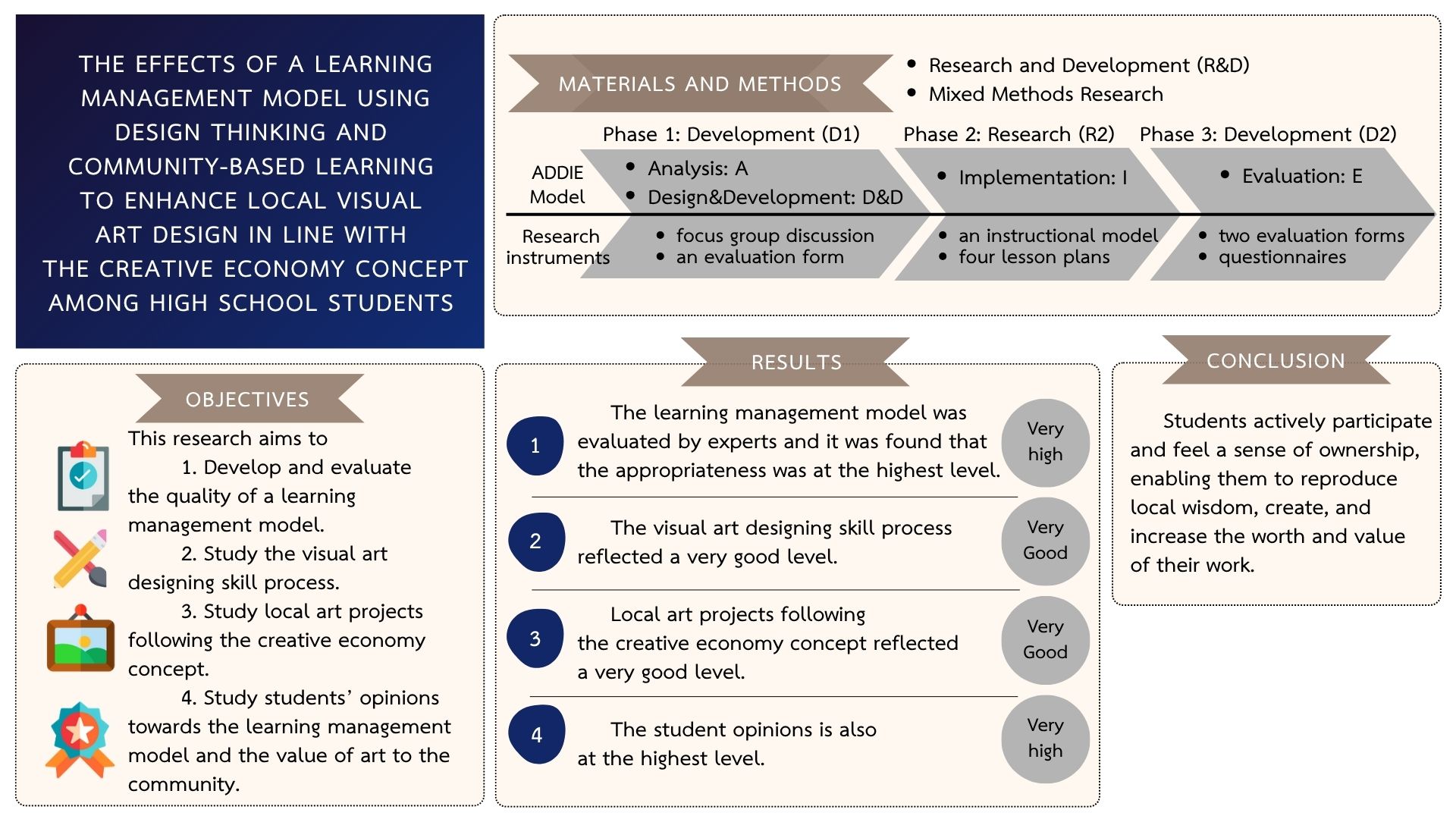
This research aims to 1) develop and evaluate the quality of a learning management model using design thinking and community-based learning to enhance local visual art design in line with the creative economy concept among high school students, 2) study the visual art designing skill process, 3) study local art projects following the creative economy concept, and 4) study students’ opinions towards the learning management model and the value of art to the community. Purposive sampling was conducted for this research, consisting of 16 high school students from Koh Kret Creative Art Club at a secondary school in Nonthaburi province in the academic year 2023. The method used in this research is research and development (R&D). Research instruments included: 1) a learning management model, 2) four lesson plans, 3) evaluation forms for the visual art design skill process, 4) evaluation forms for local art projects following the creative economy concept, and 5) questionnaires for student opinions. The data analysis was conducted by using mean (M), standard deviation (SD), and content analysis. The results show that the learning management model consisted of five components: (1) principles, (2) objectives, (3) a learning process consisting of four stages as follows: 1) Perceive (P), which includes 1.1 Community Planning Survey (CPS), 1.2 Community Learning (CL), and 1.3 Community Reflection (CR), 2) Producing Ideas (P), 3) Prototype (P), and 4) Proof (P) which includes Community Evaluation (CE). (4) measurement and evaluation, and (5) success conditions. The learning management model was evaluated by experts and it was found that, 1) the appropriateness was at the highest level (M = 4.69, SD = 0.45), 2) the visual art design skill process reflected a very good level (M = 2.61, SD = 0.48), 3) local art projects following the creative economy concept reflected a very good level (M = 2.55, SD = 0.39), and 4) student opinions toward the learning management model and the value of art in the community were at the highest level (M = 4.66, SD = 0.56).
Downloads
Article Details

This work is licensed under a Creative Commons Attribution-NonCommercial-NoDerivatives 4.0 International License.
All rights reserved. Apart from citations for the purposes of research, private study, or criticism and review,no part of this publication may be reproduced, stored or transmitted in any other form without prior written permission by the publisher.
References
Art-in, S. (2021). Science and art of learning management in the 21st century (4th ed.). Khon Kaen University. [in Thai]
Best, J. W. (1977). Research in education. Prentice Hall.
Chaichaowarat, R. (2023). Learning experience design by design thinking. Charansanitwong Printing. [in Thai]
Chalermsuk, N. (2020). The development of blended instructional model in art education based on design thinking and practical art learning integrated with cognitive tools to enhance creative thinking and artworks of high school students [Doctoral dissertation, Silpakorn University]. DSpace at Silpakorn University. http://ithesis-ir.su.ac.th/dspace/handle/123456789/3274 [in Thai]
Chanchai, S. (2014). Design and development of teaching and learning. Phetkasem Printing House. [in Thai]
Cherdjerm, S. (2017). Development of ceremony creative process with community-based Learning and constructionism for undergraduate students [Unpublished doctoral dissertation]. Naresuan University. [in Thai]
Chiu, T. K. F., Ismailov, M., Zhou, X., Xia, Q., Au, C. K., & Chai, C. S. (2023). Using self-determination theory to explain how community-based learning fosters student interest and identity in integrated STEM education. International Journal of Science and Mathematics Education, 21(1), 109–130. https://doi.org/10.1007/s10763-023-10382-x
Chutsuriyawong, S. (2014). The paradigm of community based learning for enhancing critical thinking and creative problem solving abilities for elementary school students [Doctoral dissertation, Silpakorn University]. Silpakorn University Repository (SURE). https://sure.su.ac.th/xmlui/handle/123456789/10336 [in Thai]
Department of Cultural Promotion. (2019, January 10). Culture, value to added value. Department of Cultural Promotion. http://www.culture.go.th/culture_th/ewt_news.php?nid=3972&filename=index [in Thai]
Dewey, J. (2005). How we think: A restatement of the relation of reflective thinking and the educational process. D. C. Heath.
Eggen, P. D., & Kauchak, D. P. (2006). Strategies and models for teachers: Teaching content and thinking skills (5th ed.). Pearson.
Guaman-Quintanilla, S., Everaert, P., Chiluiza, K., & Valcke, M. (2023). Impact of design thinking in higher education: A multi-actor perspective on problem solving and creativity. International Journal of Technology and Design Education, 33, 217–240. https://doi.org/10.1007/s10798-021-09724-z
Howkins, J. (2001). The creative economy: How people make money from ideas. Penguin Publishing.
IDEO Toolkit. (2012). Design thinking for educators (2nd ed.). https://f.hubspotusercontent30.net/hubfs/6474038/Design%20for%20Learning/IDEO_DTEdu_v2_toolkit+workbook.pdf
Imsamraan, S., & Sangvanich, K. (2023). Teaching art to improve decorative molding skills and product quality in a pottery design course for grade 11 learners using Harrow's learning theory. Journal of Liberal Arts, Thammasat University, 23(1), 368–384. https://doi.org/10.14456/lartstu.2023.16 [in Thai]
Kaewto, P. (2021). The development of art activities to develop the creativity and artistic skills of grade 12 students [Master’s thesis, Srinakharinwirot University]. DSpace at Srinakharinwirot University. http://ir-ithesis.swu.ac.th/dspace/handle/123456789/1958 [in Thai]
Keeratiwutipong, J. (2015). Aesthetic of visual elements in the visual art: Inspiration from Nora. Nakhon Si Thammarat Rajabhat University. [in Thai]
Khammanee, T. (2021). The science of teaching knowledge for effective learning process management (23th ed.). Chulalongkorn University Press. [in Thai]
Lowenfeld, V., & Lambert Brittain, W. (1987). Creative and mental growth (8th ed.). Macmillan.
Makkhaw, M. (2022). Development of communities-based paper art activities to enhance folk-art value appreciation for ninth grade students [Master’s thesis, Chulalongkorn University]. Chula Digital Collections. https://digital.car.chula.ac.th/cgi/viewcontent.cgi?article=7640&context=chulaetd [in Thai]
Phinla, W. (2017). Development of local studies learning management model to enhance conservative behavior of local wisdom for undergraduate students [Doctoral dissertation, Silpakorn University]. DSpace at Silpakorn University. http://ithesis-ir.su.ac.th/dspace/handle/123456789/1378 [in Thai]
Rittikoop, W. (2018). Community-based learning: Effective pedagogy strategies for teachers in the 21st century. Graduate School Journal, 11(3), 179–191. [in Thai]
Romiszowski, A. (1981). Designing instructional systems: Decision making in course planning and curriculum design. Nichols.
Saengloetuthai, J., Thongnin, P., Booncherdchoo, N., Maneerat, C., Srisopha, Y., & Takomsane, M. (2020). Action learning. Academic Journal of Phetchaburi Rajabhat University, 10(3), 115–163. https://journal.pbru.ac.th/admin/upload/article/5729-2021-04-05.pdf [in Thai]
Sa-nguanpholphairot, P. (2019). Development of a teaching model integrating local wisdom with visual arts learning management at the lower secondary education level. Burapha Arts Journal, 22(2), 105–119. https://so01.tci-thaijo.org/index.php/buraphaJ/article/view/241941 [in Thai]
Singhachotsukpat, R. (2020). Development of a virtual field trip with community-based learning to enhance civic engagement of upper secondary school students [Master’s thesis, Chulalongkorn University]. Chula Digital Collections. https://digital.car.chula.ac.th/cgi/viewcontent.cgi?article=5053&context=chulaetd [in Thai]
Sterman, C. (2015, September 28). Teaching by design: Design thinking is a problem-solving strategy that helps build students 21st century skills. National Association of Elementary School Principals (naespTM). https://www.naesp.org/resource/teaching-by-design/
Tunyaboontrakun, P. (2018). Development of place-based art education curriculum to create suburban community artistic and cultural innovations [Doctoral dissertation, Chulalongkorn University]. Chulalongkorn University Intellectual Repository (CUIR). https://cuir.car.chula.ac.th/handle/123456789/80528 [in Thai]
Wannapiroon, P., & Kangvaravoot, C. (2016). Development idea marathon instructional model via social cloud (IMSC model) to enhance creative economy thinking. The Science Journal of Phetchaburi Rajabhat University, 13(1), 72–80. [in Thai]
Watthanachanobon, W. (2020). Development of a local wisdom knowledge management model to enhance economic valued-added textile products based on Thai-Yuan ethnic groups in mid central provincial cluster [Doctoral dissertation, Silpakorn University]. DSpace at Silpakorn University. http://ithesis-ir.su.ac.th/dspace/handle/123456789/3018 [in Thai]
Wongwat, A. (2016). Guidelines for contemplative art activities to create aesthetic experiences of students age 16–18 years old [Master’s thesis, Chulalongkorn University]. Chula DigiVerse. https://digiverse.chula.ac.th/Info/item/dc:16657 [in Thai]
Wongyai, W., & Patphol, M. (2020). Creative learning. Charansanitwong Printing. [in Thai]
