
Exploring homophobia in 21st-century Taiwanese vampire light novels
Article Sidebar
Main Article Content
Abstract
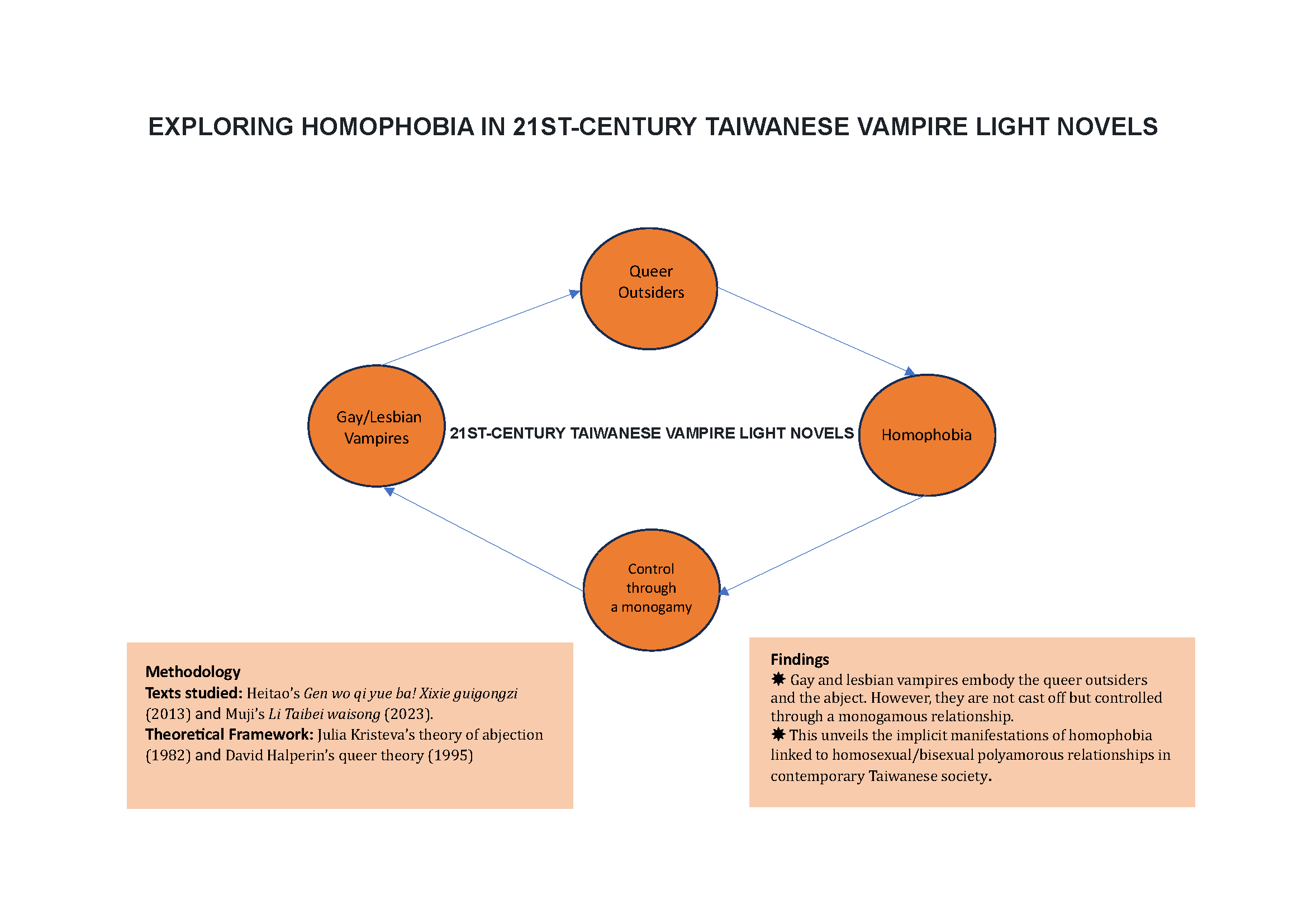
Vampire literature employs the portrayal of an immortal demon as a literary device to provoke social fears and anxieties among readers. The characteristics of the Taiwanese vampires have evolved from being horrific figures of the undead to vampires in fiction that are artistically crafted and reveal multifaceted perspectives regarding non-normative gender and sexuality. Due to their liminality, vampires are frequently employed to unveil complex issues regarding homosexuality and bisexuality. Although images of vampires in Taiwanese literature have been widely discussed, relatively few studies have examined “homophobic” perspectives. This paper therefore explores the relationship between vampire figures and homophobia in 21st-century Taiwanese vampire novels, with a focus on two Taiwanese light novels that address discrimination against homosexual and bisexual polyamorous relationships: Heitao’s Gen wo qi yue ba! Xixie guigongzi and Muji’s Li Taibei waisong. Through the lens of Julia Kristeva’s theory of abjection (1982) and David Halperin’s queer theory (1995), the vampire is regarded as “the abject” that problematises binary opposition. They are the queer outsiders, who dwell at the periphery of society and provide a metaphorical representation of the “other” that embodies homosexuality and bisexuality. Because they are abject, vampires are not cast off but rather controlled through a monogamous relationship, thus unveiling the implicit manifestations of homophobia linked to homosexual/bisexual polyamorous relationships in contemporary Taiwanese society.
Downloads
Article Details

This work is licensed under a Creative Commons Attribution-NonCommercial-NoDerivatives 4.0 International License.
All rights reserved. Apart from citations for the purposes of research, private study, or criticism and review,no part of this publication may be reproduced, stored or transmitted in any other form without prior written permission by the publisher.
References
Anastasiadou, I. (2019). “Your fall from grace has been the fall of a century”: The vampire as representation of contemporary consciousness in Anne Rice’s novels [Master’s thesis, Aristotle University of Thessaloniki]. IKEE / Aristotle University of Thessaloniki - Library. https://ikee.lib.auth.gr/record/306264/?ln=en
Auerbach, N. (1997). Our vampires, ourselves. The University of Chicago Press.
Carvalho, F. S. (2009). Sexuality and gender in contemporary women’s Gothic fiction: Angela Carter’s and Anne Rice’s vampires [Master’s thesis, Universidade Federal de Minas Gerais]. Repositório Institucional Universidade Federal de Minas Gerais. http://hdl.handle.net/1843/ECAP-7SHFJY
Chang, S. (2019). Chinese women, marriage and gender: Exploring the idea of women and marriage over time in the context of China [Unpublished master’s thesis]. University of Windsor.
Chen, J. H. (2016). Taiwan qing xiaoshuo zhong de qingshaonian qingyu [Teenage eroticism in Taiwanese light novels] [Unpublished master’s thesis]. Zhenli University. [in Chinese]
Chen, S. H. (2000). Fenghuang, e’yu, xixiegui—Shilun Taiwan wenxue chuangzuo zhong de ji ge tongxinglian yixiang [Phoenix, crocodile, vampire: A discussion on several homosexual images in Taiwanese literary creation]. Nanfang Wentan, 3, 56–64. [in Chinese]
Chen, Y. J. (2020). Qing xiaoshuo shuxie yanjiu: Yi feirenlei zhuansheng wei li [Research on light novel writing: Taking non-human reincarnation as an example] [Unpublished master’s thesis]. National Zhanghua Normal University. [in Chinese]
Cheng, W. C. (2021). Xixiegui dianying yanjiu [Research on the vampire film] [Unpublished master’s thesis]. National Kaohsiung Normal University. [in Chinese]
Creed, B. (1993). The monstrous-feminine: Film, feminism, psychoanalysis. Routledge.
Durocher, K. (2016). Men that suck: Gender anxieties and the evolution of vampire men. In A. Hobson & U. M. Anyiwo (Eds.), Gender in the vampire narrative (pp. 45–59). Sense Publishers.
Halperin, D. M. (1995). Saint Foucault: Towards a gay hagiography. Oxford University Press.
Han, E., & O'Mahoney, J. (2019, May 25). What will Taiwan’s same-sex marriages mean in the rest of Asia? The Washington Post. https://www.washingtonpost.com/politics/2019/05/25/what-will-taiwans-same-sex-marriages-will-mean-rest-asia/
Heikkila, M. (2022). Vampire narratives: Looking at queer-centric experiences in comparison to hetero-centric norms in order to model a new queer vampiric experience [Master’s thesis, Eastern Michigan University]. Digital Commons@EMU. https://commons.emich.edu/theses/1161/
Heitao. (2013). Gen wo qi yue ba! Xixiegui gongzi [Make a contract with me! The vampire nobleman]. Taiyi wenhua chubanshe. [in Chinese]
Hobson, A. (2016). Introduction. In A. Hobson & U. M. Anyiwo (Eds.), Gender in the vampire narrative (pp. 1–8). Sense Publishers.
Hong, Y. L. (2020). Taiwan qing xiaoshuo 1/2 wangzi de xingbie xushi fenxi [An analysis of gender narrative of Taiwanese light novel 1/2 Prince] [Unpublished master’s thesis]. National Zhongzheng University. [in Chinese]
Kao, L. W. (2000). Cong jingji weiji yu rentong wenti kan xixiegui [Economic crises and identifying issues: A study of Dracula and Nosferatu] [Unpublished master’s thesis]. National Tsinghua University. [in Chinese]
Kimberley, S. (2009). A psychological analysis of the vampire myth. Essex Student Journal, 1(1), 1–8. https://doi.org/10.5526/esj154
Kristeva, J. (1982). Powers of horror: An essay on abjection. Columbia University Press.
Lin, F. C. (2018). Lun Taiwan qing xiaoshuo de fazhan yu tese—Yi Huxuan、Yuwo、Shuiquan zuopin wei li [The features and the development of Taiwanese light novels: Explorations in the light novels series written by the writers Huxuan, Yuwo and Shuiquan] [Unpublished master’s thesis]. National Taidong University. [in Chinese]
Lin, Q. M., & Ye Y. L. (2017). Qingshaonian qing xiaoshuo yuedu dongji yu yuedu xingwei zhi yanjiu—yi Xinbeishi wei li [A study on reading motivations and reading behaviors of light novel for adolescents: The example of New Taipei City]. Tushu Zixunxue Yanjiu 11(2), 1–49. [in Chinese]
Ling, J. (2022). Xixiegui [Vampire]. Qihuan jidi chubanshe. [in Chinese]
Liou, L. Y. (1996). Hong Ling de zhijie yishou yu yiduan xixiegui liezhuan zhong de qingyu yu xingbie [Sexuality and gender in Hong Ling’s exotic beasts and deviant vampire stories]. Zhongwai Wenxue, 25(1), 26–38. [in Chinese]
Liu, R. P., Bai, R. M., & Ding, N. F. (2003). Xieshi de qihuan jiegou yu qihuan de xieshi xiaoying: Chongdu T-po xushi [Realistic fantasy structure and fantasy realistic effect: Re-reading T-Po’s narrative style]. In Diwujie「xing/biezhengzhi」chaoboxing guoji xueshu yantaohui (pp. 107–144). Zhongyang Daxue. [in Chinese]
Martin, F. (Trans.). (2003). Angelwings: Contemporary queer fiction from Taiwan. University of Hawai’i Press.
McFadden, M. (2021). A history of vampires and their transformation from solely monsters to monstrous, tragic, and romantic figures. Curiosity: Interdisciplinary Journal of Research and Innovation, 2. https://doi.org/10.36898/001c.22205
McGunnigle, C. (2005). My own vampire: The metamorphosis of the queer monster in Francis Ford Coppola’s Bram Stoker’s Dracula. Gothic Studies, 7(2), 172–184. https://doi.org/10.7227/GS.7.2.6
Mingyue. (2012). Tongji! Xixiegui zhengtai [Wanted! Cute Vampire]. Yaoyue wenhua shiye gufen youxian gongsi. [in Chinese]
Mo, Y. (2005). Aishang xixiegui [In love with the vampire]. Gouwu. [in Chinese]
Muji. (2023a). Li Taibei waisong [Inside Taibei Delivery]. Jianduan. [in Chinese]
Muji. (2023b, January 12). Xinshu zhongyu shangshi le! [The new book is finally released] [Facebook post]. Facebook. https://www.facebook.com/permalink.php?story_fbid=pfbid02RARoWggsk2v9WQPCS5rSjxurRaJzB6tetdr1UgpmY3bWwvLxqyCndn2eAZED2wUwl&id=100065597705551 [in Chinese]
Muskovits, E. (2010). The threat of otherness in Bram Stoker’s Dracula. TRANS-Revue de Littérature Générale et Comparée, 10. https://doi.org/10.4000/trans.391
Phelps, M. K. (2021). Fear then and now: The vampire as a reflection of society [Master’s thesis, Chapman University]. Chapman University Digital Commons. https://doi.org/10.36837/chapman.000287
Primuth, R. (2014, March–April). Vampires are us. The Gay & Lesbian Review / Worldwide. https://glreview.org/article/vampires-are-us/
Ramachandran, N. (2024, November 6). ‘The teenage psychic’ Director Chen Ho-Yu mines cultural identity in vampire comedy project at Taiwan creative content fest. Variety. https://variety.com/2024/film/news/the-teenage-psychic-vampire-comedy-tccf-1236202223
Smith, M. J., & Moruzi, K. (2020). Gender and sexuality in young adult fiction. In C. Bloom (Ed.), The Palgrave handbook of contemporary Gothic (pp. 609–622). Palgrave Macmillan. https://doi.org/10.1007/978-3-030-33136-8_36
Thobejane, T. D., & Khoza, J. (2014). Gender role expectations within the institution of marriage. Journal of Social Science, 41(3), 455–459.
Thompson, J. D. (2016). Revenge is a dish best served sapphic: The lesbian vampire film as revenge fantasy. COLLOQUY text theory critique, 31, 4–15.
Tringali, W. A. (2016). Not just dead, but gay! Queerness and the vampire [Bachelor’s thesis, Bridgewater State University]. Virtual Commons - Bridgewater State University. https://vc.bridgew.edu/honors_proj/138/
Tyler, J. (2017). The trail of blood: Queer history through vampire literature [Master’s thesis, The University of Alabama in Huntsville]. UAH Electronic Theses and Dissertations. https://louis.uah.edu/uah-theses/221/
Uygur, M. A. (2013). Queer vampires and the ideology of gothic. Journal of Yaşar University, 8(Special Issue), 47–59.
Wagoner, S. (2023, May 10). ‘Let me taste you’: Lesbian vampirism. Medium. https://scaredbisexual.medium.com/let-me-taste-you-lesbian-vampirism-acc42067654a
Walters, H. (2021). Fear itself: The vampire as moral panic. In R. Gibson & J. M. VanderVeen (Eds.), Gender, supernatural beings, and the liminality of death: Monstrous males/fatal females (pp. 85–100). Lexington Books.
Wang, N. H. (2016). An ye zhong shengkai de hong qiangwei: Taiwan xixiegui BL xiaoshuo zhi yan jiu [Blooming red rose in dark night: Research of Taiwan Vampire BL fiction] [Unpublished master’s thesis]. National Taiwan Normal University. [in Chinese]
Williamson, M. (2007). Television, vampires, and the body: Somatic pathos. Intensities: The Journal of Cult Media, 4(1). https://intensitiescultmedia.com/wp-content/uploads/2012/12/williamson-television-vampires-and-the-body.pdf
Wu, H. C. (2012). Cong minjian chuanshuo dao qingshaonian wenxue: Muguang zhi cheng zhong de xixiegui xingxiang yu yuanxing [From folklore to adolescent literature: The vampire image and archetype in the Twilight series]. National Taidung University. [in Chinese]
Wu, K. L. (2007). Dang langren aishang xixiegui [When a werewolf loves a vampire]. Weixiang. [in Chinese]
Xu, J. Q. (2003). Jiushi niandai Taiwan nütongzhi xiaoshuo yanjiu [Research on Taiwanese lesbian novels in the 1990s] [Unpublished master’s thesis]. National Zhongzheng University. [in Chinese]
Zhu, M. Z. (2014). Jiaolü、yuwang、xixiegui: Ai’lunpo duanpian gushi he Bulamu.Situoke’s Degula zhong siwang he kongju zhi meixue [Anxiety, desire and vampire: The aesthetics of death and terror in Edgar Allan Poe’s short stories and Bram Stoker’s Dracula [Unpublished master’s thesis]. Yanjiang University. [in Chinese]
Zurutuza, K. P. (2016). Images of diluted masculinity of contemporary vampire characters through racial discourse in modern American Gothic. International Journal of Arts & Sciences, 9(2), 335–356. https://ssrn.com/abstract=2960706
