
Sasak puppetry, detraditionalization, and cultural policy: An interpretative phenomenology analysis
Article Sidebar
Main Article Content
Abstract
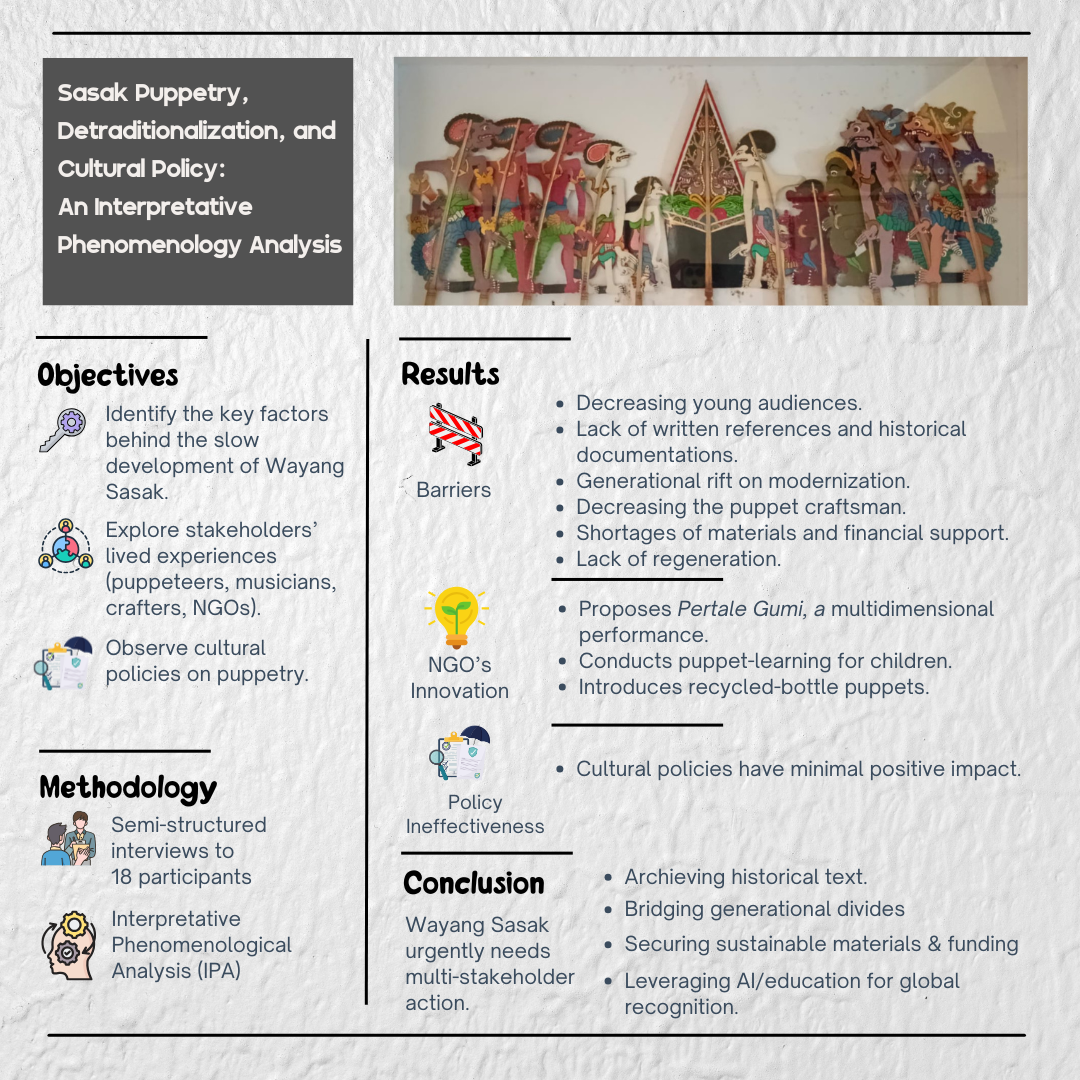
The Sasak shadow puppetry tradition, or wayang Sasak, from the Lombok Island of West Nusa Tenggara, Indonesia, stories derive from Serat Menak. Sasak shadow puppetry, in contrast to wayang in other parts of Indonesia, is stagnating and faces potential erosion in modern performances. This study aims to analyze the factors contributing to the slow development of wayang Sasak. The study gathered data from a sample of 18 participants using a combination of ethnographic techniques and semi-structured interviews. The research focused on the historical, philosophical, functional, and developmental aspects of Sasak shadow puppetry in relation to digital technology, fashion, tourism, and cultural policy. The study applied an interpretative phenomenological analysis method based on a phenomenological hermeneutic approach to explore and interpret the results from the interviews. The research found that a non-governmental organisation, Sekolah Pedalangan Wayang Sasak (SPWS), has proposed an innovative program for developing Sasak puppetry using AI, bottles, and puppets, along with regular guidance, to improve children’s understanding of puppets. This study also identified significant factors that have impeded the progress of Sasak puppetry. First, there is a lack, if not an absence, of reliable written references to the history and sources of Sasak puppet stories. Additionaly, the older and younger generations have not yet reached agreement on modernizing Sasak puppetry and the Sasak puppet actors, puppeteers, musicians, and leather workers face a challenging situation, including issues with funding, the availability of cow leather for puppet making, and the need for regeneration among puppeteers and crafters. Local and central government policies, as well as cultural policies, have not had an impact on maximizing the potential of Sasak puppetry. These findings require further action by all parties to develop Sasak puppets for local and global recognition.
Downloads
Article Details

This work is licensed under a Creative Commons Attribution-NonCommercial-NoDerivatives 4.0 International License.
All rights reserved. Apart from citations for the purposes of research, private study, or criticism and review,no part of this publication may be reproduced, stored or transmitted in any other form without prior written permission by the publisher.
References
Anoegrajekti, N., Sariono, A., Macaryus, S., & Kusumah, M. S. (2018). Banyuwangi Ethno Carnival as visualization of tradition: The policy of culture and tradition revitalization through enhancement of innovation and locality-based creative industry. Cogent Arts and Humanities, 5(1), Article 1502913. https://doi.org/10.1080/23311983.2018.1502913
Boonstra, S. (2011). Negotiating heritage: Wayang puppet theatre and the dynamics of heritage formation. In M. Halbertsma, A. van Stipriaan, & P. van Ulzen (Eds.), The heritage theatre: Globalisation and cultural heritage (pp. 27–48). Cambridge Scholars Publishing.
Brunel, P. (2012). Democratization of culture. Études, 416(5), 617–628. https://shs.cairn.info/journal-etudes-2012-5-page-617?lang=en&tab=texte-integral
Bustamante Duarte, A. M., Pfeffer, K., Indriansyah, N. R., Bhuana, A. A. D. C., Aritenang, A. F., Nurman, A., Zul Fahmi, F., Ramdan, D., Iskandar, Z. S., & Madureira, M. (2024). Creative industries in Indonesia: A socio-spatial exploration of three Kampongs in Bandung. Creative Industries Journal, 17(1), 113–141. https://doi.org/10.1080/17510694.2022.2077557
Cohen, M. I. (2007). Contemporary ‘Wayang’ in global contexts. Asian Theatre Journal, 24(2), 338–369. https://doi.org/10.1353/atj.2007.0032
Cohen, M. I. (2016). Global modernities and post-traditional shadow puppetry in contemporary Southeast Asia. Third Text, 30(3–4), 188–206. https://doi.org/10.1080/09528822.2017.1305728
Ecklund, J. (2002). Paradoxes and realities of Wayang among the Sasak of Lombok. In J. Mrazek (Ed.), Puppet theater in contemporary Indonesia: New approaches to performance events (pp. 205–221). Centers for South and Southeast Asian Studies, University of Michigan.
Folgueiras Bertomeu, P., & Sandín Esteban, M. P. (2023). The research question in hermeneutic phenomenology and grounded theory research. The Qualitative Report, 28(5), 1452–1472. https://doi.org/10.46743/2160-3715/2023.5715
Geertz, C. (1960). The religion of Java. The University of Chicago Press.
Ghani, D. B. A. (2012). Wayang Kulit Kelantan: The challenges between traditional and digital media in puppetry theatre. Arte, Individuo y Sociedad, 24(1), 135–146. https://doi.org/10.5209/rev_ARIS.2012.v24.n1.38048
Giorgi, A. (2012). The descriptive phenomenological psychological method. Journal of Phenomenological Psychology, 43(1), 3–12. https://doi.org/10.1163/156916212X632934
Goodlander, J. (2012). Gender, power, and puppets: Two early women Dalangs in Bali. Asian Theatre Journal, 29(1), 54–77. https://doi.org/10.1353/atj.2012.0013
Harnish, D. (2003). Worlds of Wayang Sasak: Music, performance, and negotiations of religion and modernity. Asian Music, 34(2), 91–120. https://www.jstor.org/stable/4098458
Harnish, D. (2007). ‘Digging’ and ‘upgrading’: Government efforts to ‘develop’ music and dance in Lombok, Indonesia. Asian Music, 38(1), 61–87. https://www.jstor.org/stable/4497041
Heelas, P. (1996). On things not being worse, and the ethic of humanity. In P. Heelas, S. Lash, & P. Morris (Eds.), Detraditionalization: Critical reflections on authority and identity (pp. 200–222). Blackwell.
Hilmiyatun, Suwandi, S., Waluyo, H. J., & Wardani, N. E. (2022). Between ecology and economics: A critical discourse analysis of Putri Mandalika folklore. Theory and Practice in Language Studies, 12(11), 2388–2396. https://doi.org/10.17507/tpls.1211.20
Hobart, M. (1999). The end of the world’ news: Articulating television in Bali. In R. Rubinstein & L. H. Conner (Eds.), Staying local in the global village: Bali in the twentieth century (pp. 265–290). University of Hawai‘i Press.
Hutagalung, H., Purwana, D., Suhud, U., Mukminin, A., Hamidah, H., & Rahayu, N. (2022). Community self-reliance of rural tourism in Indonesia: An interpretative phenomenological analysis. The Qualitative Report, 27(7), 1151–1168. https://doi.org/10.46743/2160-3715/2022.5215
Jones, T. (2018). International intangible cultural heritage policy in the neighbourhood: An assessment and case study of Indonesia. Journal of Cultural Geography, 35(3), 362–387. https://doi.org/10.1080/08873631.2018.1429351
Kumara, S. B. (2020). Transformasi Wayang Beber Dalam Batik Lukis [Transformation of Wayang Beber in painted batik]. Ikonik: Jurnal Seni Dan Desain, 2(2), 51–56. https://doi.org/10.51804/ijsd.v2i2.733 [in Indonesian]
Lash, S. (1996). Tradition and the limits of difference. In P. Heelas, S. Lash, & P. Morris (Eds.), Detraditionalization: Critical reflections on authority and identity (pp. 250–274). Blackwell.
Lazuardi, A. B., Pawito, P., & Satyawan, A. (2020). Performing arts as communication: The traditional media of Wayang Sasak in digital era. International Journal of Multicultural and Multireligious Understanding, 7(7), 121–128. https://doi.org/10.18415/ijmmu.v7i7.1756
Lindsay, J. (1995). Cultural policy and the performing arts in Southeast Asia. Bijdragen tot de Taal-, Lande- en Volkenkunde, 151(4), 656–671. https://www.jstor.org/stable/27864708
Lopes, R. O. (2016). A new light on the shadows of heavenly bodies: Indian shadow puppets: From still paintings to motion pictures. Religion and the Arts, 20(1–2), 160–196. https://doi.org/10.1163/15685292-02001008
Mahardika, M. S., Junaidy, D. W., Gary, A. A. P., Husni, E. M., Suwardhi, D., Agirachman, A., Agustina, L. K., & Wibisono, A. (2024). Digitizing cultural heritage & preserving history in the metaverse: Insights from the East Hall of the Bandung Institute of Technology in Indonesia. ISVS e-journal, 11(12), 90–109. https://doi.org/10.61275/ISVSej-2023-11-12-07
Miller, R. M., Chan, C. D., & Farmer, L. B. (2018). Interpretative phenomenological analysis: A contemporary qualitative approach. Counselor Education and Supervision, 57(4), 240–254. https://doi.org/10.1002/ceas.12114
Morris, P. (1996). Community beyond tradition. In P. Heelas, S. Lash, & P. Morris (Eds.), Detraditionalization: Critical reflections on authority and identity (pp. 223–249). Blackwell.
Mrázek, J. (2019). Wayang and its doubles: Javanese puppet theatre, television and the internet. NUS Press Singapore, National University of Singapore.
Noon, E. J. (2018). Interpretive phenomenological analysis: An appropriate methodology for educational research? Journal of Perspectives in Applied Academic Practice, 6(1), 75–83. https://doi.org/10.14297/jpaap.v6i1.304
Prasetya, H. B., Hariyanto, Pangestu, S. M., Udreka, Handayani, L. L. A., & Saka, P. A. (2024). Shortage of sculptors of shadow puppets’ facial features (Bedhahan) for Wayang performance. Humanities, Arts and Social Sciences Studies, 24(2), 467–481. https://doi.org/10.69598/hasss.24.2.267790
Rachmawati, F. (2023). Wayang Sasak: Gerakan Literasi Berbasis Tradisi [Wayang Sasak: A Tradition-based literacy movement] [Unpublished Report]. Sekolah Pedalangan Wayang Sasak (SPWS). [in Indonesian]
Ratchatakorntrakoon, R. (2024). How sustainable is traditional folk rod puppetry in Thailand? Humanities, Arts and Social Sciences Studies, 24(2), 441–453. https://doi.org/10.69598/hasss.24.2.268376
Robinson, C., & Williams, H. (2024). Interpretative phenomenological analysis: Learnings from employing IPA as a qualitative methodology in educational research. The Qualitative Report, 29(4), 939–952. https://doi.org/10.46743/2160-3715/2024.6487
Rui, T. (2018). The heritage of Wang Piying troupe: Shadow puppetry in North Sichuan. Asian Theatre Journal, 35(1), 53–69. https://doi.org/10.1353/atj.2018.0012
Satrya HD, D., Faruk, & Pujiharto. (2019). The discourse of Sasak’s art: From tradition to modernity. International Journal of Innovation, Creativity and Change, 5(6), 368–377. https://www.ijicc.net/images/vol5iss6/5640_Satrya_2019_E_R.pdf
Sears, L. J. (1996). Shadows of empire: Colonial discourse and Javanese tales. Duke University Press.
Sekolah Wayang Sasak. (2023, September 22). Wayang Multidimensi: Pertale Gumi atau Bumi Dalam Lipatan [Multidimensional Wayang: Pertale Gumi or earth in folds] [Video recording]. YouTube. https://www.youtube.com/watch?v=GJPy3ChVvL8 [in Indonesian]
Siniscalchi, M. M. (1980). E. G. Craig: The drama for marionettes. Theatre Research International, 5(2), 122–137. https://doi.org/10.1017/S0307883300002169
Smiers, J. (2003). Arts under pressure: Promoting cultural diversity in the age of globalization. Zed Books.
Suwondo, T., Zamzuri, A., Satiyoko, Y. A., Murdowo, D. A., Yono, S., Sumiyardana, K., & Sudaryani, R. R. S. (2024). Writing script and audio production: Movement to strengthen Javanese radio drama in Yogyakarta, Indonesia. Studies in Media and Communication, 12(4), 79–93. https://doi.org/10.11114/smc.v12i4.7053
Suwondo, T., Zamzuri, A., Wahyuni, D., Saptawuryandari, N., Satiyoko, Y. A., Sukistono, D., & Hariyanto, H. (2025). Exploring the potential of Wayang Beber Remeng Mangunjaya’s creative industry to develop a cultural-educational tourism village. Harmonia: Journal of Arts Research and Education, 25(1), 13–27. https://doi.org/10.15294/harmonia.v25i1.2262
Thompson, J. B. (1996). Tradition and self in a mediated world. In P. Heelas, S. Lash, & P. Morris (Eds.), Detraditionalization: Critical reflections on authority and identity (pp. 89–108). Blackwell.
Varela, M. E. (2014). Wayang Hip Hop: Java’s oldest performance tradition meets global youth culture. Asian Theatre Journal, 31(2), 481–504. https://www.jstor.org/stable/43187437
Varela, M. E. (2016). Heirlooms of the everyday: The material performances of Slamet Gundono. Theatre Research International, 41(1), 53–69. https://doi.org/10.1017/S0307883315000619
Yousof, G.-S., & Khor, K.-K. (2017). Wayang Kulit Kelantan: A study of characterization and puppets. Asian Theatre Journal, 34(1), 1–25. https://doi.org/10.1353/atj.2017.0002
Zamzuri, A., Suwondo, T., Wahyuni, D., Saptawuryandari, N., Satiyoko, Y. A., & Apriaman, A. L. (2023). Laporan Penelitian: Desa Wisata Kultural-Edukatif Berbasis Wayang Sasak [A research report: Cultural and education tourism village based on Wayang Sasak] [Unpublished report]. Badan Riset dan Inovasi Nasional. [in Indonesian]
