
The COVID-19 pandemic as a destabilizing event: Did it punctuate Thailand’s local budget dynamics?
Article Sidebar
Main Article Content
Abstract
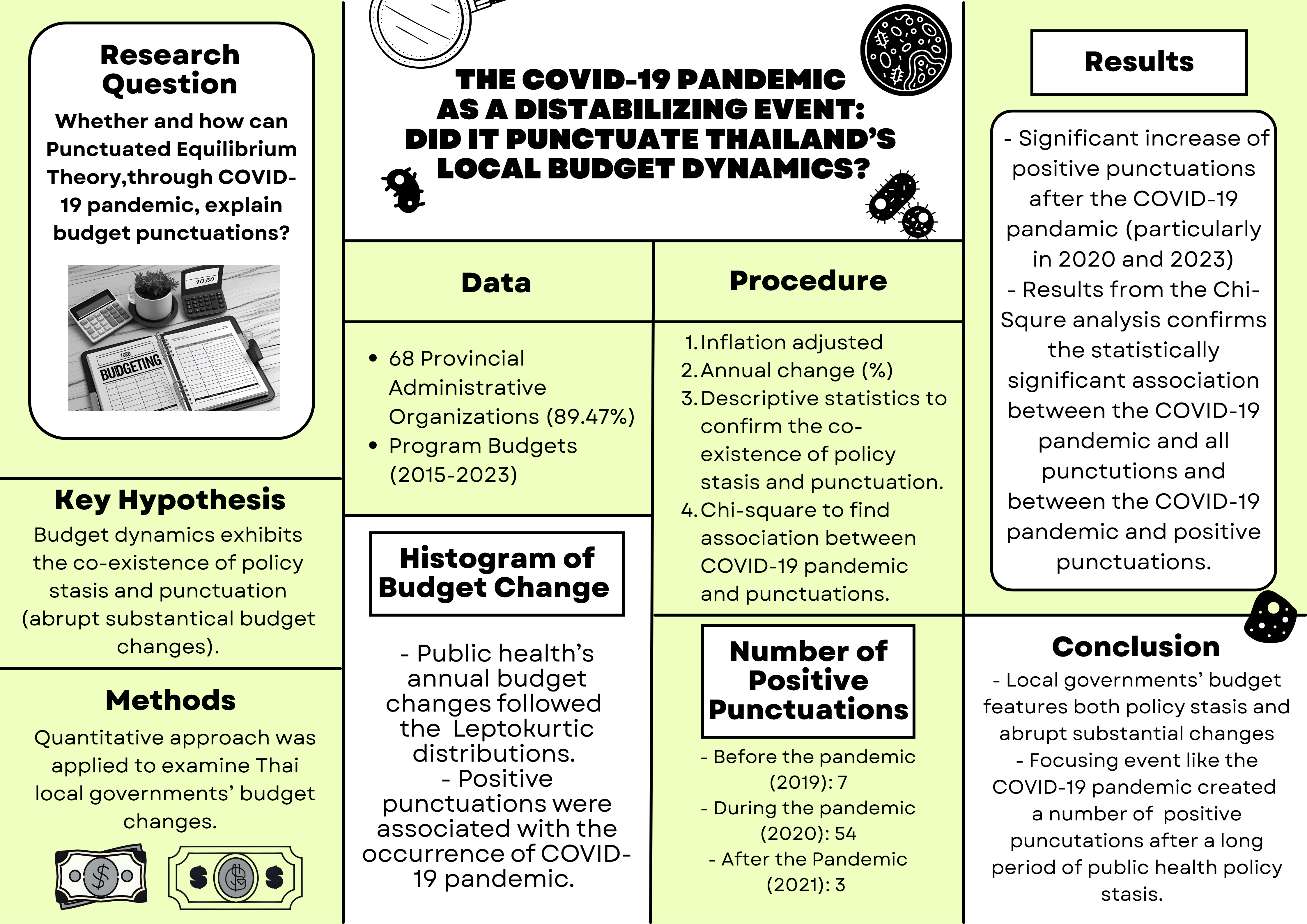
Current studies state that budget dynamics in many developed countries have followed the assumptions of the Punctuated Equilibrium Theory. However, the budget dynamics of developing countries remain inadequately examined. This research, which concentrates on public health spending in Thailand’s local government, serves as a theory-testing case study to confirm the Punctuated Equilibrium Theory’s external validity. Integrating with the focusing events of the Multiple Streams Framework, this study examines whether and how the COVID-19 pandemic punctuated public health spending among sixty-eight Thai local governments at the provincial level during 2013–2023, covering three timeframes—up until the first year of, during, and after the COVID-19 pandemic. The descriptive statistics portraying the data’s leptokurtic distribution confirm that, over a lengthy period, the local public health spending followed the Punctuated Equilibrium Theory and featured a policy stasis which was occasionally interrupted by budget punctuations or large-scale departures from the past. Meanwhile, the results from the Chi-Square test and ANOVA underscore the statistically significant association between the arrival of the COVID-19 pandemic and the surge in the number of positive punctuations. These findings reject the default assumption that budget dynamics are incremental, especially for long-term policy analysis. Instead, they urge local policymakers to be actively aware of focusing events and to constantly (re)build fiscal competency to guarantee a smooth and effective response and recovery plan when a locality faces crises or impactful occurrences.
Downloads
Article Details

This work is licensed under a Creative Commons Attribution-NonCommercial-NoDerivatives 4.0 International License.
All rights reserved. Apart from citations for the purposes of research, private study, or criticism and review,no part of this publication may be reproduced, stored or transmitted in any other form without prior written permission by the publisher.
References
Amri, M. M., & Drummond, D. (2021). Punctuating the equilibrium: An application of policy theory to COVID-19. Policy Design and Practice, 4(1), 33–43. https://doi.org/10.1080/25741292.2020.1841397
Bangkok Business Newspaper. (2021, May 31). 62 PAOs to procure COVID-19 vaccines, calling on Ministry of Interior to lift the legal block. https://www.bangkokbiznews.com/politics/940903 [in Thai]
Baumgartner, F. R., Breunig, C., Green-Pedersen, C., Jones, B. D., Mortensen, P. B., Nuytemans, M., & Walgrave, S. (2009). Punctuated equilibrium in comparative perspective. American Journal of Political Science, 53(3), 603–620. https://doi.org/10.1111/j.1540-5907.2009.00389.x
Baumgartner, F. R., Jones, B. D., & Mortensen, P. B. (2023). Punctuated equilibrium theory: Explaining stability and change in public policymaking. In C. M. Weible (Ed.), Theories of the policy process (5th ed., pp. 65–99). Routledge. https://doi.org/10.4324/9781003308201-4
Baumgartner, F. R., & Jones, B. D. (1993). Agendas and instability in American politics. The University of Chicago Press.
Berardo, R., Olivier, T., & Lavers, A. (2015). Focusing events and changes in ecologies of policy games: Evidence from the Paraná river delta. Review of Policy Research, 32(4), 443–464. https://doi.org/10.1111/ropr.12128
Breunig, C., & Koski, C. (2006). Punctuated equilibria and budgets in the American States. Policy Studies Journal, 34(3), 363–379. https://doi.org/10.1111/j.1541-0072.2006.00177.x
Cairney, P., & Heikkila, T. (2014). A comparison of theories of the policy process. In P. A. Sabatier & C. M. Weible (Eds.), Theories of the policy process (3rd ed., pp. 363–389). Westview Press.
Cohen, M. D., March, J. G., & Olsen, J. P. (1972). A garbage can model of organizational choice. Administrative Science Quarterly, 17(1), 1–25. https://doi.org/10.2307/2392088
Cohen, J. (1977). Statistical power analysis for the behavioral sciences (Rev. ed.). Academic Press.
Cramér, H. (1945). Mathematical methods of statistics. Almqvist & Wiksells.
Davis, O. A., Dempster, M. A. H., & Wildavsky, A. (1966). A theory of the budgetary process. The American Political Science Review, 60(3), 529–547. http://www.jstor.org/stable/19529691
Desmarais, B. A. (2019). Punctuated equilibrium or incrementalism in policymaking: What we can and cannot learn from the distribution of policy changes. Research and Politics, 6(3), 1–6. https://doi.org/10.1177/2053168019871399
Ecton, W. G., & Dziesinski, A. B. (2022). Using punctuated equilibrium to understand patterns of institutional budget change in higher education. The Journal of Higher Education, 93(3), 424–451. https://doi.org/10.1080/00221546.2021.1985884
Eller, W. S., Gerber, B. J., & Robinson, S. E. (2018). Public administration research methods: Tools for evaluation and evidence-based practice (2nd ed.). Routledge. https://doi.org/10.4324/9781315163727
Fagan, E. J. (2023). Political institutions, punctuated equilibrium theory, and policy disasters. Policy Studies Journal, 51(2), 243–263. https://doi.org/10.1111/psj.12460
Fernández-i-Marín, X., Hurka, S., Knill, C., & Steinebach, Y. (2022). Systemic dynamics of policy change: Overcoming some blind spots of punctuated equilibrium theory. Policy Studies Journal, 50(3), 527–552. https://doi.org/10.1111/psj.12379
Frederickson, H. G., & O’Leary, R. (2014). Local government management: Change, crossing boundaries, and reinvigorating scholarship. The American Review of Public Administration, 44(4 Suppl.), 3S–10S. https://doi.org/10.1177/0275074014534765
Gelman, A., & Hill, J. (2007). Data analysis using regression and multilevel/hierachical models. Cambridge University Press.
George, A. L., & Bennett, A. (2005). Case studies and theory development in the social sciences. MIT Press.
Gerring, J. (2017). Case study research: Principles and practices (2nd ed.). Cambridge University Press.
Gilley, B., & Laochankham, S. (2024). Can fiscal recentralization strengthen local government? The case of Thailand. International Journal of Public Administration, 47(4), 257–268. https://doi.org/10.1080/01900692.2022.2111580
Grossi, G., Reichard, C., & Ruggiero, P. (2016). Appropriateness and use of performance information in the budgeting process: Some experiences from German and Italian municipalities. Public Performance and Management Review, 39(3), 581–606. https://doi.org/10.1080/15309576.2015.1137770
Guragain, H. P., & Lim, S. (2019). Nepalese budgetary dynamics: Following incrementalism or punctuated equilibrium? Public Organization Review, 19(4), 493–518. https://doi.org/10.1007/s11115-018-0418-6
Guy, M. E., & Ely, T. L. (2022). Essentials of public service: An introduction to contemporary public administration (2nd ed.). Melvin & Leigh.
Herweg, N., Zahariadis, N., & Zohlnhöfer, R. (2023). The multiple streams framework: Foundations, refinements, and empirical applications. In C. M. Weible (Ed.), Theories of the policy process (5th ed., pp. 29–64). https://doi.org/10.4324/9781003308201-3
Hindmoor, A. (2006). Rational choice. Palgrave Macmillan.
Johnson, R. B., Onwuegbuzie, A. J., & Turner, L. A. (2007). Toward a definition of mixed methods research. Journal of Mixed Methods Research, 1(2), 112–133. https://doi.org/10.1177/1558689806298224
Jones, B. D., Baumgartner, F. R., & True, J. L. (1998). Policy punctuations: U.S. Budget authority, 1947–1995. The Journal of Politics, 60(1), 1–33. https://www.jstor.org/stable/2647999
Jones, B. D., Sulkin, T., & Larsen, H. A. (2003). Policy punctuations in American political institutions. The American Political Science Review, 97(1), 151–169. https://www.jstor.org/stable/3118227
Jones, M. D., Peterson, H. L., Pierce, J. J., Herweg, N., Bernal, A., Raney, H. L., & Zahariadis, N. (2016). A river runs through it: A multiple streams meta-review. Policy Studies Journal, 44(1), 13–36. https://doi.org/10.1111/psj.12115
Jordan, M. M. (2003). Punctuations and agendas: A new look at local government budget expenditures. Journal of Policy Analysis and Management, 22(3), 345–360. https://doi.org/10.1002/pam.10136
Kategeaw, W., Youngkong, S., Taychakhoonavudh, S., Techathawat, S., & Chaiyakunapruk, N. (2022). Potential changes in vaccine access and policy landscape in Thailand post COVID-19 pandemic. Human Vaccines and Immunotherapeutics, 18(6), Article 2095823. https://doi.org/10.1080/21645515.2022.2095823
Kingdon, J. W. (2003). Agendas, alternatives, and public policies (2nd ed.). Longman.
Koski, C., & Workman, S. (2018). Drawing practical lessons from punctuated equilibrium theory. Policy and Politics, 46(2), 293–308. https://doi.org/10.1332/030557318X15230061413778
Kuhlmann, J., & van der Heijden, J. (2018). What is known about punctuated equilibrium theory? And what does that tell us about the construction, validation, and replication of knowledge in the policy sciences? Review of Policy Research, 35(2), 326–347. https://doi.org/10.1111/ropr.12283
Lam, W. F., & Chan, K. N. (2015). How authoritarianism intensifies punctuated equilibrium: The dynamics of policy attention in Hong Kong. Governance, 28(4), 549–570. https://doi.org/10.1111/gove.12127
Lind, D. A., Marchal, W. G., & Wathen, S. A. (2019). Basic statistics for business and economics (9th ed.). McGraw-Hill Education.
Lindblom, C. E. (1979). Still muddling, not yet through. Public Administration Review, 39(6), 517–526. https://doi.org/10.2307/976178
Mascio, F. D., Natalini, A., & Cacciatore, F. (2020). Public administration and creeping crises: Insights from COVID-19 pandemic in Italy. The American Review of Public Administration, 50(6–7), 621–627. https://doi.org/10.1177/0275074020941735
Mayurasakorn, K., Pinsawas, B., Mongkolsucharitkul, P., Sranacharoenpong, K., & Damapong, S. (2020). School closure, COVID-19 and lunch programme: Unprecedented undernutrition crisis in low-middle income countries. Journal of Paediatrics and Child Health, 56(7), 1013–1017. https://doi.org/10.1111/jpc.15018
Meza, O. (2022). Punctuated equilibrium in multilevel contexts: How federal and state level forces feedback into shaping the local policy agenda in Mexico. Policy Studies Journal, 50(3), 575–594. https://doi.org/10.1111/psj.12438
Miles, M. B., & Huberman, A. M. (1994). Qualitative data analysis (2nd ed.). Sage.
Ministry of Commerce. (2024). Bureau of Trade and Economic Indices. https://www.price.moc.go.th/en/Default5.aspx
Möck, M., Vogeler, C. S., Bandelow, N. C., & Hornung, J. (2023). Relational coupling of multiple streams: The case of COVID-19 infections in German abattoirs. Policy Studies Journal, 51(2), 351–374. https://doi.org/10.1111/psj.12459
Morse, J. M., Stern, P. N., Corbin, J., Bowers, B., Charmaz, K., & Clarke, A. E. (2009). Developing grounded theory: The second generation. Left Coast Press.
Onwuegbuzie, A. J. (2003). Expanding the framework of internal and external validity in quantitative research. Research in the Schools, 10(1), 71–89. http://psycnet.apa.org/psycinfo/2004-11894-008
Pothisiri, W., Vicerra, P. M. M., & Buathong, T. (2022). Poverty, noncommunicable diseases, and perceived health risks among older adults during the COVID-19 pandemic in urban Thailand. Asian Social Work and Policy Review, 16(2), 126–135. https://doi.org/10.1111/aswp.12253
Protopsaltis, S. (2010). Multiple streams framework. In E. M. Berman & J. Rabin (Eds.), Encyclopedia of public administration and public policy (2nd ed., pp. 37–41). Taylor and Francis.
Pudpong, N., Julchoo, S., Sinam, P., Uansri, S., Kunpeuk, W., & Suphanchaimat, R. (2022). Family health among families with primary school children during the COVID pandemic in Thailand, 2022. International Journal of Environmental Research and Public Health, 19(22), Article 15001. https://doi.org/10.3390/ijerph192215001
Rajatanavin, N., Tuangratananon, T., Suphanchaimat, R., & Tangcharoensathien, V. (2021). Responding to the COVID-19 second wave in Thailand by diversifying and adapting lessons from the first wave. BMJ Global Health, 6(7), Article e006178. https://doi.org/10.1136/bmjgh-2021-006178
Robinson, S. E. (2004). Punctuated equilibrium, bureaucratization, and budgetary changes in schools. Policy Studies Journal, 32(1), 25–39. https://doi.org/10.1111/j.0190-292x.2004.00051.x
Robinson, S. E. (2010). Punctuated equilibrium models in organizational decision making. In P. C. Nutt & D. C. Wilson (Eds.), Handbook of decision making (pp. 133–149). Wiley-Blackwell.
Sabatier, P. A. (1986). Top-down and bottom-up approaches to implementation research: A critical analysis and suggested synthesis. Journal of Public Policy, 6(1), 21–48. https://doi.org/10.1017/S0143814X00003846
Sachdev, S., Viriyathorn, S., Chotchoungchatchai, S., Patcharanarumol, W., & Tangcharoensathien, V. (2022). Thailand’s COVID-19: How public financial management facilitated effective and accountable health sector responses. The International Journal of Health Planning and Management, 37(4), 1894–1906. https://doi.org/10.1002/hpm.3464
Sanders, E. (2008). Historical Institutionalism. In S. A. Binder, R. A. W. Rhodes, & B. A. Rockman (Eds.), The Oxford handbook of political institutions (pp. 39–55). Oxford University Press.
Sena, B. (2024). The case study in social research: History, methods and applications. Routledge. https://doi.org/10.4324/9781003318255
Sharp, T. (2019). Wars, presidents, and punctuated equilibriums in US defense spending. Policy Sciences, 52(3), 367–396. https://doi.org/10.1007/s11077-019-09349-z
Stockemer, D. (2019). Quantitative methods for the social sciences: A practical introduction with examples in SPSS and Stata. Springer.
Sudhipongpracha, T., & Wongpredee, A. (2015). Disequalizing equalization grant: An assessment of the relationship between equalization grant and local fiscal capacity in northeast Thailand. Asian Affairs: An American Review, 42(1), 1–21. https://doi.org/10.1080/00927678.2015.999515
True, J. L. (2000). Avalanches and incrementalism: Making policy and budgets in the United States. The American Review of Public Administration, 30(1), 3–18. https://doi.org/10.1177/02750740022064524
Turner, S., Langill, J. C., & Nguyen, B. N. (2021). The utterly unforeseen livelihood shock: COVID-19 and street vendor coping mechanisms in Hanoi, Chiang Mai and Luang Prabang. Singapore Journal of Tropical Geography, 42(3), 484–504. https://doi.org/10.1111/sjtg.12396
Ugyel, L., Givel, M., & Chophel, D. (2024). Punctuating “happiness”: Punctuated equilibrium theory and the agenda-setting of the Gross National Happiness (GNH) policy in Bhutan. Review of Policy Research, 41(3), 491–507. https://doi.org/10.1111/ropr.12559
Urdinez, F., & Cruz, A. (Eds.). (2021). R for political data science: A practical guide. Chapman and Hall/CRC Press.
van den Dool, A., & Li, J. (2023). What do we know about the punctuated equilibrium theory in China? A systematic review and research priorities. Policy Studies Journal, 51(2), 283–305. https://doi.org/10.1111/psj.12502
Walgrave, S., & Varone, F. (2008). Punctuated equilibrium and agenda-setting: Bringing parties back in: Policy change after the Dutroux crisis in Belgium. Governance: An International Journal of Policy, Administration, and Institutions, 21(3), 365–395.
Warne, R. T. (2017). Statistics for the social sciences: A general linear model approach. Cambridge University Press.
Weible, C. M. (2014). Introducing the scope and focus of policy process research and theory. In P. A. Sabatier & C. M. Weible (Eds.), Theories of the policy process (3rd ed., pp. 3–24). Westview Press.
Weible, C. M., Heikkila, T., deLeon, P., & Sabatier, P. A. (2012). Understanding and influencing the policy process. Policy Sciences, 45(1), 1–21. https://doi.org/10.1007/s11077-011-9143-5
White, R., & Smoke, P. (2005). East Asia decentralizes. In East Asia decentralizes: Making local government work (pp. 1–24). The World Bank. https://documents1.worldbank.org/curated/en/305911468032971991/pdf/344010PAPER0Ea101official0use0only1.pdf
Wildavsky, A. B. (1964). The politics of the budget process. Little, Brown and Company.
Workman, S., Baumgartner, F. R., & Jones, B. D. (2022). The code and craft of punctuated equilibrium. In C. M. Weible & S. Workman (Eds.), Methods of the policy process (pp. 51–79). Routledge. https://doi.org/10.4324/9781003269083-3
Xiao, H., Wang, X. H., & Liu, C. (2020). Budgetary punctuations: A fiscal management perspective. Policy Studies Journal, 48(4), 873–895. https://doi.org/10.1111/psj.12362
Zahariadis, N. (2014). Ambiguity and multiple streams. In P. A. Sabatier & C. M. Weible (Eds.), Theories of the policy process (3rd ed., pp. 25–58). Westview Press.
Zahariadis, N. (2016). Delphic oracles: Ambiguity, institutions, and multiple streams. Policy Sciences, 49(1), 3–12. https://doi.org/10.1007/s11077-016-9243-3
