
The employment of self-regulated reading strategies by English as a foreign language students in Vietnam
Article Sidebar
Main Article Content
Abstract
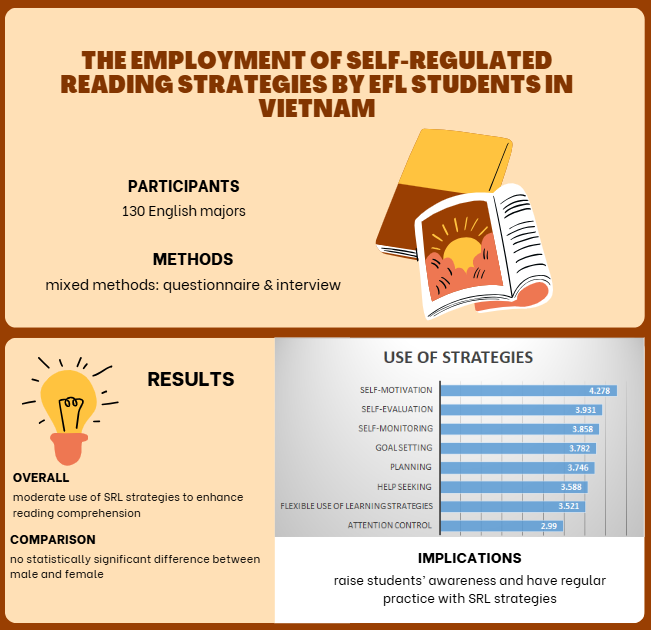
Reading comprehension is a crucial component of academic life, especially for students majoring in English. However, EFL students face various challenges in their learning, including, for example, the interpretation of reading materials and a lack of motivation. In this respect, students could utilize self-regulated learning (SRL) strategies to increase their learning autonomy and motivation, which are believed to contribute to academic success. Given that Vietnamese EFL learners also apply SRL strategies, this study aims to investigate the degree to which English majors employ SRL strategies in reading. The study also attempts to examine the most and least frequently used strategies and the differences, if any, between the two genders regarding SRL strategy use. 130 English-majored students from a university in the Mekong Delta were involved in the study. The quantitative data were gathered using a closed-ended questionnaire adapted from Duong and Ta (2022), and a follow-up interview for qualitative data was conducted with five students randomly chosen from the participants. The findings revealed that students generally employed SRL strategies to enhance reading comprehension, with different levels across the eight subcategories of strategy. In addition, a statistical test showed no significant difference between the male and female students regarding their implementation of SRL strategies. These results suggest pedagogical implications for teachers and learners, emphasizing the importance of SRL strategies in developing reading skills. Thus, teachers are expected to raise students’ awareness and practical employment of SRL to achieve their academic goals.
Downloads
Article Details

This work is licensed under a Creative Commons Attribution-NonCommercial-NoDerivatives 4.0 International License.
All rights reserved. Apart from citations for the purposes of research, private study, or criticism and review,no part of this publication may be reproduced, stored or transmitted in any other form without prior written permission by the publisher.
References
Abbasian, G.-R., & Hartoonian, A. (2014). Using self-regulated learning strategies in enhancing language proficiency with a focus on reading comprehension. English Language Teaching, 7(6), 160–167. https://doi.org/10.5539/elt.v7n6p160
Ali, H. H., & Paramasivam, S. (2016). Language learning strategies across proficiency levels among EFL pre-university students. Journal of Applied Linguistics and Language Research, 3(4), 135–148.
Butler, R. A. (1998). Determinants of help-seeking: Relations between perceived reasons for classroom help-avoidance and help-seeking behaviors in an experimental context. Journal of Educational Psychology, 90(4), 630–643. https://doi.org/10.1037/0022-0663.90.4.630
Ching, L. C. (2002). Strategy and self-regulation instruction as contributors to improving students' cognitive model in an ESL program. English for Specific Purposes, 21(3), 261–289. https://doi.org/10.1016/S0889-4906(01)00008-4
Corno, L. (1993). The best-laid plans: Modern conceptions of volition and educational research. Educational Researcher, 22(2), 14–22. https://doi.org/10.2307/1176169
Dornyei, Z., & Ryan, S. (2015). The psychology of the language learner revisited. Routledge.
Duong, T. M., & Ta, T. H. L. (2022). The employment of self-regulated learning strategies in learning English at a Ho Chi Minh City-based high school. VNU Journal of Science: Education Research, 38(4), 44–53. https://doi.org/10.25073/2588-1159/vnuer.4623
Duong, T. M., & Nguyen Dang, T. C. H. (2021). The role of learner autonomy and the use of self-regulated learning strategies: University students’ voice. In Proceedings of the 9th Open TESOL International Conference (pp. 255–276). Ho Chi Minh City Publishing House of Economics.
Griffiths, C., & Cansiz, G. (2015). Language learning strategies: An holistic view. Studies in Second Language Learning and Teaching, 5(3), 473–493. https://doi.org/10.14746/ssllt.2015.5.3.7
Khasawneh, M. A. S., & Al-Rub, M. O. A. (2020). Development of reading comprehension skills among the students of learning disabilities. Universal Journal of Educational Research, 8(11), 5335–5341. https://doi.org/10.13189/ujer.2020.081135
Kistner, S., Rakoczy, K., Otto, B., Dignath-van Ewijk, C., Büttner, G., & Klieme, E. (2010). Promotion of self-regulated learning in classrooms: Investigating frequency, quality, and consequences for student performance. Metacognition and Learning, 5(2), 157–171. https://doi.org/10.1007/s11409-010-9055-3
Kvale, S., & Brinkmann, S. (2009). Interviews: Learning the craft of qualitative research interviewing (2nd ed.). Sage.
Maftoon, P., & Tasnimi, M. (2014). Using self-regulation to enhance EFL learners’ reading comprehension. Journal of Language Teaching and Research, 5(4), 844–855. https://doi.org/10.4304/jltr.5.4.844-855
Nguyen, T. M., & Tran, T. Q. (2021). Self-regulation strategies for improving speaking skills among English-majored students. In Proceedings of the 2nd International Conference on Science, Technology and Society Studies (STS) 2021 at HUTECH University (pp. 740–749). HUTECH University Press.
Nguyen, T. V. L. (2011). Project-based learning in teaching English as a foreign language. VNU Journal of Science, Foreign Languages, 27(2), 140–146.
O’Malley, J., & Chamot, A. (1990). Learning strategies in second language acquisition. Cambridge University Press.
Oxford, R. L. (1990). Language learning strategies: What every teacher should know. Heinle & Heinle.
Pintrich, P. R. (2000). The role of goal orientation in self-regulated learning. In M. Boekaerts, P. R. Pintrich, & M. Zeidner (Eds.), Handbook of self-regulation (pp. 451–502). Academic Press.
Pressley, M., & Woloshyn, V. (1995). Cognitive strategy instruction that really improves children’s academic performance (2nd ed.). Brookline Books.
Qu, S. Q., & Dumay, J. (2011). The qualitative research interview. Qualitative Research in Accounting & Management, 8(3), 238–264. https://doi.org/10.1108/11766091111162070
Rahmah, D. A., & Mistar, J. (2023). Assessing the level of the student’s reading comprehension abilities and their difficulties. Premise: Journal of English Education and Applied Linguistics, 12(1), 46–57. https://doi.org/10.24127/pj.v12i1.4895
Ryan, A. M., Pintrich, P. R., & Midgley, C. (2001). Avoiding seeking help in the classroom: Who and why? Educational Psychology Review, 13(2), 93–114. https://doi.org/10.1023/A:1009013420053
Scheid, K. (1993). Helping students become strategic learners: Guidelines for Teaching. Brookline Books.
Schunk, D. H. (2001). Social cognitive theory and self-regulated learning. In B. J. Zimmerman & D. H. Schunk (Eds.), Self-regulated learning and academic achievement: Theoretical perspectives (2nd ed., pp. 125–151). Lawrence Erlbaum Associates.
Shuy, T. (2010). TEAL center fact sheet no. 3: Self-regulated learning. American Institutes for Research. https://lincs.ed.gov/sites/default/files/3_TEAL_Self%20Reg%20Learning.pdf
Sutiono, C., Triana, N., & Arapah, E. (2022). Reading comprehension and self-regulated learning: A cross sectional study of university students. Premise: Journal of English Education and Applied Linguistics, 11(3), 219–237. https://doi.org/10.24127/pj.v11i3.4747
Tran, T. Q., & Duong, T. M. (2013). The attitudes towards English language learning and use of self-regulated learning strategies among college non-English majors. International Journal of Scientific and Research Publications, 3(7), 1–8. https://www.ijsrp.org/research-paper-0713.php?rp=P191472
Tran, T. Q., Duong, T. M., & Le, S. H. T. (2023). Does EFL students’ self-efficacy in English language skills matter their self-regulated language learning strategy use? Language Related Research, 14(5), 59–81. https://doi.org/10.48311/LRR.14.5.59
Tran, T. Q., & Nguyen, H. N. K. (2020). Insights into tertiary English-majored students’ writing self-efficacy. TNU Journal of Science and Technology, 225(12), 47–54. https://doi.org/10.34238/tnu-jst.3273
Tran, T. Q., & Phan Tran, T. N. (2021). Vietnamese EFL high school students’ use of self-regulated language learning strategies for project-based learning. International Journal of Instruction, 14(1), 459–474. https://doi.org/10.29333/iji.2021.14127a
Vishnevsky, T., & Beanlands, H. (2004). Qualitative research. Nephrology Nursing Journal, 31(2), 234–238.
Winne, P. H. (1995). Inherent details in self-regulated learning. Educational Psychologist, 30(4), 173–187. https://doi.org/10.1207/s15326985ep3004_2
Winne, P. H., & Hadwin, A. F. (1998). Studying as self-regulated learning. In D. J. Hacker, J. Dunlosky, & A. C. Graesser (Eds.), Metacognition in educational theory and practice, the educational psychology series (pp. 277–304). Lawrence Erlbaum Associates.
Wolters, C. A. (1998). Self-regulated learning and college students’ regulation of motivation. Journal of Educational Psychology, 90(2), 224–235. https://doi.org/10.1037/0022-0663.90.2.224
Wolters, C. A. (2003). Regulation of motivation: Evaluating an underemphasized aspect of self-regulated learning. Educational Psychologist, 38(4), 189–205. https://doi.org/10.1207/S15326985EP3804_1
Zimmerman, B. J. (1990). Self-regulated learning and academic achievement: An overview. Educational Psychologist, 25(1), 3–17. https://doi.org/10.1207/s15326985ep2501_2
Zimmerman, B. J. (2002). Becoming a self-regulated learner: An overview. Theory Into Practice, 41(2), 64–70. https://doi.org/10.1207/s15430421tip4102_2
Zimmerman, B. J. (2004). Sociocultural influence and students’ development of academic self-regulation: A social-cognitive perspective. In D. M. McInerney & S. Van Etten (Eds.), Big theories revisited (pp. 139–164). Information Age.
Zumbrunn, S., Tadlock, J., & Roberts, E. D. (2011). Encouraging self-regulated learning in the classroom: A review of the literature. Metropolitan Educational Research Consortium (MERC). https://scholarscompass.vcu.edu/cgi/viewcontent.cgi?article=1017&context=merc_pubs
