
A bibliometric study of technological proficiency in higher education
Article Sidebar
Main Article Content
Abstract
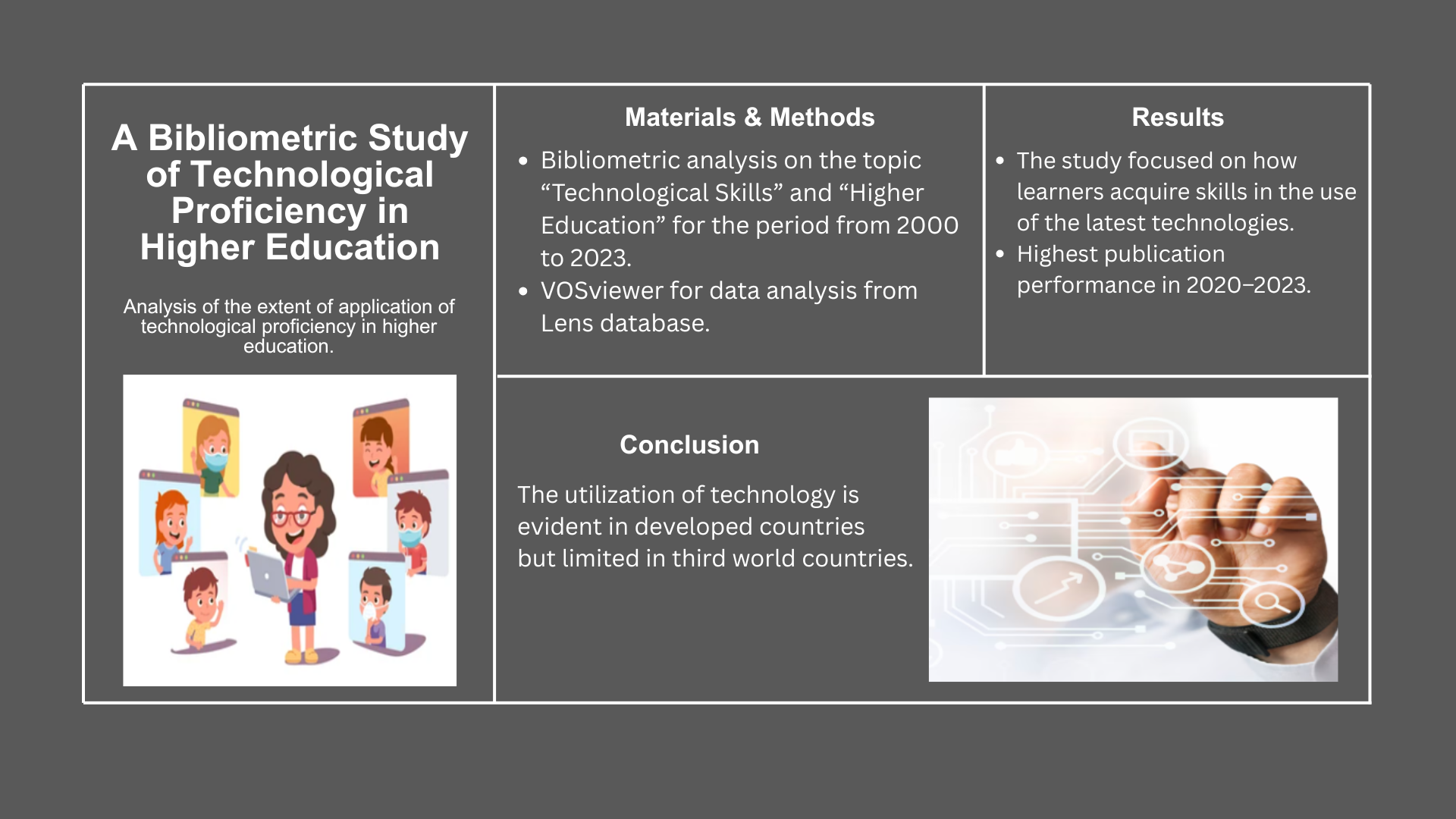
The study of technological proficiency is a key concern within a nation's educational and social programs. Throughout their academic journey, ranging from primary through secondary education and afterwards in higher education, students cultivate and enhance a diverse range of abilities, including technology proficiency. Information technology has changed the way businesses and higher education institutions work and the strategies they use. Colleges and universities worldwide are spending a lot of money on IT resources for students and faculty. Hence, this study investigates the trend of studies conducted in the field from 2000–2023 using bibliometric analysis. The bibliometric data generated contains 831 documents and was analyzed using VOSViewer software. Highlights of the findings revealed that the highest number of documents was published in 2020–2023, they were mostly sourced from journals, and top institutions performing research were from the USA, Australia, Israel, England, and Mexico. Antonella Nuzzaci was the author with the most publications, and the journals with most articles in the field were the Interdisciplinary Journal of e-Skills and Lifelong Learning Education, and Information Technologies. The results of co-occurrences based on Total Link Strength revealed keywords such as universities, internet, online learning, technology, and curriculum. The most cited documents were published from 2000–2005, and the most cited journals are Education and Information Technologies, Small Business Economics, and TechTrends. The trend of research on technological proficiency in higher education from 2000–2023 serves as reliable data to consider for further studies related to the field and for references and literature. The findings add value to current studies or topics of interest.
Downloads
Article Details

This work is licensed under a Creative Commons Attribution-NonCommercial-NoDerivatives 4.0 International License.
All rights reserved. Apart from citations for the purposes of research, private study, or criticism and review,no part of this publication may be reproduced, stored or transmitted in any other form without prior written permission by the publisher.
References
Abdullahi, H. (2013). The role of ICT in teaching science education in schools. Journal of Educational and Social Research, 3(9), 127–131. https://doi.org/10.5901/jesr.2013.v3n9p127
Alamri, H., Lowell, V., Watson, W., & Watson, S. L. (2020). Using personalized learning as an instructional approach to motivate learners in online higher education: Learner self-determination and intrinsic motivation. Journal of Research on Technology in Education, 52(3), 322–352. https://doi.org/10.1080/15391523.2020.1728449
Antonopoulou, K., Begkos, C., & Zhu, Z. (2023). Staying afloat amidst extreme uncertainty: A case study of digital transformation in higher education. Technological Forecasting and Social Change, 192, Article 122603. https://doi.org/10.1016/j.techfore.2023.122603
Binkley, M., Erstad, O., Herman, J., Raizen, S., Ripley, M., Miller-Ricci, M., & Rumble, M. (2012). Defining twenty-first century skills. In P. Griffin, B. McGaw, & E. Care (Eds.), Assessment and teaching of 21st century skills (pp. 17–66). Springer. https://doi.org/10.1007/978-94-007-2324-5_2
Brynjolfsson, E., & McAfee, A. (2014). The second machine age: Work, progress, and prosperity in a time of brilliant technologies. W.W. Norton & Company.
Cabero-Almenara, J. (2020). Aprendiendo del tiempo de la COVID-19 [Learning from the time of the COVID-19]. Revista Electrónica Educare, 24(Suplemento Especial), 1–3. https://doi.org/10.15359/ree.24-s.2 [in Spanish]
Casado-Aranda, L.-A., Sánchez-Fernández, J., Montoro-Ríos, F. J., & Horcajadas, M. I. A. (2021). Evaluation of the work-integrated learning methodology: Teaching marketing through practitioner experience in the classroom. Mathematics, 9(17), Article 2164. https://doi.org/10.3390/math9172164
Clark, R. C., & Mayer, R. E. (2016). E-learning and the science of instruction: Proven guidelines for consumers and designers of multimedia learning (4th ed.). John Wiley & Sons. https://doi.org/10.1002/9781119239086
Damşal, C. (2019). Learning with digital technologies in higher education. Journal of Educational Sciences and Psychology, 9, 5–9.
Deng, S., & Xia, S. (2020). Mapping the interdisciplinarity in information behavior research: A quantitative study using diversity measure and co-occurrence analysis. Scientometrics, 124(1), 489–513. https://doi.org/10.1007/s11192-020-03465-x
Donthu, N., Kumar, S., Pandey, N., & Gupta, P. (2021). Forty years of the international journal of information management: A bibliometric analysis. International Journal of Information Management, 57, Article 10237. https://doi.org/10.1016/j.ijinfomgt.2020.102307
Fearnley, M. R., & Amora, J. T. (2020). Learning management system adoption in higher education using the extended technology acceptance model. IAFOR Journal of Education, 8(2), 89–106. https://doi.org/10.22492/ije.8.2.05
Haleem, A., Javaid, M., Qadri, M. A., & Suman, R. (2022). Understanding the role of digital technologies in education: A review. Sustainable Operations and Computers, 3, 275–285. https://doi.org/10.1016/j.susoc.2022.05.004
Hernandez, R. M. (2017). Impacto de las TIC en la educación: Retos y perspectivas [Impact of ICT on education: Challenges and perspectives]. Propósitos Y Representaciones, 5(1), 325–347. http://dx.doi.org/10.20511/pyr2017.v5n1.149 [in Spanish]
Kolodziejczak, B., & Roszak, M. (2017). ICT competencies for academic e-learning. Preparing students for distance education—Authors’ proposal. International Journal of Information and Communication Technologies in Education, 6(3), 14–25.
Kramer, W. J., Jenkins, B., & Katz, R. S. (2007). The role of the information and communications technology sector in expanding economic opportunity. The Fellows Harvard College. https://www.knowledge4all.com/admin/Temp/Files/3192c47f-68f1-4d5c-9692-cbae02e42bb3.pdf
Lai, C.-L. (2020). Trends of mobile learning: A review of the top 100 highly cited papers. British Journal of Educational Technology, 51(3), 721–742. https://doi.org/10.1111/bjet.12884
Leelakulthanit, O. (2018). The impact of 21st century skills on the life satisfaction of the general public. Journal of Applied Economic Sciences, 13(61), 2064–2075.
Mahande, R. D., & Akram, A. (2021). Motivational factors underlying the use of online learning system in higher education: An analysis of measurement model. Turkish Online Journal of Distance Education, 22(1), 89–105. https://doi.org/10.17718/tojde.849888
Maiorov, A. A. (2021). Management of a higher education institution and ways to implement effectively its innovation policy. Economic Consultant, 34(2), 42–51. https://doi.org/10.46224/ecoc.2021.2.5
Masoumi, D., & Noroozi, O. (2023). Developing early career teachers’ professional digital competence: A systematic literature review. European Journal of Teacher Education, 1–23. https://doi.org/10.1080/02619768.2023.2229006
Molina-García, A., Diéguez-Soto, J., Galache-Laza, M. T., & Campos-Valenzuela, M. (2023). Financial literacy in SMEs: A bibliometric analysis and a systematic literature review of an emerging research field. Reviews of Management Sciences, 17(3), 787–826. https://doi.org/10.1007/s11846-022-00556-2
Mukherjee, K. (2021). Integrating technology, innovation, and policy: COVID-19 and HTA. Health Policy and Technology, 10(1), 16–20. https://doi.org/10.1016/j.hlpt.2021.01.003
Nevado-Peña, D., Lopez-Ruiz, V.-R., & Alfaro-Navarro, J.-L. (2019). Improving quality of life perception with ICT use and technological capacity in Europe. Technological Forecasting and Social Change, 148, Article 119734. https://doi.org/10.1016/j.techfore.2019.119734
Nwankwoala, H. N. L. (2015). An investigation of lecturers’ and students’ use of ICTs in Nigerian university education as a panacea for national development. Research on Humanities and Social Sciences, 5(20), 167–176. https://tinyurl.com/ruthpvv
Odigwe, F. N., Bassey, B. A., & Owan, V. J. (2020). Data management practices and educational research effectiveness of university lecturers in South-South Nigeria. Journal of Educational and Social Research, 10(3), 24–34. https://doi.org/10.36941/jesr-2020-0042
Owan, V. J., Ekpe, M. B., & Eneje, S. (2020). Undergraduates’ utilisation of social networking media and sexual behaviours in higher education: A case study. Pedagogical Research, 5(2), Article em0062. https://doi.org/10.29333/pr/7940
Oxford. (2025). Definition of information and communications technology. Oxford University Press.
Rodrigues, A. L., Cerdeira, L., de Lourdes Machado-Taylor, M., & Alves, H. (2021). Technological skills in higher education—Different needs and different uses. Education Sciences, 11(7), Article 326. https://doi.org/10.3390/educsci11070326
Rouah, I., Bourekkadi, S., Khoulji, S., Slimani, K., & Kerkeb, M. L. (2021). Mobile learning driving the development of higher education through a new vision of teaching methods thanks to educational technology. Ilkogretim Online - Elementary Education Online, 20(5), 976–987. https://doi.org/10.17051/ilkonline.2021.05.106
Roszak, M., & Kolodziejczak, B. (2017). Building a course with multimedia resources-the working time analysis on the example of the pathophysiology course. In M. Hrubý (Ed.), Proceedings of Distance Learning, Simulation and Communication 2017: Selected papers from the University of Defence (pp. 161–170). University of Defence.
Roztocki, N., & Weistroffer, H. R. (2016). Conceptualizing and researching the adoption of ICT and the impact on socioeconomic development. Information Technology for Development, 22(4), 541–549. https://doi.org/10.1080/02681102.2016.1196097
Sharma, M. K., & Sharma, R. C. (2021). Innovation framework for excellence in higher education institutions. Global Journal of Flexible Systems Management, 22(2), 141–155. https://doi.org/10.1007/s40171-021-00265-x
Singh, M. (2023). Impact of ICT on higher education. Galaxy International Interdisciplinary Research Journal, 11(3), 6–11. https://internationaljournals.co.in/index.php/giirj/article/view/3612
Su, J., & Yang, W. (2024). Digital competence in early childhood education: A systematic review. Education and Information Technologies, 29(4), 4885–4933. https://doi.org/10.1007/s10639-023-11972-6
Usher, M., Hershkovitz, A., & Forkosh-Baruch, A. (2021). From data to actions: Instructors’ reflections about learners’ data in online emergency remote teaching. British Journal of Educational Technology, 52(4), 1338–1356. https://doi.org/10.1111/bjet.13108
Volungevičienė, A., Teresevičienė, M., & Ehlers, U.-D. (2020). When is open and online learning relevant for curriculum change in higher education? Digital and network society perspective. The Electronic Journal of e-Learning, 18(1), 88–101. https://doi.org/10.34190/EJEL.20.18.1.007
Wieser, D. (2020). Integrating technology into the learning process of higher education: A creative inquiry. Industry and Higher Education, 34(3), 138–150. https://doi.org/10.1177/0950422219895773
Yang, L., García‐Holgado, A., & Martínez‐Abad, F. (2023). Digital competence of K-12 pre-service and in-service teachers in China: A systematic literature review. Asia Pacific Education Review, 24(4), 679–693. https://doi.org/10.1007/s12564-023-09888-4
Yunus, M. M., Lubis, M. A., & Lin, C. P. (2009). Language learning via ICT: Uses, challenges and issues. WSEAS Transactions on Information Science and Applications, 6(9), 1453–1467.
Yusuf, S., Durosaro, D. O., Mustapha, A. I. & Afolabi, R. (2022). An assessment of ICT competence among academic staff in Kwara State Colleges of Education, Nigeria: Implications for management. OUSL Journal, 17(1), 139–159. https://doi.org/10.4038/ouslj.v17i1.7524
Zhao, B., & Zhou, J. (2024). Research hotspots and trends in digitalization in higher education: A bibliometric analysis. Heliyon, 10(21), Article e39806. https://doi.org/10.1016/j.heliyon.2024.e39806
