
An in-depth analysis of satirical discourse in the Chinese comedy variety show ROCK & ROAST
Article Sidebar
Main Article Content
Abstract
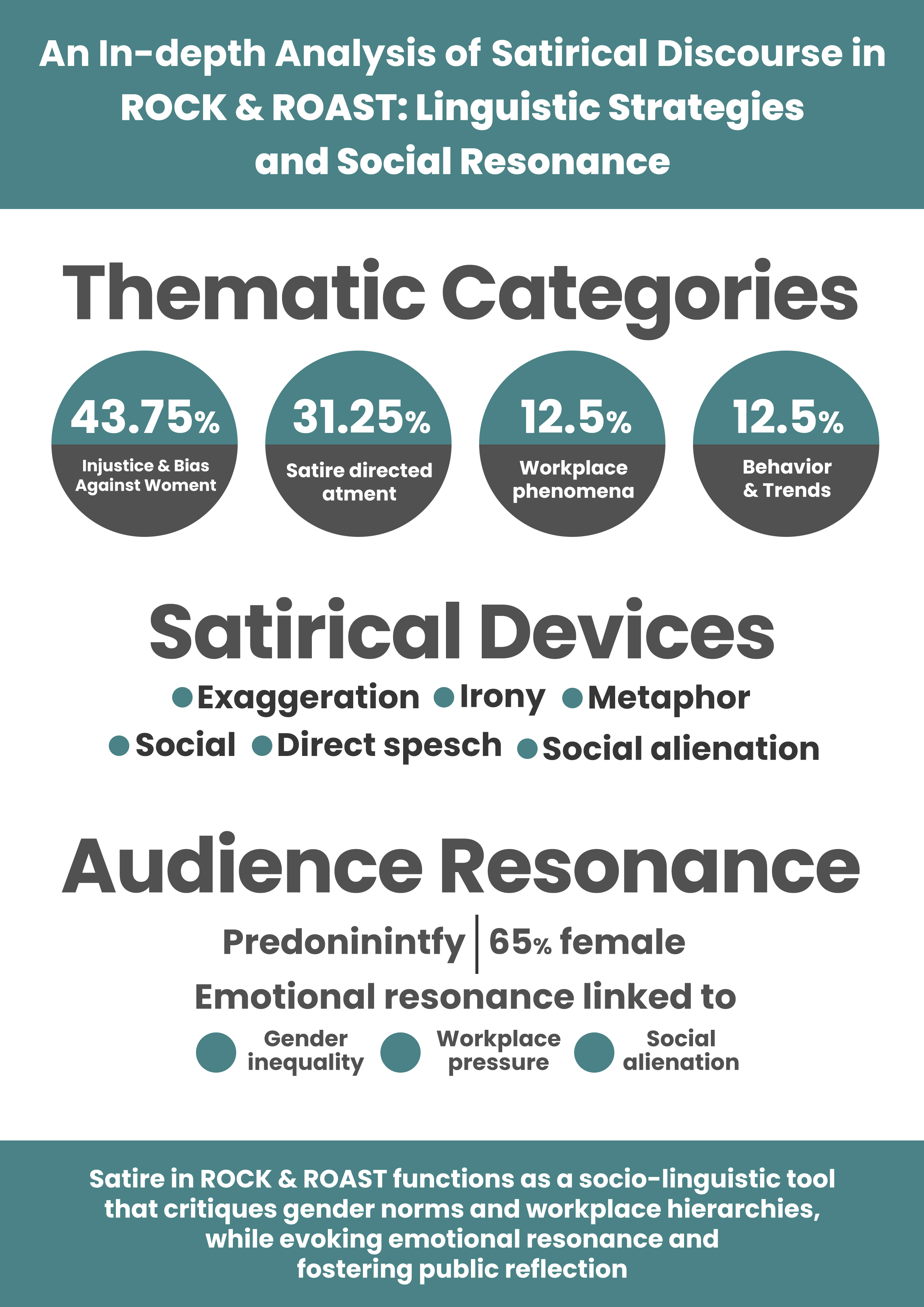
The Chinese variety show ROCK & ROAST has emerged as a significant cultural phenomenon. Distinguished by its incisive deployment of satirical discourse, the program addresses pressing societal issues while evoking emotional resonance from its audience. This study investigates the pivotal role of satirical discourse in the show, highlighting its capacity to foster social reflection and challenge entrenched norms. While previous research has predominantly focused on humor, this study fills a significant gap by analyzing the role of satire—more pointed and socially critical than humor—in fostering public discourse and societal reflection. Adopting a mixed-methods approach, this study draws on data from five seasons of 'ROCK & ROAST,' employing transcription, thematic categorization, and statistical analysis. The findings reveal four primary thematic categories: injustice and social bias against women (43.75%), satire directed at men (31.25%), critique of workplace phenomena (12.5%), criticisms of social behavior and trends (12.5%). Female comedians often employ a feminist perspective to critique gender inequality, while male performers engage in broader societal commentary through satire. These divergent perspectives enrich the discourse, highlighting the varied ways in which satire articulates and critiques social realities. Furthermore, the study identifies emotional resonance as a central factor driving audience engagement, grounded in shared identities, experiences, and societal pressures, particularly among women and working-class viewers. By examining the multifaceted role of satire in ROCK & ROAST, this study contributes to the fields of sociolinguistics and media studies by exploring how satirical language serves as both an artistic and sociopolitical tool in contemporary Chinese entertainment. This study contributes to the fields of sociolinguistics and media studies by elucidating how satire functions as an artistic and sociopolitical force in contemporary Chinese entertainment.
Downloads
Article Details

This work is licensed under a Creative Commons Attribution-NonCommercial-NoDerivatives 4.0 International License.
All rights reserved. Apart from citations for the purposes of research, private study, or criticism and review,no part of this publication may be reproduced, stored or transmitted in any other form without prior written permission by the publisher.
References
Cong, X. (2001). Humor and its neighboring forms: A comparison of several categories of the “laughter” family. Journal of Northwestern Polytechnical University (Social Science Edition), (1), 1–4. https://doi.org/10.16039/j.cnki.cn22-1249.2001.01.001 [in Chinese]
Cui, J. (2022). Deconstruction and construction: Strategy of spreading talk show. Frontiers in Art Research, 4(11), 71–75. https://doi.org/10.25236/FAR.2022.041116 [in Chinese]
Dong, J. L. (2023). Research on topic selection in Rock & Roast from the uses and gratifications perspective [Master’s thesis, Changchun University of Science and Technology]. CNKiDOI. https://doi.org/10.26977/d.cnki.gccgc.2023.000336 [in Chinese]
Duan, L. Y. (2022). A study of female stand-up comedy language based on Rock & Roast [Master’s thesis, Tianjin University]. CNKiDOI. https://doi.org/10.27356/d.cnki.gtjdu.2022.002820
Fan, Y. (1981). Sarcasm and humor: Starting from interpreting the word “SARCASM.” Journal of Foreign Languages, 5, 15–20. [in Chinese]
Fang, Y. P. (2023). Research on rhetoric in stand-up comedy [Master’s thesis, Hainan Normal University]. CNKI. https://kns.cnki.net/KCMS/detail/detail.aspx?dbname=CMFD202401&filename=1023691414.nh [in Chinese]
Fu, C. Y. (2007). Analyzing sarcastic speech acts using relevance theory. Science and Technology Information (Academic Research), 33, 138–139. [in Chinese]
Gao, S. (2004). The definition of humor and the issue of its academic affiliation. Seeking Truth Academic Journal, (5), 100–104. https://doi.org/10.16039/j.cnki.cn22-1249.2004.05.018 [in Chinese]
Gou, X. H. (2023). Gou Xiong Hui boutique cases: Analysis of the popularity of stand-up comedians and exploration of influencing factors. Sohu Entertainment. https://yule.sohu.com/a/631186748_455817 [in Chinese]
Guo, L. (2007). A pragmatic study of sarcastic speech acts in Chinese [Master’s thesis, Jinan University]. Jinan University Institutional Repository. https://kns.cnki.net/KCMS/detail/detail.aspx?dbname=CMFD2008&filename=2007191787.nh [in Chinese]
Hao, Y. (2019). A study on the phenomenon of coinage in Rock & Roast. Grand View (Forum), 1, 148–149. [in Chinese]
Huang, Y. (2022). Research on gender decoding of stand-up comedy in Chinese network communication: Taking Rock & Roast as example. In Proceedings of the 2022 International Conference on Science Education and Art Appreciation (SEAA 2022) (pp. 643–649). Atlantis Press. https://doi.org/10.2991/978-2-494069-05-3_79
Huang, Y. X. (2023). Exploring the social functions of code-switching from a sociolinguistic perspective: A case study of Rock & Roast (Season 5). Jiaying Literature, 24, 93–95. [in Chinese]
Lao, S. (1982). On humor. In She Lao collected works. People’s Literature Publishing House. [in Chinese]
Liu, J. (2023). Register deviation in verbal humor: A case study of Rock & Roast. Comedy World (Second Half), 1, 116–118. [in Chinese]
Liu, M. M. (2022). A study of code-switching in Rock & Roast from the perspective of adaptation theory. Writers’ World, 36, 91–93. [in Chinese]
Rosa, H. (2015). Acceleration: The change of temporal structures in modern society (D. Lu, Trans.). Peking University Press. (Original work published in 2005)
Rosa, H. (2019). Resonance: A sociology of our relationship to the world (J. C. Wagner, Trans.). Polity Press.
Stoyanova, E. V. (2021). Metaphor as a means of creating a humorous effect in Bulgarian media texts. The European Journal of Humour Research, 9(1), 44–56. https://doi.org/10.7592/EJHR2021.9.1.Stoyanova
Tang, S. S. (2003). An analysis of the composition of complimentary, flattering, and sarcastic speech acts. Rhetoric Learning, 4(4), 15–17. https://doi.org/10.16027/j.cnki.cn31-2043/h.2003.04.006 [in Chinese]
TopMarketing. (2022, October 10). Stand-up comedy marketing: The brand’s guide to creating viral jokes. Sohu Business. https://business.sohu.com/a/591641758_123843 [in Chinese]
Wang, J. (2022a). The relational logic of university classroom teaching from the perspective of resonance theory. Journal of Tangshan University, 35(6), 87–92. https://doi.org/10.16160/j.cnki.tsxyxb.2022.06.012 [in Chinese]
Wang, C. (2022b). A study of humorous language in stand-up comedy [Master’s thesis]. Central China Normal University. [in Chinese]
Wang, J. X. (2023). Cognitive analysis of verbal humor in Rock & Roast from the perspective of construal theory. Western China Broadcasting TV, 5, 92–94. [in Chinese]
Wang, X. J., & Liu, H. (2022). Rhetorical strategies of humorous language in Rock & Roast. Journal of Journalism and Writing, 12, 155–157. [in Chinese]
Wang, Y. N. (2021). A brief analysis of the social functions of code-switching from a sociolinguistic perspective: Taking Rock & Roast (Season 3) as an example. English Square, 17, 44–47. [in Chinese]
Weaver, S. (2012). A rhetorical discourse analysis of online anti-Muslim and anti-Semitic jokes. Ethnic and Racial Studies, 36(3), 483–499. https://doi.org/10.1080/01419870.2013.734386 [in Chinese]
Yang, J. (2021). A pragmatic study of talk show language——Take "Talk Show Conference" as an example [Master's thesis, Beihua University]. China National Knowledge Infrastructure (CNKI). https://doi.org/10.26928/d.cnki.gbhuu.2021.000031 [in Chinese]
Yang, L. F. (2022). A multimodal discourse study of Rock & Roast [Master’s thesis, Harbin Normal University]. CNKI. https://kns.cnki.net/KCMS/detail/detail.aspx?dbname=CMFD202202&filename=1022491134.nh [in Chinese]
Yang, X. M., & Qi, S. M. (2015a). A metonymic study of sarcastic speech acts. Journal of Beijing University of Chemical Technology (Social Sciences Edition), 1, 78–81. [in Chinese]
Yang, X. M., & Qi, S. M. (2015b). A study on pragmatic parameters in the metonymy of sarcastic speech acts. Journal of Jilin Institute of Chemical Technology, 32(7), 31–34. https://doi.org/10.16039/j.cnki.cn22-1249.2015.07.009 [in Chinese]
Zhao, Q. Q. (2020). An analysis of verbal humor art in Rock & Roast from the perspective of presupposition. Comparative Study of Cultural Innovation, 11(11), 48–49. [in Chinese]
Zhao, W. (2021). Engaging with female stand-up comedians in Rock & Roast 3: Genres, gender, and women’s humor [Master's thesis, Lund University]. Lund University Institutional Repository. https://lup.lub.lu.se/student-papers/search/publication/9063398
