
Airport operator’s high-value services for affluent passengers: An empirical analysis at U-Tapao International Airport, Thailand
Article Sidebar
Main Article Content
Abstract
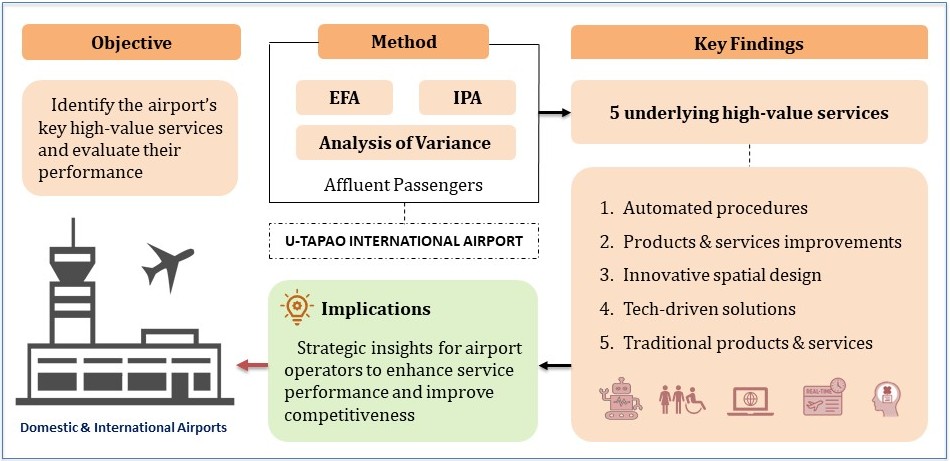
Given that airports serve as gateways for travellers to destinations around the world, they must offer competitive products and services to meet the expectations of targeted passengers. The Thai government has prioritized innovation and cutting-edge technology to modernize various industries, including affluent, medical, and wellness tourism. U-Tapao International Airport, Thailand’s third international airport and an aviation hub in the eastern region, must enhance its operational competency and strengthen its competitive advantage. This study aims to identify key high-value services (HVS) provided by airports by assessing the expectations and perceptions of affluent passengers. The airport’s service performance is also evaluated to identify areas in need of improvement. Exploratory factor analysis is utilized to identify key HVS, and data was collected from 350 passengers through a structured questionnaire survey. Findings showed that the advancement of technology and services, with a focus on automated procedures, improvements to new and standard products and services, innovative spatial design, and tech-driven solutions, is an important factor in meeting passenger needs. Moreover, traditional products and services are found to be significantly important to passengers. The insights offered implications that airport operators can incorporate into their future strategic plans.
Downloads
Article Details

This work is licensed under a Creative Commons Attribution-NonCommercial-NoDerivatives 4.0 International License.
All rights reserved. Apart from citations for the purposes of research, private study, or criticism and review,no part of this publication may be reproduced, stored or transmitted in any other form without prior written permission by the publisher.
References
Akman, G., & Yilmaz, C. (2008). Innovative capability, innovation strategy and market orientation: An empirical analysis in Turkish software industry. International Journal of Innovation Management, 12(1), 69–111. https://doi.org/10.1142/S1363919608001923
Ali, F., Kim, W. G., & Ryu, K. (2016). The effect of physical environment on passenger delight and satisfaction: Moderating effect of national identity. Tourism Management, 57, 213–224. https://doi.org/10.1016/j.tourman.2016.06.004
Argandoña, A. (2011). Stakeholder theory and value creation (Working Paper No. 922). IESE Business School, University of Navarra. http://dx.doi.org/10.2139/ssrn.1947317
Bezerra, G. C. L., & Gomes, C. F. (2019). Determinants of passenger loyalty in multi-airport regions: Implications for tourism destination. Tourism Management Perspectives, 31, 145–158. https://doi.org/10.1016/j.tmp.2019.04.003
Boc, K., Štimac, I., Pivac, J., & Bračić, M. (2023). An empirical investigation: Does new airport terminal infrastructure improve the customer experience? Sustainability, 15(17), Article 13188. https://doi.org/10.3390/su151713188
Bogicevic, V., Bujisic, M., Bilgihan, A., Yang, W., & Cobanoglu, C. (2017). The impact of traveler-focused airport technology on traveler satisfaction. Technological Forecasting and Social Change, 123, 351–361. https://doi.org/10.1016/j.techfore.2017.03.038
Booranakittipinyo, A. (2020). Driving factors of passenger satisfaction affecting airport service quality: A case of airport for low-cost carriers. Journal of Multidisciplinary in Social Sciences, 16(2), 9–18. https://so03.tci-thaijo.org/index.php/sduhs/article/view/268113
Busch-Casler, J., Haubner, S., & Pinkwart, A. (2021). Employee involvement in innovation activities in hospitals: How perception matters. Health Services Management Research, 34(2), 70–79. https://doi.org/10.1177/0951484820943600
Caetano, M., Pinto Alves, C. J., & de Oliveira Alves, L. B. (2021). Model for measuring airport innovation. Revista Brasileira de Inovação, 20, Article e21012. https://doi.org/10.20396/rbi.v20i00.8661362
Carstens, S., & Heyns, G. (2012). The influence of passenger demographics on airport attribute evaluation. Journal of Transport and Supply Chain Management, 6(1), 55–72. https://doi.org/10.4102/jtscm.v6i1.31
Champahom, T., Nisaisuk, N., Runkawee, N., Limpasirisuwun, N., & Chonsalasin, D. (2022). Exploratory of tourists’ expectation on airport service quality: Classification and regression tree approach. Journal of Global Business Review, 24(2), 1–15.
Chao, C.-C., Lin, H.-C., & Chen, C.-Y. (2013). Enhancing airport service quality: A case study of Kaohsiung International Airport. Journal of the Eastern Asia Society for Transportation Studies, 10, 2235–2254. https://doi.org/10.11175/easts.10.2235
Eastern Economic Corridor. (2022). EEC [Fact Sheet]. https://www.eeco.or.th/en/filedownload/3622/fb4d438aaea09169020a00aecaa27f1c.pdf
Fakfare, P., Wattanacharoensil, W., & Graham, A. (2021). Exploring multi-quality attributes of airports and the asymmetric effects on air traveller satisfaction: The case of Thai international airports. Research in Transportation Business & Management, 41, Article 100648. https://doi.org/10.1016/j.rtbm. 2021.100648
Giannopoulos, A., Skourtis, G., Kalliga, A., Dontas-Chrysis, D. M., & Paschalidis, D. (2020). Co-creating high-value hospitality services in the tourism ecosystem: Towards a paradigm shift? Journal of Tourism Heritage & Services Marketing, 6(2), 3–11. http://doi.org/10.5281/zenodo.3822065
Göçmen, E. (2021). Smart airport: Evaluation of performance standards and technologies for a smart logistics zone. Transportation Research Record, 2675(7), 480–490. https://doi.org/10.1177/03611981211019740
Graham, A., Budd, L., Ison, S., & Timmis, A. (2019). Airports and ageing passengers: A study of the UK. Research in Transportation Business & Management, 30, Article 100380. https://doi.org/10.1016/j.rtbm.2019.100380
Hagedoorn, J., Lokshin, B., & Malo, S. (2018). Alliances and the innovation performance of corporate and public research spin-off firms. Small Business Economics, 50, 763–781. https://link.springer.com/ article/10.1007/s11187-017-9894-2
Hair, J. F., Jr., Black, W. C., Babin, B. J., & Anderson, R. E. (2018). Multivariate data analysis (8th ed.). Cengage Learning Emea.
Halpern, N., Budd, T., Suau-Sanchez, P., Bråthen, S., & Mwesiumo, D. (2021). Conceptualising airport digital maturity and dimensions of technological and organisational transformation. Journal of Airport Management, 15(2), 182–203. https://www.henrystewartpublications.com/sites/default/files/JAM15.2Conceptualisingairportdigitalmaturityanddimensionsoftechnologicalandorganisationaltransformation.pdf
Ianioglo, A. (2022). Innovation and Entrepreneurial Ecosystems. In L. Aldieri (Ed.), Innovation, research and development and capital evaluation. IntechOpen. https://doi.org/10.5772/intechopen.102344
Jeeradist, T. (2021). SERVQUAL and Kano’s model integrated to develop a conceptual model of airport terminal service implementation. In V. Kankhva (Ed.), Ural Environmental Science Forum “Sustainable Development of Industrial Region” (UESF-2021): Vol. 258. E3S Web of Conferences (Article 02010). EDP Sciences. https://doi.org/10.1051/e3sconf/202125802010
Kalakou, S., & Moura, F. (2021). Analyzing passenger behavior in airport terminals based on activity preferences. Journal of Air Transport Management, 96, Article 102110. https://doi.org/10.1016/j.jairtraman.2021.102110
Kiliç, S., Ucler, C., & Martin-Domingo, L. (2021). Innovation at airports: A systematic literature review (2000–2019). Aviation, 25(3), 220–231. http://doi.org/10.3846/aviation.2021.14917
Kosiba, J. P., Acheampong, A., Adeola, O., & Hinson, R. E. (2020). The moderating role of demographic variables on customer expectations in airport retail patronage intentions of travellers. Journal of Retailing and Consumer Services, 54, Article 102033. https://doi.org/10.1016/j.jretconser.2020.102033
Kurniawan, R., Sebhatu, S. P., & Davoudi, S. (2017). Passengers’ perspective toward airport service quality (ASQ) (Case study at Soekarno-Hatta International Airport). Journal of the Civil Engineering Forum, 3(1), 21–32. https://doi.org/10.22146/jcef.26547
Ma, G., Ding, Y., & Ma, J. (2022). The impact of airport physical environment on perceived safety and domestic travel intention of Chinese passengers during the COVID-19 pandemic: The mediating role of passenger satisfaction. Sustainability, 14(9), Article 5628. https://doi.org/10.3390/su14095628
Mandić, D., Panić, A., & Čičin-Šain, M. (2023). Automated service delivery in hotels: Balancing efficiency and human interaction for optimal guest satisfaction. International Scientific Conference on Economy, Management and Information Technologies, 1(1), 167–174. https://doi.org/10.46793/ICEMIT23.137M
Mastercard. (2024, May). Mastercard affluent travel report 2024. Mastercard Content Exchange. https://mastercardcontentexchange.com/news/media/f4rfxx3t/mastercard-affluent-travel-report-2024-final.pdf
Medvedev, A., Alomar, I., & Augustyn, S. (2017). Innovation in airport design. Aviation, 21(1), 23–28. https://doi.org/10.3846/16487788.2017.1303542
Ministry of Tourism and Sports. (2017, February 10). The 2nd national tourism development plan, (B.E. 2560–2564). Ministry of Tourism and Sports, Thailand. https://www.ubu.ac.th/web/files_up/03f2017052216244626.pdf [in Thai]
Murat Ar, I., & Baki, B. (2011). Antecedents and performance impacts of product versus process innovation: Empirical evidence from SMEs located in Turkish science and technology parks. European Journal of Innovation Management, 14(2), 172–206. https://doi.org/10.1108/14601061111124885
Novotná, M., & Kunc, J. (2019). Experiences matter! Luxury tourism consumption patterns and motivation of the Czech affluent society. The Central European Journal of Regional Development and Tourism, 11(2), 121–142. http://doi.org/10.32725/det.2019.019
OECD/Eurostat. (2018). Oslo Manual 2018: Guidelines for collecting, reporting and using data on innovation the measurement of scientific, technological and innovation activities. OECD Publishing.
Office of the National Economic and Social Development Council. (2023). The thirteenth national economic and social development plan (2023–2027). https://www.nesdc.go.th/article_attach/article_file_20230615134223.pdf
Olya, H., Altinay, L., & De Vita, G. (2018). An exploratory study of value added services. Journal of Services Marketing, 32(3), 334–345. https://doi.org/10.1108/JSM-12-2016-0415
Orfila-Sintes, F., & Mattsson, J. (2009). Innovation behavior in the hotel industry. Omega, 37(2), 380–394. http://doi.org/10.1016/j.omega.2007.04.002
Parasuraman, A., Zeithaml, V. A., & Berry, L. L. (1985). A conceptual model of service quality and its implications for future research. Journal of Marketing, 49(4), 41–50. https://doi.org/10.1177/002224298504900403
Pantouvakis, A., & Renzi, M. F. (2016). Exploring different nationality perceptions of airport service quality. Journal of Air Transport Management, 52, 90–98. https://doi.org/10.1016/j.jairtraman.2015.12.005
Plog, S. (2001). Why destination areas rise and fall in popularity: An update of a Cornell Quarterly classic. The Cornell Hotel and Restaurant Administration Quarterly, 42(3), 13–24.
Poon, K. Y., & Huang, W. J. (2017). Past experience, traveler personality and tripographics on intention to use Airbnb. International Journal of Contemporary Hospitality Management, 29(9), 2425–2443. https://doi.org/10.1108/IJCHM-10-2016-0599
Poulaki, I., Paraschi, E. P., Marinakos, K., Avramopoulos, A., & Makrygianni, S. (2021). Digital technologies and innovation in airport services: A benefit model approach. Journal of Air Transport Studies, 12(2), 41–63. https://doi.org/10.38008/jats.v12i2.171
Reyes, A. M. D., Faner, K. D. F., Lemaitre, J. C., & Tolentino, K. Y. (2021). Tourist motivations and preferences on visiting agritourism Laguna, Philippines. Asia Pacific Journal of Management and Sustainable Development, 9(2), 31–40. https://research.lpubatangas.edu.ph/wp-content/uploads/2022/02/04-APJMSD-2021-4-1.pdf
Seyanont, A. (2012). Passengers’ perspective toward airport service quality at Suvarnabhumi International Airport. Journal of Society for Transportation and Traffic Studies, 3(3), 32–41.
Suwannakul, E. (2021). Role of technology readiness in airline passengers’ perceptions of self-service technology quality. African Journal of Hospitality, Tourism and Leisure, 10(2), 670–681. http:// doi.org/10.46222/ajhtl.19770720-125
Suwannakul, E., Khetjenkarn, S., & Wichaidit, S. (2024). Examining service gaps and passengers’ perceived service performance of Thailand’s regional airports: A comparative analysis of different characteristics. African Journal of Hospitality, Tourism and Leisure, 13(1), 142–148. https://doaj.org/article/05649ad2b8e34ec291aa9b8612121b7c
Tabachnick, B. G., & Fidell, L. S. (2007). Using multivariate statistics (7th ed.). Pearson.
Taylor Wells Advisory Firm. (2021, June 16). How it works – Value-added services examples and importance. https://taylorwells.com.au/value-added-services-examples/
The Secretariat of the Prime Minister. (2017). Thailand 4.0, driving the future to stability, prosperity, sustainability. Thaikhufah, 33, 1–43. https://media.thaigov.go.th/uploads/document/66/2017/09/pdf/Thaikhufah03_2560.pdf [in Thai]
Tsai, W.-H., Hsu, W., & Chou, W.-C. (2011). A gap analysis model for improving airport service quality. Total Quality Management & Business Excellence, 22(10), 1025–1040. https://doi.org/10.1080/14783363.2011.611326
Türeli, N. Ş., Durmaz, V., Bahçecik, Y. S., & Akay, S. S. (2019). An analysis of importance of innovative behaviors of ground handling human resources in ensuring customer satisfaction. Procedia Computer Science, 158, 1077–1087. http://doi.org/10.1016/j.procs.2019.09.149
Usman, A., Azis, Y., Harsanto, B., & Azis, A. M. (2023a). The role of innovation and airport service quality on airport image: Mediated Effect of passenger satisfaction. African Journal of Hospitality, Tourism and Leisure, 12(3), 1111–1126. https://www.ajhtl.com/uploads/7/1/6/3/7163688/article_21_12_3_1111-1126.pdf
Usman, A., Azis, Y., Harsanto, B., & Azis, A. M. (2023b). The impact of service orientation and airport service quality on passenger satisfaction and image: Evidence from Indonesia. Logistics, 7(4), Article 102. https://doi.org/10.3390/logistics7040102
Valkokari, K. (2015). Business, innovation, and knowledge ecosystems: How they differ and how to survive and thrive within them. Technology Innovation Management Review, 5(8), 17–24. https://timreview.ca/sites/default/files/article_PDF/Valkokari_TIMReview_August2015.pdf
Zehrer, A., Muskat, B., & Muskat, M. (2016). Innovation in tourism firms. In H. Pechlaner & E. Innerhofer (Eds.), Competence-based innovation in hospitality and tourism (pp. 81–94). Routledge.
