
Game-based translation of English compound words: Effectiveness of ‘2P1M’ in the translation classroom
Article Sidebar
Main Article Content
Abstract
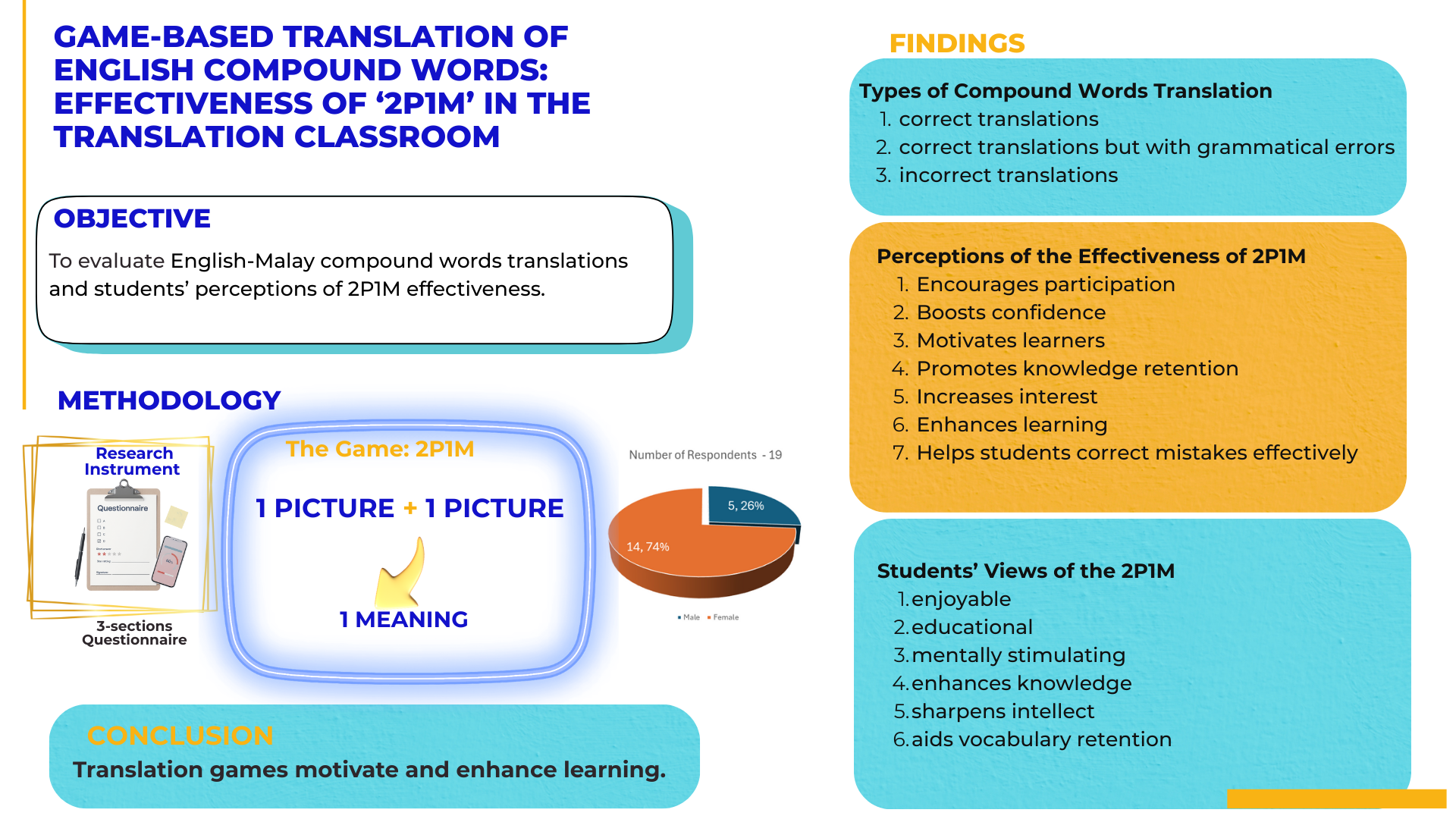
Traditional teaching methods have employed more interactive and interesting strategies, including the use of game-based activities. These games are often played in translation classrooms. One example of such games is the self-created game, known as 2P1M (2 Pictures 1 Meaning). The game helps to make learning translation more enjoyable and indirectly enhances translation skills. The game can be utilised by the students to hone their skills in translating English compound words and expressions into the Malay language. This article discusses the use of 2P1M in translation classrooms as well as the effectiveness of the game from the students’ viewpoint. A total of 19 students from a public university who enrolled for a translation course were selected for this action-based research. They are assessed based on their translation of English compound words and expressions using 2P1M. A set of questionnaires was distributed to obtain data on the effectiveness of the game from the students’ viewpoint. Findings indicate that seven out of 20 items obtain high percentages of correct answers and translations. Data from the questionnaire shows positive feedback on the use of the 2P1M game in translation classes. The findings also indicate that the students enjoy translating compound words and expressions using the 2P1M game. Suggestions from the students show that the game can be enhanced, expanded, and incorporated with more activities. It is hoped that this study will catalyse more engaging and interactive teaching methods in translation classrooms and more opportunities for more research on translation teaching, especially in Malaysia, to be conducted in the future.
Downloads
Article Details

This work is licensed under a Creative Commons Attribution-NonCommercial-NoDerivatives 4.0 International License.
All rights reserved. Apart from citations for the purposes of research, private study, or criticism and review,no part of this publication may be reproduced, stored or transmitted in any other form without prior written permission by the publisher.
References
Akpan, V. I., Igwe, U. A., Mpamah, I. B. I., & Okoro, C. O. (2020). Social constructivism: Implications on teaching and learning. British Journal of Education, 8(8), 49–56. https://eajournals.org/bje/vol-8-issue-8-september-2020/social-constructivism-implications-on-teaching-and-learning/
Alfadil, M. (2020). Effectiveness of virtual reality game in foreign language vocabulary acquisition. Computers & Education, 153, Article 103893. https://doi.org/10.1016/j.compedu.2020.103893
Al-Smaihyeen, M., & Bani Abdo, I. (2018). Problematic issues in translating: Southern Bedouin Jordanian Arabic idioms into English. Journal of Social Sciences (COES&RJ-JSS), 7(4), 366–376. https://ideas.repec.org/a/jso/coejss/v7y2018i4p366-376.html
Basuki, Y., & Hidayati, Y. N. (2019). Kahoot! or Quizizz: The students’ perspectives. In D. Mulyadi, H. D. Santoso, S. Aimah, & R. Rahim (Eds.), Proceedings of the 3rd English Language and Literature International Conference (ELLiC) (2019). EAI. http://dx.doi.org/10.4108/eai.27-4-2019.2285331
Berg, T. (2017). Compounding in German and English: A quantitative translation study. Languages in Contrast, 17(1), 43–68. https://doi.org/10.1075/LIC.17.1.03BER
Berutul, E. S., & Siregar, D. Y. (2024). The implementation of Quizizz application as a learning media in teaching English in senior high school. Didaktika: Jurnal Kependidikan, 13(3), 3213–3224. https://jurnaldidaktika.org/contents/article/view/969
Burhanuddin, N. A. N., Ahmad, N. A., Said, R. R., & Asimiran, S. (2021). Learning theories: Views from behaviourism theory and constructivism theory. International Journal of Academic Research in Progressive Education and Development, 10(1), 85–98. https://dx.doi.org/10.6007/IJARPED/v10-i1/8590
Christianto, D. (2020). Compound words in English. LLT Journal: A Journal on Language and Language Teaching, 23(1), 27–36. https://doi.org/10.24071/LLT.V23I1.2030
Daghoughi, S., & Hashemian, M. (2016). Analysis of culture-specific items and translation strategies applied in translating Jalal Al-Ahmad's By the Pen. English Language Teaching, 9(4), 171–185. https://doi.org/10.5539/ELT.V9N4P171
Damayanti, L., & Seri Malini, N. L. N. (2020). Compound words found in seventy-seven thousand service-trees (Sri Chinmoy). E-Journal of Linguistics, 14(2), 268–275. https://doi.org/10.24843/e-jl.2020.v14.i02.p10
Degirmenci, R. (2021). The use of Quizizz in language learning and teaching from the teachers’ and students’ perspectives: A literature review. Language Education and Technology (LET Journal), 1(1), 1–11. https://langedutech.com/letjournal/index.php/let/article/view/12
Deilen, S., Lapshinova-Koltunski, E., & Lafrenz, A. (2025). Translation of compound terms: Cognitive insights. Lebende Sprachen, 70(1), 179–205. https://doi.org/10.1515/les-2024-0026
Harahap, S. H., & Kembaren, F. R. W. (2023). Teachers’ perceptions of utilizing quizizz application in ELT for young learners. Scope: Journal of English Language Teaching, 7(2), 278–285. http://dx.doi.org/10.30998/scope.v7i2.16224
Hashim, H., Rafiq, K. R. M., & Yunus, M. M. (2019). Improving ESL learners’ grammar with gamified learning. Arab World English Journal (AWEJ) Special Issue on Call, (5), 41–50. https://dx.doi.org/10.24093/awej/call5.4
Imami, T. R., Mu’in, F., & Nasrullah. (2021). Linguistic and cultural problems in translation. In M. Z. Miftah & E. Arapah (Eds.), Proceedings of the 2nd International Conference on Education, Language, Literature, and Arts (ICELLA 2021) (pp. 178–186). Atlantis Press. https://doi.org/10.2991/assehr.k.211021.024
Iordan, C. (2025). The structure and translation of realia-words: Linguistic and cultural challenges. Akademos, 1(76), 145–150. https://doi.org/10.52673/18570461.25.1-76.17
Ishak, S. A., Hasran, U. A., & Din, R. (2023). Media education through digital games: A review on design and factors influencing learning performance. Education Sciences, 13(2), Article 102. https://doi.org/10.3390/educsci13020102
Jasmansyah. (2021). Pemanfaatan Aplikasi Quizizz pada Pembelajaran Bahasa Inggris dalam Perspektif Guru dan Peserta didik: Sebuah Kajian Pustaka [The using of Quizizz applications in learning English in the perspective of teachers and students: A literature review]. Manhajuna: Jurnal Pendidikan Agama Islam, 2(1), 17–40. https://ejournal.inkhas.ac.id/index.php/manhajuna/article/view/137
Karim, N. S., Onn, F. M., Musa, H., & Mahmood, A. H. (2015). Tatabahasa Dewan (Edisi Ketiga) [Standard Malay grammar]. Dewan Bahasa dan Pustaka. [in Malay]
Kiryakova, G., Angelova, N., & Yordanova, L. (2014). Gamification in education. In T. Bülbü & Y. Akic (Eds.), Proceedings of 9th International Balkan Education and Science Congress (pp. 679–683). Trakya University–Edirne. https://dosyalar.trakya.edu.tr/egitim/docs/Kongreler/FProceedings.pdf
Komiya, K., Kono, S., Seito, T., & Hirabayashi, T. (2023). Composing word embeddings for compound words using linguistic knowledge. ACM Transactions on Asian and Low-Resource Language Information Processing, 22(2), Article 58. https://doi.org/10.1145/3561299
Krath, J., Schürmann, L., & von Korflesch, H. F. O. (2021). Revealing the theoretical basis of gamification: A systematic review and analysis of theory in research on gamification, serious games and game-based learning. Computers in Human Behavior, 125, Article 106963. https://doi.org/10.1016/j.chb.2021.106963
Lin, J. (2022). The effects of gamification instruction on the roles of perceived ease of learning, enjoyment, and useful knowledge toward learning attitude. The Turkish Online Journal of Educational Technology, 21(2), 81–91. https://files.eric.ed.gov/fulltext/EJ1337923.pdf
Liu, Y. (2018). How to improve the teaching of translation: A constructivist perspective. In S. Balakrishnan & L. Zhang (Eds.), Proceedings of the 2018 International Conference on Education Science and Social Development (ESSD 2018) (pp. 129–131). Atlantis Press. https://doi.org/10.2991/essd-18.2018.37
Mallick, A., & Waheed, S. (2024). Learning Urogenital Diseases in Oddity (LUDO)—A gamification-based innovation for learning urogenital diseases in emergency medicine. International Journal of Emergency Medicine, 17, Article 8. https://doi.org/10.1186/s12245-023-00567-0
McMillan, J. H., & Hearn, J. (2008). Student self-assessment: The key to stronger student motivation and higher achievement. Educational Horizons, 87(1), 40–49. https://www.jstor.org/stable/42923742
Mee, R. W. M., Shahdan, T. S. T., Ismail, M. R., Ghani, K. A., Pek, L. S., Von, W. Y., Woo, A., & Rao, Y. S. (2020). Role of gamification in classroom teaching: Pre-service teachers’ view. International Journal of Evaluation and Research in Education, 9(3), 684–690. http://doi.org/10.11591/ijere.v9i3.20622
Mei, S. Y., Ju, S. Y., & Adam, Z. (2020). Implementing Quizizz as game based learning in the Arabic classroom. European Journal of Social Sciences Education and Research, 7(2), 80–86. https://doi.org/10.26417/ejser.v12i1.p208-212
Mohammed, S. H., & Kinyo, L. (2020). The role of constructivism in the enhancement of social studies education. Journal of Critical Reviews, 7(7), 249–256. https://dx.doi.org/10.31838/jcr.07.07.41
Muhajirah, M. (2020). Basic learning theory: (Behaviorism, cognitivism, constructivism, and humanism). International Journal of Asian Education, 1(1), 37–42. https://doi.org/10.46966/ijae.v1i1.23
Munuyandi, T., Husain, S., Abdul Jabar, M. A., & Jusoh, Z. (2021). Effectiveness of Quizizz in interactive teaching and learning Malay grammar. Asian Journal of University Education, 17(3), 109–118. https://eric.ed.gov/?id=EJ1309427
Nabila, H., Muliati, A., & Talib, A. (2023). The effectiveness of using Quizizz to improve the students’ vocabulary. Journal of Excellence in English Language Education, 2(4), 499–506. https://ojs.unm.ac.id/JoEELE/article/view/54369
Odden, D. (2003). A thematic guide to optimality theory (research surveys in linguistics) by John J. McCarthy. Phonology, 20(1), 163–167. https://doi.org/10.1017/S0952675703004494
Pavita, M. D. A., & Nirmala, D. N. (2021). Merdeka Belajar in pandemic: Using Quizizz game based learning to improve students’ vocabulary mastery. Language Literacy: Journal of Linguistics, Literature and Language Teaching, 5(1), 221–227. https://doi.org/10.30743/ll.v5i1.3842
Pham, A. T., Nguyen, L. T. D., & Pham, V. T. T. (2022). English language students’ perspectives on the difficulties in translation: Implications for language education. Journal of Language and Linguistic Studies, 18(1), 180–189. https://www.jlls.org/index.php/jlls/article/view/3136
Pitoyo, M. D., Sumardi, & Asib, A. (2020). Gamification-based assessment: The washback effect of Quizizz on students’ learning in higher education. International Journal of Language Education, 4(1), 1–10. https://ojs.unm.ac.id/ijole/article/view/8188
Rahayu, I. S. D., & Purnawarman, P. (2019). The use of Quizizz in improving students’ grammar understanding through self-assessment. In E. Kurniawan, A. A. Danuwijaya, M. Zifana, & L. Hakim (Eds.), Proceedings of the Eleventh Conference on Applied Linguistics (CONAPLIN 2018) (pp. 102–106). Atlantis Press. https://doi.org/10.2991/conaplin-18.2019.235
Rahmani, E. F. (2020). The benefits of gamification in the English learning context. Indonesian Journal of English Education, 7(1), 32–47. http://doi.org/10.15408/ijee.v7i1.17054
Selvi, M., & Çoşan, A. Ö. (2018). The effect of using educational games in teaching kingdoms of living things. Universal Journal of Educational Research, 6(9), 2019–2028. https://doi.org/10.13189/ujer.2018.060921
Sitompul, H., Sayekti, R., Saragih, S. R. D., & Salminawati. (2023). Exploring students’ perception of Quizizz as a learning media in higher education. Canadian Journal of Learning and Technology, 49(3), 1–24. https://doi.org/10.21432/cjlt28449
Su, T., Cheng, M.-T., & Lin, S.-H. (2014). Investigating the effectiveness of an educational card game for learning how human immunology is regulated. CBE—Life Sciences Education, 13(3), 504–515. https://doi.org/10.1187/cbe.13-10-0197
Subhash, S., & Cudney, E. A. (2018). Gamified learning in higher education: A systematic review of the literature. Computers in Human Behavior, 87, 192–206. https://doi.org/10.1016/j.chb.2018.05.028
Sudipa, I. N., Kusuma, I. N. W., Sudipa, M. H. D., & Candra, K. D. P. (2021). Semantic structure of Balinese process verbs. Linguistics and Culture Review, 5(S4), 183–202. https://doi.org/10.21744/lingcure.v5nS4.1591
Topalli, D., & Cagiltay, N. E. (2018). Improving programming skills in engineering education through problem-based game projects with Scratch. Computers & Education, 120, 64–74. https://doi.org/10.1016/j.compedu.2018.01.011
Tuan Zakaria, T. N., Ab Aziz, M. J., Mokhtar, M. R., & Darus, S. (2020). Semantic similarity measurement for Malay words using Wordnet Bahasa and Wikipedia Bahasa Melayu: Issues and proposed solutions. International Journal of Software Engineering and Computer Systems, 6(1), 25–40. https://doi.org/10.15282/ijsecs.6.1.2020.4.0067
Vygotsky, L. S. (1962). Thought and language. MIT Press. https://doi.org/10.1037/11193-000
Wang, M., & Zheng, X. (2021). Using game-based learning to support learning science: A study with middle school students. The Asia-Pacific Education Researcher, 30(2), 167–176. https://doi.org/10.1007/s40299-020-00523-z
Wood, J., & Donnelly-Hermosillo, D. F. (2019). Learning chemistry nomenclature: Comparing the use of an electronic game versus a study guide approach. Computers & Education, 141, Article 103615. https://doi.org/10.1016/j.compedu.2019.103615
Wulandari, E. (2020). Quizizz application for English Online learning: The students’ perceptions. Jurnal PAJAR (Pendidikan dan Pengajaran), 6(3), 640–645.
Zhang, Y., & Isahara, H. (2004). Acquiring compound word translations both automatically and dynamically. In H. Masuichi, T. Ohkuma, K. Ishikawa, Y. Harada, & K. Yoshimoto (Eds.), Proceedings of the 18th Pacific Asia Conference on Language, Information and Computation (pp. 181–186). Logico-Linguistic Society of Japan.
Zhao, F. (2019). Using Quizizz to integrate fun multiplayer activity in the accounting classroom. International Journal of Higher Education, 8(1), 37–43. https://doi.org/10.5430/IJHE.V8N1P37
