
Implementation of a code of conduct for human resource officers in happy workplace projects at autonomous universities
Article Sidebar
Main Article Content
Abstract
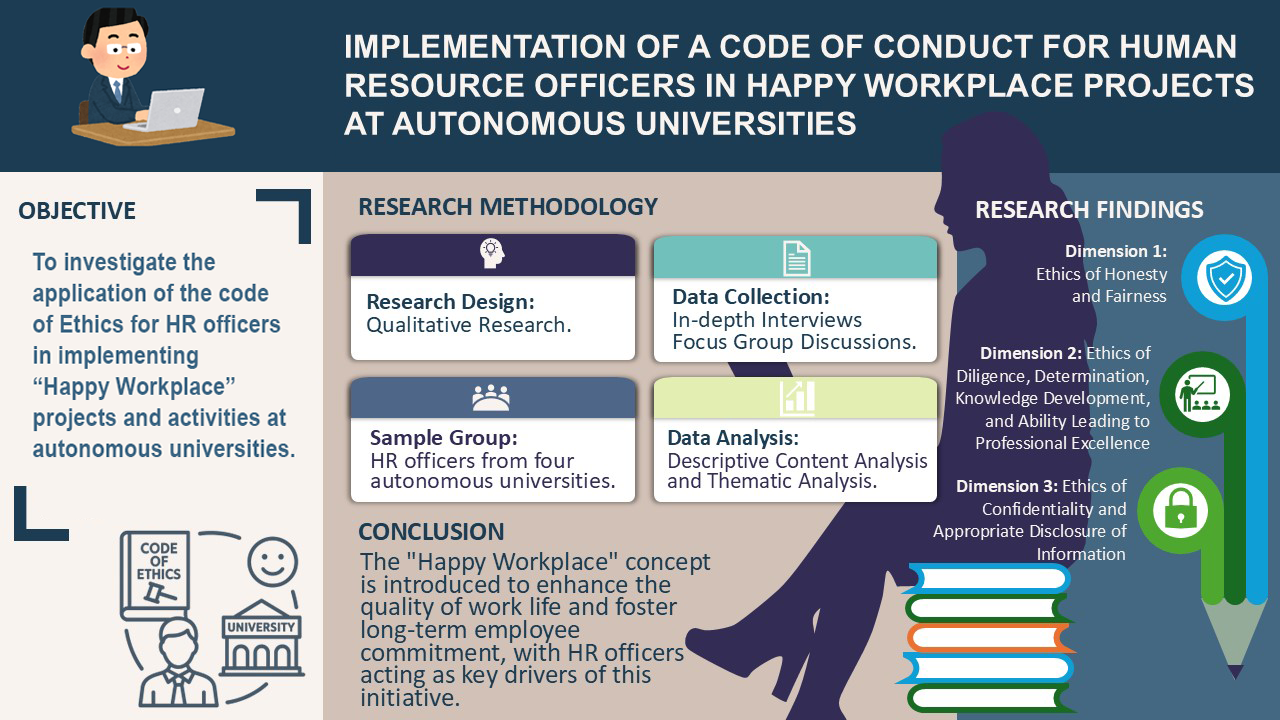
Ethics serve as fundamental guidelines that help build trust and transparency in operations, while promoting fairness and responsibility to stakeholders in the management of human resources in universities. However, discrimination, unfair practices, lack of transparency, and violation of personal rights affects the image and lack of trust in universities. The aim of this study was to examine the application of the Code of Ethics for Human Resource Officers in the Happy Workplace Project and Activities of State-controlled Universities using qualitative research approaches. The sample group was selected by collecting data from relevant documents, in-depth interviews with 6 experts, and focus group discussions with 11 human resource officers from state universities. The data analysis used descriptive content analysis and presented the results in a descriptive format. The research findings revealed the code of ethics among human resource officers in 3 dimensions: Dimension 1: Ethics of Honesty and Fairness; Dimension 2: Ethics of Diligence, Determination, Knowledge Development, and Ability Leading to Professional Excellence and Dimension 3: Ethics of Confidentiality and Appropriate Disclosure of Information. All three ethical principles were followed during the happy workplace project and activities at the universities in the following 4 steps: Step 1: Project launching; Step 2: Planning; Step 3: Operations; and Step 4: Project closure. Dimension 1 is a basic ethical principle and code of conduct that has become a behavior based on ethics consisting of fundamental moral principles. As for Dimensions 2 and 3, human resource professionals adhere to them for the equal benefits of all parties concerned, which preserves the dignity and honor of the profession.
Downloads
Article Details

This work is licensed under a Creative Commons Attribution-NonCommercial-NoDerivatives 4.0 International License.
All rights reserved. Apart from citations for the purposes of research, private study, or criticism and review,no part of this publication may be reproduced, stored or transmitted in any other form without prior written permission by the publisher.
References
Braga, B. M., de Camargo Oliva, E., de Miranda Kubo, E. K., McKenna, S., Richrdson, J., & Wales, T. (2019). An institutional approach to ethical human resource management practice: Comparing Brazil, Colombia, and the UK. Journal of Business Ethics, 169, 57–76. https://doi.org/10.1007/s10551-019-04257-x
Burton, J. (2010). WHO Healthy workplace framework and model: Background and supporting literature and practices. WHO Press, World Health Organization.
Chartered Institute of Personnel and Development. (2020, April). Code of professional conduct. https://www.cipd.co.uk/Images/code-of-professional-conduct-april-2020_tcm18-14510.pdf
Csillag, S. (2019). Ethical dilemmas and moral muteness in the HRM profession. Society and Economy, 41(1), 125–144. https://doi.org/10.1556/204.2019.41.1.8
Institute for Human Resource Professionals (IHRP). (2017, May 5). IHRP code of professional conduct. https://ihrp.sg/faq/
Kuchinke, K. P. (2017). The ethics of HRD practice. Human Resource Development International, 20(5), 361–370. https://doi.org/10.1080/13678868.2017.1329369
Lakey, B. (2013). Perceived social support and happiness: The role of personality and relational processes. In I. Boniwell, S. A. David, & A. C. Ayers (Eds.), Oxford handbook of happiness (pp. 847–859). Oxford University Press.
Osibanjo, A. O., Adeniji, A. A., Salau, O. P., Akinbola, O. A., Falola, H., & Akinbola, O. S. (2018). Expounding the relationship between human resource (HR) ethics and performance of selected technology-driven banks. International Journal of Civil Engineering and Technology, 9(12), 440–446. http://www.iaeme.com/ijciet/issues.asp?JType=IJCIET&VType=9&IType=12
Panchan, W. (2017). Professional ethics in human resource development. Ramkhamhaeng University.
Personal Data Protection Act B.E. 2562. (2019, May 27). Royal Thai Government Gazette. No. 136 Section 69 A. pp. 52–95. http://www.ratchakitcha.soc.go.th/DATA/PDF/2562/A/069/T_0052.PDF [in Thai]
Personnel Management Association of Thailand. (2005, November 18). Professional ethics of human resource management. http://www.pmat.or.th./about [in Thai]
Phiphatanakul, R. (2019). Ethics and management. Journal of Philosophical Vision, 24(2), 44–54. https://so05.tci-thaijo.org/index.php/phiv/article/view/249166 [in Thai]
Podhisita, C. (2017). Science and art of qualitative research. Amarin Printing and Publishing Public Company Limited.
Pongpisutsopa, S., Thammaboosadee, S., & Chuckpaiwong, R. (2018). HR analytics: Evolutions, organizational adaptation, lesson learnt, and future trends. Human Resource and Organization Development Journal, 10(1), 126–162. https://so01.tci-thaijo.org/index.php/HRODJ/article/view/133425 [in Thai]
Sarikaya, O. (2022). Problems faced by gen Y in recruitment processes and HRM mistakes. International Journal of Social Sciences and Education Research, 8(1), 44–50. https://doi.org/10.24289/ijsser.1012925
Simões, E., Duarte, A. P., Neves, J., & Silva, V. H. (2019). Contextual determinants of HR professionals’ self-perceptions of unethical HRM practices. European Journal of Management and Business Economics, 28(1), 90–108. https://doi.org/10.1108/EJMBE-12-2017-0062
Ulrich, D. (2017, March 21). The 2017 HR competency study & what it means for you. LinkedIn. https://www.linkedin.com/pulse/2017-hr-competency-study-what-means-you-dave-ulrich
Wasanthanarat, C. (2018). Happy organization 4.0. At 4 Print.
Williams, P., Kern, M. L., & Waters, L. (2015). A longitudinal examination of the association between psychological capital, perception of organizational virtues and work happiness in school staff. Psychology of Well-Being, 5(5), 1–18. https://doi.org/10.1186/s13612-015-0032-0
