
Technical aspect and use of ICT in writing research among tertiary institution students
Article Sidebar
Main Article Content
Abstract
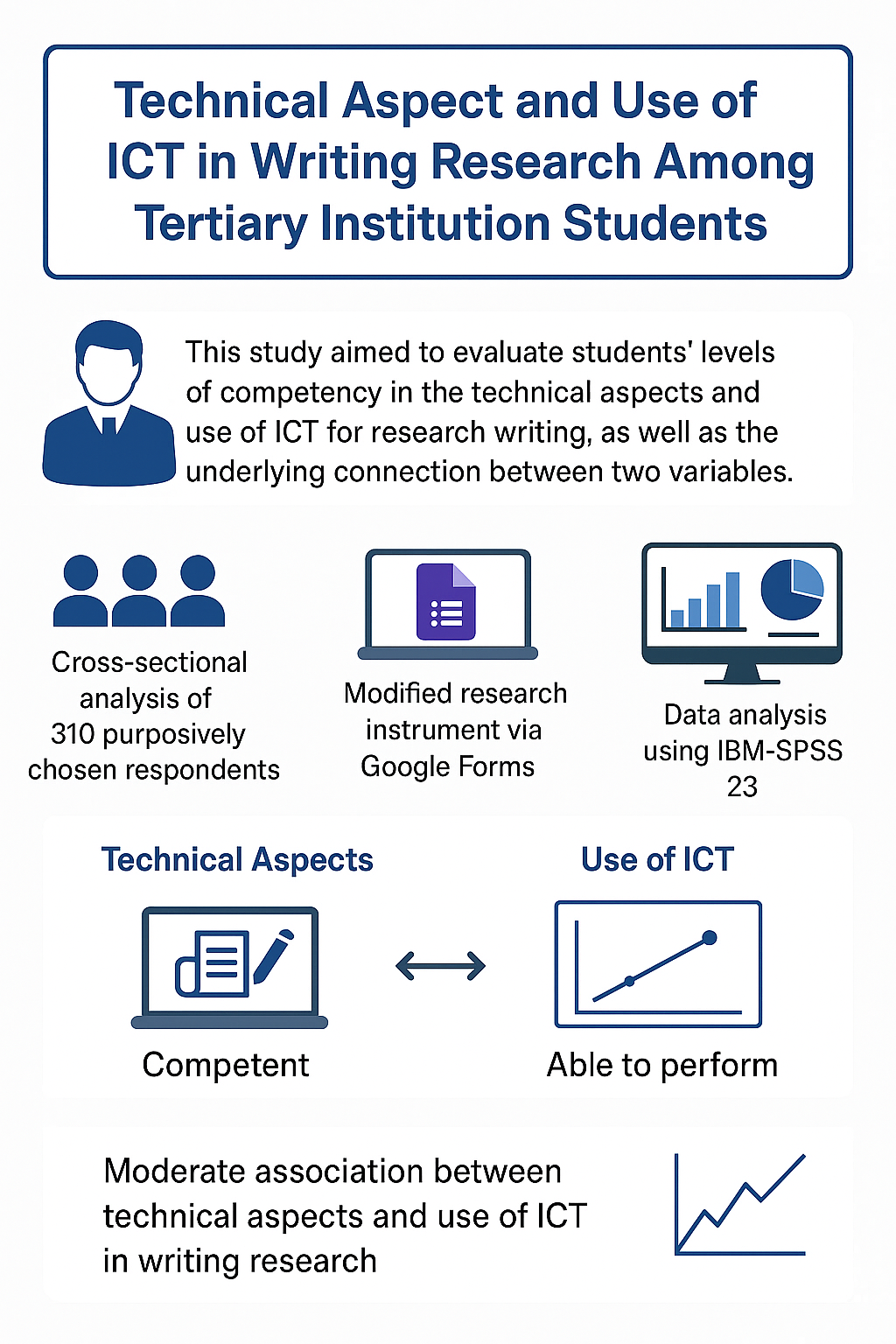
This study aimed to evaluate students’ levels of competency technical aspects and use of ICT for research writing, as well as the underlying connection between these two variables. This investigation will serve as a basis for faculty to enhance their teaching process in a research writing course at the college level. The researchers employed cross-sectional analysis with 310 purposively chosen respondents. They answered a modified research instrument via Google Forms. The researchers then subjected the gathered data to descriptive and inferential statistics using IBM-SPSS 23. The study found that the students were primarily third-year level, coming from the College of Education, Arts, and Sciences, and were female, with a GPA between 86% and 89%, pursuing a Bachelor of Science in Accountancy. In addition, regarding the technical aspect of writing research, the study revealed that the students were “competent.” As for the use of ICT in writing research, the students were “able to perform” some of the mentioned ICT tools. Inferential statistics also revealed variations in the technical aspects of writing research when grouped by year level and GPA. Regarding the use of ICT in research writing, the study observed differences in terms of year level, college, GPA, and course. A moderate association was found between technical aspects and the use of ICT in writing research, as confirmed by the linear regression. Based on the study’s results, the researchers suggested some essential implications.
Downloads
Article Details

This work is licensed under a Creative Commons Attribution-NonCommercial-NoDerivatives 4.0 International License.
All rights reserved. Apart from citations for the purposes of research, private study, or criticism and review,no part of this publication may be reproduced, stored or transmitted in any other form without prior written permission by the publisher.
References
Alobaid, A. (2020). Smart multimedia learning of ICT: Role and impact on language learners’ writing fluency— YouTube online English learning resources as an example. Smart Learning Environment, 7, Article 24. https://doi.org/10.1186/s40561-020-00134-7
Argan, M., Dinç, H., Argan, M. T., & Özer, A. (2023). What does rejection look like? A photovoice study on emotions and coping regarding manuscript rejection. Current Psychology, 43, 15983–16001. https://doi.org/10.1007/s12144-023-04253-5
Bucar, J. (2022). Teachers and Students’ Readiness in Conducting School-Based Research. Psychology and Education: A Multidisciplinary Journal, 4(3), 267–280. https://dx.doi.org/10.2139/ssrn.4273371
Ching, D. A. (2021). Motivation and competences in writing action researches: Basis for teachers’ coaching and training program. International Journal of Arts, Humanities and Social Studies, 3(5), 72–77. https://doi.org/10.5281/zenodo.5583887
Conrad, J. C., & Lee, T. R. (2020). How to capture readers and enhance citations. ACS Applied Nano Materials, 3(5), 3962–3963. https://doi.org/10.1021/acsanm.0c01089
Deb, D., Dey, R., & Balas, V. E. (2018). Technical writing and publishing. In Engineering research methodology. Intelligent systems reference library, vol 153 (pp. 49–66). Springer. https://doi.org/10.1007/978-981-13-2947-0_6
Fernández, J., Rocha-De-Lossada, C., & Rodríguez-Vallejo, M. (2022). Recommendations for writing clinical research manuscripts: From monofocal to multifocal intraocular lenses. International Journal of Environmental Research and Public Health, 19(24), Article 17036. https://doi.org/10.3390/ijerph192417036
Fernández Batanero, J. M., Montenegro Rueda, M., Fernández Cerero, J., & Román Gravan, P. (2021). Impact of ICT on writing and reading skills. Texto Livre: Linguagem E Tecnologia, 14(2), Article e34055. https://doi.org/10.35699/1983-3652.2021.34055
Fuertes, A., & Follosco, I. S. (2021). The utilization of contextualized learning activities in developing the student’s research and ICT capabilities. International Journal on Integrated Education, 4(1), 21–35. https://dx.doi.org/10.31149/ijie.v4i1.1099
Guillén-Gámez, F. D., Ruiz-Palmero, J., & García, M. G. (2023). Digital competence of teachers in the use of ICT for research work: Development of an instrument from a PLS-SEM approach. Education and Information Technologies, 28, 16509–16529. https://doi.org/10.1007/s10639-023-11895-2
Hayati, R., Anggraini, H. W., & Jaya, H. P. (2021). ICT and learning attitude towards students’ academic paragraph writing at the college level. English Franca: Academic Journal of English Language and Education, 5(1), 149–168. http://dx.doi.org/10.29240/ef.v5i1.2059
Helaluddin, Wijaya, H., Nurmadiah, Rante, S. V. N., Tulak, H., & Guntur, M. (2020). A need analysis in academic writing by using integrative-based approach: The perspective of university students. In S. Madya, E. Andriyanti, Ashadi, & W. Purbani (Eds.), Proceedings of the 1st International Conference on Language, Literature, and Arts Education (ICLLAE 2019) (pp. 172–177). Atlantis Press. https://doi.org/10.2991/assehr.k.200804.033
Iqbal, H., & Saeed, M. (2021). Exploring the writing challenges faced by M. Phil. and Ph. D. Scholars: A case study. Global Educational Studies Review, 6(4), 34–41. http://dx.doi.org/10.31703/gesr.2021(VI-IV).04
Kim, S. D., Petru, M., Gielecki, J., & Loukas, M. (2019). Causes of manuscript rejection and how to handle a rejected manuscript. In M. Shoja, A. Arynchyna, M. Loukas, A. V. D’Antoni, S. M. Buerger, M. Karl, & R. S. Tubbs (Eds.), A guide to the scientific career: Virtues, communication, research, and academic writing (pp. 419–422). Wiley. https://doi.org/10.1002/9781118907283.ch45
Kline, R. B. (2016). Principles and practice of structural equation modeling. The Guilford Press.
Krishnasamy, H., Omar, M., Ahmad, M., Yasin, A., Ibrahim, H., Soulignavong, L., & Vongsouangtham, B. (2022). The needs of Information and Communication Technology (ICT) tools for research development: A Case in Laos. Journal of Advanced Research in Applied Sciences and Engineering Technology, 28(3), 49–56. https://doi.org/10.37934/araset.28.3.4956
Mahlow, C. (2023). Writing tools: Looking back to look ahead. arXiv preprint arXiv:2303.17894. https://doi.org/10.48550/arXiv.2303.17894
Makin, T. R., & Orban de Xivry, J. J. (2019). Ten common statistical mistakes to watch out for when writing or reviewing a manuscript. eLife, 8, Article e48175. https://doi.org/10.7554/eLife.48175
Martinez-Daza, M. A., Guzmán Rincón, A., Castaño Rico, J. A., Segovia-García, N., & Montilla Buitrago, H. Y. (2021). Multivariate analysis of attitudes, knowledge, and use of ICT in students involved in virtual research seedbeds. European Journal of Investigation in Health, Psychology and Education, 11(1), 33–49. https://doi.org/10.3390/ejihpe11010004
Memon, M. A., Ting, H., Cheah, J.-H., Thurasamy, R., Chuah, F., & Cham, T. H. (2020). Sample size for survey research: Review and recommendations. Journal of Applied Structural Equation Modeling, 4(2), i–xx. http://dx.doi.org/10.47263/JASEM.4(2)01
Misdi, Hartini, N., Kusriandi, W., & Tambunan, A. R. (2020). Impact of ICT-assisted thesis writing on Student researchers’ psychological empowerment: Indonesian case. Journal of Physics: Conference Series, 1477, Article 042063. https://doi.org/10.1088/1742-6596/1477/4/042063
Misra, S. (2021). A step-by-step guide for choosing project topics and writing research papers in ICT-related disciplines. In S. Misra & B. Muhammad-Bello (Eds.), Information and communication technology and applications. ICTA 2020. Communications in computer and information science, vol 1350 (pp. 727–744). Springer International Publishing. https://doi.org/10.1007/978-3-030-69143-1_55
Nayak, M. S. D. P., & Narayan, K. A. (2019). Strengths and weaknesses of online surveys. Technology, 24(5), 31–38. https://doi.org/10.9790/0837-2405053138
Nückles, M., Roelle, J., Glogger-Frey, I., Waldeyer, J., & Renkl, A. (2020). The self-regulation-view in writing-to-learn: Using journal writing to optimize cognitive load in self-regulated learning. Educational Psychology Review, 32, 1089–1126. https://doi.org/10.1007/s10648-020-09541-1
Rabahi, H. (2019). The use of information and communication technology in academic research: Is it possible to realize academic integrity? Arab World English Journal, 10(4), 88–100. https://dx.doi.org/10.24093/awej/vol10no4.7
Rajan, S. S., & Esmail, S. M. (2021). A bibliometric analysis of international publication trends in manuscript libraries research 2011–2020. International Journal of Information Dissemination and Technology, 11(1), 63–67. http://dx.doi.org/10.5958/2249-5576.2021.00009.1
Ramírez-Castañeda, V. (2020). Disadvantages in preparing and publishing scientific papers caused by the dominance of the English language in Science: The case of Colombian researchers in biological sciences. PLOS One, 15(9), Article e0238372. https://doi.org/10.1371/journal.pone.0238372
Rulfi, V. L., & Spada, I. (2023). Guidelines for the use of generative A.I. in research paper writing. In F. Torrielli, L. D. Caro, & A. Rapp (Eds.), Proceedings of the Workshop on GENerative, Explainable, and Reasonable Artificial Learning Co-located with the 15th Biannual Conference of the Italian SIGCHI Chapter (CHITALY 2023) (pp. 54–61). https://ceur-ws.org/Vol-3571/
Samoylenko, N., Zharko, L., & Glotova, A. (2022). Designing online learning environment: ICT tools and teaching strategies. Athens Journal of Education, 9(1), 49–62. https://doi.org/10.30958/aje.9-1-4
Selvarasu, E., Thomas, A., Sundareswaran, I., Rahaman, A., Farzana, S., & Pareli, M. K. (2021). Teaching writing using online tools: An experimental study at the University of Technology and Applied Sciences. International Journal of Linguistics, Literature and Translation, 4(6), 196–201. https://doi.org/10.32996/ijllt.2021.4.6.22
Sim, K. N. (2022). ICT use in doctoral research. New Zealand Journal of Educational Studies, 57, 253–267. https://doi.org/10.1007/s40841-021-00208-1
Simamora, M. K., Inderawati, R., & Hayati, R. (2020). The use of ICT in relation to the paragraph writing achievement of English Education study program students at Sriwijaya University. English Community Journal, 4(2), 98–108. https://doi.org/10.32502/ecj.v4i2.3040
Sinha, P., & Subaveerapandiyan A. (2022). Library and Information Science Scholarly Journals Publishing Simulation: A Study. https://doi.org/10.48550/arXiv.2210.13252
Stephen, D. (2021). Peer reviewers equally critique theory, method, and writing, with limited effect on the manuscripts’ content. arXiv preprint arXiv:2110.07950. https://doi.org/10.48550/arXiv.2110.07950
Vacalares, S. T., Clarin, E., Lapid, R., Malaki, M., Plaza, V., & Barcena, M. (2023). Factors affecting the writing skills of the education students: A descriptive study. World Journal of Advanced Research and Reviews, 18(2), 1192–1201. https://doi.org/10.30574/wjarr.2023.18.2.0931
Williams, C., & Beam, S. (2019). Technology and writing: Review of research. Computers & Education, 128, 227–242. https://doi.org/10.1016/j.compedu.2018.09.024
