
“Educating diversity” and the Japanese gaze on Papua: A commodification in disguise of Waseda Boys Indonesia trip (2022) videos on Papua Island
Article Sidebar
Main Article Content
Abstract
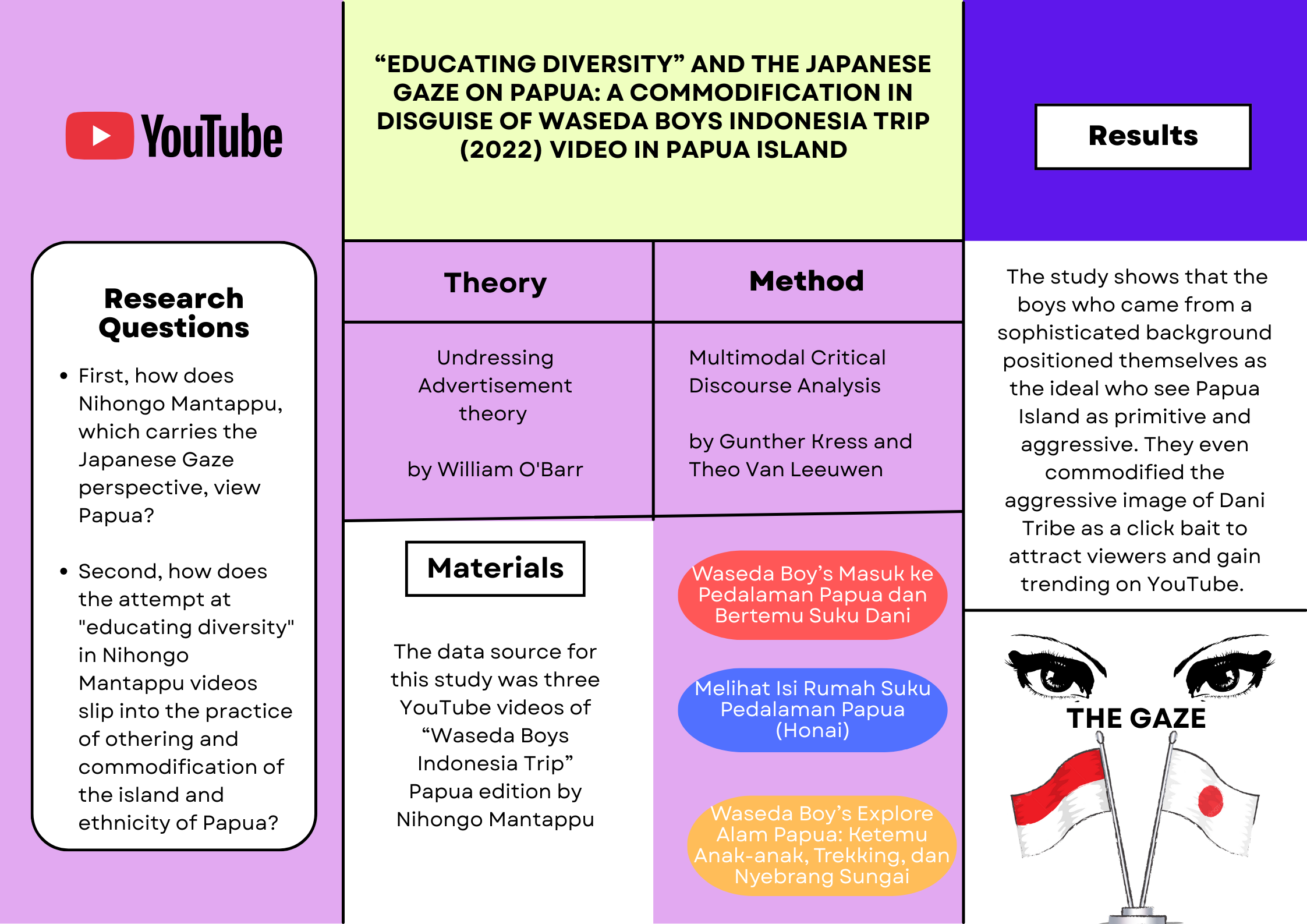
In 2022, Nihongo Mantappu’s YouTube channel created a video series called “Waseda Boys Indonesian Trip” intended to “educate” the audience about Indonesian cultural diversity. The boys, consisting of Jerome Polin (Indonesian), with Tomohiro, Yuzuke, and Otsuka (Japanese), visited various islands and tourist attractions in Indonesia and collaborated with Traveloka to promote the holiday platform. One of the islands they visited was Papua. There, they travelled to various places, including Wamena, to meet the Dani tribe in Kumugima Village. However, the prior idea of “educating diversity” seems problematic, as it was delivered through the Japanese gaze as “the Self”, positioning Papua as “the Other.” Using Undressing Advertisement theory by William O’Barr, this research aimed to explore how the othering of Papua was achieved through idealized images, social interactions, inequality, and power. Furthermore, to analyze the discourse behind the image and text, this research employed Multimodal Critical Discourse Analysis by Gunther Kress and Theo Van Leeuwen as a research method. The data source for this study was three YouTube videos of “Waseda Boys Indonesia Trip,” Papua edition by Nihongo Mantappu. The study shows that the boys from a sophisticated background positioned themselves as the ideal, while seeing Papua Island as primitive and aggressive. They even commodified the aggressive image of the Dani tribe as clickbait to attract viewers and gain YouTube trending status.
Downloads
Article Details

This work is licensed under a Creative Commons Attribution-NonCommercial-NoDerivatives 4.0 International License.
All rights reserved. Apart from citations for the purposes of research, private study, or criticism and review,no part of this publication may be reproduced, stored or transmitted in any other form without prior written permission by the publisher.
References
Aini, N. (2016). The gender performativity of female presenter in “my trip my adventure” reality show program. [Undergraduate thesis, Airlangga University]. https://repository.unair.ac.id/56899/13/FS.%20BE.%2092-16%20Ain%20t-min.pdf
Amin-Khan, T. (2012). New orientalism, securitisation and the western media’s incendiary racism. Third World Quarterly, 33(9), 1595–1610. http://dx.doi.org/10.1080/01436597.2012.720831
Andreas, R. (2020). Politik Identitas Papua dalam Iklan Telkomsel [Papuan identity politics in the telkomsel advertisement]. CALATHU: Jurnal Ilmu Komunikasi, 2(1), 1–9. https://doi.org/10.37715/calathu.v2i1.1255 [in Indonesian]
Aqila, J., Viona, F., Sinta A., & Budiyanti. (2022). Analisis Stereotip Orang Jepang Terhadap Indonesia Yang Terdapat Pada Kanal YouTube “Nihongo Mantappu” [Analysis of Japanese Stereotypes About Indonesia Found on the YouTube Channel ‘Nihongo Mantappu’]. In A. Kusumaningrum (Ed.), Prosiding Konferensi Ilmiah Pendidikan Volume 3 (pp. 883–892). Pekalongan University. [in Indonesian]
Atkins, E. T. (2010). Primitive selves: Koreana in the Japanese colonial gaze 1910–1945. University of California Press.
Bate, D. (2003). Photography & surrealism: Sexuality, colonialism and social dissent. I.B. Tauris.
Booth, A., & Deng. K. (2017). Japanese colonialism in comparative perspective. Journal of World History, 28(1), 61–98. https://www.jstor.org/stable/44631508
Budiarto, G. (2021). Media poster dan film Sebagai Instrumen propaganda Militer Jepang di Indonesia 1942–1945 [Posters and films as instruments of Japanese military propaganda in Indonesia, 1942–1945]. Agastya: Jurnal Sejarah dan Pembelajarannya, 11(1), 35–56. https://doi.org/10.25273/ajsp.v11i1.6206 [in Indonesian]
Chen, Y., Guo, Z., & Pan, Q. (2021). Analysis on the characteristics of travel vlog video and its impact on users’ travel intention. In J. Wang, B. Achour, & C. Huang (Eds.), Proceedings of the 7th International Conference on Humanities and Social Science Research. Advances in Social Science, Education and Humanities Research, Volume 554 (pp. 169–175). Atlantis Press.
Christiani, L. C. (2017). Representasi Identitas Etnis Papua dalam Serial Drama Remaja Diam-diam Suka [Representation of Papuan ethnic identity in the drama series Diam-Diam Suka]. Jurnal Komunikasi dan Kajian Media, 1(1), 15–30. https://media.neliti.com/media/publications/225025-representasi-identitas-etnis-papua-dalam-d7428d15.pdf [in Indonesian]
Fiske, J. (2011). Cultural and communication studies (I. S. Ibrahim, Ed.). Jalasutra.
Giannoulis, E. (2007, October 19). Japan as other: Examples from the contemporary shisôsetsu discourse [Paper presentation]. The Orientalist Gaze on/by Japan: Bygone Woe or Ongoing Affliction? Interdisciplinary Workshop. Max-Planck-Institute for Social Anthropology, Germany. https://www.scm.uni-halle.de/_/reporting_list/workshops/workshop2007_4/
Hadinger, D. (2007, October 19). Trapped between auto-orientalism and self-civilization: Japan at world exhibitions in the 1860s and 1870s [Paper presentation]. The Orientalist Gaze on/by Japan: Bygone Woe or Ongoing Affliction? Interdisciplinary Workshop. Max-Planck-Institute for Social Anthropology, Germany. https://www.scm.uni-halle.de/_/reporting_list/workshops/workshop2007_4/
hooks, b. (1990). Marginality as site of resistance. In R. Ferguson, M. Gever, T. T. Minh-he, & C. West (Eds.), Out there: Marginalization and contemporary cultures (pp. 341–343). The MIT Press.
Ilyasa, M., & Masitoh, S. (2019). Pengaruh Terpaan Media dan Tayangan My Trip My Adventure Terhadap MinatMeningkatkan Pelestarian Alam (Studi Pada Komunitas Mapala) [The effect of media exposure and my trip my adventure impression on interest in engaging nature conservation (Study at Mapala community)]. Metakom: Jurnal Ilmu Komunikasi, 3(2), 27–37. https://media.neliti.com/media/publications/293049-a-effects-of-media-exposure-and-my-trip-98b7da74.pdf [in Indonesian]
Kress, G. (2015). Semiotic work: Applied linguistics and a social semiotic account of multimodality. AILA Review, 28(1), 49–71. https://doi.org/10.1075/aila.28.03kre
Kublin, H. (2009). The evolution of Japanese colonialism. Comparative Studies in Society and History, 2(1), 67–84. https://doi.org/10.1017/S0010417500000554
Larasati, C. E. (2014). Representasi Etnis Papua dalam Film Lost in Papua [Representation of Papuan ethnicity in the film lost in Papua]. Jurnal Commonline, 3(3), 488–497. https://journal.unair.ac.id/download-fullpapers-comm695d75efc7full.pdf [in Indonesian]
Leeuwen, T. (2008). Discourse and practice: New tools for critical discourse analysis. Oxford University Press.
Loomba, A. (2016). Colonialism/postcolonialism (H. Hadikusumo, Trans.). Routledge.
Mead, M. (1967). The rights of primitive peoples: Papua-New Guinea: A crucial instance. Foreign Affairs, 45(2), 304–318. https://doi.org/10.2307/20039234
Myers, R. H., & Peatitte, M R. (1984). The Japanese colonial empire 1895–1945. Princeton University Press.
Nihongo Mantappu. (2022a, May 28). Wasedaboys masuk ke pedalaman papua! Ketemu suku dani! | Indonesia trip [Waseda Boys enter to the Hinterland of Papua! Meeting the Dani tribe! | Indonesia trip] [Video]. YouTube. https://www.youtube.com/watch?v=10Bps6TdeeI [in Indonesian]
Nihongo Mantappu. (2022b, May 30). Melihat isi rumah suku pedalaman papua! (honai) | wasedaboys indonesia trip [Seeing the inside of a Papua Home! (Hanoi) | Wasedaboys Indonesia trip] [Video]. YouTube. https://www.youtube.com/watch?v=4QIEPzCfj3E [in Indonesian]
Nihongo Mantappu. (2022c, June 4). Wasedaboys explore alam papua: ketemu anak2, trekking, nyebrang sungai | Indonesia trip [Waseda Boys explore Papuan nature: Meeting kids, trekking, and crossing rivers | Indonesia trip] [Video]. YouTube. https://www.youtube.com/watch?v=l0k0L4OWoww [in Indonesian]
Noviani, R. (2018). Wacana Multimodal Menurut Gunther Kress dan Theo Van Leeuwen [Multimodal discourse according to Gunther Kress and Theo Van Leeuwen]. In W. Udasmoro (Ed.), Hamparan Wacana: Dari Praktik Ideologi, Media, Hingga Kritik Poskolonial (pp. 107–133). Penerbit Ombak. [in Indonesian]
Noviani, R. (2020). Politik Representasi di Era Sibermedia [Politics of representation in the age of cybermedia]. In W. Udasmoro (Ed.), Gerak Kuasa: Politik Wacana, Identitas, dan Ruang/Waktu dalam Bingkai Kajian Budaya dan Media (pp. 59–84). KPG (Kepustakaan Populer Gramedia). [in Indonesian]
O’Barr, W. M. (1994). Culture and the ad: Exploring otherness in the world of advertising. Westview Press.
Ramadani, A. D. (2022, May 10). Seru Banget, Intip Momen Jerome Polin Ajak Waseda Boys Keliling Indonesia [So exciting! Take a look at Jerome Polin taking the Waseda Boys around Indonesia]. Merdeka.com. https://www.merdeka.com/jatim/seru-banget-intip-momen-jerome-polin-ajak-waseda-boys-keliling-indonesia.html [in Indonesian]
Said, E. (2003). Orientalism. Penguin Book.
Social Blade. (2023, September 23). Nihongo Mantappu YouTube stats summary. https://socialblade.com/youtube/channel/UC1Gmqqs_Myzl2KHIeqfUC9A
Sondakh, P. C. (2014). Maskulinitas Di Majalah Pria: Studi Semiotika Terhadap Rubrik Rupa Di Majalah Men’s Health Indonesia [Masculinity in men’s magazines: A semiotic study of the visual section in Men’s Health Indonesia Magazine]. Jurnal e-Komunikasi Universitas Kristen Petra, 2(2), 1–12. https://www.neliti.com/publications/76754/maskulinitas-di-majalah-pria-studi-semiotika-terhadap-rubrik-rupa-di-majalah-men [in Indonesian]
Spivak, G. C. (1993). Can the subaltern speak? In P. Williams & L. Chrisman (Eds.), Colonial discourse and post-colonial theory: A reader (pp. 66–111). Harvester Wheatsheaf.
Suwito, K. A. (2019). Reproduksi pengetahuan atas eksotisme tubuh perempuan: Identitas oriental dalam grup facebook ‘indonesia tempo dulu’ [Reproduction of knowledge about the exoticism of women’s bodies: Oriental identity in the Facebook group ‘indonesia tempo dulu’]. Jurnal Studi Komunikasi, 3(2), 230–252. https://doi.org/10.25139/jsk.v3i2.1601 [in Indonesian]
Windharto, A. (2017). Transformasi kecantikan wajah wanita indonesia pada mask of car moda transportasi publik (LRT, Monorail, Tramway) kota metropolitan [The transformation of Indonesian women’s beauty on the masks of public transportation (LRT, Monorail, Tramway) in metropolitan cities]. In Seminar Nasional Seni dan Desain 2017, Surabaya, Indonesia (pp. 8–15). State University of Surabaya. [in Indonesian]
