
Exploring oral traditions and divine spatial narratives: The Ni’EDi ritual among the Lisu ethnic group in Lijiang, China
Article Sidebar
Main Article Content
Abstract
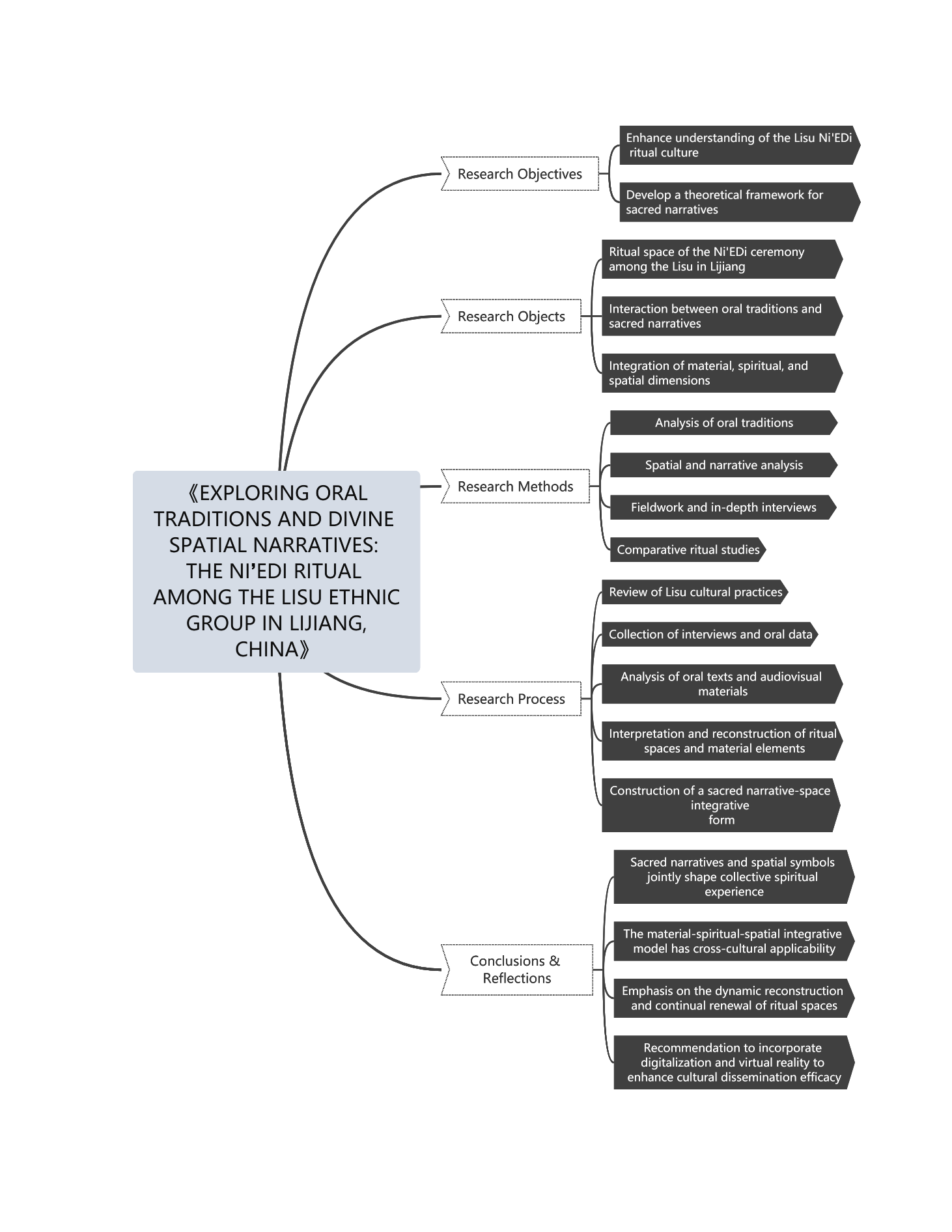
This paper presents the development of a theoretical framework for constructing sacred narratives within the Ni'EDi ritual space of the Lisu people. The primary objective is to advance cultural innovation and ensure the sustainable transmission of Lisu traditions from a theoretical perspective. The research explores the dynamic interactions between individuals and rituals, particularly emphasizing the integration of material and spiritual dimensions—including historical narratives, mythological elements, natural landscapes, and sacred architecture. Through a rigorous analysis of oral traditions, the cultural space of the Ni'EDi ritual is reinterpreted and reconstructed. The study finds that the oral tradition of the Ni'EDi ritual operates as both an individual and collective narrative process, wherein memory, guidance, retelling, and recollection interweave ancient stories with contemporary experiential interpretations. The results demonstrate that narrative and spatial analyses deepen individual spiritual engagement and reveal the broader sociocultural implications of ritual spaces. Together, these elements form the core structure of belief in the Lisu creator deity, which plays a pivotal role in shaping the collective identity and faith of the Lisu people. This research underscores the importance of narrative theory in constructing cultural spaces and interpreting ritual contexts.
Downloads
Article Details

This work is licensed under a Creative Commons Attribution-NonCommercial-NoDerivatives 4.0 International License.
All rights reserved. Apart from citations for the purposes of research, private study, or criticism and review,no part of this publication may be reproduced, stored or transmitted in any other form without prior written permission by the publisher.
References
Alaimo, S. (2010). Bodily natures: Science, environment, and the material self. Indiana University Press.
Bachmann-Medick, D., Kugele, J., & Stornig, K. (2021). Conceptualizing sacred spaces. Saeculum, 71(2), 155–166. https://doi.org/10.7788/saec.2021.71.2.155
Beane, W. C., & Doty, W. G. (1975). Myths, rites, symbols: A Mircea Eliade Reader (Vol. 1). Harper & Row.
Brie, S., Daggers, J., & Torevell, D. (Eds.). (2009). Sacred space: Interdisciplinary perspectives within contemporary contexts. Cambridge Scholars Press.
Cashman, K. V., & Cronin, S. J. (2008). Welcoming a monster to the world: Myths, oral tradition, and modern societal response to volcanic disasters. Journal of Volcanology and Geothermal Research, 176(3), 407–418. https://doi.org/10.1016/j.jvolgeores.2008.01.040
Cohen, P. S. (1969). Theories of myth. Man, 4(3), 337–353. https://doi.org/10.2307/2798111
Crane, D. (2002). Culture and globalization: Theoretical models and emerging trends. In D. Crane, N. Kawashima, & K. Kawasaki (Eds.), Global culture: Media, arts, policy, and globalization (pp. 1–25). Routledge.
Dora, V. D. (2018). Infrasecular geographies: Making, unmaking and remaking sacred space. Progress in Human Geography, 42(1), 44–71. https://doi.org/10.1177/0309132516666190
Doty, W. G. (2000). Mythography: The study of myths and rituals (2nd ed.). The University of Alabama Press.
Duan, L. (2020). Duoyuan shijiao xia de lisu zu yuanliu kaoshi [An examination of the origins of the Lisu people from multiple perspectives]. The Ideological Front (Yunnan University's Journal of Social Sciences), 46(6), 120–123. [in Chinese]
Durrenberger, E. P. (1975). Lisu occult roles. Bijdragen tot de Taal-, Land-en Volkenkunde, 131(1), 138–146. https://www.jstor.org/stable/27861443
Durrenberger, E. P. (1980). Belief and the logic of Lisu spirits. Bijdragen tot de Taal-, Land- en Volkenkunde, 136(1), 21–40. https://www.jstor.org/stable/27863274
Eliade, M. (1959). The sacred and the profane: The nature of religion. Houghton Mifflin Harcourt.
Eliade, M. (2021). The myth of the eternal return: Cosmos and history. Princeton University Press.
Finlayson, C., & Mesev, V. (2014). Emotional encounters in sacred spaces: The case of the Church of Jesus Christ of Latter-day Saints. The Professional Geographer, 66(3), 436–442. https://doi.org/10.1080/00330124.2013.802554
Finley, M. I. (1965). Myth, memory, and history. History and Theory, 4(3), 281–302. https://doi.org/10.2307/2504346
Firth, R. (1963). Offering and sacrifice: Problems of organization. The Journal of the Royal Anthropological Institute of Great Britain and Ireland, 93(1), 12–24. https://doi.org/10.2307/2844331
Foley, J. M. (2011). Oral tradition and its implications. In I. Morris & B. B. Powell (Eds.), A new companion to homer (pp. 146–173). Brill. https://doi.org/10.1163/9789004217607_007
Gao, Z. (2010). Lisu zu de kua jie qianxi yu shengji fangshi bianqian [Cross-border immigration and changes of livelihood alternatives in Lisu ethnic group]. Journal of China Agricultural University (Social Sciences Edition), 27(3), 124–131. [in Chinese]
Hamilton, S., & Spicer, A. (2016). Defining the holy: The delineation of sacred space. In A. Spicer & S. Hamilton (Eds.), Defining the holy: Sacred space in medieval and early modern Europe (pp. 19–42). Routledge.
He, W. (2017). Lisu zu de xinyang wenhua [The belief culture of the Lisu people]. Lijiang Municipal Cultural Department. [in Chinese]
Hoteit, A. (2015). Role of the landscape in the preservation of collective memory and the enhancement of national belonging. Canadian Social Science, 11(3), 42–49. https://doi.org/10.3968/6435
Hume, L. (1998). Creating sacred space: Outer expressions of inner worlds in modern Wicca. Journal of Contemporary Religion, 13(3), 309–319. https://doi.org/10.1080/13537909808580838
Jin, S., & Di, X. (2002). Zhongguo dituce [Atlas of China]. China Cartographic Printing House. [in Chinese]
Kapelrud, A. S. (1963). Temple building, a task for gods and kings. Orientalia, 32(1), 56–62. http://www.jstor.org/stable/43079513
Kilde, J. H. (2008). Sacred power, sacred space: An introduction to Christian architecture and worship. Oxford University Press.
Kluckhohn, C. (1942). Myths and rituals: A general theory. The Harvard Theological Review, 35(1), 45–79.
Landry, T. R. (2018). Vodún: Secrecy and the search for divine power. University of Pennsylvania Press.
Li, K. (2006). Cong “Lisu zu jisi jing” chumo lisu zu wenhua de gulao linghun [Touch the ancient soul of Lisu culture from "Lisu Sacrifice Scripture"]. Ethnic Today, 12, 7–8. [in Chinese]
Lincoln, B. (2014). Discourse and the construction of society: Comparative studies of myth, ritual, and classification. Oxford University Press.
Liu, G. (2001). Gudai chengwei limao yu zhong de renming chenghu [Forms of address and etiquette in naming individuals in ancient Chinese society]. Journal of Guizhou Education Institute (Social Science Edition), 17(6), 47–50. [in Chinese]
Mackay, H. (2000). The globalization of culture? In D. Held (Ed.), A globalizing world? Culture, economics, politics (pp. 47–84). Routledge.
Mazumdar, S., & Mazumdar, S. (1993). Sacred space and place attachment. Journal of Environmental Psychology, 13(3), 231–242. https://doi.org/10.1016/S0272-4944(05)80175-6
Milner, M., Jr. (1994). Status and sacredness: A general theory of status relations and an analysis of Indian culture. Oxford University Press.
Oakley, F. (2018). Voluntarist theology and early-modern science: The matter of the divine power, absolute and ordained. History of Science, 56(1), 72–96. https://doi.org/10.1177/0073275317722241
Puett, M. (2005). The offering of food and the creation of order: The practice of sacrifice in early China. In R. Sterckx (Ed.), Of tripod and palate: Food, politics, and religion in traditional China (pp. 75–95). Palgrave Macmillan. https://doi.org/10.1057/9781403979278_5
Rosenberg, B. A. (1987). The complexity of oral tradition. Oral Tradition, 2(1), 73–90. https://hdl.handle.net/10355/64049
Santiago, J. (2023). The impact of religious rituals on cultural identity: Review of the relationship between religious practices and cultural belonging. International Journal of Culture and Religious Studies, 4(2), 13–22. https://doi.org/10.47941/ijcrs.1346
Sienaert, E. R. (1990). Marcel Jousse: The oral style and the anthropology of gesture. Oral Tradition, 5(1), 91–106. https://hdl.handle.net/10355/64665
Southwest University for Nationalities Library. (1986). Yunnan Lisu zu ji Gongshan Fugong shehui diaocha baogao [Social survey report on the Lisu people in Yunnan and Fugong in Gongshan]. Southwest University for Nationalities. [in Chinese]
Yu, D. (2010). Lisu zu chuantong xinyang yu jinji tanxi [An analysis of the traditional beliefs and taboos of the Lisu people]. South-Central University for Nationalities, 30(2), 79–82. https://doi.org/10.19898/j.cnki.42-1704/c.2010.02.014 [in Chinese]
Zhang, Z. (2006a). Lisu zu jisi jing [Lisu Sacrifice Scripture]. Lijiang Municipal Cultural Department. [in Chinese]
Zhang, Z. (2006b). Zhongguo xinan de lisu zu ji qi zongjiao xinyang [The Lisu people in southwest China and their religious beliefs]. Religious Studies, 3, 118–125. [in Chinese]
