
Human darkness on screen: Cultural discounts in the reception of Chinese audiences through the South Korean film Concrete Utopia (2023)
Article Sidebar
Main Article Content
Abstract
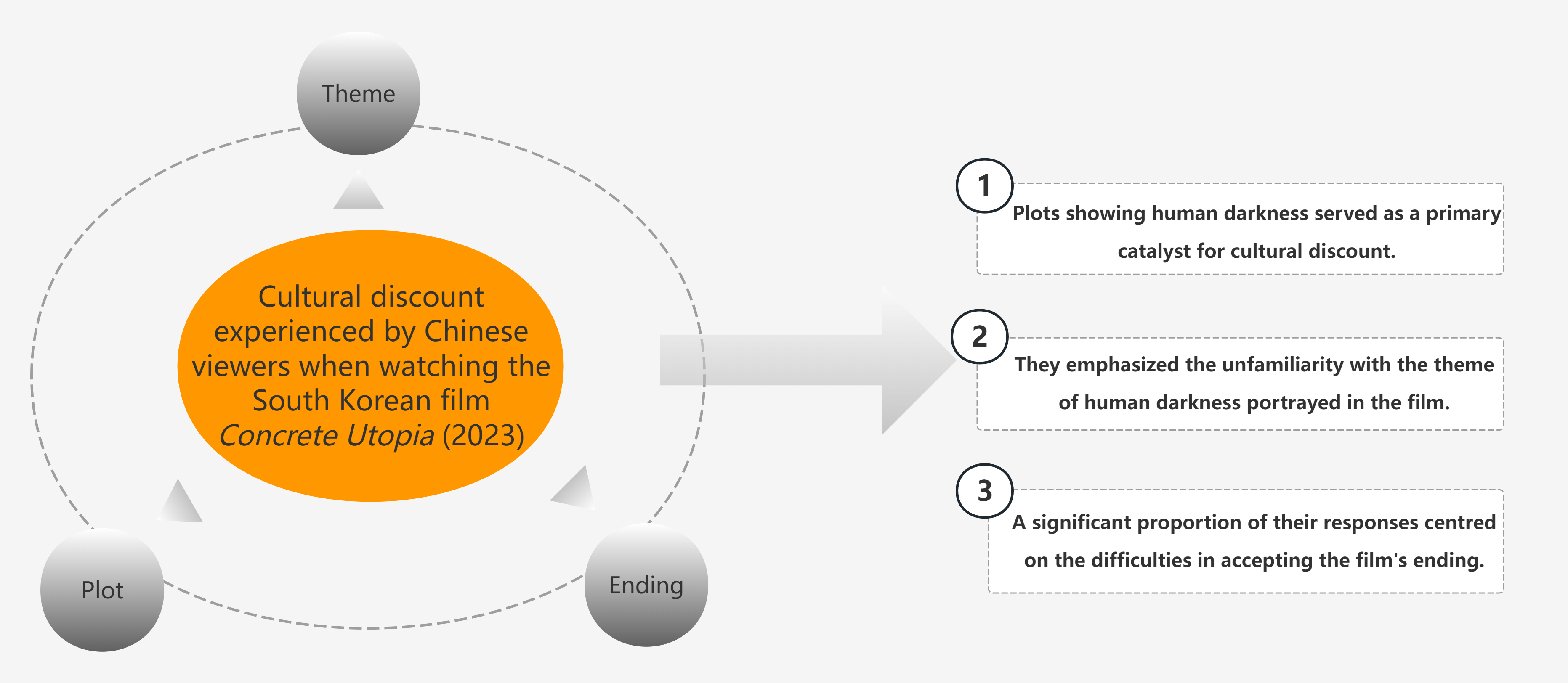
In the realm of intercultural film transmission, cultural discount is a prevalent phenomenon that reflects the devaluation of cultural content among audiences from diverse backgrounds. Despite South Korea’s robust film industry and its aggressive global expansion, there is limited research on the cultural discounts experienced by Chinese audiences when consuming South Korean films. This study undertakes a qualitative survey involving 25 Chinese viewers to investigate the cultural discount in their engagement with the South Korean film Concrete Utopia (2023), which was a contender at the Academy Awards in 2024. The research findings suggest that various content elements, such as film setting, verbal expression translation, nonverbal expression, visual image, and non-diegetic music, did not significantly contribute to cultural discounts among Chinese audience participants. The primary cultural discount experienced by Chinese audience participants centres on the portrayal of human darkness and is evident in the plot and thematic elements of Concrete Utopia. A subset of these participants also noted that the film's tragic ending led to a noticeable cultural discount. This study contends that after South Korea abolished its film censorship system in the late 1990s, the South Korean film market witnessed a surge in productions exploring humanity's dark aspects. South Korean audiences have developed sufficient aesthetic sophistication and viewing experience to effectively interpret such films. In contrast, China's propaganda framework emphasizes societal beauty and brightness, while its censorship regulations restrict filmmakers from depicting darkness of society and human nature. Consequently, Chinese audiences have limited exposure to films addressing these themes. This scarcity has resulted in limited interpretive capacity, leading to cultural discount when viewing works like Concrete Utopia.
Downloads
Article Details

This work is licensed under a Creative Commons Attribution-NonCommercial-NoDerivatives 4.0 International License.
All rights reserved. Apart from citations for the purposes of research, private study, or criticism and review,no part of this publication may be reproduced, stored or transmitted in any other form without prior written permission by the publisher.
References
Baron, C., & Carnicke, S. M. (2010). Reframing screen performance. University of Michigan Press. https://doi.org/10.3998/mpub.104480
Berghahn, D. (2019). ‘The past is a foreign country’: Exoticism and nostalgia in contemporary transnational cinema. Transnational Screens, 10(1), 34–52. https://doi.org/10.1080/25785273.2019.1599581
Boltz, M. G. (2001). Musical soundtracks as a schematic influence on the cognitive processing of filmed events. Music Perception, 18(4), 427–454. https://doi.org/10.1525/mp.2001.18.4.427
Braun, V., & Clarke, V. (2006). Using thematic analysis in psychology. Qualitative Research in Psychology, 3(2), 77–101. https://doi.org/10.1191/1478088706qp063oa
Cai, S. (2016). State propaganda in China’s entertainment industry. Routledge. https://doi.org/10.4324/9781315637082
Chen, L. X. (2015). Analysis of cultural discounts in the North American market and current Chinese films. Journal of Shanghai University (Social Sciences), 32(04), 37–49. [in Chinese]
Chen, R., Chen, Z., & Yang, Y. (2021). The creation and operation strategy of Disney’s Mulan: Cultural appropriation and cultural discount. Sustainability, 13(5), Article 2751. https://doi.org/10.3390/su13052751
Chen, X., & Liu, S. L. (2021). Genre Advantage, cultural discount and cultural premium of Chinese films in the western perspective: An empirical study based on IMDb and Douban data. Contemporary Cinema, (11), 91–98. [in Chinese]
Cheng, J. W., & Ma, Y. X. (2014). Research on cultural discount of American movies in China: Based on Box office data from 2009 to 2013, Chongqing Social Sciences, (7), 69–75. [in Chinese]
Choe, S. (2018). Ten years of philosophical thinking in Korean cinema. Journal of Japanese and Korean Cinema, 10(2), 79–84. https://doi.org/10.1080/17564905.2018.1518690
Creemers, R. (2017). Cyber China: Upgrading propaganda, public opinion work and social management for the twenty-first century. Journal of Contemporary China, 26(103), 85–100.
Gee, F. (2017). Global intimacy and cultural intoxication: Japanese and Korean film in the twenty-first century. In R. Stone, P. Cooke, S. Dennison, & A. Marlow-Mann (Eds.), The Routledge Companion to World Cinema (pp. 44–58). Routledge.
Grimm, J. (2015). The import of Hollywood films in China: Censorship and quotas. Syracuse Journal of International Law and Commerce, 43(1), 156–187.
Haviland, W. A., Prins, H. E. L., McBride. B., & Walrath. D. (2014). Cultural anthropology: The human challenge (14th ed.). Wadsworth Cengage Learning.
Hennink, M., & Kaiser, B. N. (2022). Sample sizes for saturation in qualitative research: A systematic review of empirical tests. Social Science & Medicine, 292, Article 114523. https://doi.org/10.1016/j.socscimed.2021.114523
Hoeckner, B., Wyatt, E. W., Decety, J., & Nusbaum, H. (2011). Film music influences how viewers relate to film characters. Psychology of Aesthetics, Creativity, and the Arts, 5(2), 146–153. https://doi.org/10.1037/a0021544
Hofstede, G. (2011). Dimensionalizing cultures: The Hofstede model in context. Online Readings in Psychology and Culture, 2(1), 1–26. https://doi.org/10.9707/2307-0919.1014
Hoskins, C., & Mirus, R. (1988). Reasons for the US dominance of the international trade in television programmes. Media, Culture & Society, 10(4), 499–515. https://doi.org/10.1177/016344388010004006
Huang, H. (2015). Propaganda as signalling. Comparative Politics, 47(4), 419–444. https://doi.org/10.5129/001041515816103220
Huang, H. (2018). The pathology of hard propaganda. The Journal of Politics, 80(3), 1034–1038. https://doi.org/10.1086/696863
Jin, D. Y. (2019). Transnational Korean cinema: Cultural politics, film genres, and digital technologies. Rutgers University Press. https://doi.org/10.36019/9781978807921
Jones, H. D. (2017). The box office performance of European films in the UK market. Studies in European Cinema, 14(2), 153–171. https://doi.org/10.1080/17411548.2016.1268804
King, G., Pan, J., & Roberts, M. E. (2013). How censorship in China allows government criticism but silences collective expression. American Political Science Review, 107(2), 326–343.
Klein, C. (2008). Why American studies needs to think about Korean cinema, or, transnational genres in the films of Bong Joon-ho. American Quarterly, 60(4), 871–898. https://www.jstor.org/stable/40068554
Kuzel, A. (1999). Sampling in qualitative inquiry. In B. F. Crabtree & W. L. Miller (Eds.), Doing qualitative research (2nd ed., pp. 33–45). SAGE.
Kwak, J., & Zhang, L. (2011). Does China love Hollywood? An empirical study on the determinants of the box-office performance of the foreign films in China. International Area Studies Review, 14(2), 115–140. https://doi.org/10.1177/223386591101400205
Lee, F. L. F. (2006). Cultural discount and cross-culture predictability: Examining the box office performance of American films in Hong Kong. Journal of Media Economics, 19(4), 259–278. https://doi.org/10.1207/s15327736me1904_3
Lee, F. L. F. (2009). Cultural discount of cinematic achievement: The academy awards and US films’ East Asian box office. Journal of Cultural Economics, 33(4), 239–263. https://doi.org/10.1007/s10824-009-9101-7
Matron, A. (2010). Transferability of cultural meaning: A case study on contemporary German and South Korean cinema. Literature & Aesthetics, 20(1), 26–37.
Mattingly, D. C., & Yao, E. (2022). How soft propaganda persuades. Comparative Political Studies, 55(9), 1569–1594. https://doi.org/10.1177/00104140211047403
Min, E., Joo, J., & Kwak, H. J. (2003). Korean film: History, resistance, and democratic imagination. Praeger.
Moon, J. C. (2006). The meaning of newness in Korean cinema: Korean new wave and after. Korea Journal, 46(1), 36–59.
Nolan, R. W. (1999). Communicating and adapting across cultures: Living and working in the global village. Bergin and Garvey.
Pang, Z. L., & Wang, Z. W. (2022). "Positive energy": An examination based on the history of the concept. Media Forum, 5(11), 32–35. [in Chinese]
Ramière, N. (2010). Are you lost in translation (when watching a foreign film)? Towards an alternative approach to judging audiovisual translation. Australian Journal of French Studies, 47(1), 100–115.
Shambaugh, D. (2017). China’s propaganda system: Institutions, processes and efficacy. In K. E. Brødsgaard (Ed.), Critical readings on the Chinese communist party (4 Vols. Set, pp. 713–751). Brill.
Soh, K., & Yecies, B. (2017). Korean-Chinese film remakes in a new age of cultural globalisation: Miss Granny (2014) and 20 Once Again (2015) along the digital road. Global Media and China, 2(1), 74–89. https://doi.org/10.1177/2059436416687105
Staller, K. M. (2021). Big enough? Sampling in qualitative inquiry. Qualitative Social Work, 20(4), 897–904. https://doi.org/10.1177/14733250211024516
Tang, J. (2008). A cross-cultural perspective on production and reception of Disney’s Mulan through its Chinese subtitles. European Journal of English Studies, 12(2), 149–162. https://doi.org/10.1080/13825570802151413
Terry, G., & Braun, V. (2017). Short but often sweet: The surprising potential of qualitative survey methods. In V. Braun, V. Clarke, & D. Gray (Eds.), Collecting qualitative data: A practical guide to textual, media and virtual techniques (pp. 15–44). Cambridge University Press. https://doi.org/10.1017/9781107295094
Xu, B., & Albert, E. (2017, February 17). Media censorship in China. Council on Foreign Relations. https://www.cfr.org/backgrounder/media-censorship-china
Xue, H. (2009). A study on cultural discount in film trade between China and the United States. China Media University. [in Chinese]
Yecies, B. (2016). Chinese transnational cinema and the collaborative tilt toward South Korea. In M. Keane (Ed.), The handbook of cultural and creative industries in China (pp. 226–244). Edward Elgar.
Yecies, B., & Shim, A. G. (2011). Contemporary Korean cinema: Challenges and the transformation of ‘Planet Hallyuwood’. Acta Koreana, 14(1), 1–15.
Yecies, B., & Shim, A. G. (2015). The changing face of Korean cinema: 1960 to 2015. Routledge. https://doi.org/10.4324/9781315886640
