
Kipidap: A mobile app designed for Malaysian university students to overcome procrastination
Article Sidebar
Main Article Content
Abstract
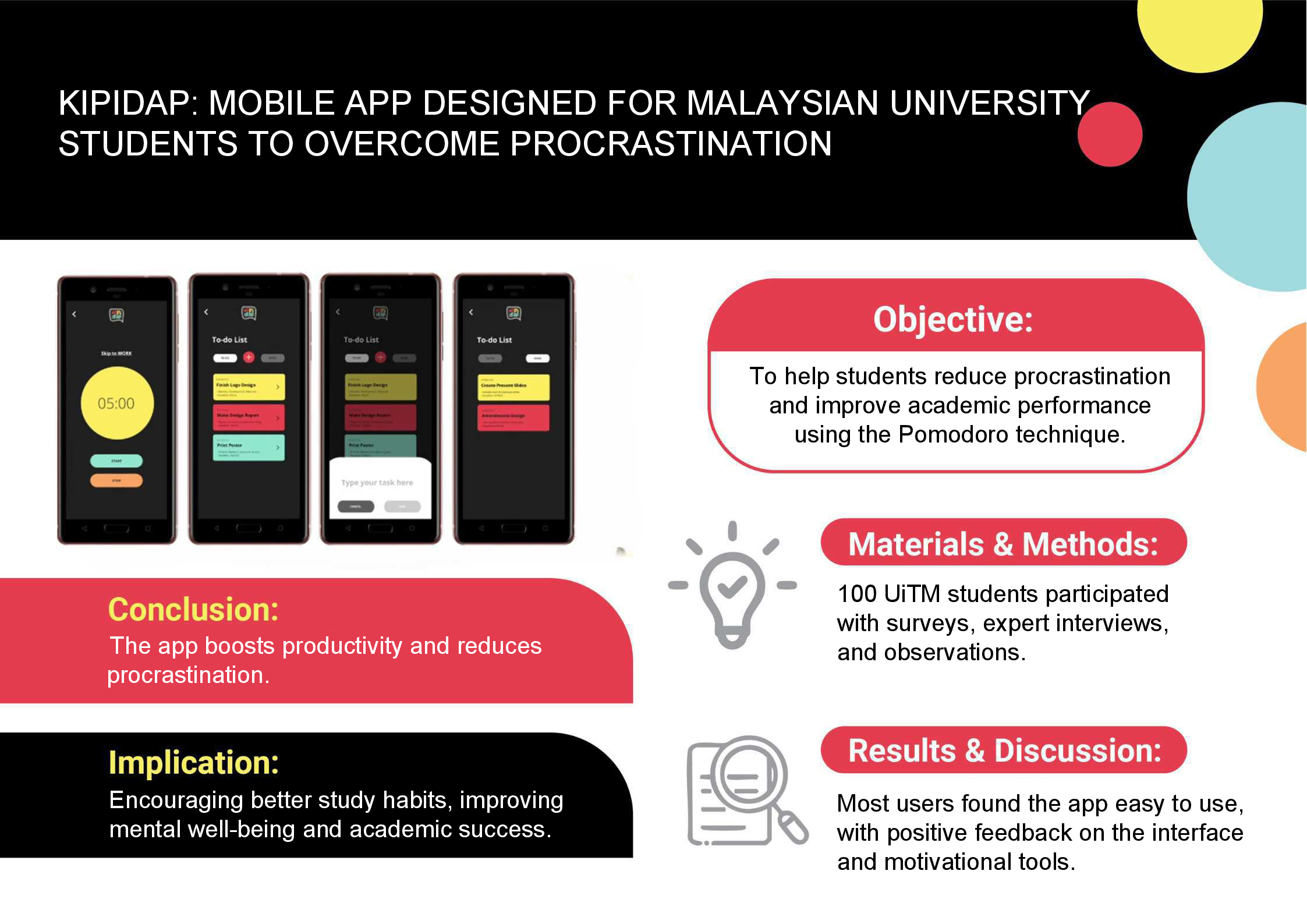
Currently students at the Malaysian Institute of Technology (UiTM) Malaysia are having trouble getting their work done on time. This affects their health and grades. The Kipidap application created for android users was designed using the Pomodoro Technique, allowing users to accomplish tasks straight away rather than postponing them. Finding out how frequently UiTM students put off activities and assessing the results were the key objectives. The respondents were 100 UITM students. They were equally divided between men and women and comprised a broad spectrum across academic disciplines, particularly in regard to work completion speed and time management skills, the data revealed notable variations. There are useful tools in the Kipidap mobile app that assist with managing oneself and working more efficiently. These include an intelligent task management system, a Pomodoro timer for effective work sessions, and inspiring incentives such discount coupons to keep people interested. Of the participants, 98% stated they utilized the educational content on the mobile app, 95% said they loved how easy it was to use, and 97% said it was simple enough to navigate their way around. Kipidap is a handy, simple, and efficient tool for students who want to improve their performance in the classroom and create positive habits that will benefit.
Downloads
Article Details

This work is licensed under a Creative Commons Attribution-NonCommercial-NoDerivatives 4.0 International License.
All rights reserved. Apart from citations for the purposes of research, private study, or criticism and review,no part of this publication may be reproduced, stored or transmitted in any other form without prior written permission by the publisher.
References
Amit, A. J., Gautam Shankararam, S. R., Pradeep, P., Perumalraja, R., & Kamalesh, S. (2021). Framework for preventing procrastination and increasing productivity. In 2021, 3rd International Conference on Signal Processing and Communication (ICPSC) (pp. 228–232). IEEE. https://doi.org/10.1109/ICSPC51351.2021.9451773
Amran, A. S. B., & Zulkifli, M. B. (2020). Index developing and modelling the factors of academic procrastination among university students. Malaysian Journal of Social Sciences and Humanities (MJSSH), 5(9), 63–75. https://doi.org/10.47405/mjssh.v5i9.482
Barel, E., Shahrabani, S., Mahagna, L., Massalha, R., Colodner, R., & Tzischinsky, O. (2023). State anxiety and procrastination: The moderating role of neuroendocrine factors. Behavioral Sciences, 13(3), Article 204. https://doi.org/10.3390/bs13030204
Chaturapanich, T. (2023). The influence of coping strategies on resilience among undergraduate students: The mediating role of trait mindfulness. Humanities, Arts and Social Sciences Studies, 23(2), 264–272. https://so02.tci-thaijo.org/index.php/hasss/article/view/263575
Cirillo, F. (2018). The pomodoro technique: The acclaimed time-management system that has transformed how we work. Currency.
Dimaano, G. M. (2023). Self-concept and social mobility of female faculty in higher education institution. Humanities, Arts and Social Sciences Studies, 23(1), 114–122. https://so02.tci-thaijo.org/index.php/hasss/article/view/261098
Dizon, R. J., Ermitanio, H. D., Estevez, D. M., Ferrer, J., Flores, S. J., Fontanilla, K. M., Frias, A., Galang, E., Guei, N. F., & Sugay, J. (2021). The effects of Pomodoro technique on academic-related tasks, procrastination behavior, and academic motivation among college students in a mixed online learning environment. Globus: Journal of Progressive Education, 11(2), 58–63. https://doi.org/10.46360/globus.edu.220212009
Jalaluddin, N. I., Bakeri, N. S. M., Nasir, K. M., Rani, N. M., & Kamaruzaman, M. F. (2016). Managing stress among adolescents by using digital visual schedule. In S. Z. Abidin, R. Legino, H. M. Noor, V. V. Vermol, R. Anwar, & M. F. Kamaruzaman (Eds.), Proceedings of the 2nd International Colloquium of Art and Design Education Research (i-CADER 2015) (pp. 241–250). Springer. https://doi.org/10.1007/978-981-10-0237-3_25
Karakaya Özyer, K., & Altinsoy, F. (2023). Academic procrastination of university students: The role of problematic internet use, self-regulated online learning, and academic self-efficacy. Malaysian Online Journal of Educational Technology, 11(1), 77–93. https://doi.org/10.52380/mojet.2023.11.1.459
Koppenborg, M., & Klingsieck, K. B. (2022). Social factors of procrastination: Group work can reduce procrastination among students. Social Psychology of Education, 25(1), 249–274. https://doi.org/10.1007/s11218-021-09682-3
Odaci, H. (2011). Academic self-efficacy and academic procrastination as predictors of problematic internet
use in university students. Computers and Education, 57(1), 1109–1113. https://doi.org/10.1016/j.compedu.2011.01.005
Ryan, R. M., & Deci, E. L. (2011). A self-determination theory perspective on social, institutional, cultural, and economic supports for autonomy and their importance for well-being. In V. I. Chirkov, R. M. Ryan, & K. M. Sheldon (Eds.), Human autonomy in cross-cultural context. cross-cultural advancements in positive psychology (Vol. 1, pp. 45–64). Springer. https://doi.org/10.1007/978-90-481-9667-8_3
Steel, P. (2007). The nature of procrastination: A meta-analytic and theoretical review of quintessential self-regulatory failure. Psychological Bulletin, 133(1), 65–94. https://doi.org/10.1037/0033-2909.133.1.65
Sweller, J., Ayres, P., & Kalyuga, S. (2011). Cognitive load theory. Springer. https://doi.org/10.1007/978-1-4419-8126-4
Touloupis, T., & Campbell, M. (2024). The role of academic context-related factors and problematic social media use in academic procrastination: A cross-sectional study of students in elementary, secondary, and tertiary education. Social Psychology of Education, 27(1), 175–214. https://doi.org/10.1007/s11218-023-09817-8
Uopasai, S., Bunterm, T., Tang, K. N., & Saksangawong, C. (2022). The effect of meditation on metacognitive ability, working memory ability, academic achievement, and stress levels. Humanities, Arts and Social Sciences Studies, 23(1), 217–226. https://so02.tci-thaijo.org/index.php/hasss/article/view/242786
van Eerde, W. (2003). A meta-analytically derived nomological network of procrastination. Personality and Individual Differences, 35(6), 1401–1418. https://doi.org/10.1016/S0191-8869(02)00358-6
