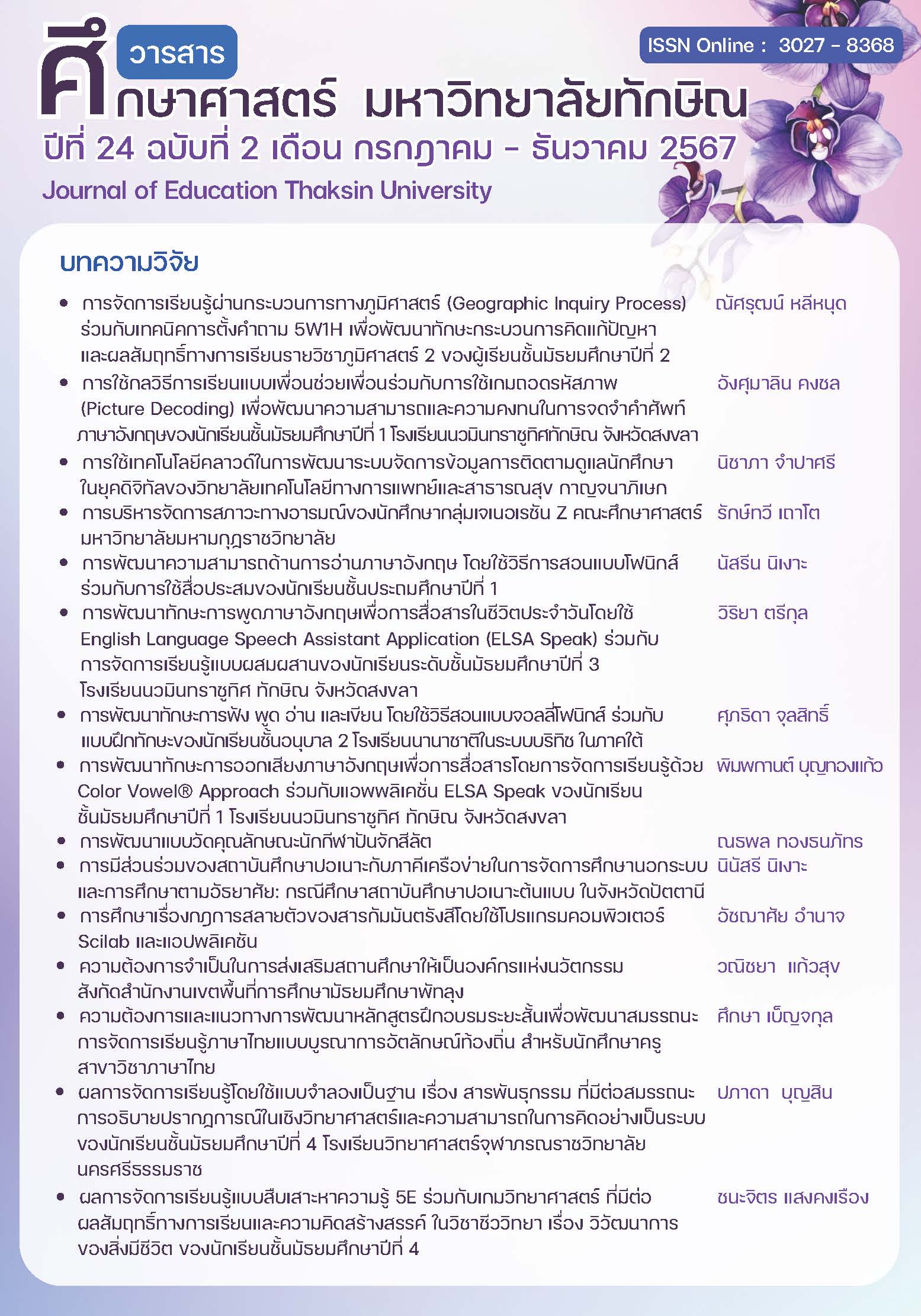
Cloud Technology for The Development of Student Monitoring and Support Data Management System in The Digital Era of Kanchanabhishek Institute of Medical and Public Health Technology
Article Sidebar
Main Article Content
Abstract
The objectives of this research are to: 1) study the situation and problems related to student monitoring and support in the digital era, 2) develop a data management system for student monitoring and support in the digital era, 3) study user satisfaction with the data management system for student monitoring and support in the digital era, and 4) study opinions on the acceptance level of the data management system for student monitoring and support in the digital era. This research is conducted using research and development methods, employing the ADDIE model for system analysis and design, and studying opinions on the acceptance level based on the innovation acceptance theory. The sample group consists of 45 teachers and 455 students. A focus group discussion was conducted with the first sample group to study the situation and problems related to student monitoring and support in the digital era, while the second sample group used the system. User satisfaction and opinions on the acceptance level were then evaluated. The statistics used for data analysis include content analysis, frequency analysis, percentage, mean, and standard deviation.
The research results indicate that in the focus group discussion, users expressed a need for a system that is accessible anytime and anywhere through computers and wireless communication devices, capable of recording, searching, processing, and displaying data online. The overall user satisfaction with the system had an average score of 4.40, indicating a high level of satisfaction. Opinions on the acceptance level of the system had an overall average score of 4.43, also indicating a high level of acceptance. The awareness stage had an average score of 4.46, the interest stage 4.37, the evaluation stage 4.48, the trial stage 4.40, and the adoption stage 4.43, all of which are at a high level. The research results demonstrate that the newly developed system is efficient and user-friendly.
Article Details

This work is licensed under a Creative Commons Attribution-NonCommercial-NoDerivatives 4.0 International License.
ในกรณีที่กองบรรณาธิการ หรือผู้เชี่ยวชาญ ซึ่งได้รับเชิญให้เป็นผู้ตรวจบทความวิจัย หรือ บทความทางวิชาการมีความเห็นว่าควรแก้ไขความบกพร่อง ทางกองบรรณาธิการจะส่งต้นฉบับให้ ผู้เขียนพิจารณาจัดการแก้ไขให้เหมาะสมก่อนที่จะลงพิมพ์ ทั้งนี้ กองบรรณาธิการจะยึดถือความคิด เห็นของผู้เชี่ยวชาญเป็นเกณฑ์
References
ขจรศักดิ์ วงค์จันทะ และคณะ. (2566). การพัฒนาระบบตอบคำถามอัตโนมัติการฝึกประสบการณ์วิชาชีพ. วารสารวิทยาศาสตร์ วิศวกรรมศาสตร์และเทคโนโลยี มหาวิทยาลัยราชภัฏเลย, 3(2), 28.
จักรพงษ์ ตระการไทย และนเรศ ขันธะรี. (2564). การดำเนินการงานระบบดูแลช่วยเหลือนักเรียนในสถานศึกษายุคดิจิทัล. วารสารบริหารการศึกษาบัวบัณฑิต, 21(1), 42.
จุมพล ศรีอุดมสุวรรณ, สมชาย อารยพิทยาล และสนิท สิทธิ. (2562). การพัฒนาระบบฐานข้อมูลเกษตรอินทรีย์ มหาวิทยาลัยแม่โจ้. วารสารแม่โจ้เทคโนโลยีสารสนเทศและนวัตกรรม มหาวิทยาลัยแม่โจ้, 5(1), 35.
บุญชม ศรีสะอาด. (2560). การวิจัยเบื้องต้น. (พิมพ์ครั้งที่ 10). กรุงเทพฯ: สุวีริยาสาส์น.
บุญสม เดชขจร. (2565). การศึกษาการยอมรับเทคโนโลยีและนวัตกรรมของวิสาหกิจขนาดกลางและขนาดย่อม (SMEs) ในจังหวัดชลบุรี. วิทยานิพนธ์ การศึกษาตามหลักสูตรบริหารธุรกิจมหาบัณฑิต: วิทยาลัยพาณิชยศาสตร์ มหาวิทยาลัยบูรพา.
พาสนา เอกอุดมพงษ์ และคณะ. (2562). การศึกษาการยอมรับการประยุกต์ใช้เทคโนโลยี AR Code สำหรับบรรจุภัณฑ์สินค้าไม้ยางพารา. ในการประชุมวิชาการระดับชาติ สารสนเทศศาสตร์วิชาการ 2019, 25-26 มิถุนายน 2562. 25-26 มิถุนายน 2562.
ฟ้า วิไลขำ และนงพงา สุขโอสถ. (2566). การพัฒนาเว็บแอปพลิเคชันประชาสัมพันธ์แหล่งท่องเที่ยว ในชุมชนราวต้นจันทร์และชุมชนบ้านวังหาด จังหวัดสุโขทัย. Information and Learning, 34(2), 99-107.
มัชฌกานต์ เผ่าสวัสดิ์ และกิตติศักดิ์ สิงห์สูงเนิน. (2566). การพัฒนาระบบจัดการศูนย์ข้อมูลเว็บไซต์บนเทคโนโลยีคลาวด์คอมพิวติง กรณีศึกษา คณะวิทยาศาสตร์และเทคโนโลยี มหาวิทยาลัยราชภัฎวไลยอลงกรณ์ ในพระบรมราชูปถัมภ์. วารสารวิจัยและพัฒนา วไลยอลงกรณ์ ในพระบรมราชูปถัมภ์, 18(2), 16.
ศศิพิมพ์ สายกระสุน และทศพร แก้วเหมือน. (2566). การศึกษาการใช้ระบบคลาวด์คอมพิวติ้งในกูเกิลแอปพลิเคชันเพื่อพัฒนาประสิทธิภาพการทำงานวิชาการร่วมกันในศตวรรษที่ 21. วารสารครุศาสตร์ปัญญพัฒน์ มหาวิทยาลัยราชภัฏสุรินทร์, 1(1), 59.
สำนักงานพัฒนาธุรกรรมทางอิเล็กทรอนิกส์. (16 มิถุนายน 2563). ศัพท์ชวนรู้. เข้าถึงได้จาก สำนักงานพัฒนาธุรกรรมทางอิเล็กทรอนิกส์: https://www.etda.or.th/th/Useful-Resource/terminology/หมวดหมู่-D/221.aspx
อมรพงศ์ สุขเสน และแจ่มจันทร์ ศรีอรุณรัศมี. (2566). การประยุกต์ใช้คลาวด์คอมพิวติงเพื่อการศึกษาสู่การพัฒนาอย่างยั่งยืน. วารสารมนุษยสังคมศาสตร์, 1(2), 1.
อัญชลี อ่ำประสิทธิ์ และญาณิศา วงษ์สมบัติ. (2565). การพัฒนาแอปพลิเคชันเรื่อง การจัดเรียงแบบฟอร์มเวชระเบียนผู้ป่วยใน. วารสารศึกษาศาสตร์ มหาวิทยาลัยทักษิณ, 23(2),82-97.
อาคม จันทร์นาม และคณะ. (2565). รูปแบบการติดตามนักเรียนนักศึกษาด้วยระบบซอฟต์แวร์บริหารการอาชีวศึกษาเพื่อลดจํานวนนักศึกษาออกเรียนกลางคัน ของวิทยาลัยเทคนิคร้อยเอ็ด. วารสารวิจัยและนวัตกรรมการอาชีวศึกษา, 6(2), 106.
LINE. (7 กรกฎาคม 2566). 12 ปี แอปพลิเคชัน LINE กับ 6 บทบาท ที่ยกระดับชีวิตคนไทยสู่โลกดิจิทัลในทุกมิติ. Retrieved from LINE: https://linecorp.com/th/pr/news/th/2023/4621
Ajzen, I. (1985). From intention to actions: A theory of planned behavior. From cognition to behavior. Berlin: Springer-Verlag.
Davis, F. D., Bagozzi, R. P. & Warshaw, P. R. (1989). User Acceptance of Computer Technology:A Comparison of Two Theoretical Models. Management Science, (pp.982-1003).
Rogers, E. M. (2003). Diffusion of innovations. New York Press. Steven J. McGriff. (2008). WikiEducator “Free e-learning content. Retrieved from ADDIE Model Diagram: https://wikieducator.org/File:ADDIE_model_diagram_by_McGriff.gif
Yamane, T. (1973). Statistics: An introductory statistics, (Second Edition). New York: Harper & Row.
Zhenlong, P., Zhonghui, O.Y., Youlan, H. (2012). The Application and Development of Software Testing in Cloud Computing Environment. Computer Science & Service System (CSSS), 2012 International Conference on (pp. 450, 454). 11-13 Aug. 2012.

