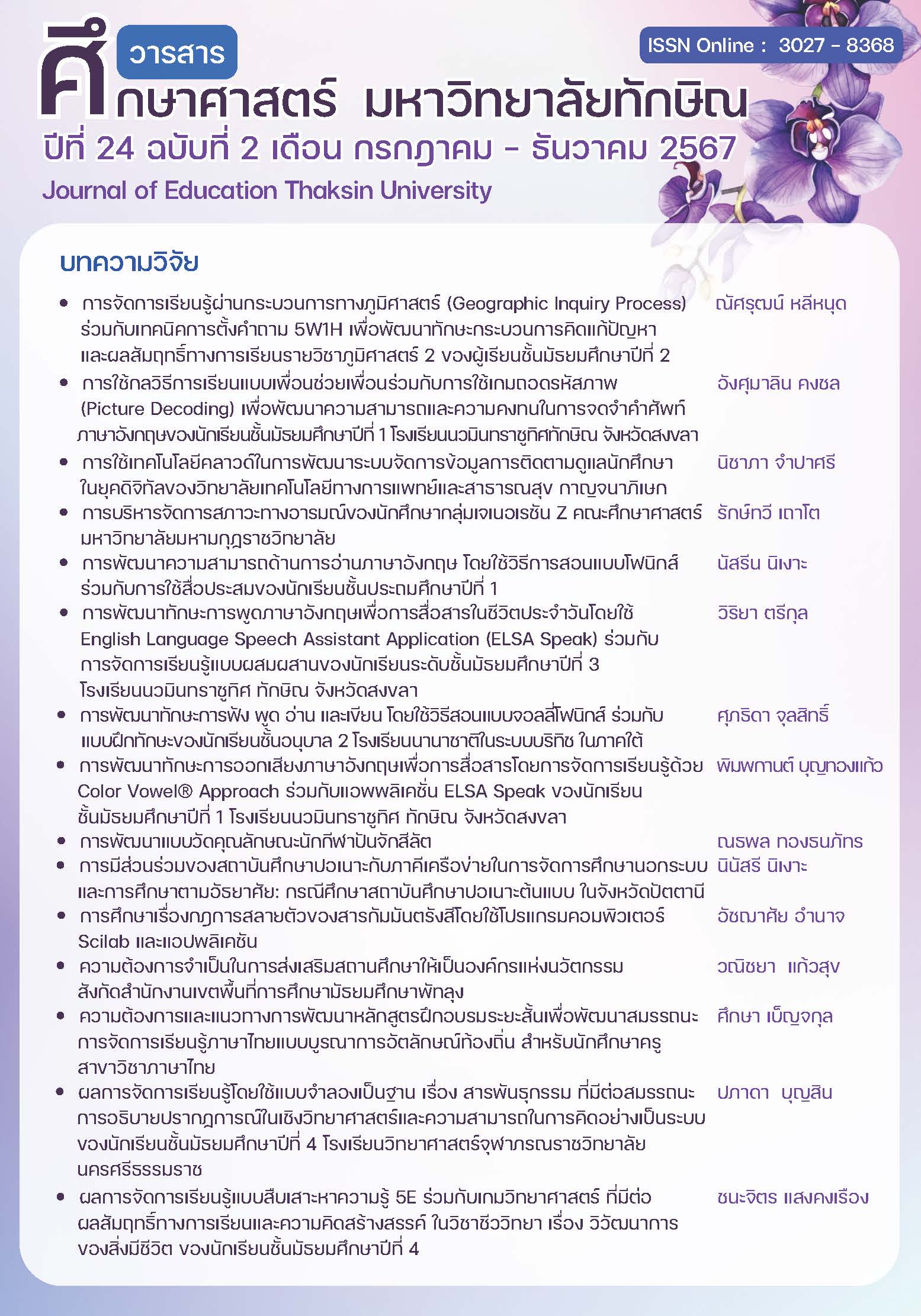
Needs and Guidelines for The Development of The Training Course to Develop Thai Language Instructional Competence integrated local identity for Student Teachers in Thai language program
Article Sidebar
Main Article Content
Abstract
This research aims to study the needs and guidelines for developing the training course to develop Thai language instructional competence integrated local identity for student teachers in Thai language program. The researcher reviewed the literature to study fundamental data, inquire about the needs of students in the Bachelor of Education program. Thai language department, Faculty of Education, Southern Alliance Rajabhat University, 5 institutions that practice teaching in educational institutions, 1 semester, 1 academic year 2023, a total of 60 people, survey of the opinions of 39 Thai language teachers and interviews of 12 Thai language teachers at the expert level or higher. Data was collected using a document analysis form, a questionnaire, a survey, and an interview. Data were analyzed using content analysis, percentage (%), mean (), and standard deviation (SD).
The research results were as follows: 1) All of the students' needs are high (, = 4.43, SD = 0.62) 2) There are 6 primary approaches for developing the training course: (1) developing local conservation awareness and metacognition, (2)developing the concept of creative integration for Thai language learning management and Demming PDCA cycle, (3) linking concepts to practice through competency-based training, (4) developing creativity and innovation competencies, (5) using technology supports hybrid learning and personalized learning environments, and (6) reflecting on development in professional learning communities collaboratively.
Article Details

This work is licensed under a Creative Commons Attribution-NonCommercial-NoDerivatives 4.0 International License.
ในกรณีที่กองบรรณาธิการ หรือผู้เชี่ยวชาญ ซึ่งได้รับเชิญให้เป็นผู้ตรวจบทความวิจัย หรือ บทความทางวิชาการมีความเห็นว่าควรแก้ไขความบกพร่อง ทางกองบรรณาธิการจะส่งต้นฉบับให้ ผู้เขียนพิจารณาจัดการแก้ไขให้เหมาะสมก่อนที่จะลงพิมพ์ ทั้งนี้ กองบรรณาธิการจะยึดถือความคิด เห็นของผู้เชี่ยวชาญเป็นเกณฑ์
References
กาญจนา คุณารักษ์. (2562). พื้นฐานการพัฒนาหลักสูตร. นครปฐม: มหาวิทยาลัยศิลปากร วิทยาเขตพระราชวังสนามจันทร์.
ชนิตา รักษ์พลเมือง, สมหวัง พิธิยานุวัฒน์, รังสรรค์ มณีเล็ก, เฟื่องอรุณ ปรีดีดิลก, และสุวิธิดา จรุงเกียรติกุล. (2560). การศึกษาสภาพและปัญหาการผลิต การใช้และการพัฒนาครูการศึกษาขั้นพื้นฐานที่สอดคล้องกับความต้องการในอนาคต. ครุศาสตร์, 45(3), 11-33.
บังอร เสรีรัตน์. (2564). การพัฒนารูปแบบการเรียนการสอนฐานสมรรถนะแบบผสานรายวิชาสำหรับนักศึกษา คณะ ครุศาสตร์ มหาวิทยาลัยราชภัฏบ้านสมเด็จเจ้าพระยา. ครุศาสตร์สาร, 15(2), 143-158.
มารุต พัฒผล. (2567). การวิจัยและพัฒนาเพื่อการพัฒนาหลักสูตร. กรุงเทพฯ: ศูนย์นวัตกรรมหลักสูตรและการเรียนรู้.
รณธิชัย สวัสดิ์ และรัตนะ บัวสนธ์. (2565). การจัดการศึกษาฐานสมรรถนะ. วารสารศิลปศาสตร์ราชมงคลสุวรรณภูมิ, 4(1), 187-201.
วรรณดี สุทธินรากร, ภูวเรศ อับดุลสตา และสมเกียรติ สุทธินรากร. (2564). การพัฒนาหลักสูตรฐานสมรรถนะและ การจัดการเรียนรู้อย่างมีความหมาย. กรุงเทพฯ: สยามปริทัศน์.
ศุภรดา อันชุนดา และจักรกฤษณ์ จันทะคุณ. (2566). การพัฒนาหลักสูตรฝึกอบรมแบบผสมผสานตามแนวคิดคอนเน็คติวิสซึม เพื่อส่งเสริมทักษะการสร้างนวัตกรรมอิงสาระการเรียนรู้ท้องถิ่น สำหรับนักศึกษาครูภาษาไทย มหาวิทยาลัยราชภัฏ. (วิทยานิพนธ์หลักสูตรการศึกษาดุษฎีบัณฑิต, มหาวิทยาลัยนเรศวร).
สุวิทย์ วงศ์รุจิราวาณิชย์. (2564). ท้องถิ่นอินเตอร์. กรุงเทพฯ: ศิริชัย การพิมพ์. สุวิไล เปรมศรีรัตน์. (2556). การจัดการเรียนการสอนโดยใช้ภาษาท้องถิ่นและภาษาไทยเป็นสื่อ: กรณีการจัดการศึกษาแบบทวิภาษา (ภาษาไทย-มลายูถิ่น) ในโรงเรียนเขตพื้นที่สี่จังหวัดชายแดนภาคใต้ (ระยะที่ 3). สำนักงานคณะกรรมการส่งเสริมวิทยาศาสตร์ วิจัยและนวัตกรรม (สกสว.).
สำนักงานเลขาธิการสภาการศึกษา กระทรวงศึกษาธิการ. (2564). แนวทางการจัดการเรียนรู้ฐานสมรรถนะเชิงรุก: ถอดบทเรียนจากแนวคิดสู่การปฏิบัติ. สมุทรปราการ: เอส บี เค การพิมพ์ จำกัด.
สำนักงานเลขาธิการสภาการศึกษา กระทรวงศึกษาธิการ. (2565). การประเมินระบบการผลิตครูในประเทศไทย. นนทบุรี: เซ็นจูรี่ จำกัด.
Casey, K., & Sturgis, C. (2018). Levers and Logic Models: A Framework to Guide Research and Design of High Quality Competency-Based Education Systems. Vienna, VA: iNACOL. Content in this report is licensed under a Creative Commons Attribution 4.0 International license.
Drake, S.M. & Reid, J.L. (2020). 21st Century Competencies in Light of the History of Integrated Curriculum. Front. Educ, 5:122. doi: 10.3389/feduc.2020.00122
Flórez González, A. M. (2018). Strengthening local identity by writing chronicles in the EFL classroom. Colombian Applied Linguistics Journal, 20(2), 195-208.
Glatthorn, A., Boschee, F., Whitehead, B.M., & Boschee, B.F. (2019). Curriculum Leadership Strategies for Development and Implementation. (5th ed.). Los Angeles: SAGE.
Hammond, L. D., Oakes, J., Wojcikiewicz, S.K., Hyler, M.E., Guha, R.,Podolsky, A., Kini, T., Cook-Harvey, C.M., Jackson Mercer, C.N. & Harrell, A. (2019). Preparing Teachers for Deeper Learning. Cambridge: Harvard Education Press.
Hernández, L. E., Darling-Hammond, L., Adams, J., & Bradley, K. (with Duncan Grand, D., Roc, M., & Ross, P.). (2019). Deeper learning networks: Taking student-centered learning and equity to scale. Palo Alto, CA: Learning Policy Institute.
Mahajan, A., & Chowdhary, R. (2019). Methodical review of literature on competencies. Prestige International Journal of Management and Research, 12(1/2), 13-22.
Mintrop, R., Zumpe, E., Jackson, K., Nucci, D. & Norman, J. (2022). Designing for Deeper Learning as an Equity Approach: Schools and School Districts Serving Communities Disadvantaged by the Educational System Benefiting from Deeper Learning. Stanford, CA: The Carnegie Foundation for the Advancement of Teaching.
Rao, N. J. (2020). Outcome-based Education: An Outline. Higher Education for the Future, 7(1), 5-21. https://doi.org/10.1177/2347631119886418
Vaganova, O.I. (2019). Organization of practical classes in a higher educational institution using modern educational technologies. Amazonia Investiga, 8(23), 81-86.
