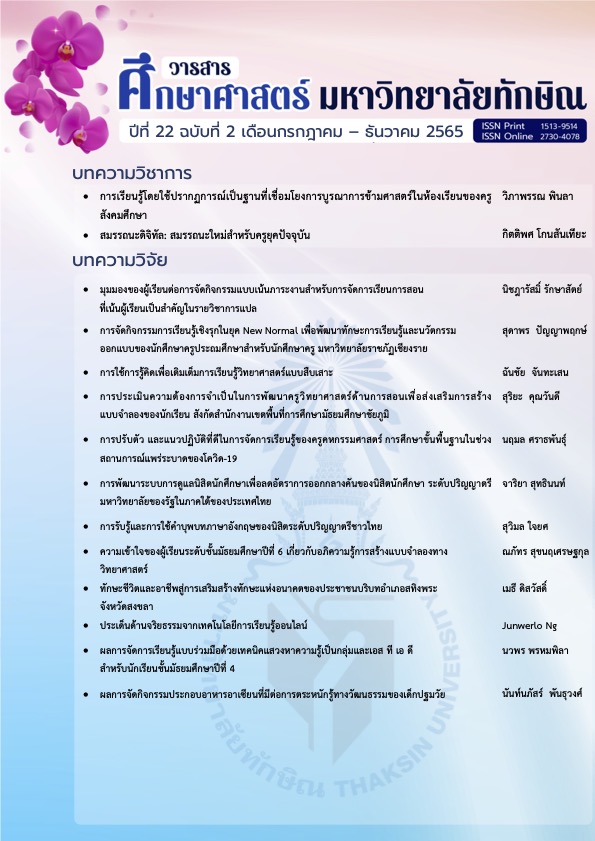
Phenomenon-based Learning that Connected to Transdisciplinary in The Classroom of Social Studies Teachers.
Article Sidebar
Main Article Content
Abstract
Phenomenon-based learning is learning activities management processes that Connected to Transdisciplinary in The Classroom of Social Studies Teachers by encouraging learners to collaboratively observe interesting phenomena and can be found in the real-world on interdisciplinary to lead the group discussion in a wider perspective as well as to inform learners about attention issues, problems, and questioning under the context of observable phenomena that consist of 6 steps as follows: Step 1: Choose an interesting social phenomenon; Step 2: Observe social phenomena together; Step 3: Search for information on social phenomena; Step 4: Implementation as planned; Step 5: Present and reflect the idea, and Step 6: Assess based on an actual condition. In each step can encourage learners to interact among learners in groups, hands-on, and learning together that lead to building on explicit knowledge and applying it to the daily life of each learner more effectively.
Article Details

This work is licensed under a Creative Commons Attribution-NonCommercial-NoDerivatives 4.0 International License.
ในกรณีที่กองบรรณาธิการ หรือผู้เชี่ยวชาญ ซึ่งได้รับเชิญให้เป็นผู้ตรวจบทความวิจัย หรือ บทความทางวิชาการมีความเห็นว่าควรแก้ไขความบกพร่อง ทางกองบรรณาธิการจะส่งต้นฉบับให้ ผู้เขียนพิจารณาจัดการแก้ไขให้เหมาะสมก่อนที่จะลงพิมพ์ ทั้งนี้ กองบรรณาธิการจะยึดถือความคิด เห็นของผู้เชี่ยวชาญเป็นเกณฑ์
References
ตะวัน ไชยวรรณ และกุลธิดา นุกูลธรรม. (2564). การจัดการเรียนรู้โดยใช้ปรากฏการณ์เป็นฐาน : การ เรียนรู้แบบบูรณาการเพื่อส่งเสริมความรู้ของผู้เรียนในโลกแห่งความจริง. วารสารบัณฑิตศึกษา มหาวิทยาลัยราชภัฏวไลยอลงกรณ์ ในพระบรมราชูปถัมภ์, 15(2), 251-263.
พงศธร มหาวิจิตร. (2560). นวัตกรรมการศึกษาจากฟินแลนด์. นิตยสาร สสวท, 42(209), 40-45. พรศักดิ์ สุจริตรักษ์ และคณะ. (2564). การประเมินหลักสูตรครุศาสตรมหาบัณฑิต สาขาวิชาการบริหาร การศึกษา (หลักสูตรปรับปรุง พ.ศ. 2560) มหาวิทยาลัยราชภัฏหมู่บ้านจอมบึง. วารสารสิรินธร ปริทรรศน์, 22(1), 338-349.
วลัย อิศรางกูร ณ อยุธยา. (2564). ประมวลสาระชุดวิชาหน่วยที่ 1 สารัตถะและวิทยวิธีทางสังคมศึกษา. (พิมพ์ครั้งที่ 3). นนทบุรี. โรงพิมพ์มหาวิทยาลัยสุโขทัยธรรมาธิราช.
อรพรรณ บุตรกตัญญู. (2561). การเรียนรู้โดยใช้ปรากฏการณ์เป็นฐานเพื่อสร้างมุมมองแบบองค์รวมและ การเข้าถึงโลกแห่งความจริงของผู้เรียน. วารสารครุศาสตร์ จุฬาลงกรณ์มหาวิทยาลัย, 46(2), 348-365.
อาจอง ชุมสาย ณ อยุธยา. (2550). รูปแบบการเรียนการสอนแบบบูรณาการคุณค่าความเป็นมนุษย์. วารสารศึกษาศาสตร์ มหาวิทยาลัยขอนแก่น, 30(1), 1-10.
Anthony J. Ryals. (2012). The recognition without cued recall phenomenon: Support for a feature-matching theory over a partial recollection account. Journal of Memory and Language, 66(4), 747-762.
Bente Borthne Hvidsten. (2021). Counsellors perceptions of the phenomenon of concentration difficulties. Support for Learning, 36(1), 84-101.
Brugar K.A. & Whitlock A.M. (2020). Explicit and Implicit Social Studies: Exploring the Integration of Social Studies Experiences in Two Elementary Classrooms. Canadian Social Studies, 51(1), 1-21.
Daehler, K., and Folsom, J. (2016). Making Sense of SCIENCE: Phenomena-Based Learning. Retrieved from: https://we-mss.weebly.com/ uploads/8/6/4/9/8649828/mss_ phenomena- based_learning.pdf
Eşref AKKAŞ and Cevat EKER. (2021). The effect of phenomenon-based learning approach on students' metacognitive awareness. Educational Research and Reviews Educ, 16(5), 181-188.
Kriengkrai Sakulprasertsri. (2017). Flipped Learning Approach: Engaging 21st Century Learners in English Classrooms. LEARN Journal Language Education and Acquisition Research Network Journal, 10(2), 132-143.
Marjaana Kangasa and Päivi Rasi. (2021). Phenomenon-Based learning of multiliteracy in a Finnish upper secondary school. Retrieved November 23, 2021, from https://doi.org/10.1080/25741136.2021.1977769
Nektaria Adaktylou. (2020). Remote Sensing as a Tool for Phenomenon-Based Teaching and Learning at the Elementary School Level: A Case Study for the Urban Heat Island Effect. International Journal of Educational Methodology, 6(3), 517-531.
Organization for Economic Cooperation and Development. (2021). PISA 2021, Results in Focus. https://www.oecd.org/pisa/pisa-2021- results-in-focus.pdf
Pamela Heidlebaugh-Buskey. (2013). A multiple case study on the phenomenon of Culturally responsive pedagogy in rural western North Carolina. Western Carolina University.
Sara Georgina Solórzano. (2013). Educating Latino immigrant students: The phenomenon of teaching Latino immigrant elementary students in Indiana. Purdue University West Lafayette, Indiana.
Silander, P. (2015). Rubric for Phenomenon Based Learning. Retrieved November 29, 2021, From http://nebula.wsimg.com/c58399e5d05e6a656d6e74f40b9e0c09?AccessKeyId=3209BE92A5393B603C75&disposition=0&alloworigin=1
Wakil, K., Rahman, R. & Hasan, D. (2015). Phenomenon-Based Learning for Teaching ICT Subject through other Subjects in Primary Schools. Journal of Computer and Education Research, 7(13), 205-212.
