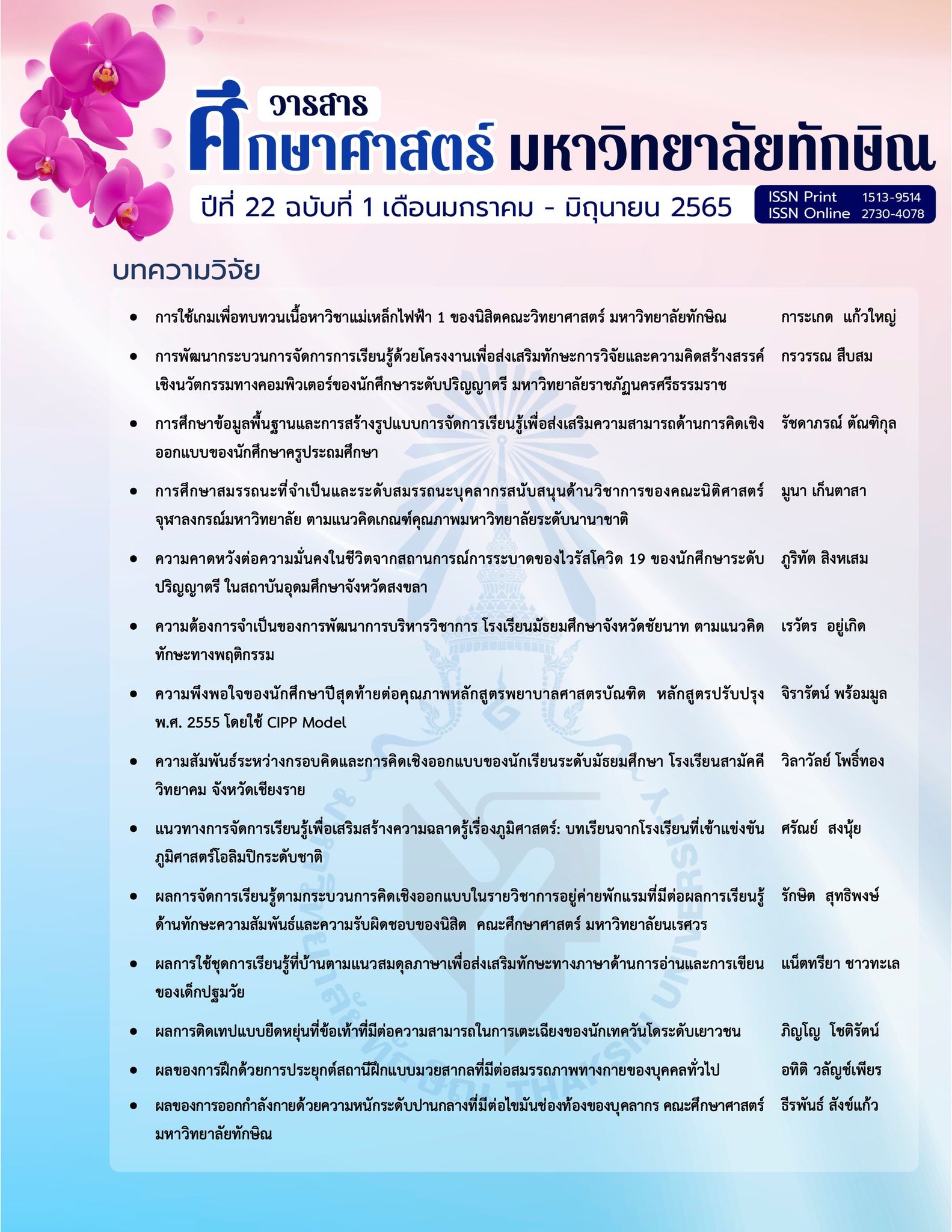
The Effects of Moderate Intensity Exercise on Visceral Fat Among Faculty of Education Staff, Thaksin University.
Article Sidebar
Main Article Content
Abstract
The purpose of this research was to study the effects of moderate intensity exercise on visceral fat among faculty of education staffs, Thaksin University. The subjects were ten female (35 years old) faculty of education staff and recruited by purposive sampling. The subjects were assigned to 30-45 minutes moderate intensity exercise at 50%–60% of the maximum heart rate, which control by polar and wireless chest strap. Physical characteristics and visceral fat mean and standard deviation were analyzed. Visceral fat was compared between before and after 12 weeks moderate intensity exercise.
The results were shown as follows:
1.) Physical characteristics of subjects found that the body weight was 57.83 ± 9.86 kg. the body height was 159.75 ± 6.93 cm. and Body Mass Index (BMI) was 22.55 ± 2.72 kg/m2
2.) The visceral fat was significantly difference between before and after 12 weeks moderate intensity exercise program (p< 0.05)
Conclusion: Moderate intensity exercise has the effect of reducing visceral fat among faculty of education staffs. In addition, the BMI and Basal Metabolic Rate (BMR) of the subjects are also likely to improve. Therefore, this activity should be encouraged and promoted on a regular exercise program
Article Details

This work is licensed under a Creative Commons Attribution-NonCommercial-NoDerivatives 4.0 International License.
ในกรณีที่กองบรรณาธิการ หรือผู้เชี่ยวชาญ ซึ่งได้รับเชิญให้เป็นผู้ตรวจบทความวิจัย หรือ บทความทางวิชาการมีความเห็นว่าควรแก้ไขความบกพร่อง ทางกองบรรณาธิการจะส่งต้นฉบับให้ ผู้เขียนพิจารณาจัดการแก้ไขให้เหมาะสมก่อนที่จะลงพิมพ์ ทั้งนี้ กองบรรณาธิการจะยึดถือความคิด เห็นของผู้เชี่ยวชาญเป็นเกณฑ์
References
เทียนทิพย์ เดียวกี่. (2562). 2:1:1 รหัสพิชิตโรค. สืบค้นจากhttps://www.thaihealth.or.th/Content/
นฤมล ลีลายุวัฒน์. (2553). สรีรวิทยาการออกกำลังกาย (Physiology of exercise). ขอนแก่น: โรงพิมพ์มหาวิทยาลัยขอนแก่น ฝ่ายบริหารกลางและทรัพยากรบุคคล มหาวิทยาลัยทักษิณ. สถิติบุคลากร. สืบค้นเมื่อ 20 เมษายน 2563 จาก http://capr.tsu.ac.th/
วิชัย เอกพลากร. (2557). การสำรวจสุขภาพประชาชนไทยโดยการตรวจร่างกาย ครั้งที่ 5 พ.ศ.2557 สถาบันวิจัยระบบสาธารณสุข. นนทบุรี.
สนธยา สีละมาด. (2555). หลักการฝึกกีฬาสำหรับผู้ฝึกสอนกีฬา (พิมพ์ครั้งที่ 3). กรุงเทพฯ: สำนักพิมพ์แห่งจุฬาลงกรณ์มหาวิทยาลัย.
American College of Sports Medicine. (2006). ACSM's advanced exercise physiology (Vol. 143). Lippincott Williams & Wilkins.
American College of Sports Medicine. (2009). The heart rate debate. Retrieved from https://www.acsm.org/access-publicinformation/articles/2012/01/13/the-heart-rate-debate
Ha, C. H., & So, W. Y. (2012). Effects of combined exercise training on body composition and metabolic syndrome factors. Iranian journal of public health, 41(8), 20.
Heydari, M., Freund, J., & Boutcher, S. H. (2012). The effect of high-intensity intermittent exercise on body composition of overweight young males. Journal of obesity, 2012
Miller, M. B., Pearcey, G. E., Cahill, F., McCarthy, H., Stratton, S. B., Noftall, J. C., & Button, D. C. (2014). The effect of a short-term high-intensity circuit training program on work capacity, body composition, and blood profiles in sedentary obese men: a pilot study. BioMed research international, 2014.
Ossanloo, P., Najar, L., & Zafari, A. (2012). The effects of combined training (aerobic dance, step exercise and resistance training) on body fat percents and lipid profiles in sedentary females of ALZAHRA University. European Journal of Experimental Biology, 2(5), 1598-1602.
Paoli A, Pacelli QF, Moro T, Marcolin G, Neri M, Battaglia G, et.al. (2013). Effects of high-intensity circuit training, low-intensity circuit training and endurance training on blood pressure and lipoproteins in middle-aged overweight men. Lipids Health Dis. 2013; 12: 131. doi: 10.1186/1476-511X-12-131.
Perry, C. G., Heigenhauser, G. J., Bonen, A., & Spriet, L. L. (2008). High-intensity aerobic interval training increases fat and carbohydrate metabolic capacities in human skeletal muscle. Applied Physiology, Nutrition, and Metabolism, 33(6), 1112-1123.
Schmidt, D., Anderson, K., Graff, M., & Strutz, V. (2015). The effect of high-intensity circuit training on physical fitness. The Journal of sports medicine and physical fitness, 56(5), 534-540.
Tjonna, A. E., Stolen, T. O., Bye, A., Volden, M., Slørdahl, S. A., Odegård, R., Skogvoll, E., & Wisløff, U. (2009). Aerobic interval training reduces cardiovascular risk factors more than a multitreatment approach in overweight adolescents. Clinical Science, 116(4), 317-326.
