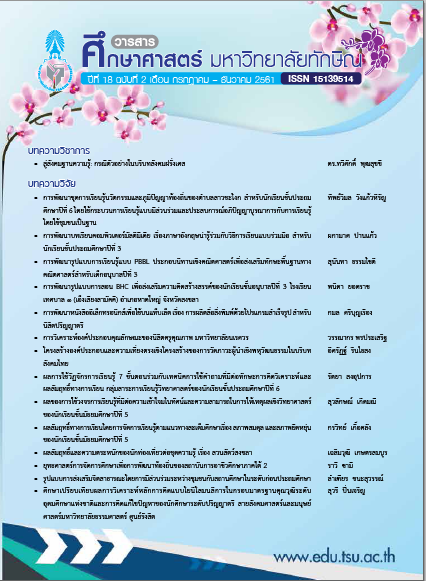
The Effect of Using 7 Steps Learning Cycle with Questioning Technique on Analytical Thinking Skills and Learning Achievement in Science Learning Area of Prathomsuksa 6 Students
Article Sidebar
Main Article Content
Abstract
The purposes of this research were to; compare the analytical thinking skills of prathomsuksa 6 students after learning through 7 step learning cycle and question technique with the 70 percent threshold and compare learning achievement of prathomsuksa 6 students after learning through 7 steps learning cycle and questioning technique with 75 percent threshold. The samples used in the research included 35 Prathomsuksa 6 students in Khian Sa District, Surat Thani province in the second semester of the 2015 academic year. They were selected by simple random . The tools used in this research included 5 lesson plans, using 7 steps learning and questioning technique. A measure analytical thinking skills and learning achievement test. The data were analyzed by using arithmetic means, percentage, standard deviations and t-test was utilized to test hypotheses.
The results of the research were as follows :
- 1. Prathomsuksa 6 students taught with the 7 steps learning cycle with questioning technique showed a higher score in analytical thinking skills the 70 percent threshold at .05 statistical significant level.
2. Prathomsuksa 6 students taught with the 7 steps learning cycle with questioning technique showed a higher score in scientific achievement the 75 percent threshold at .05 statistical significant level
Article Details
ในกรณีที่กองบรรณาธิการ หรือผู้เชี่ยวชาญ ซึ่งได้รับเชิญให้เป็นผู้ตรวจบทความวิจัย หรือ บทความทางวิชาการมีความเห็นว่าควรแก้ไขความบกพร่อง ทางกองบรรณาธิการจะส่งต้นฉบับให้ ผู้เขียนพิจารณาจัดการแก้ไขให้เหมาะสมก่อนที่จะลงพิมพ์ ทั้งนี้ กองบรรณาธิการจะยึดถือความคิด เห็นของผู้เชี่ยวชาญเป็นเกณฑ์
References
เกรียงศักดิ์ เจริญวงศ์ศักดิ์. (2553). การคิดเชิงวิเคราะห์ (Analytical Thinking). พิมพ์ครั้งที่ 6. กรุงเทพมหานคร : ซัคเซสมีเดีย.
กรมวิชาการกระทรวงศึกษาธิการ. (2552). แนวทางการจัดกิจกรรมพัฒนาผู้เรียนตามหลักสูตร แกนกลางการศึกษาขั้นพื้นฐาน พ.ศ. 2551. สำนักวิชาการและมาตรฐานการศึกษา สำนักงานคณะกรรมการการศึกษาขั้นพื้นฐาน.
โครงการ PIZA ประเทศไทย สถาบันส่งเสริมการสอนวิทยาศาสตร์และเทคโนโลยี กระทรวงศึกษาธิการ. (2556). ผลการประเมิน PISA 2012 คณิตศาสตร์ การอ่าน และวิทยาศาสตร์ บทสรุป สำหรับผู้บริหาร. สมุทรปราการ : แอดวานซ์ พริ้นดิ้ง เซอร์วิส.
ชัยวัฒน์ สุทธิรัตน์. (2553). เทคนิคการใช้คำถาม พัฒนาการคิด. นนทบุรี :สหมิตรพริ้นติ้งแอนด์พับลิสชิ่ง.
ชูศรี วงศ์รัตนะ. (2553). เทคนิคการใช้สถิติเพื่อการวิจัย. พิมพ์ครั้งที่ 12. กรุงเทพฯ:คณะศึกษาศาสตร์ มหาวิทยาลัยศรีนครินทรวิโรฒ.
ประพันธ์ศิริ สุเสารัจ, (2553). การพัฒนาการคิด. พิมพ์ครั้งที่ 4. กรุงเทพฯ : 9119 เทคนิคพริ้นติ้ง.
ภพ เลาหไพบูลย์. (2537). แนวการสอนวิทยาศาสตร์. กรุงเทพ ฯ : โรงพิมพ์คุรุสภาลาดพร้าว.
สำนักงานเขตพื้นที่การประถมศึกษาสุราษฎร์ธานี เขต 3.(2557). รายงานประจำปี. สำนักเขตพื้นที่การประถมศึกษาสุราษฎร์ธานี เขต 3 : สุราษฎร์ธานี
สำนักงานรับรองมาตรฐานและประเมินคุณภาพการศึกษา (องค์การมหาชน). (2551). คู่มือการประเมินคุณภาพภายนอกรอบสาม (2554-2558) ระดับการศึกษาขั้นพื้นฐาน ฉบับสถานศึกษา พ.ศ. 2554. (พิมพ์ครั้งที่ 3).กรุงเทพฯ : สำนักงานรับรองมาตรฐานและประเมินคุณภาพการศึกษา (องค์การมหาชน).
สุวคนธ์ ผ่านสำแดง. (2552). ผลการจัดกิจกรรมการเรียนรู้แบบวัฏจักรการเรียนรู้ 7 ขั้น (7E) เรื่องอาหารและสารอาหารกลุ่มสาระการเรียนรู้วิทยาศาสตร์ชั้นประถมศึกษาปีที่ 4.วิทยานิพนธ์ กศ.ม. หลักสูตรและการสอน : มหาวิทยาลัยมหาสารคาม.
อาร์ม โพธิ์พัฒน์ . (2550). การศึกษาผลสัมฤทธิ์ทางวิทยาศาสตร์ และความสามารถในการคิดวิเคราะห์ของนักเรียนชั้นมัธยมศึกษาปีที่ 3 ที่ได้รับการสอนโดยใช้ชุดกิจกรรมการเขียนแผนผังมโนมติ. สารนิพนธ์ กศ.ม. (การมัธยมศึกษา). กรุงเทพฯ: บัณฑิตวิทยาลัย มหาวิทยาลัยศรีนครินทรวิโรฒ.
Bloom. Benjamin S. (1976). Taxonomy of Education Objective Handbook:Cognitive Domain. New York: David McKay Company Inc.
Eisenkraft, A. 2003. Expanding the 5E Model A proposed 7E model emphasizes “transfer of learning”and the importance of eliciting prior understanding. Journal of The Science Teacher 70 : 56-59.
Kuder, Frederic G. and M.W. Richardson. (1937). The Theory of the Estimation of Test Reliability. Psychometrika. 2(September 1937), 151-160.
Lawson, A. E. (1995). Science Teaching and the Development of Thinking. Belmont : Wadsworth.
Marzano Robert J. (2001). Designing A New Taxonomy oF Education Objectives. California : Corwin Press.
