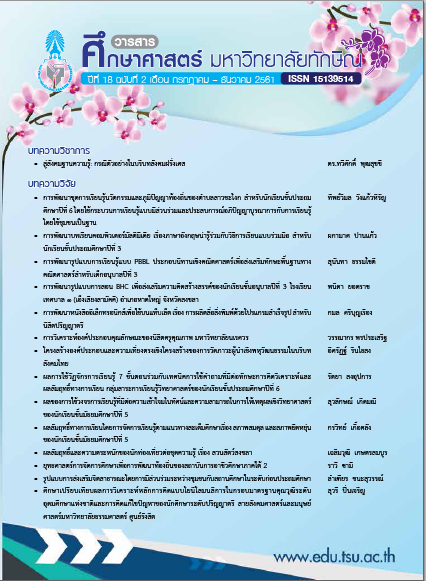
โครงสร้างองค์ประกอบและความเที่ยงตรงเชิงโครงสร้างของการวัดภาวะผู้นำเชิงพหุวัฒนธรรมในบริบทสังคมไทย
Article Sidebar
Main Article Content
บทคัดย่อ
วัตถุประสงค์การวิจัยนี้ ประกอบด้วย 1)เพื่อประเมินโครงสร้างองค์ประกอบของการวัดภาวะผู้นำเชิงพหุวัฒนธรรมใน (The Multicultural Leadership Questionnaire; MCLQ)บริบทสังคมไทย และ2)เพื่อประเมินความเที่ยงตรงเชิงโครงสร้างของแบบสอบถามภาวะผู้นำเชิงพหุวัฒนธรรม โดยการประเมินความเที่ยงตรงเชิงสอดคล้องกับความเที่ยงตรงเชิงจำแนก ตัวอย่างที่ใช้เป็นเจ้าหน้าที่รัฐขององค์กรปกครองส่วนท้องถิ่นจำนวน 282 คน ในพื้นที่สามจังหวัดชายแดนภาคใต้ ประเทศไทย ผลการวิเคราะห์จากการวิเคราะห์องค์ประกอบเชิงสำรวจและการวิเคราะห์องค์ประกอบเชิงยืนยันพบว่า MCLQ มีลักษณะเป็นพหุมิติโดยประกอบด้วยโครงสร้าง 5 องค์ประกอบ ได้แก่ 1 )ความฉลาดทางวัฒนธรรมด้านการรู้คิด 2)ความลาดทางวัฒนธรรมด้านความรู้ความเข้าใจแลแรงจูงใจ 3)ความฉลาดทางวัฒนธรรมด้านพฤติกรรม 4)อัตลักษณ์ความเป็นสากล และ 5)การเปิดกว้างต่อความหลากหลายทางวัฒนธรรม ผลการตรวจสอบพบว่าเครื่องมือวัดภาวะผู้นำเชิงพหุวัฒนธรรมมีความเที่ยงตรงเชิงโครงสร้าง
Article Details
ในกรณีที่กองบรรณาธิการ หรือผู้เชี่ยวชาญ ซึ่งได้รับเชิญให้เป็นผู้ตรวจบทความวิจัย หรือ บทความทางวิชาการมีความเห็นว่าควรแก้ไขความบกพร่อง ทางกองบรรณาธิการจะส่งต้นฉบับให้ ผู้เขียนพิจารณาจัดการแก้ไขให้เหมาะสมก่อนที่จะลงพิมพ์ ทั้งนี้ กองบรรณาธิการจะยึดถือความคิด เห็นของผู้เชี่ยวชาญเป็นเกณฑ์
เอกสารอ้างอิง
Ang, S., L., V. D., Ng, K. C., J., K. Y. T. K., & Tay, C. (2007). Cultural intelligence: Its measurement and effects on cultural judgment and decision making, cultural adaptation and task performance. Management and Organization, 3(3), 33-371.
Ang, S., Van Dyne, L., & Koh, C. (2006). Personality correlates of the four-factor model of cultural intelligence. Group & Organization Management, 31(11), 100-123.
Ang, S., Van Dyne, L., Koh, C., Ng, K. Y., Templer, K. J., Tay, C., & Chandrasekar, N. A. (2007). Cultural intelligence: Its measurement and effects on cultural judgment and decision making, cultural adaptation, and task performance. Management and Organization, 3(3), 33-371.
Baumeister, R. F., & Leary, M. R. (1995). The need to belong: Desire for inter- personal attachments as a fundamental human motivation. Psychological Bulletin, 117, 497-529.
Bentler, P. M. (1990). Comparative Fit Indexes in Structural Models. Psychological Bulletin, 107(2), 238-246.
Browne, M. W., & Cudeck, R. (1993). Alternative ways of assising model fit (K. Bollen & J. S. Long Eds.). New bury Park, CA Sage.
Canen, A., & Canen, A. (2008). Multicultural leadership: The costs of its absence in organizational conflict management. International Journal of Conflict Management, 19(1), 4-19. doi:DOI 10.1108/10444060810849155
Canen, A., & Peters, M. A. (2005). Issues and dilemmas of multicultural education: theories, policies and practices. Policy Futures in Education, 3(4).
Chen, X. P., Liu, D., & Portnoy, R. (2012). A multilevel investigation of motivational cultural intelligence, organizational diversity climate, and cultural sales: Evidence from U.S. real estate firms. Journal of Applied Psychology, 97(1), 93-106. doi:10.1037/a0024697
Chua, R. Y. J., Morris, M. W., & Mor, S. (2012). Collaborating across cultures: Cultural metacognition and affect-based trust in creative collaboration. Organizational Behavior and Human Decision Processes, 118(2), 116-131. doi:10.1016/j.obhdp.2012.03.009
Costello, A. B., & Osborne, J. (2005). Best practices in exploratory factor analysis: four recommendations for getting the most from your analysis. Practical Assessment Research & Evaluation, 10(7), 1-9.
Cox, T. J. (2001). Creating the Multicultural Organization, Jossey-Bass, San Francisco, CA. San Francisco, CA.: Jossey-Bass.
D’Netto, B., & Sohal, A. S. (1999). Human resource practices and workforce diversity: an empirical assessment. International Journal of Manpower, 20(8), 530-547.
Deng, L., & Gibson, P. (2008). A qualitative evaluation on the role of cultural intelligence in cross-cultural leadership effectiveness. International Journal of Leadership Studies, 3(2), 181-197.
Earley, P. C., & Ang, S. (2003). Cultural intelligence: Individual interactions across cultures Stanford Business Books. Standford, CA.
Erez, M., & Earley, P. C. (1993). Culture, Self-Identity, and Work. New York: Oxford University Press
Erez, M., & Gati, E. (2004). A dynamic, multi-level model of culture: from the micro level of the individual to the macro level of a global culture. Applied Psychology: An Internatioaal Review, 53(4), 583-598.
Erez, M., Lisak, A., Harush, R., Glikson, E., Nouri, R., & Shokef, E. (2013). Going global: developing management students’ cultural intelligence and global identity in culturally diverse virtual teams. Academy of Management Learning & Education, 12(3), 330-355. doi:DOI: 10.5465/amle.2012.0200
Erez, M., & Shokef, E. (2008). The Culture of Global Organizations. In P. Smith, M. Peterson, & D. Thomas (Eds.), Handbook of Cross-Cultural Management Research. Technion City, Haifa, Isarael: Sage publications.
Fornell, C., & Larcker, D. F. (1981). Evaluating structural equation models with unobservable variables and measurement error. Journal of Marketing Research, 45-46
Fujimoto, Y., Bahfen, N., Fermelis, J., & Härtel, C. E. J. (2007). The global village: Online cross-cultural communication and HRM. Cross Cultural Management: An International Journal, 14(1), 7-22.
Goldman, A. (2006). Personality disorders in leaders. ournal of Managerial Psychology, 21(5), 392-414.
Gorsuch, R. L. (1983). Factor analysis (2nd ed.). Hillside, NJ: Lawrence Erlbaum Associates (2 ed.). Hillside, NJ: Lawrence Erlbaum Associates.
Groves, K., & Feyerherm, A. (2011). Leader cultural intelligence in context: Testing the moderating effects of team cultural diversity on leader and team performance. Group & Organization Management, 36, 535-566. doi:doi:10.1177/1059601111415664
Hair, J. F., Black, W. C., Babin, B. J., & Anderson, R. E. (2010). Multivariate Data Analysis. (7 ed.). Upper Saddle River, New Jersey.: Prentice Hall.
Hair, J. F., Black, W. C., Babin, B. J., Anderson, R. E., & Tatham, R. L. (2006). Multivariate data analysis (Vol. 6): Pearson Prentice Hall Upper Saddle River, NJ.
Härtel, C. E. J. (2004). Towards a multicultural world: Identifying work systems, practices and employee attitudes that embrace diversity. The Australian Journal of Management, 29(2), 189-200.
Härtel, E. J., & Fujimoto, Y. (2000). Deversity is not a problem to be managed by organisations but openness to perceived dissimilarity is. Journal of Australian and New Zealand Academy of Management, 6(1), 14-27.
Henson, R. K., & Roberts, J. K. (2006). Use of exploratory factor analysis in published research. Educational and Psychological Measurement, 66(33), 393-416.
Hetzel, R. D. (1996). A primer on fator anaysis with comments on patterns of practice and reporting. In B. Thompson (Ed.), Advance in social science methodology (pp. 175-206). Stamford, CT: JAI Press.
Hobman, E. V., Bordia, P., & Gllois, C. (2004). Perceived dissimilarity and work group involvement: The moderating effects of group openness to diversity. Group & Organization Management, 29, 260-287.
Hu, L. T., & Bentler, P. M. (1999). Cutoff Criteria for Fit Indexes in Covariance Structure Analysis : Conventional Criteria Versus New Alternatives. Structural Equation Modeling, 6(11), 1-55.
Jackson, V. (2002). Cultural competency. Behavioral Health Management, 22(2), 20-26.
Kaiser, H. F. (1960). The application of electronic computers to factor analysis. Educational and Psychological Measurement, 20, 141-151., 20, 141-151.
Kaiser, H. F. (1974). An index of factorial simplicity. Psychometrika, 39, 31-36.
Kark, R., Shamir, B., & Chen, G. (2003). The two faces of transformational leadership: Empowerment and dependency. Journal of Applied Psychology, 88(2), 246-255.
Kim, Y. J., & Van Dyne, L. (2011). Cultural intelligence and international leadership potential: The importance of contact for members of the majority. Applied Psychology: An International Review. Advance online publication. doi:doi:10.1111/j.1464-0597.2011.00468.xdoi:http://dx.doi.org/10.1016/j.jwb.2014.01.002
Lisak, A., & Erez, M. (2015). Leadership emergence in multicultural teams: The power of global characteristics. Journal of World Business, 50(1), 3-14.
Lovvorn, A. S., & Chen, J. S. (2011). Developing a global mindset: The relationship between and international assignment and cultural intelligence. International Journal of Business and Social Science, 2(9), 275-283.
MacCallum, R. C., Browne, M. W., & Sugawara, H. M. (1996). Power analysis and determination of sample size for covariance structure modeling. Psychological Methods, 1(1), 130-149.
Manfred, K. d. V., Hellwig, T., Vrignaud, P., Laura Guillen Ramo, Florent-Treacy, E., & Korotov, K. (2008). Sustainable Effectiveness of a Transformaional Leadership Development Program.International. Journal of Coaching Psychology, Revized version of 2008/24/EFE.
Markus, H., & Kitayama, S. (1991). Culture and the self: Implications for cognition, emotion, and motivation. Psychological Review, 98, 224-253.
Marx, E. (1999). Banking Through Culture Shock. London: Nicholas Brealey Publishing.
Miville, M. L., Gelso, C. J., Pannu, R., Liu, W., Touradji, P., Holloway, P., & Fuertes, J. (1999). Appreciating similarities and valuing differences: The Miville-Guzman Universality-Diversity Scale. Journal of Counseling Psychology, 46(3), 291-307.
Moon, H. K., Choi, B. K., & Jung, J. S. (2012). Prevous international experience, intercultural training, and edpatriates intercutural adjustment: Effects of cultural intelligence and goal orientation. Human Reseource Development Quarterly, 23, 285-330.
Moon, T. (2010). Emotional intelligence correlation of the four-factor model of cutlural intellingence. Journal of Managerial Psychology, 25, 876-493.
Muller, H., & Haase, B. (1994). Managing diversity in health services organizations. Hospital and Health Services Administration, 39(4), 415-434.
Neisser, U. (1993). The perceived self: Ecological and interpersonal sources of self-knowledge. New York: Cambridge University Press. .
Ng, K. Y., Van Dyne, L., & Ang, S. (2009). Cultural intelligence: A review, reflections, and recommendations for future research. In A. M. Ryan, F. T. L. Leong, & F. Oswald (Eds.), Conducting multinational research projects in organizational psychology. Washington, DC.: American Psychological Association.
Nunnally, J. C. (1978). Psychometric theory (2nd ed.).(New York: McGraw-Hill). New York: McGraw-Hill.
Riordan, C. M., & McFarlane Shore, L. (1997). Demographic diversity and employee attitudes: An empirical examination of relational demography within work units. Journal of Applied Psychology, 82, 342-358.
Rockstuhl, T., & Ng, K. Y. (2008). The effects of cultural intelligence on interpersonal trust in multicultural teams. In S. Ang & L. V. Dyne (Eds.), Handbook of cultural intelligence: Theory, measurement, and applications (pp. 206-220). Armonk, NY: M.E. Sharpe.
Rockstuhl, T., Seiler, S., Ang, S., Van Dyne, L., & Annen, H. (2011). Beyond general intelligence(IQ) and emotinal intelligece(EQ): The role of cultural intelligene(CQ) on cross-border leadership effectiveness in a globlaized world. Journal of Social Issues, 67, 825-840.
Şahin, F., Gürbüz, S., Köksal, O., & Ercan, Ü. (2013). Meauring cultural intellingence in the Turkish context. International Journal of Selection and Assessment, 21(2), 135-144.
Shannon, L. M., & Begley, T. M. (2008). Antecedents of Four-factor model of cultural intelligence. In S. Ang & V. D. L. (Eds.), Handbook of cultural intelligence (pp. 41-55). New York: M.E. Sharpe.
Shokef, E., & Erez, M. (2006). Global work culture and global identity, as a platform for a shared understanding in multicultural teams. In E. A. M. Mannix, M. Neale, & Y. Chen (Eds.). United Kingdom: Elsevier.
Shokef, E., & Erez, M. (2008). Cultural Intelligence and Global Identity in Multicultural Teams. Armonk: M.E. Sharpe, Inc.
Tabachnick, B. G., & Fidell, L. S. (2007). Using multivariate statistics (5 ed.). Allyn and Bacon.: Allyn and Bacon.
Thomas, R. R. J., & Woodruff, M. I. (1999). Building a House for Diversity, AMACOM, New York, NY. New York: AMACOM.
Triandis, H. C. (1989). The self and social behaviour in differing cultural contexts. Psychological Review, 96, 506-520.
Van Knippenberg, D., Van Knippenberg, B., De Cremer, D., & Hogg, M. A. (2004). Leadership, self, and identity: A review and research agenda. The Leadership Quarterly, 15(6), 825-856.
Vega, G., & Comer, D. R. (2005). Sticks and stones may break your bones, but words can break your spirit: bullying in the workplace. Journal of Business Ethics, 58, 101-109.
Velicer, W. F., & Jackson, D. N. (1990). Component Analysis Versus Common Factor Analysis- Some Further Observation. Multivariate Behavioral Research, 25(1), 97-114. Multivariate Behavioral Research, 25(1), 97-114.
Ward, C., Fischer, R., Lam, F. S. Z., & Hall, L. (2009). The convergent, discriminant and increment validity of scores on a self-report measure of cultural intellingence. Educational and Psychological Measurement, 69(85-105).
Wheaton, B., Muthen, B., Alwin, D., F., and Summers, G. (1977), Assessing Reliability and Stability in Panel Models. Sociological Methodology, 8 (1), 84-136.
Zhang, Y., & Khare, A. (2009). The impact of accessible identities on the evaluation of global versus local products. Journal of Consumer Research. Journal of Consumer Research, 36, 524-537.
Zwick, W. R., & Velicer, W. F. (1986). Comparison of five rules for determining the number of components to retain. Psychological Bulletin, 99, 432-442.
