
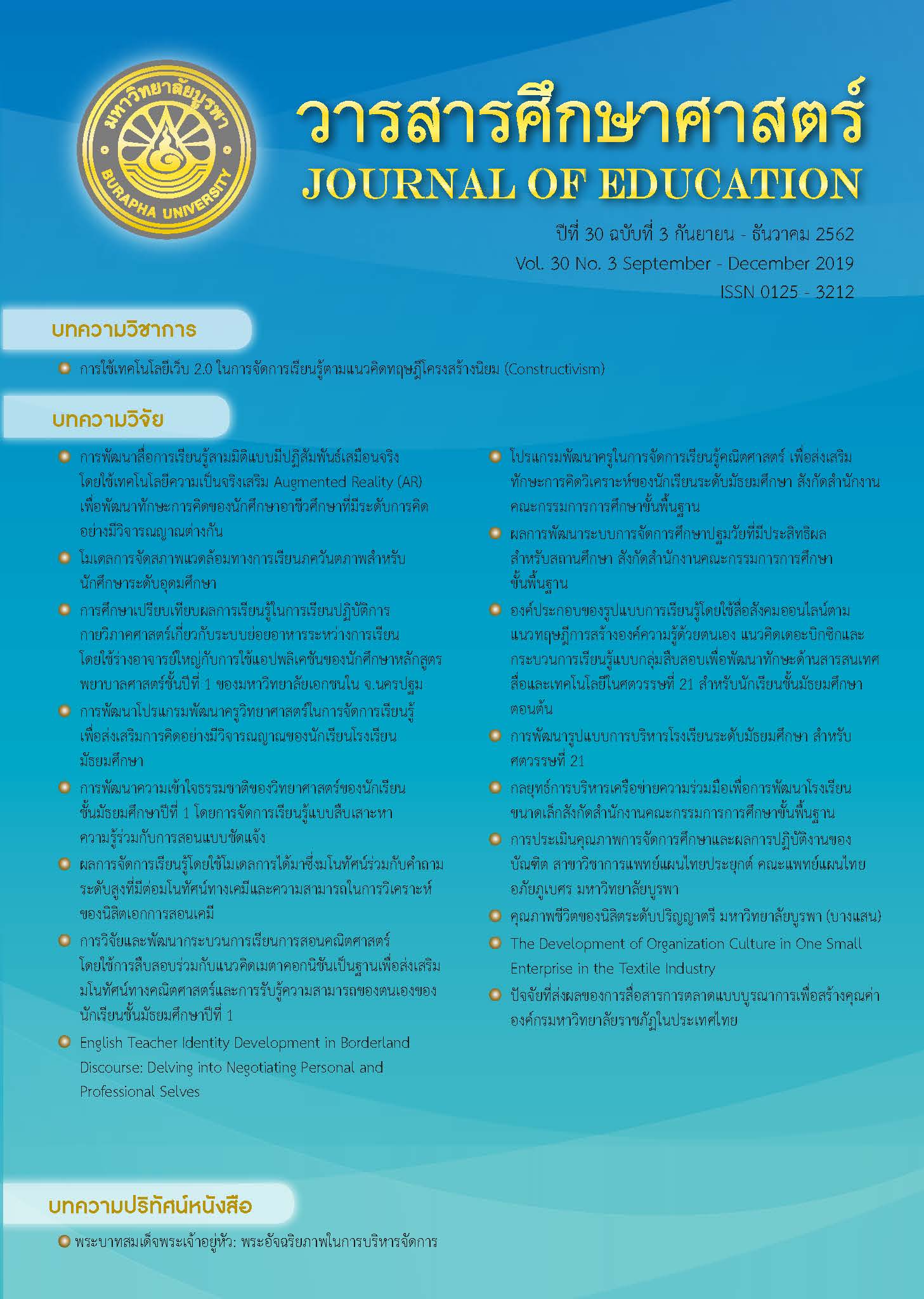
Ubiquitous Learning Environment Management Model for Undergraduate Students
Keywords:
Ubiquitous Learning Environment, Learning Environment Management Model, Ubiquitous LearningAbstract
This research aims to study the elements, design, development, and study results of the use of the ubiquitous learning environment management model for undergraduate students. The study is divided into 3 stages as follows:
Stage 1 – Study elements of the ubiquitous learning environment by (1) studying the documents, principles, concepts, and theories related to the learning environment; (2) exploring the environment conducive to the learning environment; (3) conducting an in-depth interview with professionals and experts. The samples in this research included 389 students for the learning environment survey; 20 professionals and experts for in-depth interviews. The research tools were the questionnaire and interview form.
Stage 2 - The design and development of the ubiquitous learning environment model for undergraduate students consisted of 4 stages, they were (1) the model analysis; (2) the model synthesis; (3) modeling; and (4) the model assessment. The data source was a group of 7 professionals who evaluated the model, and the used instrument was the model assessment form. Stage 3 - Study the effects of using the model of ubiquitous learning environment for undergraduate students by applying the model to the samples who were 26 undergraduate students majoring in educational technology in the Faculty of Education, Burapha University. The used instrument was the ubiquitous learning environment management for undergraduate students that included (1) 5 sets of activities; (2) communication skills assessment and use of information technology; and (3) the message design test.
The research found that;
- 1. There are 6 elements of the ubiquitous learning environment including (1) learners; (2) network; (3) learning source; (4) application software; (5) devices; and (6) policy.
- 2. The ubiquitous learning environment management model for undergraduate students consisted of 5 contexts including (1) philosophy; (2) resolution; (3) goal; (4) principle; and (5) objective. The input factors were (1) educational management in higher education; (2) elements of the ubiquitous learning environment; (3) learning supporting factors; and (4) courses.
The process consisted of 7 steps of the operation: (1) purpose analysis; (2) standardization of learning outcomes; (3) learning environment planning; (4) Determination of the way to organize the learning environment; (5) the design and development of formal environmental activities; (6) creation and organization of learning environment; and (7) assessment. The outputs included (1) communication skills and (2) information technology skills. The feedback was (1) the data from the learners’ feedback from each activity and (2) the data from the assessment of individual skills of the learners.
- 3. From the use of the model of ubiquitous learning environment management for undergraduate students , it is found that (1) the students’ message design test scores after the ubiquitous learning environment were significantly higher than before having such environment at a level of 0.01 and (2) communication and IT skills overall were at a high level ( = 2.43).
References
มหาวิทยาลัยสุโขทัยธรรมาธิราช.
ชัยยงค์ พรหมวงศ์. (2555). ภาพอนาคตการศึกษาไทย : สู่การศึกษาภควันตภาพ. (คู่มืออบรมปฏิบัติการบูรณาการใช้คอมพิวเตอร์พกพา (Tablet) เพื่อยกระดับการเรียนการ
สอน). กรุงเทพฯ : สํานักเทคโนโลยีเพื่อการเรียนการสอน สํานักงานคณะกรรมการการศึกษาขั้นพื้นฐาน.
ชัยยงค์ พรหมวงศ์ และเชาวเลิศ เลิศชโลฬาร.(2536)“ระบบและการจัดระบบ,” ในประมวลสาระชุดวิชาการจัดระบบทางการศึกษา หน่วยที่ 1. หน้า 1-62. นนทบุรี :
สาขาวิชาศึกษาศาสตร์ มหาวิทยาลัยสุโขทัยธรรมาธิราช.
ชัยยงค์ พรหมวงศ์ และวาสนา ทวีกุลทรัพย์.(2555) “การจัดสภาพแวดล้อมทางการศึกษา,”ใน เอกสารการสอนชุดวิชาเทคโนโลยีและสื่อสารการศึกษา หน่วยที่ 1-7
หน้า 6-7. พิมพ์ครั้งที่ 12. นนทบุรี: โรงพิมพ์มหาวิทยาลัยสุโขทัยธรรมาธิราช.
มหาวิทยาลัยสุโขทัยธรรมาธิราช (2557)รายงานผลการสัมมนาของศูนย์วิชาการและเทคโนโลยีสื่อสารการศึกษา สืบค้นเมื่อ 15 มกราคม, 2561<
<https://www.stou.ac.th/Schools/sst/main/KM/km-post2557.html>
เรณุมาศ มาอุ่น. (2559). การจัดการเรียนการสอนในระดับอุดมศึกษาอย่างมีประสิทธิภาพ. วารสารเทคโนโลยีภาคใต้. 9(2):, 169.
นพดล ผู้มีจรรยา. (2557). การให้บริการแบบเคลื่อนที่สำหรับมหาวิทยาลัยอัจฉริยะ. วารสารการอาชีวะและเทคนิคศึกษา. 4(7), 34-42.
สุทธิพงศ์ หกสุวรรณ. (2555). การออกแบบและพัฒนาสภาพแวดล้อมทางการศึกษา. สืบค้นเมื่อ 28 มกราคม 2560,<http://cyber class.msu.ac.th/cyber
class/library/> .
Bloom, B.S.. (1956). Taxonomy of Educational Objectives, the classification of educational goals – Handbook I: Cognitive Domain. New York:
McKay
Klein, S. B.(1991). Learning : Principles and Applications. New York : McGraw-Hill. Publishing Company,
Downloads
Published
How to Cite
Issue
Section
License
บทความทุกบทความเป็นลิขสิทธิ์ของวารสารศึกษาศาสตร์ มหาวิทยาลัยบูรพา


