
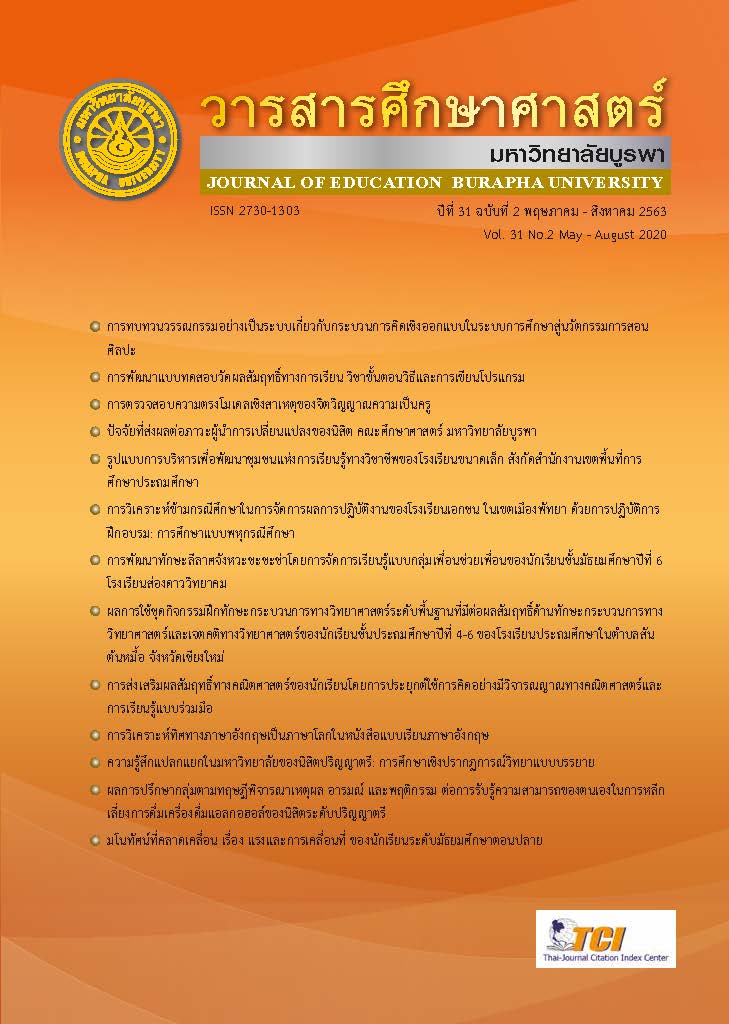
การวิเคราะห์ทิศทางภาษาอังกฤษเป็นภาษาโลกในหนังสือแบบเรียนภาษาอังกฤษ
คำสำคัญ:
ทิศทางภาษาอังกฤษในฐานะภาษาโลก, แบบเรียนภาษาอังกฤษ, สื่อการเรียนบทคัดย่อ
งานวิจัยครั้งนี้เป็นงานวิจัยเชิงคุณภาพ โดยนำการวิจัยเอกสารมาใช้ในการศึกษา เพื่อวิเคราะห์ทิศทางภาษาอังกฤษเป็นภาษาโลกในแบบเรียนภาษาอังกฤษระดับมัธยมศึกษาตอนปลาย ชั้นปีที่ 4-6 โดยมีวัตถุประสงค์
เพื่อศึกษาทิศทางภาษาอังกฤษ จำนวน 4 ด้าน คือ 1) เจ้าของภาษา 2) กลุ่มเป้าหมาย 3) รูปแบบและบรรทัดฐาน
ในการใช้ภาษาอังกฤษในแบบเรียน และ 4) ความหลากหลายทางวัฒนธรรมที่ปรากฏในแบบเรียน ผลการวิจัยพบว่าแบบเรียนในระดับมัธยมศึกษาปีที่ 4 มีเนื้อหาสัมพันธ์กับทิศทางภาษาอังกฤษเป็นภาษาโลก แต่รูปแบบและบรรทัดฐาน
ในการใช้ภาษาอังกฤษในแบบเรียนยังคงเน้นรูปแบบและบรรทัดฐานในการใช้ภาษาอังกฤษแบบเจ้าของภาษาเท่านั้น
ในระดับมัธยมศึกษาปีที่ 5 มีแบบเรียนในซี่รี่ย์ E เท่านั้นที่เน้นการสอนเจ้าของภาษา แต่ซี่รี่ย์อื่นเน้นการสอนผู้เรียนที่เป็นเจ้าของภาษาและไม่ใช่เจ้าของภาษา ในระดับมัธยมศึกษาปีที่ 6 ซี่รี่ย์ G และ ซี่รี่ย์ H เน้นการสอนเจ้าของภาษา แต่ซี่รี่ย์ E และ ซี่รี่ย์ I เน้นการสอนเจ้าของภาษาและไม่ใช่เจ้าของภาษา จึงสรุปได้ว่า แบบเรียนในระดับมัธยมศึกษาปีที่ 4-6
กำลังพยายามปรับปรุงเนื้อหาในแบบเรียนให้สัมพันธ์กับการเปลี่ยนแปลงทิศทางภาษาอังกฤษเป็นภาษาโลก
เอกสารอ้างอิง
Fang, F. (2018). Developing students’ awareness of Global Englishes. ELT Journal, 72(4), 384-389.
Galloway, N. (2013). Global Englishes and English language teaching (ELT) - Bridging the gap between theory and practice in a Japanese context. System, 41(3), 786-803.
Galloway, N., & Rose, H. (2014). Using listening journals to raise awareness of global Englishes in ELT. ELT Journal, 68(4), 386-396.
Galloway, N., & Rose, H. (2015). Introducing global Englishes. New York: Routledge.
Hayes, D. (2009). Non-native English-speaking teachers, context and English language teaching. System, 37(1), 1-11.
Hutchinson, T. & Torres, E. (1994). The Textbook as Agent of Change. ELT Journal, 48(4), 315-328
Jenkins, J. (2000). The phonology of English as an international language:
Jenkins, J. (2006). Current perspectives on teaching world Englishes and English as a lingua franca. TESOL Quarterly, 40(1), 157-181.
Jenkins, J. (2014). English as a lingua franca in the international university. The politics of academic English language policy. Abington, OX: Routledge.
Kachru B. B., G. S. & S. J. (1985). English in the World: Teaching and Learning the Language and Literatures. The Modern Language Journal, 71(1), 11–34. Retrieved from https://doi.org/10.2307/326771
Kachru, B. B. (1997). World Englishes and English-Using Communities. Annual Review of Applied Linguistics, 17, 66. Retrieved from https://doi.org/10.1017/S0267190500003287
Richards, J. (2002). The role of textbooks in a language program. New Routes, 1–6.
Retrieved from https://www.professorjackrichards.com/articles/role-of-textbooks/
Scott, J. (2006). Documentary research. Thousand Oaks, CA: Sage.
Seidlhofer, B. (2003). A concept of international English and related issues: From real English to realistic English? Retrieved from http://citeseerx.ist.psu.edu/ viewdoc/download?doi=10.1.1.475.6022&rep=rep1&type=pdf
Seidlhofer, B. (2011). Understanding English as a lingua franca. Oxford: Oxford University Press.
Sheldon, L. E. (1988). Evaluating ELT textbooks and materials. ELT Journal, 42(4), 237-246.
Song, H. (2013). Deconstruction of cultural dominance in Korean EFL textbooks. Intercultural Education, 24(4), 382-390.
Sung, C. C. M. 2013a. ‘English as a Lingua Franca and English language teaching: A way forward’. ELT Journal, 67(3), 350–353.
Sung, C. C. M. 2013b. ‘Learning English as an L2 in the global context: Changing English, Changing motivation.’ Changing English, 20(4), 377–387.
Tomlinson, B. (2003). Developing materials for language teaching. ELT Journal, 59(4), 347-351.
Vettorel, P., & Franceschi, V. (2013). English and lexical inventiveness in the Italian linguistic landscape. English Text Construction, 6(2), 238-270.
ดาวน์โหลด
เผยแพร่แล้ว
รูปแบบการอ้างอิง
ฉบับ
ประเภทบทความ
สัญญาอนุญาต
ลิขสิทธิ์ของบทความที่ปรากฏในวารสารศึกษาศาสตร์ มหาวิทยาลัยบูรพา เป็นของวารสารศึกษาศาสตร์ มหาวิทยาลัยบูรพา ทั้งนี้บทความทุกเรื่องผ่านการตรวจสอบความถูกต้องทางวิชาการจากผู้ทรงคุณวุฒิ ข้อความและข้อมูลของบทความในวารสารฯ เป็นแนวคิดของผู้แต่ง มิใช่เป็นความคิดเห็นของกองบรรณาธิการ และมิใช่ความรับผิดชอบของคณะศึกษาศาสตร์ มหาวิทยาลัยบูรพา ไม่สงวนลิขสิทธิ์การนำไปใช้ประโยชน์ทางวิชาการแต่ต้องอ้างอิงแสดงแหล่งที่มาและอยู่ในขอบเขตของกฎหมายลิขสิทธิ์


