
การพัฒนากิจกรรมการเรียนรู้ตามแนวคิดเชิงออกแบบที่ส่งเสริมความสามารถในการคิดสร้างสรรค์ทางวิทยาศาสตร์สำหรับนักเรียนชั้นประถมศึกษาปีที่ 3
Article Sidebar
Main Article Content
บทคัดย่อ
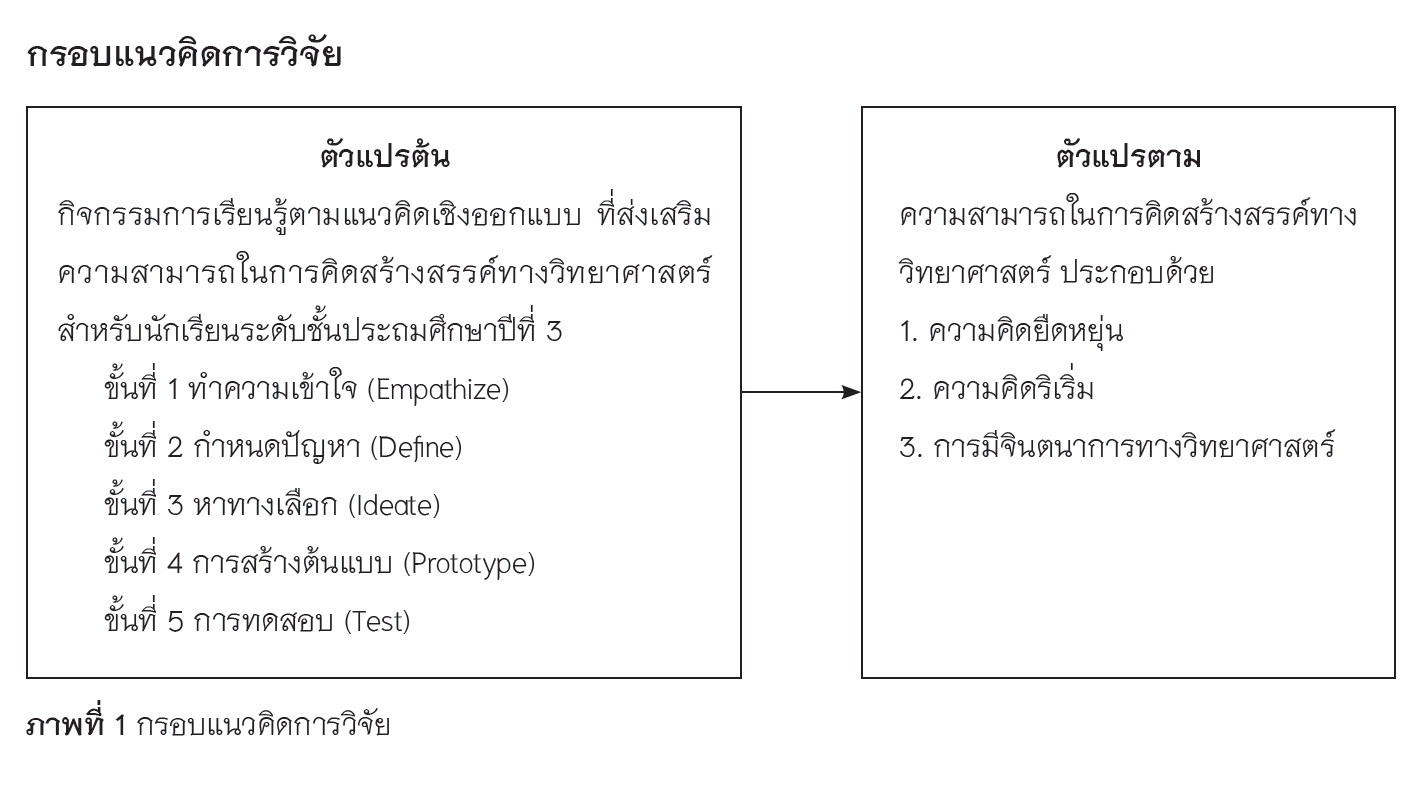
การวิจัยในครั้งนี้มีวัตถุประสงค์เพื่อ 1) สร้างและประเมินประสิทธิภาพกิจกรรมการเรียนรู้ตามแนวคิดเชิงออกแบบที่ส่งเสริมความสามารถในการคิดสร้างสรรค์ทางวิทยาศาสตร์ตามเกณฑ์ 75/75 และ 2) ทดลองใช้กิจกรรมการเรียนตามแนวคิดเชิงออกแบบฯ ดำเนินการวิจัยด้วยกระบวนการวิจัยและการพัฒนา กลุ่มตัวอย่าง คือ นักเรียนชั้นประถมศึกษาปีที่ 3 ภาคเรียนที่ 2 ปีการศึกษา 2565 โรงเรียนบ้านสามหลัง จังหวัดสุโขทัย จำนวน 21 คน ได้มาจากการสุ่มอย่างง่าย เครื่องมือที่ใช้ในการวิจัย ได้แก่ แผนการจัดกิจกรรมการเรียนรู้ตามแนวคิดเชิงออกแบบ แบบประเมินความสามารถในการคิดสร้างสรรค์ทางวิทยาศาสตร์ สถิติที่ใช้ในการวิเคราะห์ข้อมูล ได้แก่ ค่าเฉลี่ย ค่าส่วนเบี่ยงเบนมาตรฐาน ร้อยละ และการทดสอบที (t-test) ผลวิจัยพบว่า 1. กิจกรรมการเรียนรู้ตามแนวคิดเชิงออกแบบที่ส่งเสริมความสามารถในการคิดสร้างสรรค์ทางวิทยาศาสตร์ สำหรับนักเรียนชั้นประถมศึกษาปีที่ 3 ที่พัฒนาขึ้นมี 5 ขั้นตอน คือ 1) การทำความเข้าใจ 2) กำหนดปัญหา 3) หาทางเลือก 4) สร้างต้นแบบ และ 5) ทดสอบ ผลการประเมินความเหมาะสมของกิจกรรมการเรียนรู้ มีความเหมาะสมอยู่ในระดับมาก (= 4.27 S.D. = 0.31) และมีประสิทธิภาพเท่ากับ 77.22/76.67 ซึ่งเป็นไปตามเกณฑ์ที่กำหนดไว้ 2. กลุ่มตัวอย่างมีความสามารถในการคิดสร้างสรรค์ทางวิทยาศาสตร์ หลังเรียนด้วยกิจกรรมการเรียนรู้ตามแนวคิดเชิงออกแบบที่ส่งเสริมความสามารถในการคิดสร้างสรรค์ทางวิทยาศาสตร์สูงกว่าเกณฑ์ร้อยละ 75 อย่างมีนัยสำคัญทางสถิติที่ระดับ.05
Downloads
Article Details

อนุญาตภายใต้เงื่อนไข Creative Commons Attribution-NonCommercial-NoDerivatives 4.0 International License.
เอกสารอ้างอิง
Buason, R. (2012). Leadership in educational innovation. (2nd ed.). Phitsanulok: Bump Creerick. [In Thai]
Guilford, J.P. (1967). The nture of human intelligence. New York: McGraw-Hill Book Co.
Hu, W., & Adey, P. (2002). A scientific creativity test for secondary school student. International Journal of Science Education, 24(4), 389-403.
Jantakoon, J. (2021). Final report of the educational quality development and development project. Phitsanulok: Naresuan University. Research Councilnational. [In Thai]
Jui, C. (2018). Study on the learning effectiveness of Stanford design thinking in integrated design education: Graduate School of Design. International Journal of Science Education,38(2), 23–44.
Ministry of Education. (2017). Basic education core curriculum, B.E. 2551, revised edition 2017. Bangkok: Agricultural Cooperative Federation of Thailand. [In Thai]
PhanitPhalinchai, T. (2014). Statistics for research. Phitsanulok: Naresuan University. [In Thai]
Phoonkhetkid, S. (2020). The deveropment of learning actives by using design thinking approach to enhance creativity and innovation skill for Mathhayomsuksa 6 students. (Master’s thesis, Naresuan University). [In Thai]
Panasuphon, P. (2013). Education reform in the second decade. Academic Journal, 5(3), 2-14. [In Thai]
Sritha, S. (2018). The development of twelfth grade students scientific creativity using learning management based on constructionism approach on the nervous system. (Master’s thesis, Kasetsart University). [In Thai]
Saenna, W. (2022). The development of science creativity thinking test for high school students of northeastern Princess Chulabhorn Science High Schools. (Master’s thesis, Mahasarakham University). [In Thai]
Stanford Design School. (2005). Bootcamp bootleg. Retrieved from https://dschool.stanford.edu/fellows-in-residence/project-fellowship-historyapproach
The Standford D. School Bootcamp Bootleg. (2010). Bootcamp Bootleg. Retrieved from http://dschool. stanford.edu/wp-content/uploads/2011/03/BootcampBootleg2010v2SLIM.pdf
The Stanford D. School Bootcamp Bootleg. (2019). Design thinking bootcamp bootleg. Retrieved from https://dschool.stanford.edu/resources/the-bootcampbootleg
Thongjun, N. and Pankaew, P. (2016). Development of creative thinking in science of lower secondary students learning through brain storming. (Master’s thesis, Chiang Mai University). [In Thai]
