
Development of the Problem-Based Learning Activities Model for Enhancing Social Skills of Preservice Teachers
Article Sidebar
Main Article Content
Abstract
The objectives of this research were to: 1) develop and evaluate a problem-based learning activity model for enhancing the social skills of preservice teachers, and 2) examine the effects of the developed model. The population consisted of 986 preservice teachers enrolled in the Professional Practicum Course in the 2024 academic year. The sample consisted of two clusters of preservice teachers selected through cluster random sampling: 16 second-year students and 21 third-year students. The study employed a one-group posttest-only experimental design. The research instruments consisted of: 1) a problem-based learning activity model for enhancing the social skills of preservice teachers, 2) a social skills test, and 3) a questionnaire on mentor teachers’ and supervising instructors’ perceptions of preservice teachers’ social skill behaviors. Data were analyzed using mean, standard deviation, one-sample t-test, independent-samples t-test, and content analysis.
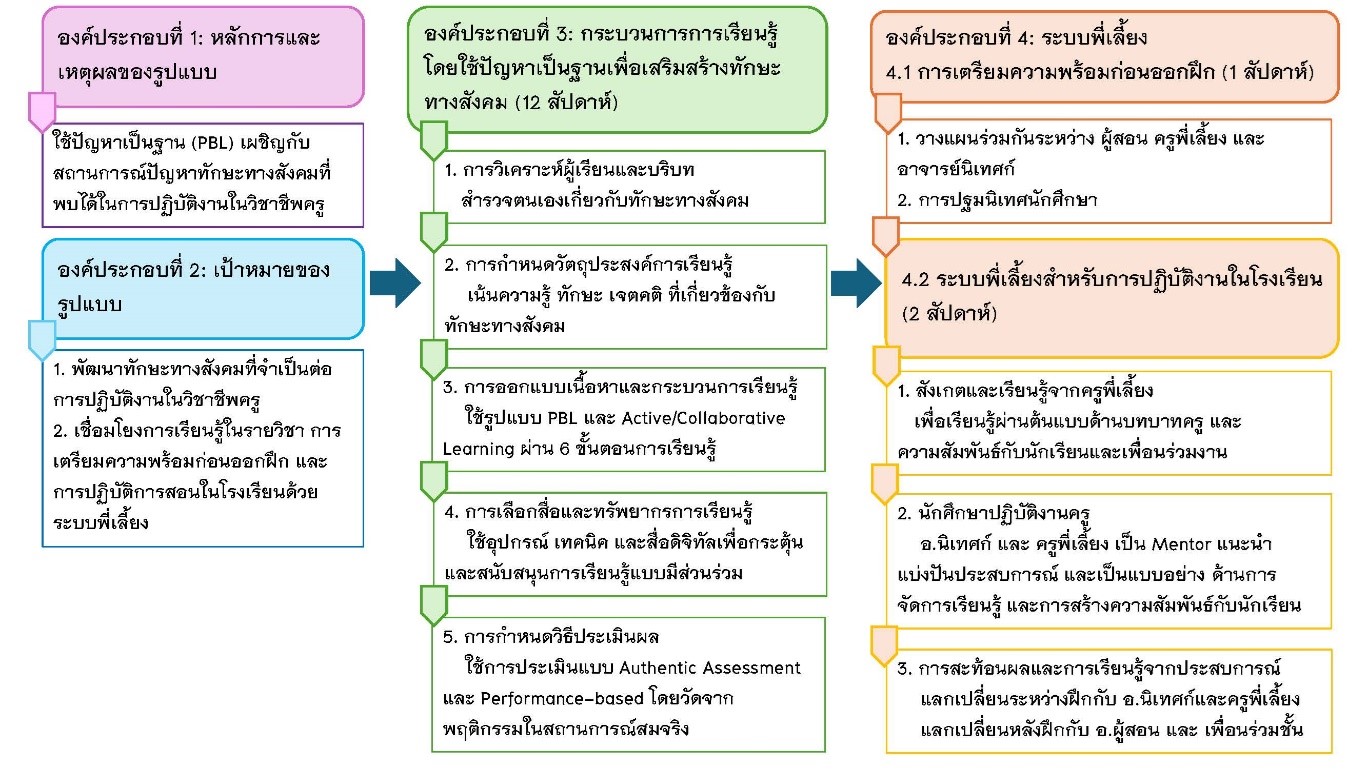
The findings revealed that: 1) the developed problem-based learning activity model for enhancing the social skills of preservice teachers consisted of four major components, including a six-step PBL process and five social-skill enhancement activities, and the quality of the model was evaluated at a very high level in terms of feasibility ( = 4.52, S.D. = 0.18) and usefulness (
= 4.52, S.D. = 0.11), and at a high level in terms of appropriateness (
= 4.48, S.D. = 0.18) and accuracy (
= 4.36, S.D. = 0.17); 2) the students’ posttest social skill scores were significantly higher than the 80 percent criterion at the .01 level of statistical significance; 4) the third-year students obtained significantly higher social skill scores than the second-year students at the .05 level of statistical significance; and 5) according to the perceptions of mentor teachers and supervising instructors, the overall social skills of the preservice teachers were rated at a high level (
= 4.50, S.D. = 0.16).
Downloads
Article Details

This work is licensed under a Creative Commons Attribution-NonCommercial-NoDerivatives 4.0 International License.
References
Argyle, M. (1994). The psychology of interpersonal behaviour. Penguin Books.
Bandura, A. (1977). Self-efficacy: Toward a unifying theory of behavioral change. Psychological Review, 84(2), 191–215. https://doi.org/10.1037/0033-295X.84.2.191
Chanpala, P., Panyamoonwongsa, C., & Boonklin, W. (2022). The development of a preparation model for teaching practicum to enhance preservice teachers’ learning management competency at Lampang Rajabhat University. Nakhon Si Thammarat Rajabhat University Journal of Education, 5(2), 74–90. https://so02.tci-thaijo.org/index.php/edunsrujo/article/download/258245/174399/995926 [In Thai]
Collaborative for Academic, Social, and Emotional Learning [CASEL]. (2020). SEL assessment guide. https://casel.org/state-resource-center/assessment-tools/
Dick, W., Carey, L., & Carey, J. O. (2014). The systematic design of instruction (8th ed.). Pearson Education.
Duemrimumgkit, A., & Kitkuekul, S. (2021). Mentor teachers’ and student teachers’ perspectives on science learning management approaches in the 21st century. Karupiboon Journal, 8(2), 228–239. https:// so02.tci-thaijo.org/index.php/edupsru/article/view/247316 [In Thai]
Eisenberg, N., & Mussen, P. H. (1989). The roots of prosocial behavior in children. Cambridge University Press.
Elliott, S. N., Busse, R. T., & Shapiro, E. S. (1999). Intervention techniques for academic performance problems. In C. R. Reynolds & T. B. Gutkin (Eds.), The handbook of school psychology (3rd ed., pp. 613–634). Wiley.
Gillies, R. M., & Ashman, A. F. (Eds.). (2003). Cooperative learning: The social and intellectual outcomes of learning in groups. Routledge.
Goleman, D. (1995). Emotional intelligence: Why it can matter more than IQ. Bantam Books.
Gulikers, J. T. M., Bastiaens, T. J., & Kirschner, P. A. (2004). A five-dimensional framework for authentic assessment. Educational Technology Research and Development, 52(3), 67–86. https://doi.org/10.1007/BF02504676
Guskey, T. R. (2002). Professional development and teacher change. Teachers and Teaching: Theory and Practice, 8(3), 381–391. https://doi.org/10.1080/135406002100000512
Harnthes, S., Prapapan, A., & Chantra, T. (2023). Guidelines for the development of student teachers through a supervision system in collaboration with network schools: A case study of Mahachulalongkornrajavidyalaya University, Nakhon Si Thammarat Campus. Mahachula Thammasat Journal, 10(5), 311–324. https://so03.tci-thaijo.org/index.php/JMND/article/view/269520 [In Thai]
Higher Education Standards Committee. (2022). Learning outcomes details according to the Thai Qualifications Framework for Higher Education B.E. 2565 (A.D. 2022). Office of the Permanent Secretary, Ministry of Higher Education, Science, Research and Innovation. https://www.ops.go.th/th/ches-downloads/edu-standard/item/6940-2022-07-22-02-54-49 [In Thai]
Hmelo-Silver, C. E. (2004). Problem-based learning: What and how do students learn? Educational Psychology Review, 16(3), 235–266. https://doi.org/10.1023/B:EDPR.0000034022.16470.f3
Jennings, P. A., & Greenberg, M. T. (2009). The prosocial classroom: Teacher social and emotional competence in relation to student and classroom outcomes. Review of Educational Research, 79(1), 491-525. https://doi.org/10.3102/0034654308325693
Joint Committee on Standards for Educational Evaluation [JCSEE]. (2011). The Program Evaluation Standards: A guide for evaluators and evaluation users (3rd ed.). Sage Publications.
Ministry of Education. (2008). The basic education core curriculum B.E. 2551 (A.D. 2008). Bureau of Academic Affairs and Educational Standards, Office of the Basic Education. Commission [In Thai]
Ministry of Education. (2017). The early childhood education curriculum B.E. 2560 (A.D. 2017). Bureau of Academic Affairs and Educational Standards, Office of the Basic Education Commission. [In Thai]
Myers, D. G., & Twenge, J. M. (2018). Social psychology (13th ed.). McGraw-Hill Education.
Nuchprasop, K. (2023). Development of a training program to enhance group counseling competency in life skills promotion among psychology students at Phranakhon Rajabhat University. Journal of Buddhist Psychology, 8(1), 1–17. https://so03.tci-thaijo.org/index.php/jbp [In Thai]
Özkan, M. (2013). The effects of social skills training program on the self-confidence of preservice teachers. Procedia-Social and Behavioral Sciences, 93, 1459-1464. https://doi.org/10.1016/j.sbspro.2013.10.064
Paivittayasiritham, C., & Yanpreechaset, Y. (2021). Enhancing life and work skills of student teachers. Silpakorn Educational Research Journal, 13(2), 161–175. https://so05.tci-thaijo.org/index.php/suedureasearchjournal/article/download/247396/171188 [In Thai]
Phengsuk, A. (2022). Development of problem-solving skills of student teachers through simulation-based learning. Valaya Alongkorn Review, 12(3), 103–114. https: //so06.tci-thaijo.org/index.php/var/article/view/253168 [In Thai]
Phikunkwan, P. (2020). Development of social skills and learning achievement in a biology course on genetic inheritance through STAD cooperative learning combined with concept mapping among Bachelor of Education students majoring in science. Karusat Parithat Journal, 7(2), 268–279. https:// so02.tci-thaijo.org/index.php/EDMCU/article/view/243963 [In Thai]
Reiser, R. A., & Dempsey, J. V. (Eds.). (2018). Trends and issues in instructional design and technology (4th ed.). Pearson Education.
Riggio, R. E. (1986). Assessment of basic social skills. Journal of Personality and Social Psychology, 51(3), 649–660. https://doi.org/10.1037/0022-3514.51.3.649
Robbins, S. P., & Judge, T. A. (2019). Organizational behavior (18th ed.). Pearson Education.
Rubin, K. H., Bukowski, W. M., & Laursen, B. (2009). Handbook of peer interactions, relationships, and groups. The Guilford Press.
Savery, J. R. (2006). Overview of problem-based learning: Definitions and distinctions. Interdisciplinary Journal of Problem-based Learning, 1(1), 9–20. https://doi.org/10.7771/1541-5015.1002
Schonert-Reichl, K. A. (2017). Social and emotional learning and teachers. The Future of Children, 27(1), 137–155. https://files.eric.ed.gov/fulltext/EJ1145076.pdf
Soparat, S., Pornseema, D., Chamratsri, P., & Naksaat, C. (2022). Assessment of teacher professional competency among students in the Graduate Diploma in Teaching Profession Program at Phranakhon Rajabhat University. Journal of Educational Research and Innovation, Phranakhon Rajabhat University, 2(1), 96–107. https://so06.tci-thaijo.org/index.php/jeri/index [In Thai]
Teachers’ Council of Thailand. (2019). Announcement of the Teachers’ Council of Thailand on the details of knowledge standards and professional experience for teachers according to the Teachers’ Council regulations on professional standards (No. 4), B.E. 2562 (2019). Royal Gazette. [In Thai]
Vygotsky, L. S. (1978). Mind in society: The development of higher psychological processes. Harvard University Press.
Wentzel, K. R. (2003). Sociometric status and adjustment in middle school: A longitudinal study. The Journal of Early Adolescence, 23(1), 5–28. https://doi.org/10.1177/0272431602239128
Wentzel, K. R. (2015). Social competence. In R. M. Lerner (Ed.), Handbook of child psychology and developmental science (7th ed.). Wiley.
Wiggins, G. (1998). Educative assessment: Designing assessments to inform and improve student performance. Jossey-Bass.
Yarbrough, D. B., Shulha, L. M., Hopson, R. K., & Caruthers, F. A. (2011). The program evaluation standards: A guide for evaluators and evaluation users (3rd ed.). Sage Publications.
Zimmerman, B. J. (2000). Attaining self-regulation: A social cognitive perspective. In M. Boekaerts, P. Pintrich, & M. Zeidner (Eds.), Handbook of self-regulation (pp. 13–39). Academic Press.
Zuckerman, M. (1994). Behavioral expressions and biosocial bases of sensation seeking. Cambridge University Press.
