
Development of a Competency-based Curriculum in Fundamental Computer Science Course Based on Blended Learning Approach and Cooperative Learning Theory for Undergraduate Students
Article Sidebar
Main Article Content
Abstract
The objectives of this research were to: 1) develop a competency-based curriculum for the fundamentals of computer science course using a blended learning approach and cooperative learning theory to meet the 80/80 efficiency criterion; 2) study the results of implementing a competency-based curriculum for the Fundamentals of Computer Science course, as follows: 2.1) compare students' knowledge in fundamental computer science before and after instruction, and against the 80% benchmark, 2.2) compare practical skills in fundamental computer science with the 80% of the total score criterion, 2.3) compare desirable learning characteristics between before and after learning; and 3) study students' opinions after learning. The sample consisted of 30 first-year Computer Science students at the Faculty of Science and Technology, Sakon Nakhon Rajabhat University, who enrolled in the Fundamentals of Computer Science course in the first semester of the 2024 academic year, selected by purposive sampling. The research instruments consisted of 1) the competency-based curriculum and lesson plans, 2) a curriculum handbook, 3) a knowledge test, 4) a skills assessment form, 5) a learning characteristics evaluation form, and 6) a student opinion questionnaire. The statistical analysis used mean, standard deviation, percentage, the one-sample t-test, and the dependent samples t-test.
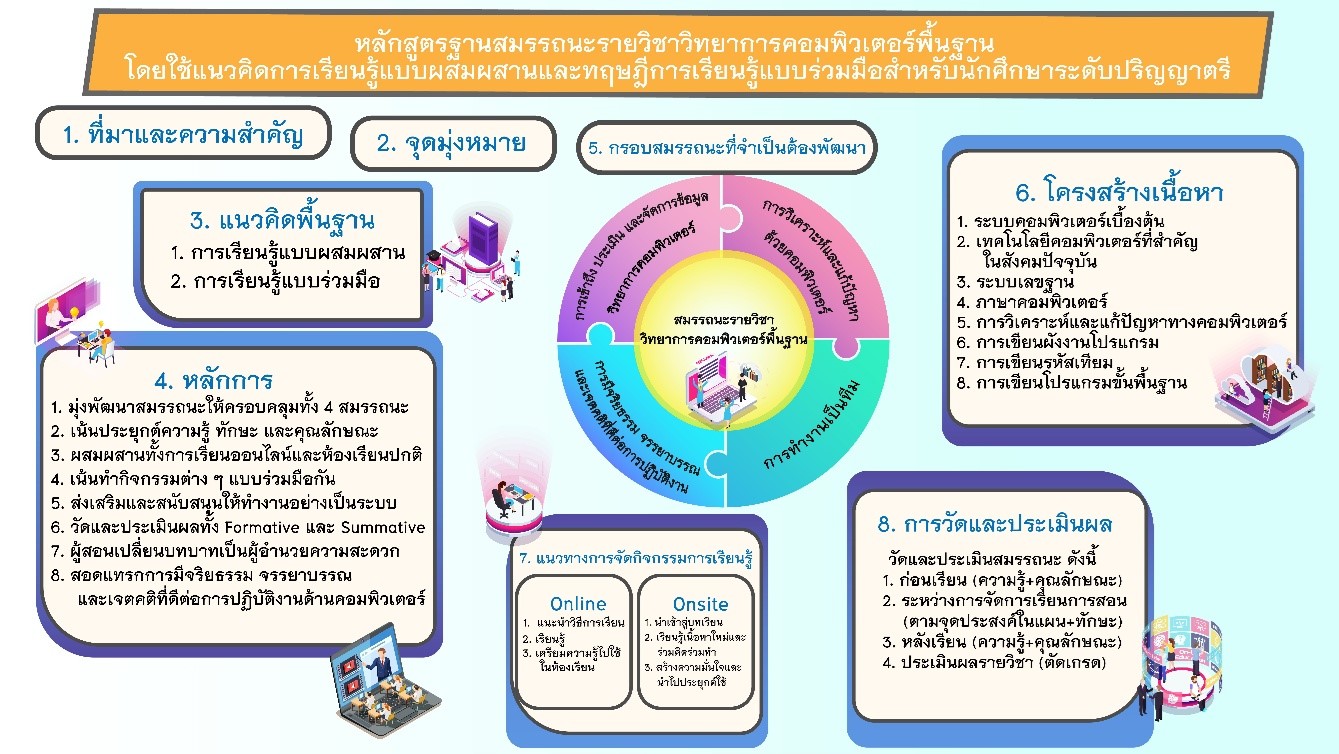
The findings of the study were as follows: 1) the developed curriculum consisted of eight components: (1) background and importance, (2) objectives, (3) fundamental concepts, (4) principles, (5) necessary competency framework, (6) content structure, (7) learning process and activities, and (8) measurement and evaluation. Expert evaluation rated the curriculum as highly appropriate (M = 4.70, S.D. = 0.52), and its implementation achieved an efficiency score of 85.17/83.85, exceeding the 80/80 criterion. 2) Regarding the implementation results: 2.1) students' post-learning knowledge scores were significantly higher than their pre-learning scores and the 80% benchmark (p < .01); 2.2) their practical skills scores were significantly higher than the 80% benchmark (p < .01); 2.3) there was no significant difference in desirable learning characteristics before and after instruction (p > .05). 3) Students expressed highly positive opinions about learning through the curriculum (M = 4.59, S.D. = 0.42).
Downloads
Article Details

This work is licensed under a Creative Commons Attribution-NonCommercial-NoDerivatives 4.0 International License.
References
Allen, I. E. & Seaman, J. (2010). Learning on demand: Online education in the United States. Massachusetts: Babson Survey Research Group.
Bidaki, R., Saghafi, F., Majoumard, M. M., Nadershahbaz, M., Hadavi, M., Sajadi, M. A., Sepehri, F., Ghazalbash, H., & Sahebnasagh, A. (2022). The moral development based on Kohlberg’s Theory among medical students. Journal of Social Behavior and Community Health, 6(1), 802-809.
Bonk, C. J. & Graham, C. R. (2006). Handbook of blended learning: Global perspectives, local designs. San Francisco: Pfeiffer Publishing.
Boonchai, P. (2024). Development of a competency-based enrichment curriculum based on phenomenon-based learning and service-learning approaches to enhance global competence of student teachers. Journal of Graduate Research, 15(1), 109-130. [In Thai]
Chookhampaeng, C. (2010). Research of curriculum and instructional. (2nd ed.). Mahasarakham: Mahasarakham University. [In Thai]
Chutima, S., Intasingh, S., Adipattaranan, N., & Nguenyuang, S. (2022). Curriculum development for English reading and writing skills enhancement using content- based instruction approach with local issues for graduate students in faculty of education. Journal of Graduate Research, 13(1), 91-105. [In Thai]
Department of Computer. (2021). Bachelor of Science program, computer science revised curriculum 2021. Sakon Nakhon: Faculty of Science and Technology, Sakon Nakhon Rajabhat University. [In Thai]
Department of Computer. (2022). Self-assessment report of the bachelor of science program, computer science academic year 2021. Sakon Nakhon: Faculty of Science and Technology, Sakon Nakhon Rajabhat University. [In Thai]
Johnson, R. T. & Johnson, D. W. (1994). An overview of cooperative learning. In J. S. Thousand, R. A. Villa & A. I. Nevin (Eds.). Creativity and collaborative learning. (pp. 31-34). Baltimore: Paul H. Brookes Publishing.
Kammanee, T. (2017). The science of teaching: knowledge for organising effective learning process. (8th ed.). Bangkok: Chulalongkorn University. [In Thai]
Kamolrat, K. (2024), Development of competency-based curriculum for the Fundamental Computer Science Course based on blended learning approach and cooperative learning theory for undergraduate students. (Doctoral Dissertation, Research of Curriculum and Instruction, Sakon Nakhon Rajabhat University). [In Thai]
Kamolrat, K., Gumjudpai, S., & Junwandee, P. (2024). A study of components and needs assessment for competency-based development of fundamentals of computer science course for undergraduate students. Journal of Graduate Research, 15(1), 169-187. [In Thai]
Kenan Foundation Asia. (2021). The COVID-19 pandemic has had three major impacts on Thai education. Retrieved from https://www.kenan-asia.org/th/covid-19-education-impact/
Kohlberg, L. (1981). Essays on moral development: Vol. 1. The philosophy of moral development. New York: Harper & Row.
Lalognum, N. (2018). A development of blended instructional model by creative media of students and cooperative learning for practicing in using educational technology equipment for undergraduate in educational technology. Journal of Education, 29(2), 123-141. [In Thai]
Makalew, B. A. & Pardamean, B. (2017). Team based learning in computer science students. In The 3rd International Conference on Science in Information Technology (pp. 296-301), 25-26 October 2017 Bandung, Indonesia: Curran Associates, Inc.
McClelland, D., C. (1973). Testing for competency rather than intelligence. American Psychologists, 17(7), 57-83.
Ministry of Science and Technology. (2017). Digital action plan of Ministry of Science and Technology, year 2017 – 2021. Bangkok: Ministry of Science and Technology. [In Thai]
Phonphotthanamat, W. (2022). A comparative study of verifying the content validity of a research instrument with the IOC, CVR and CVI. Rangsit Information, 28(1), 169-190. [In Thai]
Sawat, R. & Buosonte, R. (2022). Competency-based education: CBE. Journal of Liberal Art of Rajamangala University of Technology Suvarnabhumi, 4(1), 187-201. [In Thai]
Setthasiwanon, I., Prakobpol, T., & Yeneng, S. (2017). Development of system for collaborative learning on computer network in computer architecture. Journal of Education Studies, 11(1), 151-162. [In Thai]
Simões, S., Oliveira, T., & Nunes, C. (2022). Influence of computers in students' academic achievement. Heliyon, 8(3), e09004. https://doi.org/10.1016/j.heliyon.2022.e09004
Slavin, R. E. (1990). Cooperative learning: Theory, research and practice. Englewood Cliffs: Prentice Hall, Inc.
Spencer, L. M., & Spencer, S., M. (1993). Competence at work: Model for superior performance. New York: John Wiley & Sons.
Srisa-ard, B. (2011). Introduction to research. (9th ed.). Bangkok: Suweerivasarn Company Limited. [In Thai]
Wombacher, K. (2017). Reliability, Kuder-Richardson formula. Retrieved from https://methods.sagepub.com/ency/edvol/the-sage-encyclopedia-of-communication-research-methods/chpt/reliability-kuderrichardson-formula
